

You’re trying to run a plant where every shift depends on cattle availability, labor, cold storage, and inspection readiness, yet the market keeps changing underneath you. That’s why beef industry issues aren’t just a ranch conversation anymore. It’s a packing-plant reality that shows up as volatile livestock costs, tighter schedules, more spec pressure from customers, and consumers watching prices like never before.
Here’s the backdrop: the latest national inventory report put total cattle and calves at 86.7 million head (Jan 1, 2025). Commercial beef production is estimated at 26.000 billion pounds for 2025, with 25.735 billion pounds forecast for 2026. On the consumer side, beef and veal prices were 16.4% higher in Dec 2025 than a year earlier, and the current forecast calls for another 9.4% increase in 2026.
In this guide, you’ll map the current issues and what they mean for your plant. For a broader context on meat industry challenges and solutions, that resource pairs well with this one.
US Beef Market Snapshot
Get a quick, data-backed view of the US beef market, including supply, production, pricing, and demand. Understand what today’s numbers mean for your plant decisions.
Supply
The pipeline is tight because the herd is smaller than it was a few years ago, and rebuilding takes time. When cattle numbers are down, you feel it in procurement leverage, pricing power, and weekly kill schedules.
Demand
Demand hasn’t disappeared; it’s shifted. Consumers respond to price by changing cuts and channels, while retailers push harder for consistent price points.
The Processor Reality
When livestock costs move faster than boxed or retail pricing, your margin window shrinks. Add labor constraints, and the “small stuff” (changeovers, rework, holds) becomes a big P&L line.
| Metric | Latest signal | Why it matters in-plant |
| Cattle & calves inventory | 86.7M head (Jan 1, 2025) | Tighter procurement + less scheduling flexibility |
| Beef production | 26.000B lb (2025); 25.735B lb (2026 fcst) | Volume pressure + mix changes |
| Retail beef/veal prices | +16.4% YoY (Dec 2025); +9.4% fcst (2026) | Trade-down pressure on cut value |
| Per-capita beef availability | 56.4 lb (2026 fcst, -4.6% YoY) | Less buffer for disruptions |
| Imports role | Supports ground-beef blending | Trim balance affects grind programs |
If you want one practical habit: update this dashboard monthly, then adjust staffing, inventory targets, and customer allocations before volatility forces your hand.
Is there a Beef Shortage or a Tighter Market that feels Like One?
“Beef shortage” usually means consumers can’t find the product. What’s happening more often is constraint: the supply chain can deliver beef, but not always the exact cut, lean point, or spec your customers want at a price they’ll accept. When per-capita availability is forecast lower, there’s less buffer to absorb surprises.
Ground beef is where the constraint can feel sharpest. Grind programs depend on the right lean-to-fat balance, and imported lean product often supports blending. So, trade and logistics become part of your “shortage” story.
What to watch:
- Placements/marketings (future supply),
- Carcass weights (volume cushion),
- Import pace for lean blending (grind stability).
What to do: Pre-approve spec substitutions with key customers and keep lot-level traceability tight, so you can re-route product fast when plans change. If you’re improving controls, start here: food traceability software.
“Is the Meat Industry Declining?” The Honest Answer
If you’re asking “Is the meat industry declining?” you’re usually reacting to higher prices, more scrutiny, and noisier headlines. But beef is a cycle-driven business, not a straight-line decline story.
Right now, the core issue is a tighter cattle supply plus strong demand. That pushes prices up and forces behavior shifts with more value cuts, more grind focus, and more retailer pressure on price points.
Forecasts also suggest per-capita beef availability is expected to edge down in 2026. That doesn’t mean “people stopped buying beef”, it means the system has less cushion when disruptions hit, so packers feel volatility sooner and harder.
One simple translation: Less cushion means tighter inventory targets, faster allocation decisions, and fewer “extra” pounds to cover a quality hold or a late truck.
The practical takeaway: Don’t plan around collapse, plan around volatility. Your advantage comes from faster cut-mix decisions, tighter yield control, and audit-ready records.
The 10 Biggest Beef Industry Issues Impacting Producers and Consumers
Explore the most critical beef industry issues affecting producers and consumers today. See how each challenge directly impacts processing costs, supply stability, and customer expectations.
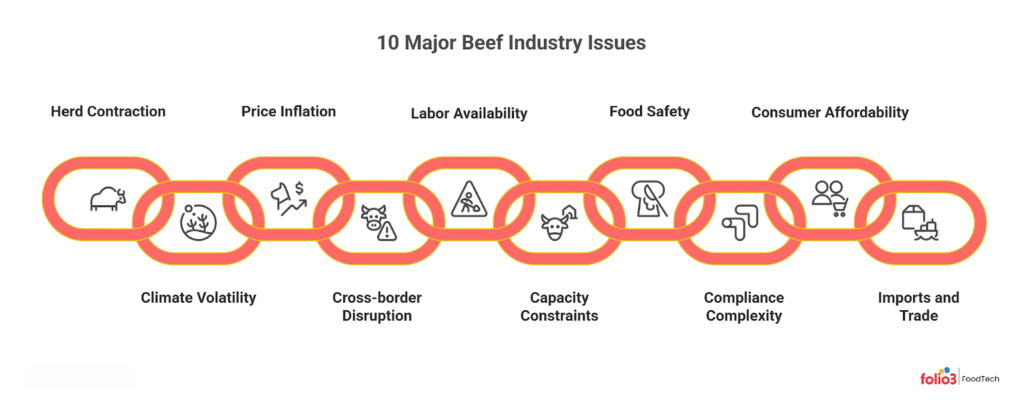
1) Herd Contraction & Rebuild lag
A smaller herd tightens feeder and fed cattle availability, and rebuilding takes time. For plants, that shows up as more competitive procurement, less schedule flexibility, and stronger exposure to price spikes.
Plant takeaway: Run a rolling 8–12 week procurement-to-production plan, with trigger points for allocation and customer communication.
2) Climate Volatility and Pasture Pressure
Dry conditions can reduce pasture and harvested feed, shifting liquidation and market timing. That can translate into inconsistent weights, changing regional supply, and more variability in raw material quality.
Plant takeaway: Tighten incoming-spec checks and align yield teams with procurement so variability doesn’t turn into rework and shrink.
3) Price Inflation and Margin Compression
Retail prices can rise while cut economics don’t move evenly. When input costs climb faster than what customers will pay for every cut, you get margin compression, and yield loss becomes painfully expensive.
Plant takeaway: Review yield, trim loss, downtime, and rework weekly alongside cattle cost and cut mix; treat them as one story.
4) Cross-border Disruption and Animal Health Risk
Live-animal trade restrictions for pest or disease containment can tighten regional supplies and create uncertainty in feedyard flows. It also increases scrutiny on sourcing documentation and movement controls.
Plant takeaway: Maintain a contingency supplier map and validate documentation workflows now, not during a disruption.
5) Labor Availability and Skills Gaps
Staffing instability shows up as slower throughput, more downtime, and inconsistent trim/yield. Payroll data for animal slaughtering and processing shows employment around the mid-500k range in late 2025, but the real issue is skill consistency across shifts.
Plant takeaway: Tie training to measurable outcomes, such as yield, rework, safety deviations, and standardize “gold cuts” with simple visual controls.
6) Capacity and Throughput Constraints
When cattle supplies are tight, plants can run below capacity while fixed costs remain. That makes scheduling discipline, preventive maintenance, and minimizing changeovers high-ROI work. Because a few lost minutes per hour adds up fast, especially when you’re running tight labor.
Plant takeaway: audit the top recurring downtime causes monthly and protect line time with standard work and disciplined changeovers.
7) Food Safety Expectations Rising
Specs, verification testing, and pathogen risk increase pressure on prevention and evidence. A structured food safety risk assessment helps identify hazards before they become events. Even one event can force holds, rework, customer disruption, and brand damage. In the most recent annual summary, there were 34 recalls totaling 19,913,171 pounds in calendar year 2024, an uncomfortable reminder of how fast a “small” control gap can scale.
Plant takeaway: Prioritize faster traceability and digital records, so holds/releases are targeted, not plant-wide.
8) Compliance Complexity
Consistent HACCP execution, sanitation, and lot-level documentation are the hard parts, especially across exceptions. Reinforcing core food safety practices across all shifts reduces variability. What breaks plants isn’t the rule; it’s inconsistent execution across shifts, products, and “edge cases.”
Plant takeaway: Build a single source of truth for specs, HACCP records, and corrective actions. For deeper insights, see our guide to USDA regulations for meat processing.
9) Consumer Affordability Reshaping Cut Mix
Higher prices can shift demand toward value cuts and ground beef, changing your optimal cut strategy and packaging plan. With more value cuts moving through retail, vacuum sealed meat safety becomes critical to shelf life and quality. That impacts yield targets, inventory turns, and the way you prioritize fabrication.
Plant takeaway: Re-forecast cut mix monthly and align it to what customers are actually moving, not what last quarter preferred.
10) Imports and Trade Dynamics
Imports help keep product flowing, especially for ground beef blending, while exports influence higher-end cut value. When domestic supply tightens, trade becomes a bigger lever and a bigger risk.
Plant takeaway: Monitor trim balance and import pace as closely as cattle prices, and pre-plan substitutions in grind programs.
What These Issues Mean Inside the Beef Processing Plant
Translate market and supply pressures into real plant-floor impact across procurement, QA, yield, and operations. Connect industry issues to your daily processing risks and controls.
Procurement & Livestock Buyers
Expect more price risk and spec variability. Your edge is forward visibility, clear acceptance criteria, and faster feedback loops from yield and QA back to buying decisions.
Plant Managers & Operations
Variability hits staffing, line speed, and changeovers. Stable standard work and accurate production planning reduce the cost of “surprises,” especially when you’re running tight schedules.
Yield & Carcass Evaluation
In tight-margin periods, small yield swings become big dollars. Make yield data same-day, tie it to corrective action, and connect it to training, not just weekly reporting.
QA & Compliance
You carry the burden of proof. Faster traceability and consistent records reduce holds, rework, and recall exposure. Start with quality management and recall management workflows.
Immediate Operational Actions Beef Packers Should Take Now
Review practical, plant-level actions you can implement immediately to protect margin, yield, and compliance. Turn beef industry challenges into structured operational responses starting this quarter.
Margin Protection Moves
- Build a rolling procurement plan tied to customer allocations (8–12 weeks).
- Track cattle cost vs cut-mix profitability weekly, not monthly.
- Reduce changeover time and protect line minutes.
- Put downtime and rework into the same meeting as pricing decisions.
Yield Protection Moves
- Standardize trimming/cutting “gold standards” by product family.
- Align these with proper meat preservation and storage methods to protect yield through the cold chain.
- Put yield dashboards on the floor, not just in reports.
- Treat trim loss and rework as root-cause events.
- Calibrate one high-volume line weekly, then scale the learnings.
Compliance & QA Moves
- Digitize HACCP checks, corrective actions, and verification evidence.
- Run a quarterly mock recall to test speed and completeness.
- Strengthen lot/batch traceability end-to-end.
- If you’re modernizing systems, align plant data with a connected meat processing ERP.
Risk & Resilience Moves
- Maintain a supplier contingency list and document requirements.
- Pressure-test your grind program against trim variability and import delays.
- Keep a “disruption playbook” for allocations, holds, and customer updates.
When you treat data, execution, and compliance as one system, you stay in control. For a practical refresher, revisit meat processing plant operations. Then tighten your playbook today, right now.
What the Next 6–18 Months Look Like for the Beef Industry
Current forecasts still point to tighter beef volumes, with 2026 production projected below 2025. Price pressure is also expected to remain, with beef and veal prices forecast to rise again in 2026. Per-capita disappearance is forecast to be lower, another signal that the system has less slack when something goes wrong.
Leading indicators to track:
- Cattle inventory updates and heifer retention,
- Carcass weights and placements,
- Import pace for lean blending,
- Retail price momentum.
If you tie these to a monthly dashboard and a clear “if-this-then-that” plan, volatility becomes manageable instead of chaotic.
Make this actionable by assigning owners: Procurement updates the dashboard, ops adjusts schedules, QA verifies holds/releases, and leadership aligns customer messaging.
Conclusion
The biggest problems with meat right now aren’t “one thing.” They’re a stack: tighter cattle supply, higher prices, tougher labor realities, and rising expectations around safety and documentation. If you lead a plant, your edge is operational discipline with better forecasting, tighter yield control, and faster traceability. As a result, you protect margin while still meeting customer specs when the market shifts.
FAQs
Why Is Beef So Expensive Right Now?
Tighter supply plus resilient demand push cattle costs up, which eventually shows up at retail. Recent data shows beef and veal pricing running materially higher year over year, with continued upward pressure expected.
Are We Actually Facing A Beef Shortage In The U.S.?
More often, it’s constrained supply: product exists, but not always the exact spec, lean point, or cut mix you need, especially for grind programs that rely on imported lean blending.
What’s Happening To U.S. Beef Production In 2025–2026?
Commercial production is estimated at 26.000 billion pounds in 2025, with 2026 forecast at 25.735 billion pounds in the latest outlook.
Is U.S. Beef Consumption Falling?
The forecast for 2026 per-capita disappearance is 56.4 pounds, down year over year, meaning less cushion in the system.
What Are The Biggest Operational Risks For Packing Plants This Year?
Volatility plus execution risk: staffing instability, inconsistent yield, and documentation gaps that slow holds/releases. That’s why recall readiness and traceability matter.


