

Automated meat processing refers to the use of robotics, intelligent machinery, and integrated software to perform tasks traditionally handled by manual labor across slaughtering, cutting, deboning, packaging, and inspection lines. By combining precision equipment with data-driven control systems, automated meat processing improves consistency, throughput, and traceability inside modern plants.
Across the sector, processors are facing mounting operational pressure. Labor availability remains unpredictable, compliance expectations continue to tighten, and margin compression is affecting facilities at every scale. At the same time, global industry data shows that robotics adoption in food and beverage manufacturing continues to rise as plants seek greater consistency and labor efficiency. This trend signals that automated meat processing is no longer a forward-looking concept reserved for large enterprises. It is increasingly viewed as a practical solution to stabilize production and improve output quality.
Workplace safety is another critical driver. Repetitive cutting tasks, heavy carcass handling, and high line speeds create both injury risks and turnover challenges. Automated meat processing helps reduce physical strain, improve process control, and allow skilled employees to focus on supervision, quality assurance, and optimization rather than repetitive manual tasks.
This article examines how automated meat processing is transforming plant operations, from core equipment and integrated systems to species-specific applications and future automation trends shaping the next generation of meat processing facilities.
Why Automated Meat Processing Is Accelerating Across Plants
Labor and Throughput Pressure
Labor instability continues to reshape plant level decision making across protein facilities. Skilled line workers remain difficult to recruit and retain, while absenteeism and turnover disrupt production schedules. At the same time, retailers and foodservice buyers expect consistent volumes delivered on strict timelines. These dual pressures are pushing plants to reconsider manual heavy workflows. Automated meat processing is increasingly adopted to stabilize line speed, maintain predictable throughput, and reduce dependence on fluctuating labor availability. By deploying automated meat processing solutions, facilities can maintain output levels even during staffing shortages, while also improving cut precision and yield control.
Beyond workforce challenges, margin compression demands measurable efficiency gains. Higher input costs, transportation volatility, and energy pricing leave little room for production inefficiencies. Automated meat processing allows processors to optimize trim accuracy, reduce giveaway, and maintain uniform specifications across shifts, directly impacting profitability.
Safety and Compliance Expectations
Worker safety and regulatory compliance are also driving automation decisions. Repetitive knife work, carcass handling, and high speed processing increase injury risk and workers’ compensation exposure. By shifting hazardous tasks to robotics and controlled machinery, automated meat processing reduces repetitive strain and creates more consistent working conditions.
Regulatory oversight has intensified, particularly following high profile ground beef recalls that exposed traceability gaps and documentation weaknesses. Facilities must demonstrate stronger food safety practices, maintain sanitation controls, and ensure product accountability from slaughter through packaging. Automated meat processing supports standardized workflows, minimizes human variability, and creates digital audit trails that simplify compliance reporting.
Traceability and Risk Management
Risk management has become central to plant operations. Buyers demand transparency, regulators require documented controls, and recalls can quickly escalate into significant financial losses. Automated meat processing integrates data capture across stages, improving lot tracking, yield documentation, and production reporting.
Digital traceability systems embedded within automated meat processing environments enable faster response times, clearer product histories, and more controlled recall procedures if issues arise. As exposure risk increases across supply chains, automation is no longer a technology upgrade. It is a structural safeguard supporting operational resilience.
Core Equipment Behind Automated Meat Processing
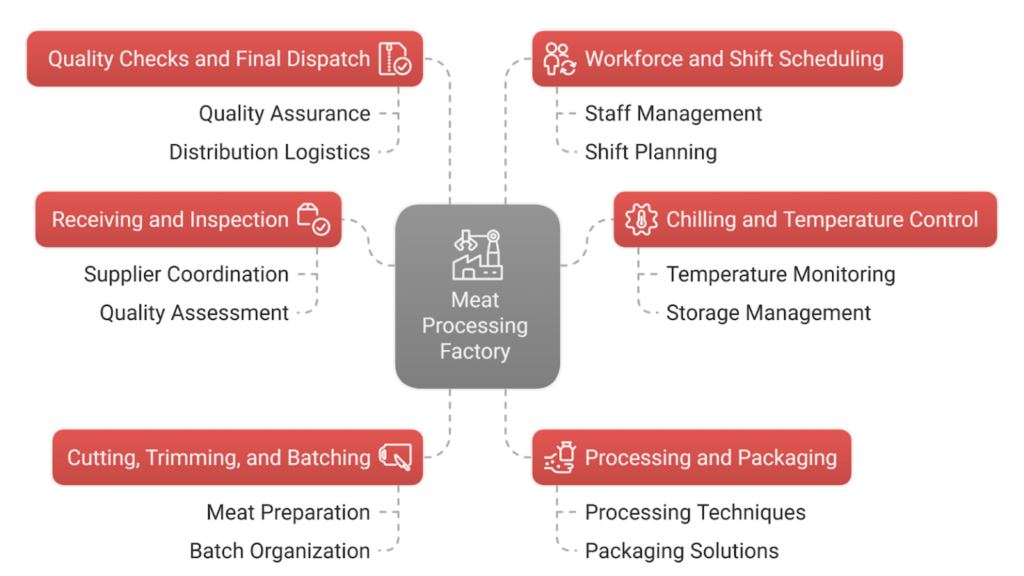
Modern plants rely on a coordinated mix of machinery, robotics, and digital controls to execute automated meat processing efficiently. Rather than operating as isolated units, these machines function as integrated components within a controlled production environment. The goal is not simply speed, but precision, consistency, and measurable yield improvement. Understanding the equipment categories behind automated meat processing helps clarify how plants reduce variability while maintaining throughput.
Primary Line Automation
Primary processing begins immediately after slaughter and includes stunning, bleeding, hide removal, carcass splitting, and evisceration. These steps traditionally required heavy manual labor and precise knife work. Today, automated meat processing integrates controlled mechanical systems that standardize these tasks.
Technologies such as carcass opening automation improve consistency during the initial breakdown phase, reducing contamination risk and improving cut accuracy. Automated systems use sensors and positioning controls to align carcasses precisely, allowing uniform operations regardless of operator variability. By stabilizing early-stage handling, automated meat processing creates a reliable foundation for downstream processing efficiency.
Cutting and Deboning Robotics
Robotic systems have become central to automated meat processing in fabrication areas. A modern meat robot equipped with machine vision can identify anatomical landmarks and adjust cutting paths in real time. This improves portion accuracy and reduces material loss compared to fully manual trimming.
Advanced cutting cells combine imaging, data analytics, and programmable blades to maintain consistent specifications across high-volume lines. Rather than replacing human expertise entirely, automated meat processing allows skilled workers to oversee performance, manage quality checks, and handle exceptions. This collaborative model enhances productivity while maintaining oversight.
Packaging and Secondary Processing
Secondary operations such as grinding, portioning, sorting, and packaging are increasingly handled through integrated automated meat processing equipment designed for speed and repeatability. These systems control weight accuracy, minimize giveaway, and support standardized labeling and batch tracking.
In automated meat processing environments, packaging machinery synchronizes with upstream production data, ensuring lot traceability and consistent output. The combination of mechanical precision and human supervision improves both yield and compliance, demonstrating how machine capability and operator expertise function together rather than in competition.
Integrated Meat Processing Systems and Plant Architecture
Automated meat processing delivers its full value only when individual machines operate within a connected framework. Standalone robotics may improve isolated tasks, but true operational gains emerge when cutting lines, inspection systems, packaging equipment, and data platforms communicate in real time. Modern plant architecture is designed around integration, ensuring that automated meat processing functions as a coordinated ecosystem rather than a collection of independent tools.
At the core of this structure are centralized meat processing systems that link equipment across the production floor. These systems manage data flow between primary slaughter lines, fabrication areas, and packaging operations. As automated meat processing scales within a facility, machine communication becomes critical for maintaining line balance, preventing bottlenecks, and synchronizing output with downstream demand.
Data collection is another foundational element. Sensors embedded within automated meat processing environments capture weight metrics, yield percentages, line speeds, downtime events, and sanitation checkpoints. This data is transmitted to supervisory dashboards, enabling plant managers to monitor performance continuously rather than relying on end-of-shift reporting.
Integration with ERP and Manufacturing Execution Systems further strengthens plant control. By connecting automated meat processing equipment to enterprise platforms, facilities gain real-time inventory updates, production reporting, and cost tracking. This linkage reduces manual data entry and ensures alignment between floor activity and financial planning.
Effective meat processing automation also enhances traceability. Each batch, cut specification, and packaging run can be tracked digitally from intake to shipment. Real-time visibility allows managers to identify deviations quickly, respond to anomalies, and maintain compliance documentation without disrupting throughput.
As plants modernize, automated meat processing is increasingly defined not just by machinery, but by the architecture that connects machines, data, and decision-making into a unified operational system.
Automated Pork Processing and Species-Specific Applications
While automated meat processing principles apply across protein categories, implementation differs significantly by species. Pork plants, in particular, present unique operational characteristics that influence line design, robotics integration, and yield strategy. Understanding these differences is essential when evaluating automation investments.
Pork carcasses tend to be more uniform in size and structure compared to some other livestock categories. This relative consistency makes them well suited for robotic intervention and precision cutting technologies. Automated meat processing systems can take advantage of standardized anatomical landmarks, allowing vision guided equipment to execute repeatable cutting paths with minimal adjustment. As a result, yield control and trimming accuracy can be optimized more predictably in pork operations.
Line speed is another defining factor. Pork facilities often operate at very high throughput rates. Automated meat processing supports these speeds by stabilizing repetitive tasks such as splitting, trimming, and portioning. Rather than relying solely on manual skill at scale, automated meat processing maintains uniform performance even as volume increases. This reduces variability between shifts and improves output predictability.
In the context of automated pork processing, automation also improves fat trimming precision and cut consistency. Small deviations in trimming depth or portion size can accumulate into significant yield loss across thousands of carcasses per day. Automated meat processing systems minimize these variations, contributing directly to margin preservation.
Yield management is especially critical in pork operations, where product segmentation and value differentiation depend on cut quality. By integrating automated meat processing with data analytics, facilities can monitor yield trends in real time and adjust parameters as needed. Species specific automation does not replace operator oversight, but it enhances control, allowing pork plants to operate at high speed while maintaining consistency and compliance.
Automation in Industrial Meat Processing Environments
Large scale facilities operate under a different set of constraints than small regional processors. High volume throughput, multi shift production, and national distribution networks require structured operational control. In these settings, automated meat processing becomes less about incremental improvement and more about maintaining stability at scale.
Within industrial meat processing, even minor inefficiencies can compound into significant cost exposure. A small percentage of yield loss, unplanned downtime, or inconsistent cut specifications can impact margins across thousands of carcasses per day. Automated meat processing helps reduce variability by standardizing repetitive tasks and maintaining consistent output regardless of operator fatigue or shift changes. This level of control supports predictable production planning and inventory management across enterprise operations.
Enterprise scaling also demands integration across multiple plants. Automated meat processing enables centralized performance monitoring, allowing leadership teams to compare yield metrics, downtime patterns, and safety indicators across locations. When automation systems are aligned with enterprise reporting platforms, decision makers gain visibility that supports strategic expansion and capital allocation planning.
From a capital investment perspective, automation decisions in industrial meat processing environments are evaluated against long term return on investment. Facilities consider equipment lifespan, maintenance requirements, labor redeployment potential, and risk reduction benefits. Automated meat processing is often justified not only through labor efficiency, but through improved safety outcomes, lower recall exposure, and more consistent product quality.
Downstream Automation: Packaging, Preservation, and Cold Chain
Downstream operations are where product integrity, shelf life, and brand reputation converge. Automated meat processing does not end at fabrication. It extends into packaging, preservation, and cold storage coordination, where precision and consistency directly influence product safety and market performance.
Automated packaging lines play a critical role in modern facilities. Equipment synchronizes portioning, labeling, sealing, and weight verification in a continuous flow. As the meat packaging industry evolves toward higher efficiency and traceability standards, automated meat processing integrates packaging systems with upstream production data. This ensures that batch information, production timestamps, and lot identifiers are captured automatically, reducing manual errors and improving recall readiness.
Shelf life optimization is another core function of automated meat processing. Technologies such as modified atmosphere packaging and vacuum sealed meat systems help control oxygen exposure and extend freshness. When packaging parameters are standardized through automation, processors can maintain uniform quality across distribution channels. Automated meat processing equipment monitors sealing integrity, gas composition, and package consistency to reduce spoilage risk and maintain compliance with labeling standards.
Cold storage coordination is equally important. Effective automation links production output with refrigeration systems, ensuring that product moves quickly into controlled temperature environments. These processes align with broader meat preservation and storage methods, where temperature control, humidity management, and rapid transfer reduce microbial growth risk.
By connecting packaging lines with cold chain systems, automated meat processing enhances traceability, maintains product quality, and supports logistical efficiency. Downstream automation ensures that the benefits gained during primary processing are preserved through final distribution, protecting both operational performance and consumer trust.
Strategic ROI and Adoption Considerations
Investing in automated meat processing requires careful evaluation beyond equipment performance. Decision makers must assess financial impact, workforce implications, and long term risk exposure before committing capital. While the operational benefits are measurable, successful adoption depends on structured planning and realistic modeling.
Capital Expenditure vs. Operating Costs
Automation projects typically involve significant upfront capital expenditure. Equipment acquisition, installation, integration, and training contribute to initial costs. However, when evaluating automated meat processing investments, processors must compare these capital expenses against long term operating cost reductions. Labor redeployment, reduced injury claims, lower product giveaway, and improved yield consistency all influence operating margins over time. In many facilities, automation shifts cost structure from variable labor driven expenses to predictable, technology based performance.
Payback Modeling and Performance Metrics
Return on investment should be quantified using clear performance indicators. Plants often evaluate automated meat processing based on throughput stability, yield improvement percentage, downtime reduction, and recall risk mitigation. Payback periods vary depending on plant size and automation scope, but modeling should account for both direct financial savings and indirect benefits such as safety improvement and regulatory confidence.
Workforce Transition and Risk Mitigation
Adoption also requires workforce planning. Rather than eliminating roles entirely, automation often shifts labor toward supervision, quality assurance, and system oversight. Structured retraining programs help employees adapt to technology supported environments.
From a risk perspective, automated meat processing strengthens documentation, traceability, and consistency. These factors reduce exposure to compliance penalties and operational disruptions. When implemented strategically, automation beco
Technology Enablement and the Future of Automated Meat Processing
The next phase of automated meat processing will not be defined by machinery alone, but by the intelligence layered on top of equipment. As plants adopt robotics and integrated systems, the competitive advantage increasingly comes from how production data is captured, analyzed, and acted upon in real time. Software platforms are becoming the connective layer that transforms isolated automation into coordinated operational control.
Modern facilities require centralized visibility across slaughter, fabrication, packaging, and cold storage. Folio3 Foodtech meat processing software supports this landscape by consolidating plant floor data into unified dashboards. Within automated meat processing environments, AI driven optimization tools analyze throughput patterns, downtime events, trim loss, and yield variances to identify performance gaps. Rather than relying solely on end-of-shift reports, managers can make adjustments based on live production intelligence.
Predictive maintenance is another critical component. Equipment failure in automated meat processing lines can halt production and create cascading delays. By monitoring sensor data, vibration patterns, temperature readings, and cycle counts, predictive systems anticipate mechanical wear before breakdown occurs. This approach reduces unplanned downtime and protects capital investments across high volume facilities.
Real-time yield analytics further enhance performance management. Folio3 Foodtech platforms enable processors to track carcass weight distribution, cut accuracy, and product segmentation in continuous cycles. Automated meat processing becomes more precise when data is immediately available to supervisors and executive teams, allowing proactive adjustments rather than reactive corrections.
As automation matures, software driven coordination will define plant competitiveness. The broader meat industry outlook indicates that processors adopting intelligent systems alongside robotics will be better positioned to manage volatility, compliance demands, and margin pressure. The future of automated meat processing lies in the integration of hardware precision with data intelligence, creating facilities that are not only automated, but strategically optimized.
Conclusion
Automated meat processing is no longer a future concept reserved for advanced facilities. It has become a competitive necessity for plants facing labor instability, regulatory pressure, and tightening margins. From robotics and integrated systems to intelligent software oversight, automated meat processing strengthens consistency, improves yield control, and enhances traceability across the production chain.
The operational transformation underway is structural, not incremental. Facilities that strategically adopt automated meat processing position themselves for long term resilience, safer workplaces, and more predictable performance in an increasingly complex industry landscape.
What Is Automated Meat Processing?
Automated meat processing refers to the use of robotics, intelligent machinery, and integrated software systems to perform tasks such as slaughtering, cutting, deboning, packaging, and inspection with minimal manual intervention. These systems improve consistency, yield precision, traceability, and compliance by standardizing operations across the plant floor. Rather than replacing human oversight entirely, automated environments shift labor toward supervision, quality assurance, and data-driven decision making.
How Does Automated Meat Processing Improve Food Safety?
Automation improves food safety by reducing human handling, standardizing sanitation protocols, and creating digital audit trails across processing stages. Sensors and integrated systems monitor temperature, contamination risks, and line conditions in real time. By minimizing variability and capturing production data automatically, automated meat processing strengthens traceability and simplifies compliance documentation during inspections or recall events.
Is Automated Meat Processing Cost Effective For Mid-Size Plants?
Cost effectiveness depends on plant volume, operational complexity, and long-term strategy. While initial capital expenditure can be significant, automated meat processing often reduces labor dependency, improves yield accuracy, lowers injury risk, and minimizes product loss. When these factors are modeled over time, many mid-size facilities find that automation delivers measurable return on investment through improved efficiency and reduced operational disruption.
What Are The Four Types Of Meat Processing?
The four primary types of meat processing are slaughtering, fabrication, further processing, and preservation. Slaughtering includes stunning and carcass preparation. Fabrication involves cutting and deboning into primal and retail cuts. Further processing covers grinding, curing, smoking, or value-added product creation. Preservation includes refrigeration, freezing, drying, or packaging techniques designed to extend shelf life and maintain product safety.
How Do Meat Processing Systems Integrate With Enterprise Software?
Modern meat processing systems connect plant floor equipment with ERP and Manufacturing Execution Systems to synchronize production data, inventory levels, and compliance documentation. Integration enables real-time monitoring of throughput, yield performance, downtime events, and batch tracking. This connectivity ensures that operational decisions are aligned with financial reporting, planning, and regulatory requirements across the organization.


