

Campylobacteriosis causes a substantial global health burden; foodborne diseases lead to roughly 550 million diarrheal illnesses every year, and Campylobacter is one of the top four bacterial culprits. You may already know Campylobacter as a cause of food poisoning linked to undercooked chicken or cross-contamination in kitchens.
As a food processor or safety manager, your goal is to keep Campylobacter out of the food chain. By understanding how the bacteria enter and spread in production and by following proven Campylobacter prevention methods, you can keep your products safer and your customers healthier.
What is Campylobacter in Food?
Campylobacter are spiral-shaped bacteria (most notably C. jejuni and C. coli) that live in the guts of birds and other animals. They thrive in warm, moist environments, which is why poultry flocks often carry them asymptomatically. Humans get infected when Campylobacter gets into food or water. Illness (Campylobacteriosis) typically causes diarrhea, cramping, fever, and sometimes vomiting. As one of several critical foodborne pathogens threatening food safety, Campylobacter requires targeted prevention strategies. Although the bacteria don’t harm chickens, even a tiny amount in undercooked meat can infect a person. Campylobacter multiplies poorly in the refrigerator, but survives chilling, so only adequate heat or disinfection kills it.
Health & Economic Impact of Campylobacter Contamination
The human and economic costs are serious. The following impacts show why prevention of Campylobacter in your facility must be a high priority:
- Illness toll: Campylobacter causes the most bacterial foodborne diarrheal illness in the U.S., with ~1.5 million cases annually. Globally, it ranks among the leading foodborne pathogens.
- Symptoms and complications: Infected people suffer severe diarrhea (often bloody), abdominal pain, fever, and dehydration. Rare complications include neurological conditions (e.g., Guillain-Barré syndrome).
- Vulnerable groups: Young children, the elderly, and immunocompromised individuals are at higher risk of severe disease.
- Economic cost: In the U.S., each year, medical and productivity costs from Campylobacter are estimated at $1.7 billion. WHO/EFSA analyses suggest Europe sees millions of cases each year, costing governments billions of euros in healthcare and lost work.
- Food industry impacts: Campylobacter contamination can trigger costly recalls, brand damage, and regulatory penalties. Preventing it protects public health and your bottom line.
Pathways of Campylobacter Contamination in Food Processing
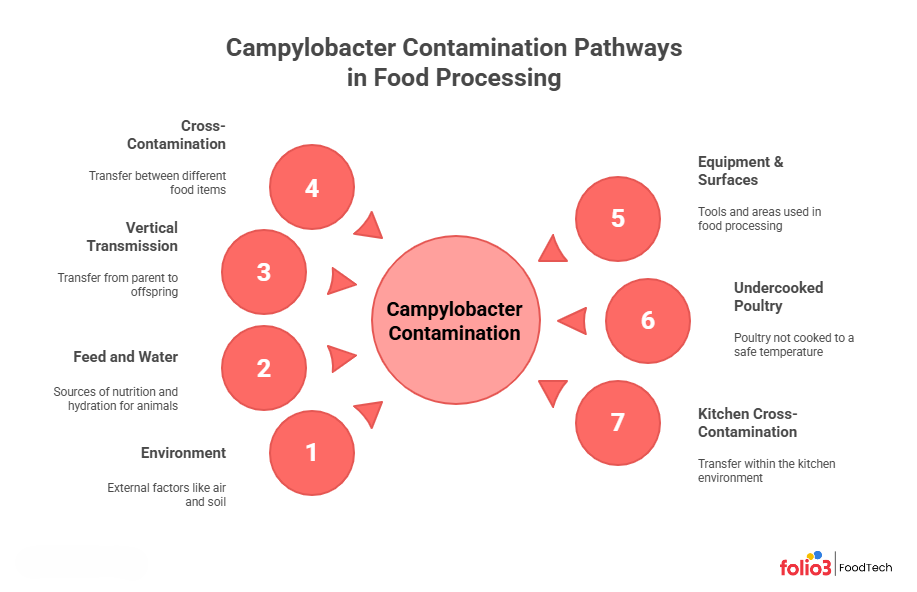
Campylobacter gets into poultry processing from multiple points along the farm-to-fork chain. Understanding each pathway helps you plug leaks in your system.
On‑farm Sources
- Environment: Campylobacter lives in soil, water, and feces around poultry farms. Contaminated water, wet litter, or unhygienic housing allows the bacteria to spread in flocks. Wildlife, rodents, or insects that contact birds or feed can also introduce Campylobacter. You should ensure your bird suppliers maintain strict farm hygiene to keep loads low.
- Feed and water: Chickens can ingest Campylobacter from contaminated feed or drinking water. Feed additives (e.g., organic acids) or probiotics on farms may reduce this risk, but are not fully proven.
- Vertical transmission: Fortunately, Campylobacter is rarely passed through eggs. Studies show no firm evidence of infected chicks being hatched from breeders, though eggshell contamination is possible. So, you should focus more on farm biosecurity than hatchery risks for Campy control.
Processing Facility Risks
- Cross-contamination: Once infected flocks enter the plant, Campylobacter on carcasses can easily spread. For example, bacteria from one batch can linger on equipment and contaminate subsequent processing lines. If a clean flock follows an infected one on the kill line, shared knives, conveyors, or crates can carry Campylobacter over.
- Equipment & surfaces: Scalders, defeatherers, and evisceration tables are notorious spots. If these are not cleaned and disinfected between flocks, residual feces and viscera can contaminate the next batch. Crates, transport modules, and work surfaces can harbor bacteria if not sanitized. Ensure all equipment is hygienically designed and that you flush and sanitize lines thoroughly each shift.
- Water: Chiller and rinse water can also spread Campylobacter if reused or re-circulated without disinfection. Proper water treatment is critical, since Campylobacter is killed by chlorinated water. Make sure chilling water stays clean or uses antimicrobial additives that target Campy.
Consumer End
- Undercooked poultry: If Campylobacter survives processing, consuming improperly cooked chicken is a direct infection route. Cooking poultry to 165°F (74°C) kills it, so education of your distribution network and consumer labels on thorough cooking is essential.
- Kitchen cross-contamination: Even without illness at processing, poor handling at home or restaurants causes illness. Raw chicken juices can contaminate cutting boards, knives, and salad if not kept separate. We will cover training (workers and public) later, but note this final link in the chain exists: your aim is zero Campylobacter on shipped products so that consumer errors do not become poisonings.
Pre‑Harvest Strategies: Reducing the Bacterial Load Before Processing
The first line of defense is to lower Campylobacter on farms before birds reach your plant. Pre-harvest control is a cooperative effort with growers and suppliers.
Biosecurity & Flock Management
Implement or require strict biosecurity on the farm. It means controlling access, disinfecting vehicles/crews before entering chicken houses, and regularly cleaning barns. Providing clean drinking water and good ventilation prevents the buildup of bacteria. Rodent control, pest-proofing, and rapid cleanout of litter between flocks are key to avoiding environmental carryover. You should verify that your suppliers have these measures in place, for example, confirm they follow standard codes. Studies have found that strong on-farm biosecurity and strict hygiene correlate with far fewer Campylobacter-positive flocks.
Feed Additives & Probiotic Approaches
A variety of feed and water additives are being explored to suppress Campylobacter in birds. These include probiotics, beneficial bacteria like Lactobacillus strains, prebiotics, and organic acids like formic or sorbic acid added to drinking water.
Some natural compounds, plant essential oils (thymol, carvacrol), or bacteriocins have antimicrobial effects. In practice, however, no single additive eliminates Campylobacter.
Combination strategies (synbiotics combining prebiotics + probiotics) sometimes perform better than one additive alone. The use of organic acids added to feed or water can inhibit gut colonization, too. While these interventions offer promise, they should be viewed as complementary; you should not rely on them alone. Instead, use them alongside biosecurity, as part of an integrated prevention plan.
Vaccines, Immunization & Novel Interventions
In theory, vaccinating poultry against Campylobacter would protect consumers by reducing bird colonization. Many researchers have tried vaccines, but no commercial poultry vaccine is currently available. Maternal immunity (antibodies from breeder hens) gives chicks some early protection, but it wanes by 2–3 weeks, leaving older flocks vulnerable. The poultry industry has been slow to adopt a Campylobacter vaccine, partly because infected chickens show no signs of illness or performance loss; still, the human health stakes are high.
New interventions are on the horizon: research into Campylobacter bacterial phage treatments, or genetic selection of more resistant chicken lines, is ongoing. Some biotech firms are exploring endolysins or enzyme-based treatments that break down Campylobacter cells. As of now, you should keep abreast of any approved vaccine or novel tool emerging, but focus on biosecurity and processing controls as the reliable methods.
Post‑Harvest Control: Sanitation & Processing Interventions
Once birds arrive at your plant, post-harvest interventions take center stage. Sanitation, facility design, and processing steps must be engineered to kill or wash away Campylobacter on carcasses.
Hygiene & Facility Design
Your processing facility’s layout and cleanliness standards are the foundation of prevention. Ensure separation of raw and cooked areas (zoning) so that raw poultry cannot touch finished product. Equip all work surfaces, walls, and floors with food-grade, non-porous materials (like stainless steel or epoxy-coated concrete) that are easy to clean. Install proper drainage to avoid stagnant water where bacteria can collect.
On a day-to-day basis, follow a strict cleaning regimen: dismantle and CIP (clean-in-place) machines after each shift. At minimum, wash and sanitize scalders, defeatherers, knives, and conveyors between flocks. The hygienic design of equipment is crucial: for example, machines should allow adjustment for varying carcass sizes to prevent gut rupture, and should be flushed and disinfected after use.
So, train your crew to remove all visible debris (feces, feathers) before sanitizing. Avoiding common sanitation and safety mistakes can dramatically reduce contamination risks in your facility. Good Manufacturing Practices (GMPs) like handwashing stations with reminders to sanitize knives and gloves are non-negotiable. Even the Solenis resource stresses that hygienic equipment design and routine cleaning are key to minimizing pathogens.
Physical Interventions
Beyond cleaning, apply physical treatments that directly reduce bacteria on the product:
- Drying/Chilling: After evisceration, carcasses should be rapidly chilled (air-chill or immersion chillers) to stop bacterial growth. Campylobacter does not multiply below about 30°C, so chilling to refrigeration temperatures halts their growth (though it doesn’t instantly kill them). Some facilities also use air-drying tunnels after chilling, which can further reduce surface moisture and bacterial load.
- Heat Pasteurization: Campylobacter is heat-sensitive. Steam pasteurization or hot water sprays (e.g., 80–90°C steam) applied to carcasses can kill a significant fraction of bacteria on surfaces. For instance, industrial steam cabinet treatments can cut C. jejuni counts by several orders of magnitude. Typical regulations require cooking to 165°F (74°C) for a 7-log kill, but even brief steam on raw carcasses helps. Under optimal conditions, steam can reduce Campylobacter by ~2–3 log10. While you may not steam-cook raw products, in-plant steam washers or infrared systems can be very effective.
- Freezing: Although Campylobacter survives chilling, freezing at commercial rates will slowly kill some cells. Quick-freezing of poultry thighs or products can reduce counts (up to several log10 over weeks). Use blast freezers or cold storage immediately if there will be any delay. However, do not rely on freezing alone; it is a backup measure.
Chemical & Natural Interventions
Chemical sanitizers and antimicrobials provide another barrier:
- Sanitizers (chlorine/Ozone): Treat scalding or chilling water with chlorine or ozone. Campylobacter is readily inactivated by chlorinated water. Maintain ~50–100 ppm chlorine in chiller tanks, and test levels frequently. Acidified sodium chlorite (ASC) and peracetic acid are also allowed spray-chilling treatments; they have been shown to reduce Campylobacter on whole birds by roughly 1–2 log10.
- Organic acids: Spray-washes of lactic acid or acetic acid (vinegar) on carcasses can lower Campylobacter counts. Studies report that 1–2% lactic acid sprays can achieve 1–3 log reductions on treated meat. These acids are relatively safe and approved for poultry decontamination. We recommend validating your own rinse chemistry for efficacy.
- Natural antimicrobials: Plant-derived compounds (e.g., citrus extracts, essential oils like thymol or eugenol) have moderate activity against Campylobacter. For example, thyme oil sprays can reduce surface counts by ~1 log. Such natural additives may enhance overall kill when used with chemical sanitizers, though cost and strong odor can be issues.
- Advanced technologies: Emerging tools include nanotechnology coatings, UV light irradiation tunnels, or pulsed light systems. UV-C light applied to moving carcasses has shown some kill (around 1 log) without chemicals. Cold plasma and other non-thermal methods are under pilot testing. While still novel, these technologies may integrate into future “post-harvest hurdles” to push contamination even lower.
Regulatory Guidelines & Best Practice Standards
Your Campylobacter prevention plan must mesh with existing regulations and industry standards. These provide a framework and minimum expectations:
International Standards
- Codex Alimentarius: The Codex Commission has a 2006 Guideline (CAC/GL 78-2011) on controlling Campylobacter (and Salmonella) in chicken meat, emphasizing a farm-to-fork risk management approach (biosecurity, hygiene, HACCP). Use Codex principles to shape your controls (e.g., HACCP-based preventive plan).
- ISO 22000/HACCP: Many countries base their food safety laws on HACCP/ISO 22000. It means formally analyzing Campylobacter as a hazard in your processing flow, setting critical limits, and monitoring them. Documented Good Hygienic Practices (GHP) are a prerequisite.
- Global Codex or WHO guidance: WHO and FAO periodically publish risk assessments and best practices. For example, WHO’s Five Keys to Safer Food reminds handlers to “cook thoroughly” and “avoid cross-contamination” – reinforcing the need for your facility to deliver safe raw materials.
National Regulations & Audits
- Government standards: In the U.S., USDA-FSIS requires poultry plants to implement HACCP specifically for Campylobacter and meet performance standards (via periodic sampling). The 2021 FSIS Campylobacter guideline (GD-2021-0006) provides detailed control recommendations. In the EU, Commission Regulation (EU) 2017/1495 sets a maximum of 1,000 CFU/g in fresh chicken meat and mandates routine sampling under official controls. Other countries (Canada, Australia, New Zealand) have similar targets and inspection criteria.
- Audits and certification: Many processors seek third-party certifications (e.g., BRC, IFS, SQF), which include Campylobacter control in their poultry modules. These audits look for evidence of monitoring (test records) and employee training. Use them as a guide: implement a test-and-verify program. Record all sanitation cycles, chemical concentrations, and worker training sessions for traceability.
Educating Workers & Consumers
- Worker training: Every employee should be aware of why Campylobacter matters and how they play a role. Train line workers, sanitation crews, and supervisors on key points: wash hands after touching raw meat, change gloves regularly, clean knife blades, etc. Provide simple reminders (“Wash hands after de-feathering”) at stations. Building a comprehensive approach to preventing food safety failures requires creating a culture where everyone understands that a slip is like leaving a door open for bacteria.
- Consumer/retailer outreach: Part of your responsibility is ensuring the chain beyond your factory stays safe. Provide clear labeling: “Cook poultry to 165°F – kills bacteria.” If you supply foodservice, educate chefs about cross-contamination and safe thawing practices. Many outbreaks arise from home errors, so some companies include consumer food safety tips on packaging.
Building a Comprehensive Campylobacter Prevention Plan
To bring it all together, create a documented program that identifies risks and controls every step of the way.
Hazard Analysis & Risk Assessment
Begin by mapping your entire process (from incoming birds to shipping product). At each step, ask “Can Campylobacter be introduced or multiplied here?” It is your Hazard Analysis. Understanding biological hazards in food and their control mechanisms helps you categorize Campylobacter within your broader food safety framework. Plus, estimate risks quantitatively if possible, like how many birds/test results are positive, and consult the latest scientific data on contamination levels.
Moreover, your plant’s HACCP team should list critical control points (CCPs) like final internal temperature, scald tank levels, chlorination, and set critical limits based on science (165°F cooking for a 7-log kill, >50 ppm free chlorine in chilling water, etc.). Document everything in a HACCP or Food Safety Management Plan.
Control Measures & Monitoring
With hazards pinpointed, implement targeted control measures for each. Some will be CCPs (Critical Control Points) with measurable critical limits, and others might be prerequisite programs. For instance:
- If your hazard analysis shows defeathering spreads contamination, consider a CCP at the chiller. Set a critical limit for chlorine or pH in chill water to reduce Campy, and monitor it continuously.
- Use multiple hurdles: add a lactic acid rinse after evisceration, or implement blast freezing for a percentage of product, to knock down contamination.
- Strengthen sanitation controls, like mandating a full equipment breakdown wash mid-shift in high-risk areas.
- Environmental monitoring is also valuable: routinely swabbing equipment, floors, and drains for Campylobacter to catch hotspots early. If positives are found, investigate and improve cleaning in those spots.
- Verification & documentation: Monitor each measure, record sanitizer concentrations, check cooler temperatures, and test some carcasses for Campylobacter periodically. Use these records to verify that your controls are working. If targets aren’t met, adjust processes or retrain staff accordingly.
Continuous Improvement & Training
Campylobacter control is not “set and forget.” Periodically review your program outcomes. After each production cycle, hold a brief meeting with QA and operations: what went well, what needs tweaking. Keep educating staff on the latest practices, a biannual refresher on safe handling, or a monthly safety talk that highlights one issue. Encourage feedback: workers often see problems on the line before managers do.
By fostering a culture of vigilance and openness, you’ll catch potential lapses early. In sum, treat Campylobacter control as a dynamic system: monitor, review, tweak, and re-train in a cycle of continuous improvement.
Emerging Technologies & Future Outlook
Looking ahead, new tools are on the horizon for Campylobacter prevention:
Antibiotic Adjuvants & Novel Antimicrobials
Researchers are exploring compounds that boost existing antibiotics (adjuvants) or that attack Campylobacter in novel ways. For example, certain enzyme inhibitors make Campylobacter more susceptible to low doses of antibiotics, potentially allowing the use of weaker treatments in feed. Non-traditional antimicrobials like bacteriocins and Campylobacter-specific enzymes are being tested. These could one day be used as feed additives or washes, but they remain largely experimental.
Bacteriophage Therapy, Biosensors & Rapid Detection Systems
As discussed, Campylobacter-specific viruses (phages) have shown strong promise. Some plants spray phages on carcasses and see similar reductions. Meanwhile, biosensor technology is maturing: imagine a real-time sensor on your line that lights up when it detects Campylobacter DNA on a carcass. Rapid PCR or immunoassay kits are also becoming more user-friendly. These tools will enable you to detect contamination quickly and adjust controls on the fly.
Integration into HACCP systems
Ultimately, these emerging strategies and tools will be folded into your HACCP-based plan. For instance, a phage spray could become a documented control step with a verification test. New sensors or digital data collection (IoT platforms) will give you unprecedented visibility. The key is to stay informed: subscribe to food safety research updates and industry alerts. As these technologies move from trial to commercial use, be prepared to validate and adopt those that fit your operations.
Conclusion
Campylobacter prevention in food processing is a formidable but achievable goal. By addressing every link in the chain, from strict biosecurity on the farm to smart interventions, you create a multi-layered defense that significantly lowers contamination. As a food safety manager or processor, you’ve learned how to prevent Campylobacter using both time-tested practices like hygiene and temperature control and emerging solutions. The key is a holistic, proactive approach: integrate these strategies into your HACCP plan, enforce them rigorously, and keep abreast of new developments.
FAQs
What Food Is the Leading Cause of Campylobacter?
Poultry, especially raw or undercooked chicken, is the leading cause of Campylobacter infections. The bacteria naturally live in the intestines of birds and can spread during slaughter or processing. Proper cooking to 165°F (74°C) and avoiding cross-contamination are the best safeguards.
Which Critical Control Points Help Reduce Campylobacter in My HACCP Plan?
Key CCPs include scalding, evisceration, and chilling. Each must have measurable limits, such as minimum scald temperature, controlled pH or chlorine in chill water, and regular microbial testing to verify Campylobacter reduction.
Can Cleaning and Sanitizing Alone Eliminate Campylobacter?
Cleaning and sanitizing significantly reduce contamination but rarely eliminate Campylobacter completely. Combining sanitation with physical controls (temperature, drying) and chemical interventions (organic acids, peracetic acid) yields the best results.
How Often Should I Test for Campylobacter in My Facility?
Testing frequency depends on your regulatory framework and risk profile, but weekly to biweekly monitoring is common. Routine carcass and environmental swabs help track contamination trends and verify that controls remain effective.
How Do We Measure ROI and Compliance Impact of Campylobacter Bacteria Prevention Programs?
Measure ROI by comparing pre- and post-intervention data: reduced Campylobacter positives, fewer recalls, lower non-compliance penalties, and improved audit outcomes. Tangible benefits also include brand protection, higher customer confidence, and smoother export certifications.


