

Remember when selling food online simply meant listing products on a website and hoping someone clicked “Add to Cart”? That era is long gone. The pandemic forced a reactive digital scramble across the food and beverage industry, but 2026 has flipped the script entirely.
Today, the ecommerce food trends shaping the market are proactive, AI-driven, and deeply personalized. We’re no longer just talking about putting groceries on the internet. We’re talking about intelligent ecosystems that predict what your customers want before they even know it themselves.
Whether you’re a direct-to-consumer (D2C) snack brand scaling your first subscription box or a legacy food manufacturer exploring digital food & beverage channels for the first time, this guide is built for you. The brands winning in 2026 aren’t the ones with the biggest budgets; they’re the ones that understand the shift and move with it.
In this blog, you’ll find validated market data, actionable strategies, and a clear prioritization framework to help you decide where to invest next. We’ll cover everything from predictive AI and social commerce to blockchain-powered transparency and the fulfillment infrastructure that makes sub-two-hour delivery possible.
The State of the E-Commerce Food Industry in 2026
The e-commerce food industry is booming. Yet a massive gap still exists between what consumers expect and what most brands deliver.
A Rapidly Expanding Market
The numbers tell a compelling story. The global food and beverages e-commerce market is projected to reach $894.68 billion in 2026, growing at a compound annual growth rate (CAGR) of 16.9%. That trajectory is expected to push the market to $1.68 trillion by 2030 at a 17.2% CAGR. To put that in perspective, food and beverage ecommerce trends 2026 reflect a sector that has nearly doubled in size within half a decade.
The Consumer Expectations Gap
The gap between consumer expectations and what traditional F&B brands currently offer online is widening. Shoppers now demand same-day delivery, transparent sourcing information, and hyper-personalized product recommendations. The food and beverage market overall is valued at approximately $9.79 trillion in 2026, and the online retail channel within it is growing at a 5.63% CAGR, making it the fastest-expanding distribution channel in the industry.
The Rise of Hybrid Commerce
What’s also reshaping the e-commerce food industry is the convergence of B2B and B2C channels. Hybrid commerce is no longer a buzzword; it’s a business model. Manufacturers who once sold exclusively through distributors are now opening D2C storefronts while still serving wholesale clients through the same platform. This dual-channel approach demands flexible food supply chain management that can handle bulk B2B orders and individual consumer shipments without breaking down. If your tech stack can’t handle both, you’re already behind.
From SEO to Answer Engine Optimization
Basic SEO is no longer enough. With AI-powered search engines and voice assistants fielding more product queries, brands need to think about Answer Engine Optimization (AEO). When a customer asks their assistant, “What’s the best organic protein bar for keto diets?” your product description needs to be structured so that AI bots can recommend it. It isn’t a future problem. It’s a right-now opportunity.
Top Food Ecommerce Trends Dictating Growth in 2026
The food ecommerce trends driving growth in 2026 aren’t theoretical. They’re already being deployed by the brands, outpacing their competitors. Below, we break down the six most impactful trends, each with practical context so you can evaluate where your business stands and what to prioritize.
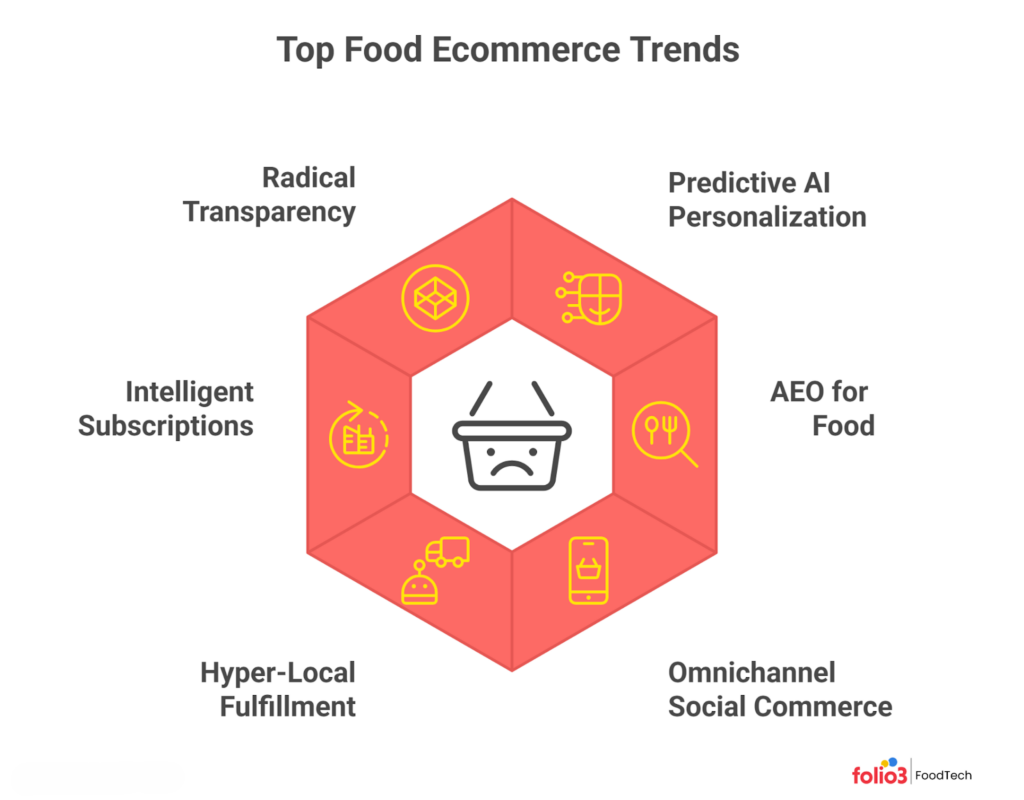
1. Predictive AI, Personalization, and Zero-Party Data
Privacy regulations have made third-party cookies unreliable, which means the smartest food brands are going straight to the source: their customers. Zero-party data, information that shoppers voluntarily share through quizzes, preference surveys, and profile builders, has become the foundation of next-level personalization.
Think of it this way: when a customer takes a “Build Your Flavor Profile” quiz on your D2C site, they’re handing you data that no third-party tracker could provide. You learn their dietary restrictions, taste preferences, and purchase intent all at once. That data then feeds predictive AI models that can anticipate when a customer is about to run out of their favorite coffee or protein powder and trigger a replenishment nudge at the perfect moment.
The impact is measurable. Companies using AI-driven personalization can generate up to 40% more revenue than those that don’t. In food ecommerce, where repeat purchases drive lifetime value, this isn’t a nice-to-have. It’s the engine of sustainable growth. Product recommendations alone can boost sales by up to 59%, making personalized storefronts one of the highest-ROI investments a D2C food brand can make.
2. Answer Engine Optimization (AEO) for Food Brands
Search behavior has fundamentally changed. Consumers increasingly ask conversational questions through AI assistants and chatbots: “What are the best organic, gluten-free snacks for toddlers?” If your product page answers that question in natural, structured language, your brand gets recommended. If it doesn’t, your competitor does.
AEO goes beyond traditional keyword stuffing. It requires product descriptions written in the way real people speak, supported by structured data (schema markup), comprehensive FAQ sections, and clear, factual claims about ingredients and sourcing. For F&B brands, it is especially powerful because food queries are inherently specific. People aren’t searching for “snacks.” They’re searching for “low-sugar, high-fiber snacks for diabetic-friendly diets.”
With 84% of e-commerce businesses now ranking AI as their highest priority, AEO is emerging as a low-cost, high-impact strategy that every digital food brand should adopt. The brands that structure their content for AI-driven recommendations will capture organic visibility that paid ads simply cannot replicate.
3. Omnichannel Social Commerce & Shoppable Video
Beyond just a brand awareness tool, social media has become a full-fledged sales channel. In the U.S. alone, social commerce sales are expected to surpass $100 billion for the first time. For food brands, the opportunity lies in shoppable video. Imagine a TikTok recipe video where viewers can tap to add the entire ingredient list to their cart in one click.
Platforms like TikTok and Instagram now allow product tagging in videos, and video commerce captured over 43% of the social commerce market share in 2025, making it the dominant purchase-driving format. With 82% of consumers using social media for product discovery, your food and beverage ecommerce strategy needs to meet customers where they’re already scrolling.
4. Hyper-Local Fulfillment & Micro-Fulfillment Centers
Speed is the new currency in food ecommerce. Same-day and two-hour delivery windows are quickly becoming table stakes, not differentiators. The micro-fulfillment center market reached $8.54 billion in 2026 and is projected to hit $25.89 billion by 2031, growing at a 24.84% CAGR.
So what does this mean for you? D2C brands and even mid-sized food companies are partnering with dark stores and ghost kitchens to offer ultra-fast delivery without owning massive warehouses. These compact facilities, typically 5,000 to 25,000 square feet, are strategically placed within urban centers, slashing last-mile delivery costs while keeping perishable goods fresh. The best part: many operators now offer robotics-as-a-service contracts, converting heavy capital expenditures into manageable operating costs.
An efficient food distribution network powered by automated inventory routing is what separates brands that meet the two-hour delivery promise from those that lose customers to competitors who can. North America currently holds over 40% of the global micro-fulfillment market, with heavy investment from major retailers setting the pace that smaller brands must now match through strategic partnerships rather than pure capital spending.
5. Intelligent Subscriptions & “Set-and-Forget” Restocking
Basic subscribe-and-save models were a good start, but consumers in 2026 expect more intelligence. Dynamic subscriptions now use AI to adjust delivery frequency based on real-time consumption patterns. If a customer’s household is going through their coffee supply faster than usual, the system detects the change and moves the next delivery up automatically.
This goes beyond convenience; it’s about reducing churn and increasing customer lifetime value (CLV). Seasonal flavor rotations, surprise add-ons based on past preferences, and flexible “pause” options all contribute to a subscription experience that feels tailored rather than rigid. When your food inventory management system is integrated with your storefront, you can sync real-time stock data with subscription fulfillment, preventing the dreaded “out-of-stock” notification that kills loyalty.
With subscription-based models identified as a key growth driver in the F&B ecommerce forecast through 2030, investing in intelligent restocking technology now positions your brand for compounding returns.
6. Radical Transparency with Blockchain & Ethical Sourcing
Modern consumers don’t just want to know what’s in their food. They want to know where it came from, who grew it, and whether it was sourced ethically. This demand for radical transparency is reshaping how food brands present themselves online.
Blockchain-powered digital ledgers are enabling brands to embed full traceability data directly on product pages. Scan a QR code on a bag of coffee, and you can see the exact farm it came from, the harvest date, and the certifications the supplier holds. Approximately 75% of consumers are willing to pay a premium for products without synthetic additives. So, transparency is the mechanism that converts that willingness into actual purchases.
The FDA’s Food Traceability Rule, which became effective in January 2026, now requires enhanced tracking systems for certain food categories. Brands with robust food traceability solutions in place aren’t just meeting compliance. They’re building a competitive moat of consumer trust that price alone cannot replicate.
Navigating the Digital Food & Beverage Shift From Traditional to D2C
If you’re a traditional food manufacturer, the idea of launching a D2C channel can feel overwhelming. You’ve spent decades perfecting manufacturing and distribution through retail. Going direct means handling everything from storefront design to customer service to last-mile logistics. But ecommerce trends for food 2026 make one thing clear: the brands that don’t build direct customer relationships will struggle to grow.
The playbook starts with your technology stack. MACH architecture, which stands for Microservices, API-first, Cloud-native, and Headless, has emerged as the technical foundation that allows food businesses to remain agile. Instead of being locked into a monolithic platform where every change requires months of development, MACH enables you to swap out individual components (payment gateways, CMS, product recommendation engines) without disrupting your entire system.
Here’s a practical roadmap for traditional brands entering D2C:
- Audit your current digital capabilities. Identify where your existing ERP, inventory, and order management systems have gaps. A purpose-built food ERP system that integrates ecommerce channels is a critical starting point.
- Launch a pilot D2C storefront targeting a niche product line. Don’t try to put your entire catalog online on day one. Start small, learn fast, and scale what works.
- Integrate B2B and B2C channels on a unified platform. Hybrid commerce allows you to serve distributors and end consumers through the same backend, reducing operational complexity.
- Invest in customer data infrastructure early. Zero-party data collection tools, CRM integration, and personalization engines should be part of your foundation, not an afterthought.
The digital food & beverage shift isn’t about abandoning your existing channels. It’s about adding direct, data-rich customer relationships to your portfolio. Many brands find that a phased approach, starting with a pilot D2C line while maintaining existing distribution partnerships, delivers the fastest time-to-value with the lowest risk.
One often-overlooked advantage of the D2C model is the food procurement intelligence it generates. When you sell directly, you gain real-time visibility into consumer demand patterns that can inform purchasing decisions, reduce overstock, and minimize waste across your entire operation.
How to Overcome the Core Challenges in Food Ecommerce
Let’s address what every food brand knows, but few want to talk about openly: selling perishable goods online is hard. Cold-chain management, shelf-life constraints, and the razor-thin margins that define the grocery sector make ecommerce food trends harder to capitalize on than in, say, fashion or electronics.
Cold-Chain Logistics and Perishable Fulfillment
Perishable logistics require a supply chain management system that does more than track shipments. It needs to handle temperature monitoring, FEFO (First Expired, First Out) inventory rotation, and dynamic routing that accounts for traffic, weather, and delivery windows. When your platform can automatically reroute a delivery based on real-time conditions, you reduce spoilage, cut waste, and protect margins.
Smart Packaging for Consumer Confidence
Smart packaging is another area worth investigating. Innovations like time-temperature indicators (TTIs) and modified atmosphere packaging (MAP) give you verifiable proof that cold-chain integrity was maintained throughout transit. It not only reduces returns but also builds consumer confidence, an invaluable asset in the e-commerce food industry.
Tackling Thin Margins With Automation
Margin pressure is real, but it’s solvable. Automated inventory routing, demand forecasting powered by AI, and strategic partnerships with micro-fulfillment providers all contribute to a more efficient cost structure. The key is viewing technology not as an expense, but as a margin-protection investment. Brands that build a robust food delivery infrastructure from the start avoid the costly retrofitting that catches unprepared competitors off guard.
Multi-Channel Inventory Synchronization
There’s also the operational complexity of managing multiple sales channels simultaneously. When you’re fulfilling orders from your website, Amazon, a TikTok Shop integration, and B2B wholesale portals, inventory synchronization becomes mission-critical. A single oversell on a perishable SKU doesn’t just cost you a refund; it costs you a customer. Centralized supply chain planning that connects all sales channels to a single source of inventory truth is no longer optional for brands operating at scale.
How to Implement These Trends into Your Strategy
You’ve now seen the full landscape of food and beverage ecommerce trends shaping 2026. The question is: where do you start? Not every business has the budget to implement all six trends simultaneously. Use the prioritization matrix below to map each initiative against your resources and expected return.
2026 F&B Ecommerce Tech Prioritization Matrix
| Trend / Technology | Implementation Cost | Potential ROI | Ideal Business Type |
| Zero-Party Data Quizzes | Low–Medium | High (Loyalty/LTV) | D2C Brands |
| Shoppable Video Integrations | Medium | Very High | D2C / Omnichannel |
| Micro-Fulfillment Centers | High | High (Volume) | Traditional F&B Scaling |
| AEO (Answer Engine Optimization) | Low | Long-term High | All Digital F&B Brands |
| Headless Commerce Architecture | High | Transformational | Enterprise / Scaling B2B |
If you’re a D2C brand with a limited budget, start with zero-party data quizzes and AEO optimization. These are low-cost, high-impact moves that build a foundation of customer intelligence and organic visibility. If you’re an established F&B manufacturer looking to scale, prioritize micro-fulfillment partnerships and a headless commerce migration. The upfront investment is higher, but the operational agility and customer experience improvements deliver compounding returns.
The Future is Fast, Transparent, and Tailored
The ecommerce trends for food 2026 all point toward one unifying reality: the winners will be brands that treat their online presence as a living, intelligent system rather than a static storefront. Predictive AI, shoppable social content, blockchain-backed transparency, and lightning-fast fulfillment aren’t separate initiatives. They’re components of a single, integrated digital experience that modern consumers expect.
The good news? You don’t have to transform everything overnight. Start with the trends that align with your current capabilities and budget. Build incrementally. Test, learn, and iterate. The food and beverage ecommerce landscape rewards brands that move with purpose, even if they move one step at a time.
Ready to take the next step? Schedule a free FoodTech consultation to identify where your biggest growth opportunities lie, and build a roadmap tailored to your business model. Your customers are already digital. It’s time your food business caught up.
FAQs
What Is the Biggest Challenge for Small Food Brands Entering Ecommerce?
For most small food brands, perishable logistics and cold-chain compliance are the steepest hurdles. Unlike shelf-stable products, perishable goods require temperature-controlled storage, specialized packaging, and expedited shipping, all of which compress already thin margins without the right fulfillment partnerships.
Can Traditional F&B Manufacturers Sell D2C Without Conflicting With Retail Partners?
Yes. Many legacy brands avoid channel conflict by offering exclusive D2C product lines, bundles, or subscription options that aren’t available in retail. This approach adds a direct revenue stream and valuable first-party customer data without undercutting existing distributor relationships.
What Role Does AI Play in Reducing Food Waste in Ecommerce?
AI-powered demand forecasting analyzes purchase history, seasonal patterns, and external factors to predict order volumes more accurately. This reduces overproduction and overstocking of perishable goods. When paired with FEFO inventory systems, AI can automatically prioritize items closest to expiry, significantly cutting spoilage rates.
Is Blockchain Traceability Worth the Investment for Mid-Sized Food Brands?
It depends on your category. If you sell products where provenance matters to buyers, such as organic coffee, grass-fed meat, or single-origin chocolate, blockchain traceability directly supports premium pricing. For commodity products with lower differentiation, the ROI may take longer to materialize.


