

When you search “ground beef recall,” you’re usually answering one question: Is my product in the blast radius? For your plant, the same question becomes: can we prove it fast and isolate the right lots without stopping the whole operation?
Food safety news can feel noisy, but the stakes are real: an estimated 48 million people get sick from foodborne illness each year. Ground beef recalls are one symptom of broader meat industry challenges that processors must navigate daily. Therefore, it gets extra attention because grinding can spread one upstream issue across many units.
“Is There a Recall on Beef Right Now?” A 60-second Verification Workflow
If you’re asking, “is there a recall on beef right now?”, use a 60-second check:
- Scan recall and public health alert listings.
- Confirm whether your establishment number, brand, or lot codes match right away
- Capture the essentials as lot/batch IDs, production dates, ship-to list, and inventory location.
For mixed operations, also check the federal recall hub for non-USDA items. A connected food traceability system makes this a minutes-long task, not a scramble.
Major Ground Beef Recalls (2024–Jan 2026)
Below is a practical “recall memory” table you can keep in your back pocket. It’s not here to scare you, it’s here to show patterns. Across 2024–early 2026, you’ll see the same few triggers repeat: routine verification testing, company or customer testing after shipment, illness investigations, and consumer complaints.
Ground beef is a special case because commingling can turn one upstream miss into many downstream SKUs. That makes discipline and speed-to-trace as important as your microbiology program.
Use the table in two ways:
- Fast verification: When your team hears “ground beef recalled,” you can quickly check the establishment number, date window, and distribution footprint.
- Prevention clues: Each row calls out the most likely process gap and the floor-level control that would have reduced scope.
One note: Public health alert is still operationally painful. Even without a formal recall, you may still need retrieval, customer communication, and documentation, especially if you sell into retailers or foodservice chains today.
| Date announced | Product/brand | Establishment | Hazard | Trigger | Approx. lbs | Distribution | Control gap |
| Dec 27, 2025 | Forward Farms grass-fed ground beef, 16-oz vac pack | Mountain West Food Group (EST 2083) | E. coli O26 | Routine verification test | 2,855 | CA, CO, ID, MT, PA, WA | Release gate too loose |
| Jun 3, 2025 | Organic Rancher ground beef 85/15, 1-lb vac pack | NPC Processing (EST 4027) | E. coli O157:H7 | Company post-ship positive | Not stated | Whole Foods nationwide | Results after distribution |
| Jan 5, 2025 | Frozen raw ground beef | Stockyards Packing Co. (EST M2035) | Hard plastic/metal | Consumer complaint | Not stated | Retail (Ohio) | Equipment wear/detection |
| Nov 20, 2024 | Fresh & frozen ground beef for restaurants | Wolverine Packing (EST 2574B) | E. coli O157:H7 | Illness investigation + lab positive | 167,277 | Restaurants nationwide | Commingling/supplier verification |
| May 1, 2024 | Packaged raw ground beef & patties | Cargill Meat Solutions (EST 86P) | E. coli O157:H7 | Company notification/verification | 16,243 | Retail distribution (multi-state) | Segregation + release controls |
| Apr 20, 2024 | Raw ground beef packaged Mar 28 | Greater Omaha Packing (EST 960A) | E. coli O157:H7 | Internal review found risk | Not stated | Foodservice + retail (nationwide) | Inventory/lot controls |
Signals to Trigger a Ground Beef Recall
Read those “trigger” columns carefully. Many ground beef recall events start with routine verification sampling, but a serious chunk begins after the product leaves your control, such as customer testing, company verification, or illness investigations. That’s why your program can’t be only “lab-driven.” It has to be system-driven: clear hold rules, lot genealogy, and instant forward/back traceability when the phone rings. Aim for speed with precision, not panic.
Mini-case Takeaways Based on Failure Points and How You Could Prevent Them
Instead of treating each recalled ground beef headline as random bad luck, pull out the operational lesson:
Case A: Routine positive (Dec 2025, E. coli O26).
- If your release gate allows the product to move before results are confirmed, you’ve created a recall-sized risk.
- Tighten “test-and-hold” so holds are automatic, visible, and auditable—not a spreadsheet on one person’s laptop.
Case B: Post-shipment Positive (Jun 2025 alert).
- When verification happens after distribution, your best defense is trace speed: lot → customer → location in minutes, not days. A dedicated recall management workflow automates this sequence.
- Treat retailer-driven testing as part of your hazard landscape, not an exception.
Case C: Illness-linked Recall (Nov 2024, E. coli O157:H7).
- Once illnesses are involved, regulators and customers will assume “worst case” until you prove otherwise.
- Commingling (trim, rework, multi-day grind) can explode scope; tighten lot architecture and document it.
Case D: Foreign Material Alert (Jan 2025).
- Consumer complaints often point to a simple root cause: equipment wear, damaged packaging, or a missed detection step.
- Build a closed loop from complaint → hold → inspection → corrective action.
Case E/F: “Not a Recall” Still Hurts (Apr 2024 alert + May 2024 recall).
- Alerts still drive retrievals, customer questions, and audit trails—so your response playbook must treat them like recalls.
- The best plants run mock recalls, time their traces, and fix the slow steps before a real ground beef outbreak forces the issue.
Across all cases, the win is the same: smaller scope, faster notifications, clean documentation, and a CAPA trail you can defend. For a deeper look at building this capability, see our guide to food recall management strategies.
What Regulators Mean by “Recall” and Why Some Events Aren’t Recalls
Understand how regulators define recalls vs public health alerts. Learn what each action means for your plant’s response, documentation, and customer communication duties.
Recall vs Public Health Alert
A “recall on meat” is a coordinated effort to remove products from commerce. A “public health alert” is used when a product may still be in freezers or foodservice, but a recall can’t be recommended (often because the product is no longer for sale). For you, the operational work looks similar: isolate lots, confirm what shipped, notify customers, and document every action so you can show control clearly.
Class I / II / III Risk Levels
Recall class tells you how aggressively you’ll be expected to move.
- Class I means there’s a reasonable probability of serious adverse health consequences or death.
- Class II signals a lower, medically reversible risk.
- Class III is unlikely to cause harm.
In practice, Class I drives tighter stop-ship behavior, faster customer notifications, and more intense effectiveness checks. Even if the volume is small, the clock starts immediately internally.
USDA vs FDA Recall Oversight
Ground beef falls under the meat inspection system, so most “beef recall” actions you see are handled through that channel. But many facilities are mixed: ingredients, ready-to-eat components, or adjacent categories may fall under different oversight. That’s why your recall readiness shouldn’t live in a silo. Pair your meat-focused monitoring with the broader federal recall listing so you don’t miss cross-category risk signals. in busy weeks.
Why Ground Beef Keeps Getting Recalled
See the real drivers behind repeated ground beef recalls. Connect hazard patterns like E. coli, foreign material, and lot commingling to your daily plant controls.
Why E. coli in Ground Beef Triggers Immediate Recalls
With intact cuts, surface contamination can often be addressed by cooking the outside. With ground beef, that “surface” gets mixed throughout, so undercooking becomes a real risk. Add in Shiga toxin–producing E. coli (STEC), and you get fast escalations.
In the U.S., raw ground beef contaminated with E. coli O157:H7 has been treated as adulterated, meaning it can’t be sold. Estimates for STEC O157 are about 97,000 illnesses annually, plus ~169,000 for non-O157 STEC. So prevention must be systematic. A structured food safety risk assessment helps you identify where STEC risk enters your process and where controls must hold.
Other Repeat Drivers
Not every ground beef recall event is a pathogen story. Foreign material alerts like hard plastic, metal, or other fragments often begin with a consumer complaint and trace back to equipment condition, packaging, or handling steps.
Mislabeling can also spark a recall on meat, even when the microbiology is fine. Your prevention program has to cover both “bugs” and “bolts,” because customers judge you on outcomes, not compliance nuance. Every day.
The Grinding Problem
Grinding is a scope multiplier. One trim lot can feed multiple grinds; one grind can feed multiple SKUs; one production day can ship to many customers. If your lot’s genealogy is weak, the safe move becomes “recall everything,” and that’s when margin and reputation take the hit. Strong lot architecture starts with disciplined meat processing plant operations.
How to Avoid a Ground Beef Recall
Follow a practical prevention playbook built for processors. Strengthen supplier checks, grind controls, testing, and traceability to reduce recall risk and scope.
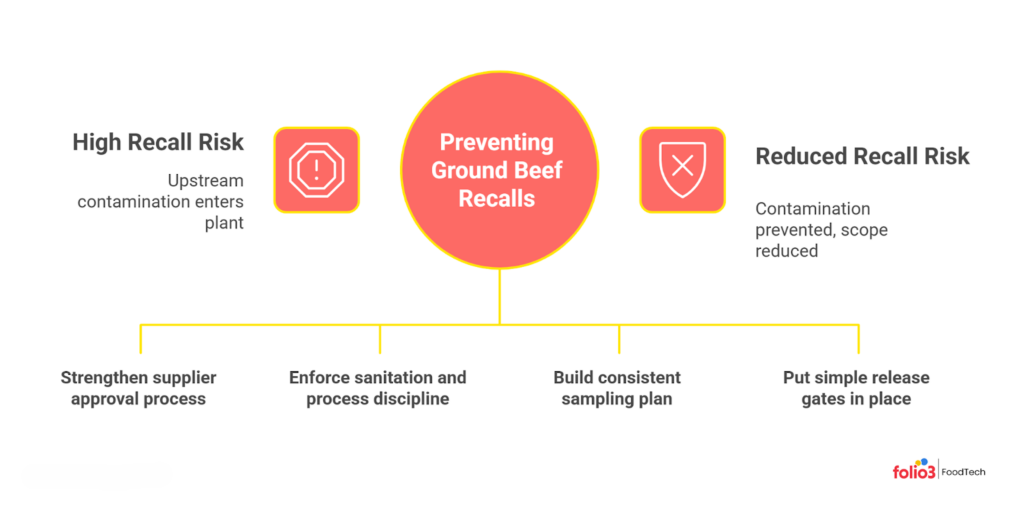
Control Points 1–4: Supplier & Incoming Verification
Start where most recalls start: upstream. For ground beef, supplier approval and receiving controls decide whether risk enters your plant quietly. Build a disciplined process for supplier onboarding, specs, COAs, and corrective actions—then make it visible, not tribal knowledge. Pairing this with preventive measures for food safety control strengthens your upstream defense.
A digital supplier compliance workflow helps you track approvals, expirations, and non-conformances without chasing emails. At the dock, enforce lot IDs, temperature checks, and segregation rules so the questionable pallet” doesn’t get mixed into tomorrow’s grind. Document those receiving decisions, because they become your defense in audits.
Control Points 5–8: Sanitation & Process Controls at Grind
Your grind room is where “good trim” can become “ground beef ecoli” risk if sanitation and process discipline slip. Treat sanitation operating procedures (SSOPs) like production steps, not paperwork: define teardown frequency, pre-op checks, and verification records. This aligns with core food safety practices that reduce contamination risk at the source. Keep people, and product flows along raw zones, tools, and gloves should not drift across lines.
Control rework with rules on what qualifies, how long it can be held, and how it’s labeled. Pair that with preventive maintenance focused on seals, gaskets, blades, guards, and any points where foreign material can enter, then document it inside your HACCP plan.
Control Points 9–10: Testing Strategy that Actually Reduces Recalls
Testing doesn’t prevent contamination by itself, but it can prevent shipment. The practical goal is a release gate that matches your risk: higher-risk lots stay on hold until results clear, and holds are enforced by process, not memory. Build a sampling plan you can run consistently, then review trends by supplier, shift, and line.
Rapid methods can shrink time-to-release, but only if your approvals and holds are automated. A connected quality workflow keeps records and actions in one place. That’s how you keep a ground beef recall from spreading. For foundational guidance, review our food safety and quality assurance guide.
Control Points 11–12: Labeling, Release Gates & Distribution Discipline
Many “recalled ground beef” incidents become expensive because the paperwork can’t keep up with reality. Put simple release gates in place: label verification, correct mark-of-inspection data, and “who approved shipment” captured every time. For vacuum-packed ground beef, also follow vacuum sealed meat safety best practices to protect shelf life and traceability.
Tighten distributor data requirements so ship-to, ship-date, and lot IDs are always complete. When you can run an instant forward and backward trace, you can target the right customers instead of blasting everyone. That’s how you defend margin when a recall e coli arrives.
Recall Prevention Checklist Mapped to Hazard
To keep prevention actionable, map each hazard to the exact control, record, owner, and frequency. When this is in one checklist, you can audit yourself weekly instead of “discovering” gaps during an inspection or a ground meat recall. Below is a compact example you can adapt to your lines. The goal is fewer surprises and faster proof when questions come.
| Hazard | Typical trigger | Control points | Verification record | Owner | Frequency | Software support |
| STEC (E. coli) | Positive test / illnesses | Test-and-hold, sanitation, lot segregation | Hold log, lab results, release approvals | QA | Every lot | Trace + approvals |
| Foreign material | Complaint / inspection | PM, detection, packaging checks | PM log, inspection photos, disposition | Maintenance + QA | Daily / weekly | CAPA + evidence vault |
| Labeling | Label mismatch | Label verification gate | Label check record | QA + Ops | Every run | Workflow + audit trail |
Your First 24-Hour Response Plan When a Ground Beef Recall Hits
Act faster and smarter in the first 24 hours. Contain product, trace lots, notify customers, and document actions without losing operational control.
0–2 Hours: Contain First, then Communicate
The moment you suspect a recall on ground beef is possible, contain first. Stop-ship anything in the affected window, place affected lots on physical and digital hold, and protect your evidence: labels, production logs, lab results, and shipping records. Your goal in the first two hours is to prevent further distribution while creating a single, time-stamped incident record your team can work from without conflicting versions flying around internally.
2–8 Hours: Trace + Notify + Align
Next, trace and notify. Run a forward trace (every ship-to customer, DC, and internal location) and a backward trace (incoming lots, suppliers, and rework inputs) so you can define scope with facts. If you sell into retail, your customer list must be exportable in minutes, not built by hand. A recall workflow system makes the difference between “we think” and “we know,” especially when you’re fielding questions from customers and inspectors at the same time. today.
8–24 Hours: Retrieval + Verification + CAPA Kickoff
Finally, execute the retrieval and start your corrective actions. Document every notification and response, then perform effectiveness checks: did customers confirm hold, disposal, or return? In parallel, start a structured CAPA investigation considering equipment, sanitation, supplier lots, training, and release gates. The trick is sequencing: you can investigate the root cause without delaying containment. A food safety QMS that links incident → evidence → CAPA keeps your response audit-ready. and reduces repeat events across shifts.
How Recall Management Software Shrinks Scope, Time, and Audit Pain
Use connected recall workflows instead of manual spreadsheets. Speed up traceability, notifications, and audit evidence while reducing recall scope and compliance stress.
Non-negotiables a Software Must Support
Here’s the truth: a ground beef recall is a data-and-workflow problem before it’s a PR problem. If your traceability is slow, you’ll recall broadly. If notifications are manual, you’ll miss someone. If evidence is scattered, audits get ugly.
The non-negotiables are:
- Instant lot genealogy,
- Role-based workflows and approvals,
- Customer notification logs,
- An evidence vault for labels/results/photos
- Built-in mock recalls with timing KPIs.
A recall management platform is built for this. It turns recall steps into tasks with an audit trail.
Plant-ready Requirements Matrix
When you evaluate tools, buy recall managenet software with the ability to prove control, rather that just adding another kit to your tech stack. A simple requirements matrix keeps procurement honest: you list must-haves, nice-to-haves, owners, current gaps, and target SLAs.
Then you can run a mock recall drill and measure time-to-trace and time-to-notify before go-live. If it can’t run forward/back trace, it won’t save you in a crisis.
| Capability | Must-have | Owner | Target SLA |
| Forward & backward trace | Yes | QA/Compliance | < 2 hours |
| Customer notifications + logs | Yes | QA + Ops | < 1 hour |
| Evidence vault + audit trail | Yes | QA | Same day |
| CAPA linkage | Yes | QA + Maintenance | < 7 days |
| ERP/MES integration | Nice | IT | Project |
Take Control Of Ground Beef Recall Risk With Foodtech By Folio3
If you want one place to run the playbook, trace, notify, document, and close CAPA, connect recall workflows with traceability and QMS. That’s the idea behind our recall management software: it automates alerts, tracks actions, and keeps evidence audit-ready, while your traceability layer narrows scope fast.
Turn recall response from chaos into a controlled, auditable workflow. Foodtech by Folio3 helps your plant trace faster, act sooner, and prevent repeat recall events with connected food safety and recall management tools.
So, connect with our foodtech experts and see how connected recall, traceability, and quality workflows can protect your plant.
FAQs
Which Ground Beef Was Recalled Most Recently?
The most recent ground beef recalled can change quickly, so don’t rely on headlines alone. Check official recall listings and confirm the brand, lot code, dates, and establishment number against your inventory and shipment records.
How Do I Know If My Beef Is Recalled?
Start by checking official recall and public health alert listings, then match details to what you purchased or produced. Verify the establishment number, product description, dates, and lot codes before deciding on holds, returns, or disposal.
What Internal Temperature Makes Ground Beef Safe?
Ground beef is considered safe when it reaches 160°F (71°C) internally. Use a calibrated food thermometer in the thickest part, color isn’t reliable and document checks where your food safety program requires it.
How Fast Should A Plant Be Able To Complete A Trace?
A recall-ready plant should complete forward and backward traceability within a few hours, not days. Regular mock recall drills help you prove speed, accuracy, and scope control when a real incident happens.
What Records Do Inspectors/Auditors Ask For First?
Expect requests for lot genealogy, production dates, lab results, hold/release approvals, and shipping/customer distribution logs. Having these records centralized, time-stamped, and easy to export shows control and reduces back-and-forth during audits.


