

A single contamination event can shut down your production line, trigger a multimillion-dollar recall, and permanently damage your brand. In the modern meat supply chain, the stakes have never been higher for food safety and quality managers.
The economic burden of foodborne illness in the United States now stands at approximately $74.7 billion annually. Today, only meat and poultry are responsible for an estimated 22% of those illnesses and 29% of the associated deaths.
This guide is your definitive resource for understanding the full spectrum of meat contamination. Whether you manage a slaughterhouse floor, oversee cold chain logistics, or run quality assurance for a distribution network, you will walk away with actionable strategies to protect your operation and your consumers.
What Is Meat Contamination?
Meat contamination occurs when harmful agents enter meat products at any point in the supply chain. Understanding these threats is your first line of defense.
So, what is meat contamination exactly? It refers to the presence of any biological, chemical, or physical agent in meat that makes it unsafe for human consumption. Contamination of meat can occur at every stage, from the farm and slaughterhouse through processing, packaging, transportation, and retail display. The consequences range from mild consumer illness to fatal outcomes, regulatory shutdowns, and class-action lawsuits.
For processing professionals, the goal is not simply to react to contamination events but to build systems that prevent them. That starts with understanding the three primary hazard categories that affect raw meat contamination.
The Big Three Threats
Here are the major threats that lead to the contamination of meat:
Biological Contamination
Biological contamination is the most common and most dangerous category. It involves the introduction of harmful microorganisms, primarily bacteria, viruses, and parasites, into meat products. The pathogens that dominate meat safety concerns include Salmonella, E. coli (particularly STEC O157:H7 and non-O157 serogroups), Listeria monocytogenes, and Campylobacter.
In 2024, Listeria, Salmonella, and E. coli recalls increased by 41% and accounted for 39% of all food recalls in the United States. Hospitalizations from contaminated food more than doubled that year, rising from 230 to 487, and deaths climbed from 8 to 19.
In slaughterhouses, microbial contamination often begins during hide removal and evisceration, where gut contents can contact the carcass surface. Once a pathogen is introduced, warm temperatures and moisture create ideal conditions for rapid microbial growth. It commonly occurs if core food safety practices like proper chilling and sanitation are not immediately applied.
Chemical Contamination
Chemical contamination refers to the unintended presence of harmful chemical substances in meat. These can originate from multiple points in the supply chain. On the farm, veterinary drug residues (antibiotics, growth promoters) and agricultural chemicals (pesticides, herbicides) can accumulate in animal tissue. In the processing plant, cleaning agents and industrial sanitizers left on equipment surfaces, conveyor belts, and cutting surfaces pose a direct contamination risk.
In 2024, the USDA’s FSIS recalled approximately 93,277 pounds of raw meat products from a single New York establishment after they were found to be contaminated with a non-food-grade mineral seal oil, a chemical not approved for use in meat processing. This case underscores how chemical hazards can enter the supply chain through improper maintenance or unauthorized substances.
Robust food safety compliance management programs should include chemical hazard analysis for every substance used in your facility, from farm-level inputs to the sanitizers your team applies during washdowns.
Physical Contamination
Physical contamination involves foreign objects that end up in meat products. Common culprits include bone fragments, metal shavings from grinding and cutting equipment, plastic from packaging materials, and glass from broken fixtures.
This hazard category has been making headlines. In March 2026, the USDA’s FSIS issued a public health alert for White Oak Pastures ground beef due to potential metal contamination. Two consumer complaints led to the discovery. Just months earlier, in January 2025, another FSIS alert flagged frozen ground beef from Stockyards Packing Company for containing hard plastic and metal fragments.
These incidents highlight a systemic industry challenge: grinding operations are especially vulnerable to physical contamination because equipment wear introduces metal shavings into the product stream. Without inline inspection systems, these contaminants reach the consumer.
The Core Mechanics of Raw Meat Cross Contamination
Cross-contamination turns a localized hazard into a facility-wide crisis. Understanding its mechanics is essential for every processing operation.
Raw meat cross-contamination is the process by which pathogens or foreign materials spread from one surface, product, or area to another. It is one of the leading drivers of foodborne illness outbreaks. Meat cross-contamination does not just happen at a single touchpoint; it can cascade across your entire operation if your preventive controls have gaps.
Slaughterhouse and Processing Vulnerabilities
The highest-risk moments for cross-contamination in a slaughter and processing environment include:
- Hide removal: When the animal’s hide, which carries soil, fecal matter, and environmental bacteria, contacts the carcass surface.
- Evisceration: The most critical single step. A nicked intestine releases gut contents directly onto the carcass, introducing Salmonella, E. coli, and other enteric pathogens.
- Grinding and further processing: Grinding combines meat from multiple carcasses. If even one source carries a pathogen, the entire batch becomes contaminated, and the mechanical action distributes bacteria throughout the product.
- Shared equipment: Conveyor belts, cutting surfaces, and knives that contact multiple products without proper sanitation between uses spread contamination from batch to batch.
Effective meat traceability systems allow processors to isolate affected lots quickly when contamination is detected, limiting the scope of recalls and protecting your downstream supply chain.
The Cold Chain and Transportation
Temperature abuse during transit is a major amplifier of raw meat cross-contamination. When refrigerated trucks experience compressor failures, doors are left open at loading docks, or pallets are improperly staged, internal product temperatures can climb into the danger zone (40°F to 140°F / 4°C to 60°C). Within this range, bacteria like Salmonella and Listeria can double in population roughly every 20 minutes under ideal conditions.
The risk compounds in mixed loads. If drip from raw poultry at the top of a pallet reaches whole beef cuts below, the cross-contamination is both microbial and physical. A strong food traceability program that includes continuous cold chain monitoring helps you catch temperature excursions before they become full-blown food safety events.
How Should Covered Raw Meat Be Stored to Prevent Contamination?
Proper storage practices are your strongest daily defense against meat contamination. The right protocols protect product integrity from cooler to consumer.
The direct answer: covered raw meat should be stored at or below 40°F (4°C) in a commercial walk-in cooler, placed according to a strict vertical hierarchy based on minimum internal cooking temperatures. Poultry goes on the lowest shelf, ground meats above it, whole cuts of beef and pork higher, and ready-to-eat foods at the very top. Every product must be wrapped or covered to prevent drip-down contamination.
This hierarchy exists for a practical reason: if raw poultry drips onto a whole beef cut, the beef will still reach a high enough internal temperature during cooking to destroy the poultry-related pathogens. But if poultry drips onto a ready-to-eat salad, there is no kill step, and the consumer faces direct exposure.
Temperature Controls and Continuous Monitoring
Industrial cooling requires more than simply setting a thermostat. Walk-in coolers should maintain a consistent temperature at or below 40°F (4°C), while freezers should hold at 0°F (–18°C) or below. The challenge is maintaining those temperatures uniformly across the entire storage area, especially near doors, loading zones, and areas with high product turnover.
IoT-enabled temperature sensors now provide real-time, continuous monitoring with automated alerts when thresholds are breached. These sensors integrate directly with digital environmental monitoring platforms, giving your team instant visibility into cooler performance and generating the documentation you need for HACCP verification and regulatory audits.
Commercial Storage Hierarchy
The following table outlines the correct storage order for commercial walk-in coolers and transport pallets, organized by minimum internal cooking temperature. Products with the highest required cooking temperature go on the bottom to prevent drip-down contamination of items above them.
| Shelf Position | Product Category | Min. Cooking Temp. | Storage Rationale |
| Top (Highest) | Ready-to-eat foods (deli meats, salads, prepared items) | No cooking required | No kill step; must be protected from all drip contamination |
| Second | Seafood, whole cuts of beef, pork, lamb, veal | 145°F (63°C) | Lower cooking temp; drip from poultry or ground meats below poses minimal upward risk |
| Third | Ground meats and ground fish | 155°F (68°C) | Higher cooking temp compensates for potential cross contamination from poultry below |
| Bottom (Lowest) | Whole and ground poultry | 165°F (74°C) | Highest cooking temp; highest pathogen risk; drip only reaches shelving, not other products |
This storage order is standard across USDA regulations for meat processing, and it applies equally to walk-in coolers, reach-in refrigerators, and transport pallets.
Advanced Packaging Technologies
Beyond storage hierarchy and temperature control, packaging technology plays a critical role in preventing environmental exposure and extending shelf life. Two technologies have become standard in commercial meat processing:
Modified Atmosphere Packaging (MAP) replaces the air inside a package with a controlled gas mixture, typically a combination of carbon dioxide, nitrogen, and sometimes oxygen. The reduced oxygen environment slows aerobic bacterial growth and oxidative spoilage, extending the shelf life of fresh meat by several days to weeks, depending on the gas ratio and storage temperature.
Vacuum sealing removes nearly all air from the package, creating an anaerobic environment that inhibits most spoilage organisms. For processors handling primal and sub-primal cuts, vacuum sealed meat packaging is essential for maintaining product quality during distribution and storage. Both MAP and vacuum sealing must be paired with strict temperature controls to be effective, as anaerobic pathogens like Clostridium botulinum can grow in oxygen-free environments if temperatures are not maintained.
Industrial Strategies to Prevent Cross-Contamination When Preparing Raw Meat
To prevent cross-contamination when preparing raw meat at the industrial scale, you need a layered system that addresses facility design, equipment management, sanitation, and human behavior. Each layer reinforces the others. If one fails, the remaining layers catch the hazard before it reaches the finished product.
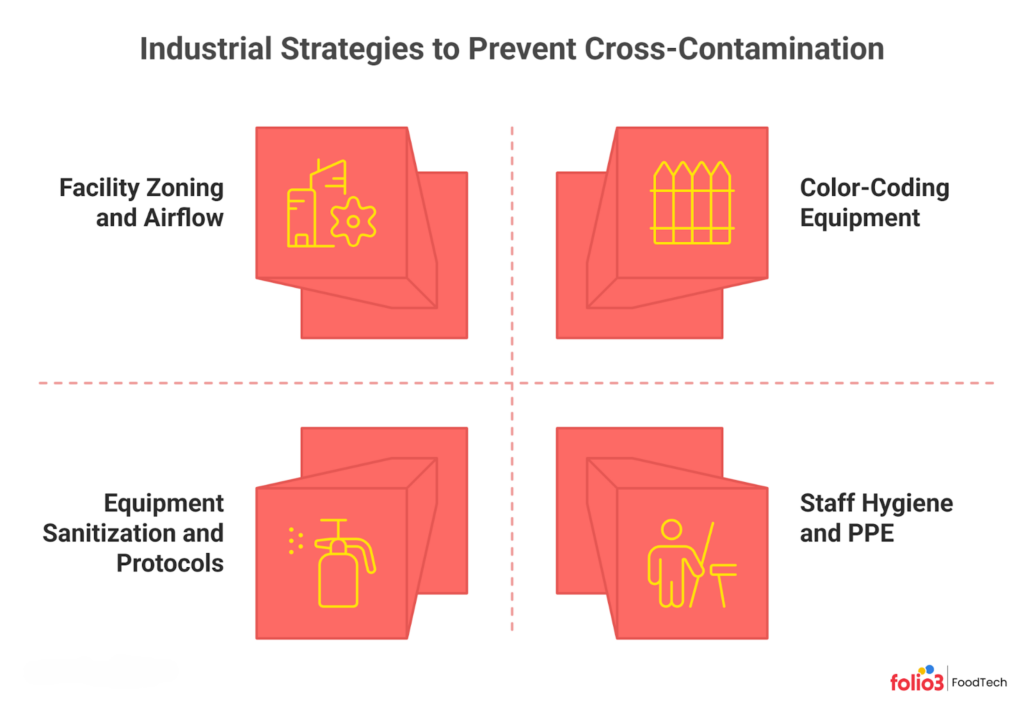
Facility Zoning and Airflow
Modern meat processing facilities operate on the principle of physical separation between “clean” zones (where cooked, ready-to-eat, or packaged products are handled) and “dirty” zones (where raw materials are received, slaughtered, or initially processed). This separation prevents raw meat contamination from reaching finished products.
Key zoning elements include:
- Positive air pressure in clean zones: Air flows from clean areas into dirty areas, never the reverse. This prevents airborne pathogens from drifting into finished-product areas.
- Physical barriers: Walls, separate HVAC systems, and dedicated doorways between zones.
- Foot baths and hygiene stations: Placed at every transition point between zones to decontaminate boots and hands before entry into clean areas.
- Dedicated employee flow: Staff working in raw zones should not enter cooked-product zones without a full change of PPE.
Color-Coding Equipment
Color-coded equipment is one of the simplest and most effective tools to prevent cross-contamination when preparing raw meat. By assigning distinct colors to specific product types and processing stages, you create a visual management system that every employee can follow instantly, regardless of language barriers.
A standard color-coding protocol might include:
- Red: Raw beef cutting boards, knives, and conveyor belt sections.
- Yellow: Raw poultry equipment.
- Blue: Seafood processing.
- Green: Ready-to-eat and cooked products.
- White: Dairy and bakery.
The key rule: equipment of one color never contacts products assigned to another color. This system must extend to scrapers, tubs, gloves, and even the aprons worn by line workers.
Equipment Sanitization and Washdown Protocols
Sanitation is not a one-time event. It is an ongoing process with defined protocols for shift changes, product changeovers, and end-of-day deep cleans. Your standard operating procedures (SOPs) should specify:
- Pre-operational sanitation: Inspect and sanitize all food-contact surfaces before each production shift begins.
- Mid-shift sanitation: Clean and sanitize equipment between product runs, especially when switching between species (e.g., from beef to poultry).
- End-of-day washdown: A comprehensive facility-wide cleaning using food-safe chemical sanitizers, followed by visual and ATP (adenosine triphosphate) verification testing.
- Documentation: Every sanitation event must be logged, including the chemicals used, concentrations, contact times, and responsible personnel. This documentation is essential for both HACCP verification and regulatory inspections.
Implementing a digital food safety and quality assurance system allows your team to record sanitation events in real time, attach photo verification, and trigger automatic corrective actions when deviations occur.
Staff Hygiene and PPE
Your employees are both your greatest asset and a potential contamination vector. Human-to-meat contact introduces skin-borne bacteria, and improper PPE use is a leading cause of cross-contamination in processing facilities.
Effective hygiene protocols should include:
- Gowning procedures: Employees should change into dedicated facility clothing (smocks, hair nets, beard covers) in designated changing areas. Street clothes should never enter the processing floor.
- Glove change frequency: Gloves must be changed between handling different products, after touching non-food-contact surfaces, after coughing or sneezing, and at regular timed intervals.
- Handwashing compliance: Hand-washing stations with warm water, soap, and single-use towels must be available at every entry point and within reach of every workstation. Automated hand-wash timers can enforce the recommended 20-second minimum.
- Health screening: Employees exhibiting symptoms of gastrointestinal illness must be restricted from food-contact roles until cleared by a medical professional.
Regulatory Framework and Standards
Food safety regulations set the legal floor for your operation. Understanding and exceeding them protects both your consumers and your business.
Meat contamination prevention is not just a best practice; it is a legal mandate enforced by regulatory bodies around the world. Here is a breakdown of the key frameworks you need to understand.
United States
The USDA’s Food Safety and Inspection Service (FSIS) is the primary federal agency responsible for ensuring the safety of meat, poultry, and egg products. Under the Federal Meat Inspection Act and the Poultry Products Inspection Act, FSIS conducts continuous in-plant inspection of all slaughter and processing operations.
HACCP plans are mandatory for all federally inspected meat and poultry plants, requiring processors to identify hazards, establish critical control points, and maintain verifiable records. For a comprehensive overview, explore this guide on USDA regulations for meat processing.
European Union
In the EU, the European Food Safety Authority (EFSA) provides independent scientific advice on food-related risks. Meanwhile, the European Center for Disease Prevention and Control (ECDC) coordinates surveillance of foodborne diseases.
EFSA’s Panel on Biological Hazards evaluates risks associated with biological contaminants in food, including meat, and issues guidance that informs EU food safety legislation. EU regulation requires all food business operators to implement HACCP-based systems.
HACCP and Quality Indicators
At its core, HACCP (Hazard Analysis and Critical Control Points) is a systematic, science-based framework for identifying food safety hazards. It establishes controls at critical points in the production process and implements corrective actions when deviations occur.
Implementation of HACCP principles is the legal and operational backbone of meat contamination prevention worldwide. For meat processors specifically, this means systematic microbial testing at receiving, during processing, and at finished-product stages.
Codex Alimentarius and International Standards
The Codex Alimentarius, developed jointly by the FAO and WHO, provides internationally recognized guidelines for food safety, including codes of hygienic practice for meat. Beyond Codex, global standards such as ISO 22000 (Food Safety Management Systems) and FSSC 22000 (which builds on ISO 22000 with additional prerequisite programs) offer certifiable frameworks that harmonize food safety practices across borders. For operations pursuing global market access, understanding food and beverage certifications is essential for demonstrating compliance to international buyers and auditors.
How to Leverage Modern Foodtech for Meat Contamination Detection
Even the most well-designed prevention program needs verification. Quality control technologies give you the data and confidence to confirm that your meat contamination controls are working, and to catch failures before products reach the consumer.
Metal Detection and X-Ray Inspection
Given the recurring FSIS public health alerts for metal in ground beef, inline metal detection and X-ray inspection systems are not optional for modern processors. They are your primary defense against physical contamination reaching the consumer.
Metal detectors identify ferrous, non-ferrous, and stainless steel fragments in product streams. X-ray inspection systems go further, detecting bone, glass, stone, dense rubber, and calcified material in addition to metals. For high-volume grinding operations, placing these systems immediately after the grinder and again at the packaging stage creates a dual-checkpoint system that catches contaminants introduced at either point.
Microbial Testing and Environmental Swabbing
Pathogen testing is the verification layer that confirms your HACCP controls are eliminating biological hazards. Two primary approaches are used in modern meat processing:
- ATP testing: Adenosine triphosphate bioluminescence testing measures the cleanliness of food-contact surfaces. It provides results in seconds, making it ideal for pre-operational sanitation verification between shifts.
- Rapid PCR (Polymerase Chain Reaction) tests: These detect specific pathogen DNA, such as Salmonella, Listeria, or E. coli, in meat samples or environmental swabs within hours rather than the days required by traditional culture methods. Rapid results mean you can hold product until clearance, reducing the risk of shipping contaminated lots.
Environmental swabbing programs target high-touch and hard-to-clean surfaces like drains, conveyor belt undersides, blade guards, and cooler door handles where biofilms can harbor persistent pathogen populations. A robust food quality management program integrates these testing results into a centralized dashboard, giving your team real-time visibility into facility hygiene status.
HACCP Implementation as Your Operational Backbone
A Hazard Analysis and Critical Control Points plan is not a document that lives in a binder on a shelf. It is the active, living system that connects every prevention and detection strategy covered in this guide. Your HACCP plan identifies the specific hazards relevant to your operation and designates the critical control points where those hazards must be controlled. Plus, it sets measurable critical limits, defines monitoring procedures, and prescribes corrective actions when limits are exceeded.
For meat processors, moving from paper-based HACCP records to digital food safety software transforms compliance from a reactive paperwork exercise into a proactive, data-driven system. Automated alerts, real-time monitoring dashboards, and audit-ready reporting reduce human error and ensure that your critical controls are verified continuously, not just during inspections.
Safeguard Your Meat Supply Chain
Meat contamination is not a single-point problem, and it does not have a single-point solution. From biological pathogens and chemical residues to the metal fragments making recent headlines, the threats are diverse, persistent, and evolving. The only effective defense is a multi-layered approach that combines proper storage protocols, facility zoning, equipment sanitation, staff discipline, robust HACCP implementation, and modern detection technology.
Every strategy discussed in this guide, from storage hierarchy and cold chain monitoring to color-coded equipment and X-ray inspection, represents one layer in that defense. When these layers work together within a digitized, auditable system, you do not just meet regulatory requirements; you build a food safety culture that protects your consumers, your brand, and your bottom line.
Ready to close the gaps in your meat safety program? Explore how Folio3 FoodTech’s food safety suite can digitize your HACCP plans, automate environmental monitoring, and give you real-time traceability across your entire supply chain. Talk to a food safety specialist today to schedule a facility safety audit!
FAQs
What Temperature Kills Bacteria in Meat?
Most harmful bacteria in meat are destroyed when the internal temperature reaches 165°F (74°C), the safe threshold for poultry. Whole cuts of beef and pork require a minimum of 145°F (63°C) with a three-minute rest, while ground meats must reach 155°F (68°C).
How Long Can Raw Meat Sit Out Before It Becomes Unsafe?
Raw meat should never sit at room temperature for more than two hours, or one hour if the ambient temperature exceeds 90°F (32°C). Beyond that window, bacterial populations can reach dangerous levels that cooking may not fully eliminate.
Can You Remove Contamination by Washing Raw Meat?
No. Washing raw meat does not remove bacteria; instead, it splashes contaminated water onto nearby surfaces, sinks, and ready-to-eat foods. Proper cooking to the correct internal temperature is the only reliable method to destroy pathogens in meat.
What Is the Difference Between a Meat Recall and a Public Health Alert?
A recall is a voluntary action by a company to remove unsafe products from stores. A public health alert is issued by FSIS when the product is no longer available for purchase but may still be in consumers’ homes, urging them not to consume it.
How Does Meat Contamination Affect Small Processing Plants Differently?
Small plants often lack the budget for inline X-ray systems, dedicated lab staff, or redundant cold chain monitoring. This makes robust sanitation SOPs, third-party testing partnerships, and digital HACCP tools even more critical for closing the gap with larger operations.


