

Modern food production relies on precise food processing methods to transform raw agricultural inputs into safe, high-quality consumables. For professionals in the industry, understanding these methods is essential not only to ensure product consistency but also to optimize efficiency, maintain regulatory compliance, and preserve nutritional integrity. Food production methods today extend beyond basic cooking or packaging, incorporating advanced technologies, automation, and data-driven controls that enhance both output and safety standards.
The global food processing industry was valued at nearly USD 2.9 trillion in 2023 and is projected to reach around USD 4.4 trillion by 2030 at a compound annual growth rate (CAGR) of 6 percent, reflecting rapid expansion driven by rising demand for processed foods and modernization across supply chains.
While often used interchangeably in casual discussion, there is a clear distinction between food processing and manufacturing. Processing focuses on transforming ingredients into edible forms, including preservation and preparation steps, whereas manufacturing encompasses the full-scale industrial operations required to produce, package, and distribute food products efficiently. Recognizing this difference allows food engineers to design workflows and systems that maximize both operational efficiency and product quality.
Types of Food Processing Methods
Modern food production relies on a variety of food processing methods to transform raw ingredients into safe, high-quality products. Understanding the distinctions among primary, secondary, and tertiary processing is critical for professionals to design efficient workflows and select the right food processing techniques for each product type. These types of food processing determine how raw materials are handled, preserved, and prepared for consumption while maintaining safety and nutritional value.
Primary Processing
Primary processing involves the initial transformation of raw agricultural materials into ingredients or semi-processed products. Key food processing methods at this stage include:
- Milling: Converting grains into flour or other derivatives
- Cleaning and washing: Removing soil, debris, and contaminants from crops
- Sorting and grading: Ensuring uniform size, ripeness, and quality
- Smoking: Preserving and flavoring meat or fish
These food processing methods set the foundation for downstream production steps, ensuring ingredient quality and safety before further processing.
Secondary Processing
Secondary processing uses ingredients generated through primary processing to create ready-to-eat or semi-processed foods. Common methods of food processing include:
- Fermenting: Producing yogurt, wine, or fermented vegetables
- Baking: Transforming dough into bread, pastries, or baked goods
- Curing: Preserving and flavoring meats such as hams and sausages
- Mixing and blending: Combining multiple ingredients to create a uniform product
Secondary processing integrates multiple food processing methods to achieve both safety and sensory quality while preparing products for distribution or further processing.
Tertiary Processing
Tertiary processing refers to large-scale industrial operations that produce finished, packaged foods ready for consumption. Key activities include:
- Manufacturing frozen meals, packaged snacks, and canned goods
- Standardizing recipes for consistency and efficiency
- Automating production lines to reduce human error
- Implementing rigorous quality control protocols
Thermal Processing
Thermal processing is a core component of modern food processing methods, using controlled heat to eliminate pathogens and extend shelf life. Key techniques include:
- Pasteurization: Ensuring microbial safety in liquids such as milk and juice
- Sterilization: Maintaining long-term shelf stability in canned and packaged foods
- Blanching: Preparing vegetables for freezing or further processing
Thermal processing ensures both safety and preservation of nutritional content, making it indispensable in secondary and tertiary operations.
Meat Processing
Industrial meat processing requires specialized food processing methods to maintain product quality, safety, and compliance. Key practices include:
- Cutting and deboning for standardized portions
- Curing and smoking for preservation and flavor
- Controlled fermentation for sausages and specialty products
- Automated temperature control and hygiene protocols for regulatory compliance
Professional meat processing integrates both traditional techniques and modern technologies to deliver consistent, safe, and high-quality products.
Processing Stages and Techniques
Modern food production relies on structured food processing methods to ensure consistency, safety, and efficiency. Understanding the sequence of different types of food processing and the methods in food processing applied at each stage enables professionals to optimize workflows and reduce operational risks.
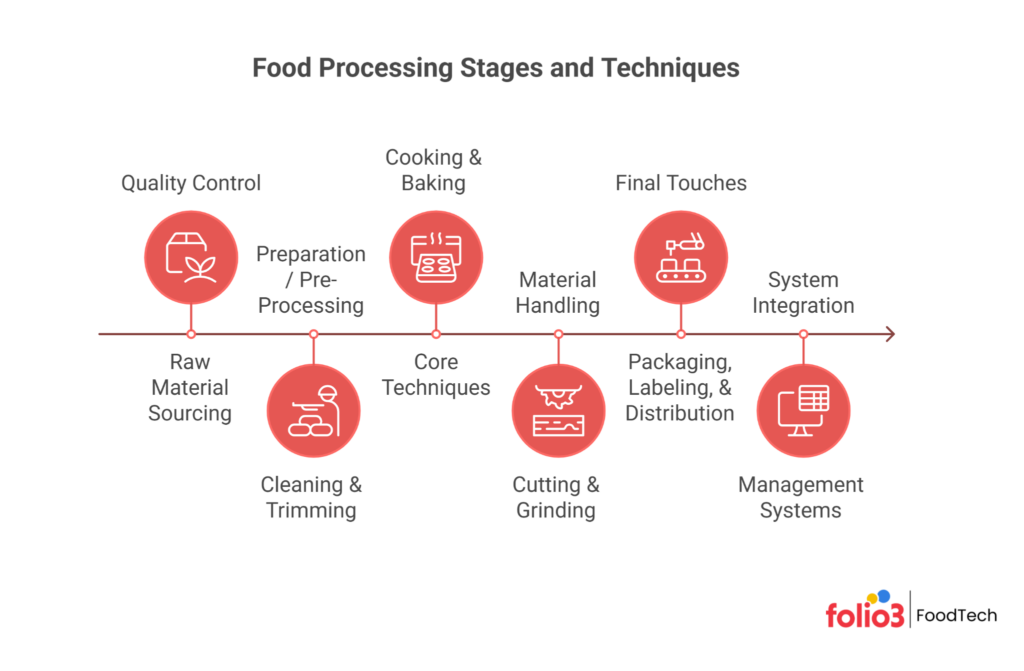
Raw Material Sourcing, Quality Control, Supplier Standards
The foundation of any product begins with high-quality raw materials. Key practices include:
- Selecting ingredients based on grade, freshness, and origin
- Conducting microbial, chemical, and physical inspections
- Establishing supplier standards for hygiene, sustainability, and traceability
These measures are critical to ensure that food processing types meet regulatory and quality benchmarks from the outset.
Preparation / Pre-Processing of Raw Materials
Before core processing, raw materials undergo pre-treatment to standardize quality and safety:
- Cleaning, washing, and sorting
- Trimming, peeling, and portioning
- Controlled blending and emulsification for uniformity
These methods in food processing ensure that subsequent operations are efficient, predictable, and reproducible.
Core Techniques: Cooking, Baking, Frying, Steaming, Grilling
Primary preparation transforms ingredients into consumable forms using heat, moisture, or dry techniques:
- Cooking/boiling: Ensures microbial safety and texture development
- Baking: Produces breads, pastries, and shelf-stable goods
- Frying: Creates high-flavor, ready-to-eat products
- Steaming and grilling: Preserves nutrients and enhances taste
Each technique represents a critical food processing method, applied with precision to maintain both safety and sensory quality.
Material Handling: Cutting, Slicing, Grinding, Emulsification, Marinating
- Cutting and slicing: Standardizes portion size for packaging or cooking
- Grinding: Produces a consistent texture for meat, grains, or spices
- Emulsification: Combines liquids or ingredients for sauces, dressings, and processed products
- Marinating: Enhances flavor and tenderizes proteins
Efficient handling minimizes waste, ensures uniformity, and integrates seamlessly into different types of food processing workflows.
Core Techniques: Cooking, Baking, Frying, Steaming, Grilling
Primary preparation transforms ingredients into consumable forms using heat, moisture, or dry techniques:
- Cooking/boiling: Ensures microbial safety and texture development
- Baking: Produces breads, pastries, and shelf-stable goods
- Frying: Creates high-flavor, ready-to-eat products
- Steaming and grilling: Preserves nutrients and enhances taste
Each technique represents a critical food processing method, applied with precision to maintain both safety and sensory quality.
Material Handling: Cutting, Slicing, Grinding, Emulsification, Marinating
- Cutting and slicing: Standardizes portion size for packaging or cooking
- Grinding: Produces a consistent texture for meat, grains, or spices
- Emulsification: Combines liquids or ingredients for sauces, dressings, and processed products
- Marinating: Enhances flavor and tenderizes proteins
Efficient handling minimizes waste, ensures uniformity, and integrates seamlessly into different types of food processing workflows.
Discrete vs Process Manufacturing in Production Lines
Production lines can be designed as Discrete vs Process Manufacturing depending on the product:
- Discrete manufacturing: Produces batch-oriented items such as baked goods or packaged snacks
- Process manufacturing: Continuous systems for liquid foods, sauces, or beverages
Understanding this distinction allows professionals to optimize line configuration, reduce downtime, and improve throughput.
Packaging, Labeling, and Distribution
Final stages of processing include:
- Automated or manual packaging to maintain safety and freshness
- Labeling with accurate ingredients, nutrition, and regulatory information
- Distribution strategies to ensure timely delivery and minimize spoilage
These steps are part of modern food processing methods that connect production with market-ready products.
Integration with Food Production Management Systems
Advanced systems enable centralized monitoring and optimization of all stages:
- Inventory and ingredient tracking
- Production scheduling and efficiency analysis
- Quality assurance and compliance documentation
Integration with food production management systems ensures traceability, reduces errors, and enhances overall operational control.
Methods of Food Preservation Used in Food Processing
Preservation is a critical aspect of modern food processing methods, ensuring that products remain safe, nutritious, and high-quality throughout their shelf life. Understanding the different ways of processing food for preservation allows industry professionals to select appropriate techniques based on product type, desired shelf life, and production scale.
Canning and Vacuum Sealing
- Canning: Food is sealed in airtight containers and heated to destroy pathogens and enzymes, providing long-term storage without refrigeration.
- Vacuum sealing: Oxygen is removed from packaging to inhibit microbial growth, prolong freshness, and maintain product quality. This technique is widely applied in vacuum packaging to ensure safety, extend shelf life, and preserve flavor and texture in industrial and commercial food operations.
These methods of processing food are widely used in both industrial and small-scale operations for fruits, vegetables, and ready-to-eat meals.
Freezing and Freeze-Drying
- Freezing: Rapid cooling of food to subzero temperatures slows microbial growth and preserves taste, texture, and nutritional content.
- Freeze-drying: Moisture is removed under low pressure while maintaining structural integrity, ideal for high-value products like berries, coffee, or prepared meals.
Freezing and freeze-drying are essential ways of processing food for products that require extended storage without chemical preservatives.
Dehydration and Air-Drying
- Dehydration: Moisture removal from fruits, vegetables, and meats prevents bacterial growth.
- Air-drying: Traditional method for foods such as herbs, grains, and cured meats.
These methods of processing food are energy-efficient and suitable for lightweight, shelf-stable products.
Fermentation and Pickling
- Fermentation: Beneficial microbes convert sugars into acids or alcohol, enhancing flavor, nutritional value, and shelf life.
- Pickling: Preservation in acidic solutions like vinegar or brine, commonly applied to vegetables, fruits, and some proteins.
These biological methods are key ways of processing food for value-added products with functional benefits.
Salting/Curing and Smoking
- Salting/curing: Draws moisture out of food to inhibit microbial growth, widely used for meats and fish.
- Smoking: Adds flavor while simultaneously preserving the product through heat and antimicrobial compounds from smoke.
Advanced Industrial Preservation Technologies
- Irradiation: Uses controlled radiation to eliminate pathogens without affecting product quality.
- High-pressure processing (HPP): Preserves texture, flavor, and nutrients while inactivating microorganisms in juices, meats, and ready-to-eat foods.
These advanced techniques highlight how industrial-scale food processing methods integrate science and technology to maintain quality, safety, and efficiency in modern food production.
Improving Food Processing Efficiency
Optimizing food processing methods is crucial for reducing costs, improving product quality, and maintaining competitiveness in modern production environments. Professionals must focus on identifying bottlenecks and implementing best practices across all methods of processing food.
Lean Manufacturing Principles: VSM, Kaizen, 5S, Kanban, Poka-Yoke
- Value Stream Mapping (VSM): Visualizes every step in production to detect inefficiencies
- Kaizen (Continuous Improvement): Encourages incremental improvements at all levels
- 5S: Organizes workspaces to enhance efficiency and reduce waste
- Kanban: Pull-based inventory control ensures materials are available as needed
- Poka-Yoke: Mistake-proofing techniques reduce errors and rework
Applying these principles helps increase food processing efficiency while maintaining consistency and safety.
Process Optimization and Minimizing Waste
- Streamlining workflows to reduce redundant steps in food processing methods
- Monitoring critical control points to prevent product loss
- Implementing quality checks early in the process to reduce defective outputs
These strategies ensure each method of processing food contributes to maximum productivity and minimal material loss.
Sustainable Practices for Energy, Water, and Materials
- Using energy-efficient equipment and heat recovery systems
- Minimizing water usage through closed-loop systems
- Reducing raw material waste by repurposing by-products
Sustainable practices not only lower operating costs but also align with regulatory and environmental standards, reinforcing best practices in modern food processing methods.
Technology Adoption to Improve Throughput and Yield
- Automation of repetitive tasks and robotic handling
- Digital monitoring for real-time performance analytics
- Predictive maintenance to prevent unplanned downtime
Integrating advanced technologies strengthens the reliability of methods of processing food while increasing yield, throughput, and overall operational efficiency.
How Folio3 FoodTech Helps Ease Food Processing Throughout
Folio3 FoodTech’s Food Manufacturing Software is designed to streamline modern food processing methods for industry professionals. By integrating production management, quality control, and process monitoring, it provides actionable insights that help maximize efficiency while maintaining product safety and consistency.
Key benefits for food processing operations include:
- Smarter Yield Management In Food Production: Analytics tools optimize raw material usage, reduce waste, and improve overall production output
- Real-Time Process Monitoring: Tracks every step in food processing methods, from raw material preparation to final packaging
- Quality and Compliance Oversight: Ensures adherence to food safety regulations and internal standards, minimizing risks
- Integrated Production Management: Centralizes scheduling, inventory, and resource planning, improving coordination across processing lines
By leveraging this software, professionals can enhance operational efficiency, maintain high product quality, and respond quickly to changes in production demand. Its design aligns with the practical needs of modern food processing methods, making it a critical tool for large-scale and industrial food manufacturing operations.
Conclusion
Modern food production relies on sophisticated food processing methods to ensure safety, quality, and efficiency across all stages of production. From primary transformations like milling and cleaning to tertiary processes such as packaging and large-scale ready-to-eat manufacturing, each food processing method plays a critical role in delivering consistent and reliable products.
Efficiency in workflows, adherence to rigorous safety protocols, and adoption of advanced technologies such as thermal processing, vacuum packaging, and high-pressure preservation allow professionals to meet the increasing demands of global food supply chains. By integrating lean principles, process optimization, and sustainability practices, production teams can maximize throughput, minimize waste, and maintain high-quality standards.
For industry professionals, understanding these methods is not just a technical necessity but a strategic advantage. A thorough grasp of the various food processing methods, combined with careful monitoring and management, ensures that products meet regulatory requirements, satisfy consumer expectations, and contribute to a competitive, modern food manufacturing operation.
The evolving landscape of food production continues to introduce innovations that improve efficiency, extend shelf life, and enhance nutritional and sensory qualities. Professionals who stay informed and apply best practices across all food processing methods will be well-positioned to lead in modern, high-quality food production.
FAQs
What Are the Key Challenges in Modern Food Processing?
Modern food processing faces several critical challenges for professionals aiming to maintain efficiency, quality, and safety. Variability in raw materials can impact consistency and yield, making it essential to implement standardized food processing methods from sourcing to packaging. Regulatory compliance and food safety standards require continuous monitoring, documentation, and quality control at every stage. Reducing waste and optimizing throughput while maintaining nutritional value is another ongoing concern, particularly in large-scale operations. Additionally, adopting new technologies, from automation to thermal and mechanical processing techniques, demands investment and training but is essential for staying competitive.
What Are The 5 Methods Of Food Processing?
The five main food processing methods include primary processing, such as cleaning, milling, washing, and sorting raw materials, followed by secondary processing, which covers baking, fermenting, and curing to prepare semi-processed foods. Tertiary processing involves large-scale manufacturing of ready-to-eat or packaged products. Thermal processing, including pasteurization, sterilization, and blanching, ensures safety and shelf life. Meat processing applies specialized techniques such as curing, smoking, and controlled fermentation. Understanding these food processing methods helps professionals design efficient workflows and maintain product quality.
Do Processed Foods Cause Inflammation?
Processed foods do not automatically cause inflammation. Certain highly refined or ultra-processed foods that are rich in sugars, trans fats, or artificial additives can contribute to chronic inflammation if consumed excessively. In contrast, other processed foods, such as pasteurized dairy, frozen vegetables, or fermented products, utilize food processing methods that preserve nutrients and can be part of a balanced, anti-inflammatory diet.
What Are The 7 Preservation Methods?
Food preservation methods are designed to maintain quality, safety, and shelf life. These include canning, where foods are sealed and heated to eliminate microbes, freezing to slow microbial growth, and dehydration or air-drying to remove moisture. Fermentation uses beneficial microbes to generate acids that prevent spoilage, while pickling preserves foods in acidic solutions like vinegar. Salting and curing draw out moisture to inhibit bacterial growth, and smoking exposes foods to smoke, which both dehydrates and adds antimicrobial compounds. All these approaches are integral components of modern food processing methods.
What Is The Correct Order Of Food Processing?
The correct sequence of food processing starts with sourcing and inspecting raw materials to ensure quality and safety. This is followed by primary processing, which transforms raw ingredients into usable forms. Secondary processing then prepares these ingredients into semi-processed or ready-to-eat foods, and tertiary processing handles large-scale manufacturing, packaging, and distribution. Throughout these stages, professionals rely on standardized food processing methods and quality control protocols to ensure product safety, consistency, and compliance.


