

Every year, thousands of new food products hit store shelves, and the vast majority never make it past year five. Whether you’re a product manager at a growing food brand or an entrepreneur with a bold culinary concept, food product development (FPD) is the structured process that turns an idea into a market-ready product. It bridges the gap between what consumers want and what your business can profitably deliver.
Done right, FPD balances creativity with science, commercial viability with safety, and speed-to-market with sustainability. Done wrong, it’s an expensive lesson. This blog walks you through every stage of the process, from the first spark of an idea all the way to post-launch lifecycle management. So, you have a clear roadmap to build products that actually succeed. You’ll also see where modern tools and cross-functional collaboration make all the difference.
Market Landscape and the Importance of New Food Product Development
The global food and beverage industry keeps evolving, and companies that don’t innovate get left behind. New product development is one of the most powerful levers available to food businesses, whether you’re trying to capture an emerging trend, respond to a competitive threat, or simply energize a maturing brand.
Why Companies Invest in New Products
- Market expansion: New SKUs open doors to untapped consumer segments and geographies that existing products can’t reach.
- Revenue growth: Differentiated products command premium pricing and drive incremental sales that strengthen your category position.
- Brand relevance: Regular innovation signals to consumers that your brand is dynamic, current, and genuinely responsive to their evolving needs.
- Competitive defense: Launching first or better in a trending category protects shelf space and reduces the risk of being displaced.
The Failure Rate Reality
The statistics are stark: up to 80–90% of new food and beverage products fail within their first year on shelf. That’s not a reason to stop innovating, it’s a reason to be more deliberate about how you do it. A structured food product development process dramatically reduces that risk by filtering weak concepts early and investing resources in ideas with real commercial potential.
Consumer-Driven Trends You Can’t Ignore
- Alcohol-free alternatives: The no- and low-alcohol category is among the fastest-growing globally, demonstrating the scale of shifting consumer drinking habits.
- Functional foods: Products delivering health benefits beyond basic nutrition, immunity, gut health, and cognitive function are attracting significant retail and investor attention.
- Clean labels: Consumers are scrutinizing ingredient lists more than ever, demanding shorter and more recognizable formulations with no artificial additives.
- Fermented and probiotic products: Growing awareness of gut microbiome health has driven explosive consumer interest in this category.
- Sustainability: Regenerative sourcing, reduced packaging waste, and carbon-conscious supply chains are shifting from differentiators to baseline buyer and retailer expectations.
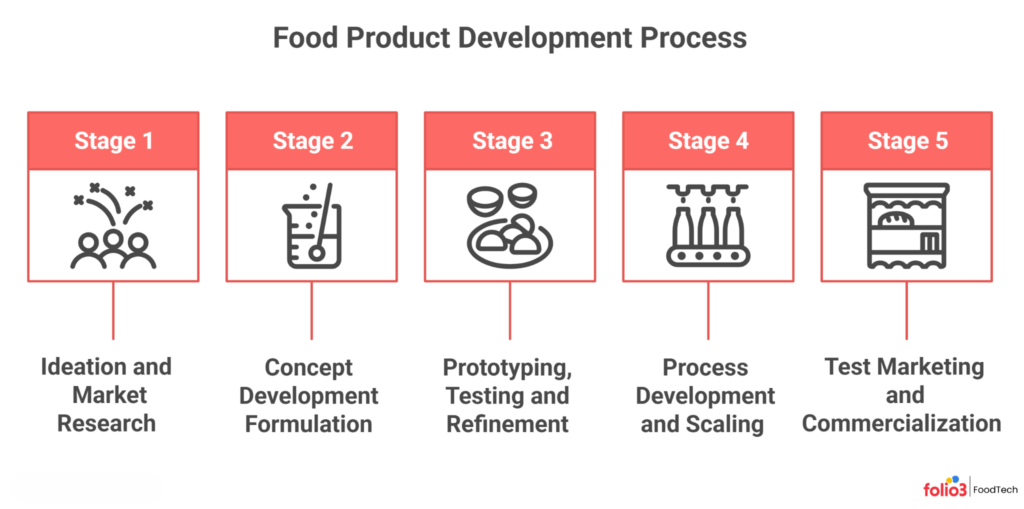
Stage 1: Ideation and Market Research
The first stage of the food product development process is where creativity meets discipline. It’s tempting to rush through ideation, but the brands that consistently launch winning products invest heavily in understanding their market before they ever enter a lab. Good ideas are cheap; validated ideas are valuable.
Idea Generation
Great ideas come from many places, and the best development teams keep multiple channels open simultaneously.
- Market research and trend watching: Tools like Mintel and SPINS, combined with social listening platforms, surface emerging consumer preferences before they hit the mainstream.
- Gap analysis: Mapping category white space helps you identify underserved consumer needs that existing competitors haven’t yet addressed.
- Consumer feedback: Customer reviews, support tickets, and ethnographic research reveal pain points that current products fail to solve, often pointing directly to your next opportunity.
- Trade shows and industry events: Events like IFT FIRST and the Specialty Food Association’s Fancy Food Show expose development teams to novel ingredients, processing technologies, and emerging formats.
- Incremental vs. disruptive innovation: Not every new product needs to reinvent the category. Incremental improvements, such as a reformulation, a new flavor variant, or an extended shelf life, can be just as commercially valuable as truly novel concepts. Knowing which approach fits your brand strategy is itself part of ideation.
Market Research and Validation
Once you have a pool of ideas, the next step is filtering them through rigorous market validation before you spend a dollar on development.
- Competitor benchmarking: Analyze what’s already on shelf. Where are the gaps? Where are competitors over-indexed? What positioning space is unclaimed?
- Shelf audits: Physical and digital shelf reviews reveal packaging norms, price point conventions, and visual cues that define the competitive set in your target category.
- Surveys and focus groups: Quantitative surveys give you scale; qualitative focus groups give you depth. Use both to stress-test a concept’s appeal with real target consumers before committing resources to development.
- Screening questions to ask every concept: Who is the target user? What core benefit does this deliver? Why is it meaningfully better than existing alternatives? What does the competitive set look like at the price point?
Defining the Target Consumer and Positioning
You can’t build a great product for “everyone.” Defining your target consumer with precision is what separates products that resonate from those that confuse.
- Demographic profiling: Age, income, geography, and household size are the basic filters that shape distribution strategy and pricing decisions.
- Psychographic profiling: Values, lifestyle, and purchase motivators, the deeper drivers that shape both your formulation choices and your communication strategy.
- Positioning statement: A clear, single-minded statement of who your product is for, what it uniquely delivers, and why consumers should believe it. It should be grounded in quality and safety expectations that your brand can consistently meet.
Stage 2: Concept Development and Formulation
With a validated concept and a defined consumer target, you move into the technical heart of food product development: turning your idea into a real, formulated product. That’s where food science product development expertise becomes essential, and where decisions made now echo through every subsequent stage.
Project Definition and Design Specifications
- Define purpose and scope: What exactly is this product? What problem does it solve for your target consumer? What does commercial success look like in year one and year three?
- Features and benefits documentation: Record the intended sensory profile, nutritional targets, product format, pack size range, and shelf life requirements before formulation begins.
- Cross-functional alignment: Bring in design, engineering, marketing, and operations at this stage, not when you’re ready to launch. Late-stage surprises are significantly more expensive than early-stage alignment.
- Consumer-centered specifications: Write your specifications from the consumer’s perspective first, then work backward to technical and manufacturing feasibility.
Ingredient Selection and Formulation
This is where food science product development really begins. Ingredient choices shape everything from flavor and texture to cost structure and regulatory status.
- Sensory performance: Does the ingredient deliver the taste, texture, and appearance profile you’re targeting? Bench trials are the only way to know.
- Cost and availability: Exotic ingredients can be powerful differentiators, but supply volatility and margin pressure are real risks at commercial scale.
- Sustainability and clean label: Opt for ingredients that align with your brand’s sustainability commitments and meet your target consumers’ label expectations.
- Regulatory compliance: Confirm that ingredients are approved for use in your target markets and compatible with any intended label claims.
- Prototype documentation: Rigorously document every bench-top prototype. Use Design of Experiments (DoE) methodology to efficiently explore formulation variables and identify optimal combinations with fewer trials.
Feasibility Screening and Regulatory Considerations
- Equipment and manufacturing: Can you produce this product on existing lines, or does it require capital investment? Get manufacturing input early; their constraints should shape your formulation, not the other way around.
- Supplier capacity: Are your key ingredients available at the volumes and specifications you need, reliably and at scale?
- Financial viability: Run preliminary COGS models at this stage to confirm your formula can deliver acceptable margins at target retail price points.
- Regulatory landscape: Understand standards of identity, labeling requirements, and special regulations, particularly for low-acid canned foods, organic claims, and health-related statements. Explore how food safety and compliance software can help you stay ahead of these requirements.
Stage 3: Prototyping, Sensory Testing, and Refinement
Getting into the kitchen is when food product development gets exciting. But prototype creation without structured sensory evaluation is little more than expensive guesswork. This stage is where food science and consumer psychology meet, and both deserve equal attention.
Prototype Creation and Iterative Development
Start with bench-top prototypes that can be rapidly created and iterated. Involve your contract manufacturer or co-packer early; processes that work at two kilograms in the lab don’t always translate to a commercial-scale mixing bowl. Co-developing with ingredient suppliers can unlock technical support, application expertise, and preferential pricing. Expect multiple iteration rounds; the best food products rarely emerge from the first bench trial, and that’s not a failure; it’s the process working correctly.
Sensory Science and Consumer Testing
Sensory evaluation is a formal scientific discipline, not just “have the team taste it and vote.”
- Trained sensory panels: Internal panels trained in descriptive analysis can precisely identify and quantify flavor, aroma, texture, and appearance attributes, giving you actionable formulation data.
- Consumer panels: Untrained consumer groups reflect real purchase intent. Hedonic scales measuring overall liking and preference are your most direct window into commercial viability.
- Focus groups: Qualitative sessions generate rich feedback on concept appeal, packaging design, and positioning, complementing the product performance data from panel testing.
- AI-assisted flavor profiling: Emerging AI tools can model flavor interactions, predict shelf-life degradation, and accelerate formulation optimization. Learn more about how AI is reshaping food and beverage product development and what it means for your development process.
Refinement and Specification Management
Every accepted prototype needs a complete product specification: physical attributes, chemical parameters (pH, water activity, moisture content), nutritional profile (pulling data via a nutrition API saves significant manual calculation time), and packaging specifications. Cloud-based specification management platforms ensure your specs are version-controlled, accessible across teams, and aligned with current regulatory requirements. They eliminate the costly errors that come from emailed spreadsheets and informal updates. This documentation discipline also accelerates regulatory submissions and retailer onboarding.
Stage 4: Process Development and Scaling Up
A formula that works at five kilograms doesn’t automatically work at five hundred. Process development bridges the gap between food science and manufacturing reality, and skipping it is one of the most reliably expensive mistakes a food business can make.
Process and Technology Considerations
- Pilot plant trials: Run production-representative trials in a pilot facility to identify process sensitivities before committing to full-scale manufacturing runs.
- Equipment mapping: Where possible, design your process around existing equipment to minimize capital expenditure. Where new equipment is required, build time for installation, qualification, and operator training into your launch timeline.
- Parameter optimization: Process engineers work to identify the optimal temperature, pressure, mixing time, and other critical control parameters that deliver consistent food product quality across production shifts.
- Inline quality checkpoints: Build quality checks for visual inspection, fill weight verification, and pH monitoring into every critical step of your process, not just at the end of the line.
Supply Chain Planning and Sustainability
Reliable supply chains don’t build themselves, and sustainable ones require intentional design choices from the outset.
- Partner with multiple approved suppliers for critical ingredients to eliminate single-source risk.
- Build demand forecasting models to manage inventory efficiently and minimize raw material waste.
- Incorporate sustainability commitments at the formulation and packaging stage: regeneratively sourced ingredients, reduced water and energy use in processing, and recyclable or compostable packaging options.
Sustainable product development in the food industry is no longer just a marketing story; it’s increasingly a hard requirement in retail and foodservice buyer conversations. Explore how the food supply chain management system can help you manage supply chain sustainability at scale.
Regulatory and Safety Requirements
- Hazard analysis (HACCP): Identify biological, chemical, and physical hazards and establish critical control points. Explore a practical guide to HACCP plan implementation, it’s a legal requirement in most markets and a commercial necessity with major retail partners.
- Allergen management: Document all allergens present in your formula and facility. Cross-contact risks must be controlled at the process level and communicated clearly on the label.
- Microbiological testing: Establish challenge studies and shelf-life validation protocols to confirm your product is safe throughout its intended shelf life under realistic storage conditions.
- Special regulatory categories: Low-acid canned foods, acidified foods, infant formula, and certain health claim categories face additional regulatory scrutiny and process filing requirements; plan for these early.
Stage 5: Test Marketing and Commercialization
You’ve got a validated product with a sound process behind it. Now comes the real test: will real consumers buy it, repeatedly, at a price point that makes your business viable? This is the stage where cross-functional coordination becomes the deciding factor between a successful launch and an expensive lesson.
Test Marketing
Before a national rollout, run controlled pilot batches and limited distribution tests. This might mean a regional retail launch, a foodservice pilot with a select group of operators, or a direct-to-consumer e-commerce trial in a defined geography.
- Gather structured consumer feedback: sales velocity, repeat purchase rates, and direct consumer reviews.
- Refine pricing based on real consumer price sensitivity data, not just cost-plus assumptions built from your COGS model.
- Document every parameter of your pilot production batches meticulously; this data is essential when you scale to full production.
Commercialization Planning
Full commercialization is a cross-functional marathon, and every department has a critical role to play:
- Operations and supply chain: Finalize production scheduling, inventory positioning, and logistics arrangements well ahead of launch.
- Marketing and creative: Complete packaging artwork, finalize regulatory-compliant claims, and build your full suite of launch campaign assets.
- Sales and distribution: Secure distribution agreements, set up retailer and foodservice accounts, and brief field sales teams on positioning and key selling points.
- Quality assurance: Conduct final pre-launch quality audits and confirm all regulatory filings and product specifications are in order.
- Finance: Lock in COGS projections, confirm trade spend commitments, and finalize launch investment budgets.
- Project management: A dedicated project manager facilitating communication across all functions is invaluable at this stage. Explore food and beverage ERP solutions that support end-to-end commercialization planning and cross-functional visibility.
Pricing, Profitability, and Launch Strategy
- Cost analysis: Build a full cost model; COGS, logistics, trade spend, and marketing investment to confirm your target retail price delivers acceptable gross and net margins.
- Packaging finalization: Ensure final packaging meets all regulatory label requirements and retail shelf standards, including barcode placement, nutrition facts panel, and allergen declarations.
- Marketing execution: Coordinate a multi-channel launch: digital campaigns, in-store activations, sampling events, coupons, and PR outreach aligned to your target consumer’s media habits.
- Distribution strategy: Choose channels that match your target consumer’s shopping behavior. A direct-to-consumer launch has very different economics and logistics requirements than a national grocery distribution play.
Post-Launch and Product Lifecycle Management
The best food brands don’t just launch products; they manage them actively throughout their commercial life. Post-launch evaluation and lifecycle management are how you protect and extend the return on your development investment.
Post-Launch Evaluation and Continuous Improvement
- Monitor sales velocity, distribution performance, and consumer feedback consistently across all retail and foodservice channels.
- Track incoming quality data, including consumer complaints, retailer returns, and QA audit results, as early warning signals for formulation or process issues before they become costly.
- Plan for line extensions: new flavors, pack sizes, or format variants that leverage existing brand equity and production infrastructure without requiring a full development cycle.
- Address cost reduction opportunities as ingredient costs shift, substitutions that maintain consumer-perceived quality while improving your margin structure.
Understanding Product Life Cycles
Every food product moves through four distinct phases, and recognizing where you are determines your investment and management strategy:
- Introduction: Sales are low, marketing investment is high, and the priority is building consumer awareness and driving trials. Expect to operate at a loss or breakeven in this phase; it’s normal and planned for.
- Growth: Consumer adoption accelerates, distribution expands, and the product approaches profitability. Protect your position with consistent marketing investment and relentless quality management.
- Maturity: Sales plateau and competition intensifies as followers enter the category. This is the time to consider refreshes, such as reformulation, new packaging, and limited editions, to reinvigorate brand momentum.
- Decline: Volume drops, and distribution begins to thin. Evaluate objectively whether it’s more value-creating to invest in a relaunch, roll the equity into a line extension, or retire the product and redirect resources toward higher-growth opportunities.
Future Trends and Innovations in Food Product Development
The future of food innovation is faster, more personalized, and more sustainable than ever before. Staying ahead of these trends is essential to keeping your development pipeline genuinely competitive.
AI, Digital Tools, and Smart Technologies
Artificial intelligence is reshaping the front end of food science product development. AI-powered flavor profiling tools can predict consumer acceptance before the prototype is built. Machine learning models trained on ingredient interaction data accelerate formulation optimization dramatically.
Meanwhile, digital twins of manufacturing processes allow engineers to simulate scale-up scenarios without costly physical trials. Cloud-based specification management platforms ensure real-time accuracy and regulatory compliance across distributed development teams, collapsing timelines that once took months.
Sustainability and Regenerative Practices
Consumer expectations around sustainability are moving faster than most brands’ supply chains. The key trends to embed in your development process now:
- Regenerative sourcing: Ingredients sourced from farming systems that actively restore soil health and biodiversity are commanding premium positioning in premium and natural retail channels.
- Upcycled ingredients: Food waste-derived ingredients, such as spent grain, fruit pomace, whey permeate, and vegetable trimmings, are gaining real traction as both a sustainability credential and a cost optimization tool.
- Carbon reduction: Scope 3 emissions reduction is increasingly appearing in retail buyer conversations, pushing product developers to factor the full carbon footprint of their ingredient choices into sourcing decisions.
- Recyclable and compostable packaging: Legislative pressure in the EU and growing retailer mandates across North America are making sustainable packaging a baseline requirement. The global sustainable packaging market is projected to reach almost $450 billion by 2030, reflecting the scale of this commercial transition.
Personalized Nutrition and Health Trends
Advances in nutrigenomics and digital health are moving the food industry toward mass personalization. Functional foods, nutraceuticals, and condition-specific formats, such as low-sugar, gluten-free, high-protein, gut-health-focused, and fortified, are growing faster than the broader market.
The global functional food market is projected to reach $586 billion by 2030, growing at a CAGR of over 8.6% from 2024 to 2030. So, building a formulation platform that can flex toward personalized nutrition is a significant long-term competitive advantage.
Emerging Consumer Preferences and Novel Formats
- Fermented and probiotic products continue to attract strong consumer demand as gut health awareness becomes mainstream rather than niche.
- Home-growing kits and meal kit formats are blurring the line between food product and consumer experience, opening new premium positioning territory.
- Longer-term advances like precision fermentation, cultivated meat, mycoprotein-based proteins, and 3D-printed food formats represent the frontier of food and beverage product development. They are worth monitoring even if commercial readiness is still years away.
Building a Cross-Functional Team and Organizational Culture
The most common reason food product development projects stall isn’t a bad formula; it’s a broken organizational process. Cross-functional collaboration, clear role definition, and a culture that values both creativity and rigor are what consistently separate high-performing development organizations from the rest.
Roles and Responsibilities
- Product developers/food scientists: Lead formulation, sensory testing, and specification development. They’re the technical engine of the process and the keepers of product integrity.
- Process and manufacturing engineers: Own scale-up, process optimization, and equipment qualification. Early involvement prevents expensive late-stage surprises and speeds commercialization.
- Quality assurance specialists: Ensure products meet safety, regulatory, and brand quality standards at every development stage, not just at launch.
- Regulatory affairs specialists: Navigate labeling requirements, health claims, ingredient approvals, and market-specific compliance obligations, especially critical in multi-market launches.
- Marketing and sales: Provide consumer insight throughout development, shape positioning strategy, and own the go-to-market execution.
- Financial analysts: Model COGS at each development stage, assess capital requirements, and build the business case for continued investment at every Stage-Gate decision.
- Market researchers: Supply ongoing competitive intelligence and consumer trend data to keep the development pipeline grounded in commercial reality.
Collaboration, Stage-Gate, and Decision Making
The Stage-Gate process, widely adopted across the food industry, provides a structured framework for evaluating and filtering development projects at defined checkpoints. Each gate requires cross-functional agreement that the project merits continued investment based on updated data. This discipline prevents organizations from over-investing in weak concepts and ensures that development resources stay focused on the highest-potential projects in your pipeline.
Transparent communication between functions and genuinely data-driven decisions at each gate are what make the system work. Gut feel has its place in ideation; at commercialization, you need numbers.
Cultivating an Innovative Culture
Innovation requires an organizational environment where teams feel genuinely safe to propose bold ideas, challenge conventional assumptions, and learn from failures without fear of blame. You need to balance creative ambition with rigorous feasibility assessment. Celebrate cross-functional learning, not just successful launches. The teams that consistently build winning products treat every development cycle as an opportunity to improve the process itself, not just deliver an outcome.
Conclusion and Key Takeaways
Bringing a new food product from concept to commercialization is genuinely complex, but it’s a process you can master. The journey from ideation through market research, formulation, scale-up, and launch is most reliably navigated when creativity is matched with scientific rigor and genuine consumer insight. There are no shortcuts that consistently work.
The brands that win in today’s market don’t just have better ideas; they have better processes. Consumer-centric design, sustainability commitments, and modern digital tools are no longer optional extras; they’re table stakes for any food business serious about long-term competitiveness.
Whether you’re a product manager at an established food company or an entrepreneur developing your first SKU, the framework in this blog gives you a foundation to innovate with confidence. Apply these steps, challenge assumptions at every stage, and never stop iterating on both your products and your development process.
Ready to build a smarter food product development process? Connect with Folio3 FoodTech’s experts to explore how our solutions can accelerate your next launch and support your team from concept to commercialization.
FAQs
What Is the Typical Timeline for Food Product Development?
Most food products take 12–24 months from concept to shelf, though simpler line extensions can move faster. Product complexity, regulatory requirements, and manufacturing scale-up are the biggest variables that affect development timeline and launch readiness.
How Much Does It Cost to Develop a New Food Product?
Development costs vary widely by product complexity, from under $50,000 for straightforward reformulations to several million dollars for novel categories requiring new process technology, extensive consumer research, and formal regulatory filings. Building a realistic budget before Stage 2 is essential to avoid mid-development surprises.
What Are the Most Common Reasons New Food Products Fail?
The most frequently cited failure drivers are poor market fit, insufficient consumer research, pricing misalignment with perceived value, and weak distribution execution, not formulation quality. Building genuine market validation into your process early addresses the majority of these risks before they become costly.
When Should You Bring in a Contract Manufacturer?
Engage contract manufacturers during Stage 2 or early Stage 3, early enough to align your formulation with their equipment capabilities, but after your concept has cleared initial market and concept validation. Their process constraints should inform your formulation decisions, not override them late in development.
How Do You Protect a New Food Product Idea?
Trade secrets (confidentiality agreements, proprietary formulations), trademarks (brand names and logos), and utility patents (novel processing methods or ingredient applications) are the primary IP tools available to food product developers. Consult an IP attorney early, especially before any public disclosure of your concept.
What Role Does Sustainability Play in Modern Food Product Development?
Sustainability is now a meaningful purchase driver and a retailer listing requirement, not just a positioning claim. Sustainable formulation choices, sourcing decisions, and packaging design directly influence consumer preference, retail buyer decisions, and long-term brand equity, making it a core development consideration from Stage 1 onward.


