

You can run every audit, document every HACCP step, and still watch a recall unravel the business overnight. The reason is almost always the same: the system was on paper, but it never lived on the floor.
Food safety culture is what closes that gap, when a line worker stops production without hesitation, a supervisor logs a near-miss, and leadership treats safety as a strategic asset rather than a compliance line item. Understanding food safety and its stages at every level of your operation is the foundation for everything else.
This guide breaks down what food safety culture is, the dimensions that make it measurable, and how to build one that survives shift changes and regulatory shifts.
Evolution of Food Safety Culture From Compliance to Core Value
Food safety culture did not appear overnight. It evolved through decades of outbreaks, regulation, and hard-won lessons that reshaped how you think about what food safety culture is today.
Early Safety Incidents That Changed the Industry
Modern food safety didn’t emerge from a boardroom; it emerged from tragedy. The 1993 Jack in the Box E. coli O157:H7 outbreak sickened more than 700 people and killed four children, reshaping how the industry handles undercooked beef. The late-1980s BSE crisis reshaped feed and traceability rules across Europe. The 2008 Peanut Corporation of America salmonella outbreak sent a CEO to prison for 28 years, a turning point that put personal accountability squarely on executive desks. Understanding the full spectrum of food safety hazards, biological, chemical, and physical, is what makes these incidents comprehensible and preventable.
Regulatory Milestones
These incidents triggered structural change. The Global Food Safety Initiative (GFSI) launched in 2000 to harmonize private standards and end audit fatigue. The U.S. Food Safety Modernization Act (FSMA), signed in 2011, shifted federal focus from responding to contamination to preventing it. The EU followed with Regulation 2021/382. Most significantly, the FDA’s New Era of Smarter Food Safety Blueprint made culture one of its four core pillars, signaling that regulators now see behavior, not just paperwork, as the real driver of safe food.
The Shift to Organizational Value
What changed fundamentally is the framing. For decades, food safety was a compliance function that passed or failed audits. Today, it’s treated as an organizational value woven into hiring, onboarding, and KPIs. The GFSI’s 2026 position paper makes this explicit: culture isn’t a ‘soft’ add-on to your food safety management system, it’s the thing that determines whether the system works at 3 a.m. when no auditor is watching.
What is Food Safety Culture?
Before you can build or measure food safety culture, you need a working definition, one that distinguishes it from programs, policies, and the paper trail that often stands in for real behavior.
The Updated GFSI Definition
The GFSI A Culture of Food Safety, Version 2.0, released in March 2026, describes food safety culture as the deeply rooted beliefs, behaviors, values, and assumptions that are learned and shared by employees and that directly shape food safety performance. The framework draws on more than 180 academic and industry sources to move organizations beyond compliance language into measurable behavior. For a deeper look at how GFSI benchmarking requirements work in practice, see our guide to GFSI certification for the food industry.
The keyword is shared. Culture isn’t what the quality manual says; it’s what your newest line employee does when a container falls on the floor, and no one is watching.
Culture vs. Systems and Programs
Your food safety management system (FSMS), HACCP plan, GMPs, and SOPs are structures. Culture is what makes them actually get used, especially under pressure, on a short-staffed shift, or when production targets are slipping. The relationship between culture and systems is explored thoroughly in our guide to food safety and quality assurance. Systems without culture produce beautiful binders and recurring deviations. Culture without systems produces good intentions and unpredictable outcomes. You need both.
Why Culture Is Hard to Change
Culture develops over the years, reinforced by what leaders reward and what gets ignored. Stated values matter far less than observed behavior. If your VP says ‘safety first’ but praises the line lead who shipped despite a borderline temperature log, the culture lesson has been delivered, and it’s not the one you wanted. That’s why changing food safety and quality culture takes 18-36 months of sustained effort, not a quarterly training push.
Why Does Food Safety Culture Matter?
A strong food safety culture isn’t a soft-skill indulgence. It’s a measurable driver of consumer safety, regulatory standing, brand equity, cost control, and workforce stability.
Protecting Consumers First
The ethical case starts with people. Unsafe food causes roughly 600 million illnesses and 420,000 deaths globally each year, with children under five bearing 40% of that burden. No audit score justifies a preventable illness. Robust food quality control is only as effective as the people executing it, and a strong culture means the person closest to the problem feels empowered to stop it before it reaches a consumer.
Meeting Regulatory Expectations
FSMA’s preventive controls rule, the EU’s culture requirements under Regulation 2021/382, and the GFSI Benchmarking Requirements v2024 all now reference food safety culture directly. When inspectors arrive, they ask line workers about reporting channels and training. If the answers contradict your documentation, you have a finding.
Protecting Brand Trust and Reputation
A single recall can drop a brand’s market share for quarters, and class-action lawsuits now follow most pathogen-related recalls in the U.S. Having solid strategies for food recall management in place is essential. Still, a strong culture reduces the likelihood of getting there in the first place. It produces fewer incidents, and when incidents occur, it produces faster, more transparent responses, the kind that preserve retail relationships rather than destroy them.
Cutting Costs and Mitigating Risk
The financial case is blunt. A single food recall can exceed $10 million in direct costs before factoring in lost contracts, retailer penalties, and insurance hikes. Label-error recalls alone cost the U.S. food industry an estimated $1.92 billion in 2024. A proactive food safety culture catches these issues upstream, before they become crisis line items.
Improving Morale, Retention, and Market Access
Employees stay at companies where they feel their work matters and their voices are heard. A strong culture reduces turnover, lowers training costs, and produces the institutional memory that catches rare hazards. It also opens doors: GFSI-recognized certifications, expected by most global retailers, now require demonstrable culture elements, not just documentation.
Core Dimensions of Food Safety Culture
The GFSI 2026 framework organizes food safety culture into two tiers, organizational foundations and manifested essentials, and pairs them with seven operational elements that make abstract values visible in daily behavior.
Organizational Foundations
- Vision, Values, and Mission: Your culture starts with what leadership says matters most, and more importantly, what the rest of the organization believes leadership actually cares about. A clear, consistent food-safety-first message shapes every downstream decision.
- People, Commitment, and Accountability: Every employee, from the CEO to the sanitation crew, needs to own a piece of food safety. Accountability is specific, documented, and tied to performance reviews.
Manifested Essentials
- Hazard and Risk Awareness: Employees recognize hazards relevant to their work, understand why controls exist, and know what to do when something looks off.
- Consistency for Food Safety: FSMS, HACCP, and GMPs are applied the same way on day shift and night shift, in the main plant and at the co-packer.
- Adaptability, Change, and Continuous Improvement: The organization learns from deviations, audits, near-misses, and industry incidents, and updates practice without waiting for a regulator to force change.
Seven Operational Elements in Practice
Translating these dimensions into daily behavior means addressing seven operational elements. These are the levers you actually pull. Here’s how they map to observable behaviors and metrics you can track:
| Dimension / Element | Example Behaviors | Metrics to Track |
|---|---|---|
| Leadership Commitment | GEMBA walks by senior leadership; safety discussed in every ops meeting; safety goals in executive bonuses | Leadership walkthrough frequency; % of ops meetings with safety as agenda item |
| Open Communication | Anonymous reporting tools; no-blame investigations; multilingual signage | Near-miss reports per 1,000 hours; time to close reports; employee survey scores |
| Training and Competency | Role-specific onboarding; annual refreshers; competency verification, not just attendance | Training completion %; post-training assessment scores; skill re-verification rates |
| Risk Awareness | Line workers can name the top 3 hazards in their area; pre-shift hazard briefings | Hazard identification audit scores; frequency of pre-shift briefings |
| Empowerment and Accountability | Stop-work authority at every workstation; recognition for safety catches | # of stop-work events logged; # of recognitions tied to safety behavior |
| Continuous Improvement | CAPA reviews that examine cultural root causes; quarterly trend analysis | CAPA closure rate; recurrence of same deviation type; audit finding trends |
| Resources and Environment | Adequate staffing; working sanitation equipment; environmental monitoring | Environmental sampling positives; equipment downtime tied to sanitation |
How to Assess and Measure Food Safety Culture
You cannot improve what you don’t measure. Culture assessment reveals maturity, surfaces blind spots, and gives you a baseline against which every future change can be benchmarked.
Why Measurement Matters
Most organizations overrate their own culture. Self-perception at the executive level almost always outpaces reality on the floor. A structured assessment closes that gap and tells you whether your culture is aspirational, emerging, established, or mature, so your investment goes where it’s actually needed.
Surveys and Metrics
A good food safety culture survey is anonymous, available in every language spoken at the site, and short enough that people complete it. Effective tools ask employees to rate statements like ‘I feel safe reporting a food safety concern to my supervisor.’ Combine survey results with operational metrics: audit findings, near-miss reports, training completion, employee turnover, and customer complaints. One data point misleads. A dashboard of five or six tells the truth.
Observation and Interviews
Walk the floor during an unannounced night shift. Watch how line workers handle a temperature deviation. Ask three employees at random to explain the top hazard in their area. What you see and hear will always tell you more than what the documentation claims.
Benchmarking Against Standards
GFSI-recognized schemes, including BRCGS, SQF, FSSC 22000, and IFS, now require culture assessment as part of certification. Use their tools as a starting point, and supplement with behavioral frameworks like SGS VEST (Vision, Empowerment, Systems, Trust). Digital food safety and quality assurance platforms can automate much of this data collection, letting you trend culture metrics quarter over quarter.
How to Build and Improve a Proactive Food Safety Culture
Building culture is systematic, not mystical. Anchoring your approach in core food safety practices before layering behavioral change ensures your systems and culture reinforce each other. These nine steps, sequenced deliberately, take an organization from compliance-driven to genuinely proactive food safety culture.
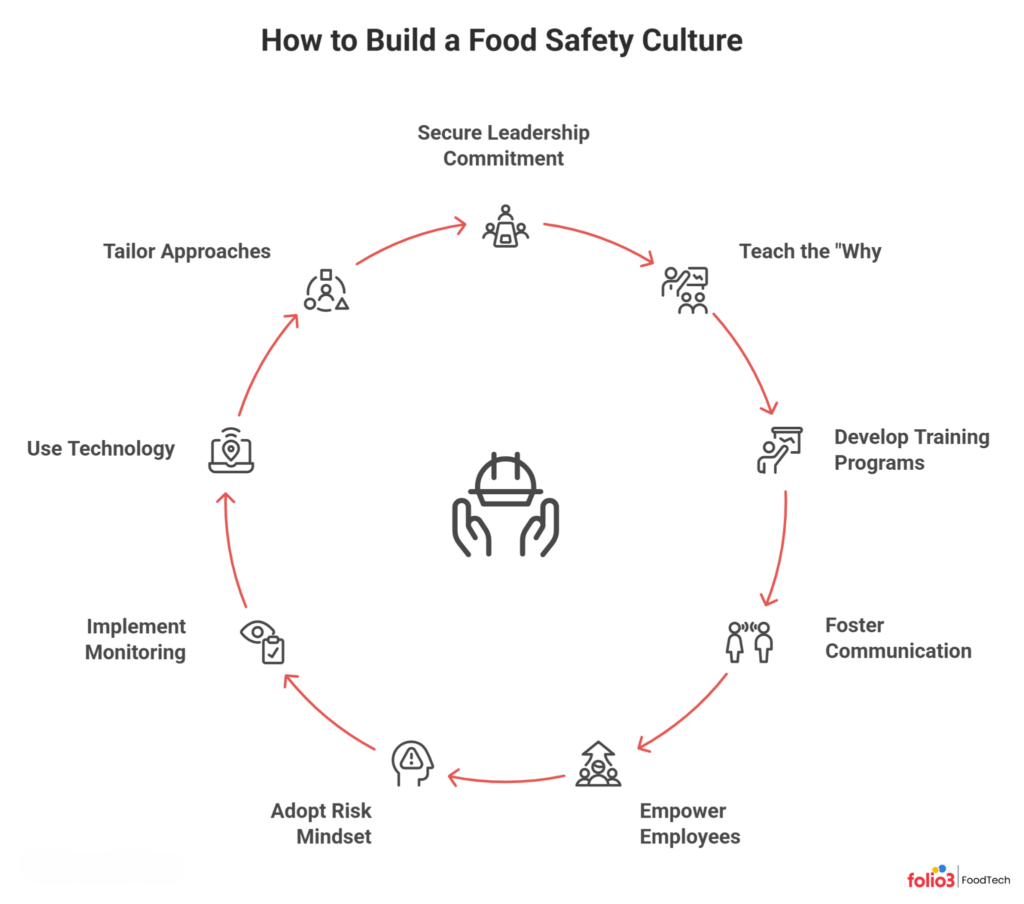
Secure Leadership Commitment
Nothing else works without this. Senior leaders must set the vision, fund it, and visibly live it through floor walks, safety-first decisions during production pressure, and explicit prioritization in every operational meeting. When leaders choose safety over shipment under stress, the organization learns the real rules.
Teach the “Why” Behind the “What”
Procedures employees understand are procedures they follow. Explain that a 165°F cook temperature exists because it destroys Salmonella, and what can happen when it doesn’t. Context transforms compliance into comprehension.
Develop Comprehensive Training Programs
Move beyond once-a-year slideshows. Build role-specific training, cross-training to deepen bench strength, and competency verification that tests actual knowledge, not just attendance. Platforms that support digital HACCP plan management and real-time compliance tracking make verification continuous rather than annual.
Foster Open Communication and Reporting
Two-way communication is non-negotiable. Establish anonymous reporting channels, protect whistleblowers explicitly, and investigate every report without blame. Share findings openly, including what was wrong, what was fixed, and who made the catch. Celebrate reporting, not silence.
Empower Employees to Act
Give every worker explicit stop-work authority, and back it up when they use it. The line employee who stopped production because of a borderline metal-detection reading should be named in the company newsletter, not quietly reassigned.
Adopt a Risk Mitigation Mindset
A thorough food safety risk assessment tells you what could go wrong and helps you determine whether to accept, transfer, avoid, or actively monitor each risk. Teams with mature food safety risk assessment practices proactively identify hazards before they escalate into incidents.
Implement Monitoring, Audits, and Continuous Improvement
Combine internal audits, third-party certification audits, and trending analysis. Implementing preventive measures for food safety control upstream reduces the frequency of deviations that require corrective action. When deviations recur, investigate cultural root causes, not just the proximate mechanical ones. A properly executed corrective and preventive action (CAPA) program ties each deviation to a systemic fix.
Use Technology and Tools
Paper-based systems create gaps that culture alone cannot close. Modern food safety software, with mobile checklists, IoT temperature sensors, and AI-driven trend analysis, makes the right behavior the easiest behavior. When a sensor flags a deviation at 2 a.m. and auto-alerts the on-call supervisor, culture and technology reinforce each other.
Tailor Approaches to Cultural and Regional Contexts
Multilingual workforces and multinational facilities need tailored approaches. Translate training materials, not just signs. Account for hierarchical communication styles that may discourage upward reporting. What works at a Midwestern plant may not work at a processing facility in Southeast Asia, and vice versa.
Integrating Food Safety Culture into Management Systems and Certification
Culture isn’t a parallel track to your management system; it’s the connective tissue. Major regulations and certification schemes now require evidence that you’ve embedded it.
FSMA Preventive Controls
FSMA’s Preventive Controls for Human Food rule requires a qualified individual to develop and oversee your food safety plan. Our guide to FSMA certification and compliance covers the full scope of what that qualification requires. The New Era of Smarter Food Safety Blueprint identifies culture as one of four core pillars alongside tech-enabled traceability, smarter prevention tools, and new business models.
GFSI Scheme Requirements
All major GFSI-recognized schemes now include culture requirements. Here’s how they compare at a high level:
| Requirement | BRCGS | SQF | FSSC 22000 | IFS |
|---|---|---|---|---|
| Management Commitment | Required, documented culture plan | Required, management review | Required via ISO 22000 | Required, corporate policy |
| Employee Training | Role-based, verified | Competency-based | Role-based, documented | Role-based, verified |
| Communication Channels | Two-way required | Two-way required | Two-way required | Two-way required |
| Reporting Mechanisms | Confidential reporting | Required | Required | Required |
| Culture Assessment | Required (Issue 9) | Required (Ed. 9) | Required (v6) | Required (v8) |
| Management Review | Annual, documented | Annual, documented | Annual, documented | Annual, documented |
ISO 22000 and Codex Alimentarius
ISO 22000:2018 integrates culture through its leadership and worker-participation clauses, requiring top management to demonstrate commitment and ensure employees understand their food safety responsibilities. Codex Alimentarius General Principles of Food Hygiene, updated in 2020, explicitly added food safety culture as a foundational concept. For a broader view of how these frameworks fit together, see our guide to food and beverage certifications.
Regional Requirements
EU Regulation (EC) 852/2004, updated by Commission Regulation 2021/382, now explicitly requires operators to establish and maintain a food safety culture with named elements: commitment, leadership, communication, and training. Australia’s Food Standards Code takes a similar approach, and China’s GB 14881 has added management-commitment language. The regional details differ, but the global direction is unmistakable.
How to Overcome Common Challenges in Building a Food Safety Culture
Every food business hits the same obstacles when building culture, resources, diversity, production pressure, and turnover. Here’s how to work through each without stalling.
Resource Constraints for SMEs
Small and medium food businesses often feel that culture programs are a luxury for large processors. They aren’t. Start with peer-led training using free FDA and Codex materials, deploy simple paper or phone-based surveys, and leverage supplier-provided training content. Track two or three metrics consistently, not twenty sporadically.
Cultural and Language Diversity
Translate materials into the languages spoken on your floor, and use visual SOPs where literacy varies. Identify cultural champions within each language group to serve as peer trainers. Uniform expectations, delivered in locally relevant ways, outperform generic content every time.
Work Pressure and Competing Priorities
Production targets and safety don’t have to compete if leadership makes the priority order clear before a conflict arises. Adjust shift schedules to protect training time, cross-train so that one absence doesn’t force shortcuts, and use cross-functional teams that include ops, QA, and maintenance in every improvement initiative.
Employee Fatigue and Turnover
High turnover destroys institutional memory. Invest in recognition programs, career development paths from line to lead to supervisor, and onboarding that takes new hires’ food safety understanding seriously from day one. Retention is a food safety strategy.
Creating a Food Safety Culture Plan and Checklist
A food safety culture plan turns good intentions into a sequenced, accountable roadmap. Here’s a working framework you can adapt to your organization’s size and maturity.
Step-by-Step Planning Approach
- Assess current state: Run surveys, interviews, and floor observations. Document findings with evidence.
- Define vision and goals: Align with corporate mission, and set 12-, 24-, and 36-month targets.
- Develop policies and documentation: Management commitment statement, communication policy, training curriculum, risk mitigation procedures, reporting mechanisms, recognition program.
- Set metrics and KPIs: Choose leading indicators (near-miss reports, training completion, stop-work events) and lagging indicators (audit findings, recalls, turnover).
- Implement and iterate: Roll out in phases, review metrics monthly, adjust based on feedback, and report progress to leadership quarterly.
Food Safety Culture Checklist
Use this checklist to assign ownership and track progress across the foundational tasks:
| Task | Responsible Role | Cadence |
|---|---|---|
| Baseline culture assessment (survey + interviews) | QA Director / HR | Annual |
| Publish vision, values, and commitment statement | CEO / Senior Leadership | Once, reviewed annually |
| Role-specific training curriculum with competency verification | Training Manager / QA | Onboarding + annual |
| Anonymous reporting channel with investigation protocol | QA Director / HR | Ongoing |
| Stop-work authority signage and employee acknowledgment | Plant Manager / QA | Onboarding + annual |
| Leadership floor walks with documented observations | Senior Leadership | Weekly minimum |
| Monthly KPI dashboard and trend review | QA Director | Monthly |
| Management review of culture performance | Senior Leadership + QA | Quarterly |
| External culture assessment against GFSI requirements | Third-party auditor | Annual |
Conclusion and Future Outlook
Food safety culture is a long-term investment and a strategic differentiator. The organizations that treat it that way will own the next decade of the industry.
The takeaways are straightforward. Food safety culture is measurable, manageable, and essential. It sits above your FSMS, giving every HACCP plan, SOP, and audit its real force. When leadership commits, employees are empowered, communication flows both ways, and technology reinforces the right behaviors; incidents drop, margins improve, and the brand strengthens.
Looking ahead, expect IoT sensors, AI-driven risk analytics, and blockchain-enabled traceability to become standard tools for monitoring culture in real time. Regulators will keep raising the bar. Your advantage will come from starting now. Begin with an honest baseline assessment, pick three metrics you’ll track every month, and talk with specialists who can help you design a program that fits your operation. If you want a hands-on partner for that journey, our FoodTech experts work with processors across every major segment to turn cultural intention into measurable performance.
FAQs
How Long Does It Take to Build a Strong Food Safety Culture?
Meaningful culture change typically takes 18 to 36 months, depending on starting maturity and leadership commitment. Visible behavioral shifts often appear within 6 to 12 months, but an embedded, self-sustaining culture requires consistent reinforcement across multiple operational cycles.
Who Should Own the Food Safety Culture Program?
Ownership must sit with senior leadership, typically the CEO or COO, with day-to-day execution led by the Head of Quality. Shared accountability across HR, Operations, and QA works best because culture cuts across every function, not just the quality department.
What Is the Difference Between Food Safety Culture and Food Safety Climate?
Culture refers to the deep, shared values and behaviors that develop over years and persist across leadership changes. Climate refers to the current, perceived state of food safety priority at a given moment. Climate is a snapshot; culture is the long-term photograph.
How Do Small Food Businesses Build a Culture Without a Big Budget?
Start with free FDA, Codex, and trade association training materials. Run simple paper-based surveys quarterly, prioritize two or three behavioral metrics, and lean on supplier-provided content. Peer-led training often outperforms expensive external programs in smaller operations.
What Role Does Technology Play in Reinforcing Food Safety Culture?
Technology makes the right behaviors easier to execute and easier to measure. Digital checklists, IoT sensors, mobile reporting apps, and automated CAPA workflows remove friction from compliance tasks while producing the real-time data that leadership needs to spot cultural drift before it becomes an incident.
Can a Food Safety Culture Assessment Fail an Audit?
Yes. Under current BRCGS, SQF, FSSC 22000, and IFS requirements, inadequate culture evidence or contradiction between documentation and employee interviews can result in major nonconformities. Auditors now talk directly to line workers to validate what the documentation claims.
How Do You Measure Return on Investment From a Culture Program?
Track reductions in recall costs, audit nonconformities, customer complaints, employee turnover, and rework. Most organizations see ROI through avoided incidents, lower insurance premiums, and retained retail contracts within two to three years. One prevented recall often pays for years of program investment.


