

According to the CDC, the United States sees an estimated 48 million cases of foodborne illness each year, resulting in 128,000 hospitalizations. Improper thawing is one of the recognized contributing factors, as it places food inside the temperature danger zone and allows pathogens to multiply before the product ever reaches the cooking stage. For commercial food processing plants, the stakes are much higher than for a home kitchen. One wrong call on a thawing food decision can lead to a product recall, regulatory action, or a public health incident that damages your brand for years.
Thawing food in a commercial setting is not just about getting a product from frozen to usable. It is about maintaining control over every variable, temperature, time, contamination risk, and throughput, all at the same time. This blog covers what thawing food means from a food safety standpoint, the four approved methods of thawing frozen food, what you should never do, how HACCP and regulatory standards apply, and how commercial plants can build a reliable thawing process that holds up under inspection.
What Thawing Food Means in a Commercial Context
Thawing food means reversing the freezing process by raising the internal temperature of a product above 32°F (0°C), so it becomes usable for the next stage of processing or cooking. At its core, thawing food is a temperature management challenge.
When food freezes, ice crystals form inside the product. When you begin thawing frozen food, those crystals melt at different rates across the surface. The thinner, outer layers warm first. If that warming happens in an uncontrolled environment, the outer portions enter what food safety regulators call the temperature danger zone, between 40°F and 140°F (4°C to 60°C), while the center stays frozen.
In that danger zone, bacteria like Salmonella, Listeria, and E. coli can double in number every 20 minutes. A commercial plant running hundreds or thousands of pounds of product per shift cannot afford to have that happen.
This is why the question of which is an approved method of thawing frozen food is not academic. It directly affects the safety profile of everything that leaves your facility. Understanding the biological hazards in food that emerge during temperature mismanagement is the first step toward building a sound thawing protocol.
Why Thawing Frozen Food Safely Matters More in Processing Plants
In a restaurant or home kitchen, a thawing mistake might affect one meal. In a processing plant, it can compromise an entire batch or production run.
Commercial food plants deal with larger volumes, longer processing cycles, and more complex supply chains. A product may be thawed in one shift and not reach the cooking stage until the next. That gap creates risk if your thawing food methods are not tightly controlled.
Beyond the safety issue, improper thawing also affects yield and quality. Thawing frozen food too quickly or unevenly causes drip loss, texture breakdown, and color change in meat. For a plant dealing in frozen meat shelf life optimization, these losses translate directly to reduced revenue and higher waste costs.
Regulators pay close attention to thawing practices. During inspections under FSMA and USDA rules, auditors will look for documented procedures, temperature logs, and evidence that your team understands what method is appropriate for thawing food at each stage.
The 4 Approved Methods of Thawing Frozen Food
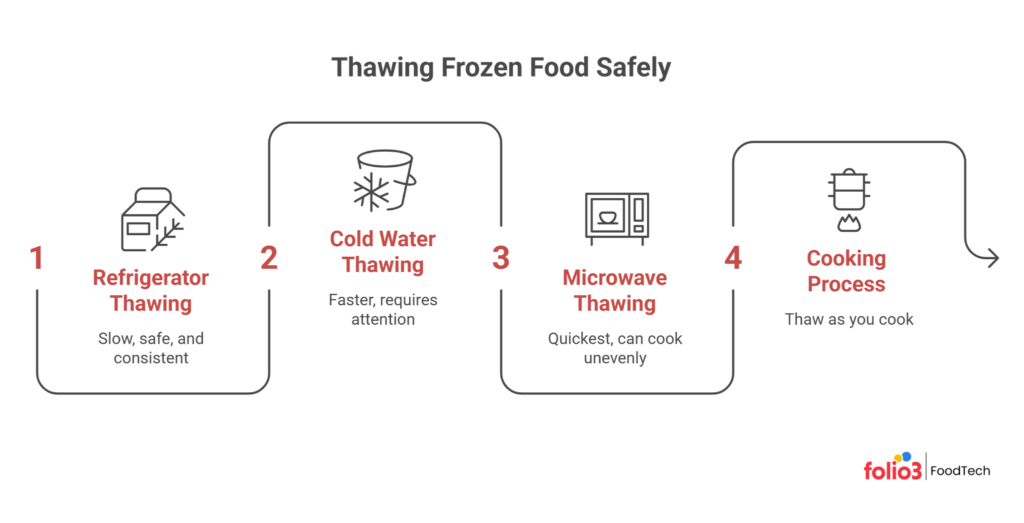
Food safety agencies including the USDA and FDA recognize four approved methods of thawing frozen food. Each one keeps food out of the danger zone long enough to prevent pathogen growth, or moves it through that zone so quickly that bacteria do not have time to multiply.
1. Refrigerator Thawing
Thawing frozen food inside a refrigerator held at or below 40°F (4°C) is the safest and most widely recommended method. The product never enters the danger zone because the ambient temperature stays below it throughout the entire process.
This is the best method for large cuts of meat, whole poultry, and bulk frozen proteins. It requires planning. A large block of frozen beef may need 24 to 48 hours in refrigerated storage before it is ready for processing. But once thawed, the product can remain safely refrigerated for another day or two before cooking.
For commercial plants, refrigerator thawing usually means dedicated thawing coolers or controlled holding areas kept at consistent temperatures. Temperature logs are critical here. If a cooler cycles above 40°F during the night, you need to know about it.
One key advantage in commercial operations: a product thawed in refrigerated conditions can be refrozen if production plans change, without the same safety risk as other methods. Quality may degrade slightly, but safety is maintained as long as the product stays below 40°F throughout.
2. Cold Water Thawing
Thawing food in cold water is a faster option when refrigerator thawing is not practical for your production schedule. The product must be placed in a leak-proof, sealed package and fully submerged in potable cold water at 70°F (21°C) or below. The water must be changed every 30 minutes to maintain safe temperatures.
This method works well for mid-sized cuts and portioned seafood. Cold water conducts heat away from the surface far more efficiently than air, which is why it speeds up the process significantly compared to refrigerator thawing.
In commercial settings, plants sometimes use cold-water immersion tanks with continuous water flow and temperature controls. This is acceptable as long as water temperature is monitored and the product packaging remains intact throughout. Any breach in packaging means the water can directly contaminate the product.
Product thawed using cold water must be cooked immediately. It cannot be safely refrozen without cooking first because portions of the product likely passed through the danger zone during the process.
Thawing frozen food this way is a common approved method of thawing frozen food for seafood operations. It is faster than refrigerator thawing and fits high-throughput production cycles. For plants focused on seafood traceability and safety, cold water thawing with documented water change intervals is a standard HACCP control point.
3. Microwave Thawing
Thawing frozen food in a microwave using the defrost setting is one of the approved methods of thawing frozen food. In commercial contexts, this generally means industrial microwave thawing systems rather than household units. These systems are designed for consistent, controlled application of microwave energy across large volumes of product.
The limitation of microwave thawing is uneven heat distribution. Thin edges and irregular surfaces can start to cook while the center remains frozen. This is why food thawed using any microwave process must be moved directly into the cooking stage without delay.
In a commercial plant, microwave thawing is typically used for smaller batches, portion-controlled items, or products where speed matters more than uniformity. It is not suitable for large, dense cuts where even thawing is critical to product safety and quality.
4. As Part of the Cooking Process
Some frozen food products can bypass the thawing step entirely and go directly into cooking. This is an acceptable method for thin or small items where heat can penetrate evenly before the outer surface overcooks.
Burger patties, French fries, fish fillets, and certain breaded products are good examples. The heat from cooking reaches the center quickly enough that the product passes through the danger zone without stopping there long enough to be a risk.
This approach must be validated for each product type. You need to confirm that your cooking process reliably achieves the correct internal temperature throughout the product, even when it starts from a frozen state. Cooking times and temperatures will be different from those used for pre-thawed product. Your HACCP plan for meat processing should document this validation clearly.
Thawing Methods Comparison Table
| Method | Speed | Safety Level | When to Use |
| Refrigerator thawing | Slow (12–48 hrs) | Highest | Large cuts, advance planning |
| Cold water thawing | Moderate (1–4 hrs) | High (with controls) | Mid-sized items, faster turnaround |
| Microwave thawing | Fast (minutes) | High (if cooked immediately) | Small batches, portion items |
| Cook from frozen | Fastest | High (with validated process) | Thin or small items only |
What Is Never an Acceptable Method for Thawing Food
Just as important as knowing the approved methods is knowing what not to do. Several thawing practices are common but unsafe, and any of them can create serious liability for a commercial plant.
Counter or Room Temperature Thawing
Leaving frozen product on a prep table, dock, or counter to thaw at room temperature is never an acceptable method for thawing food. Room temperature sits squarely in the middle of the danger zone. As the outer layers warm, bacteria begin multiplying almost immediately. By the time a large cut feels thawed on the outside, the exterior may have already spent several hours in unsafe temperature territory.
This mistake is one of the most frequently cited contributing factors to foodborne illness outbreaks in commercial food settings, according to CDC outbreak investigation data. It is also one of the most common food sanitation and safety mistakes seen during facility audits.
Hot Water Thawing
Using hot water to speed up the thawing process creates a dangerous temperature gradient. The product’s outer surface quickly reaches temperatures that encourage bacterial growth while the interior stays frozen. This gives you the worst of both worlds: a warm exterior that has been in the danger zone and a cold interior that may still cook unevenly.
Hot water thawing is not an approved method of thawing frozen food under any regulatory framework.
Standing Water Without Temperature Control
Submerging a product in a sink of standing water that is not changed regularly is different from cold water thawing. As the water warms from contact with the product, its temperature rises into unsafe ranges. Without regular water changes or temperature monitoring, this method becomes unsafe quickly and cannot be relied on as a controlled thawing food procedure.
HACCP and Regulatory Requirements for Thawing Food Safely
Thawing food safely is not just best practice. It is a regulatory requirement for commercial plants operating under HACCP, FSMA, or USDA inspection programs.
Under a standard HACCP framework, thawing is typically identified as a step requiring control measures because it presents a biological hazard opportunity. Your HACCP plan should include the thawing method used for each product, the temperature parameters, time limits, monitoring frequency, corrective action procedures, and verification records.
The HACCP principles require you to identify every critical control point where a hazard can be prevented, eliminated, or reduced. Thawing is one of those points. If you are using cold water thawing, your plan should specify the maximum water temperature allowed, how often the water must be changed, who is responsible for checking it, and what happens if a batch falls outside those parameters.
Under FSMA, preventive controls for human food require that facilities implement and document processes that address known or reasonably foreseeable hazards. Thawing is clearly in scope. The FSMA compliance requirements include validation of your thawing procedure, meaning you must be able to demonstrate that your method actually achieves safe temperatures consistently.
USDA’s Food Safety and Inspection Service also addresses thawing in its guidelines for meat and poultry processing. Plants under USDA inspection must have written procedures and be prepared to demonstrate compliance during regulatory visits.
Building a Thawing Protocol for Your Commercial Plant
Having a thawing food policy on paper is not enough. You need a protocol that your team can follow consistently on every shift, with every product type.
Set Clear Temperature and Time Standards
Define the maximum allowable internal temperature at which thawed product can enter the next processing stage. Specify maximum time limits for each thawing method. For example, if you use cold water thawing, state that water temperature must stay at or below 70°F and must be changed every 30 minutes, and that the product must move to cooking within a defined window after thawing is complete.
Train Your Team
Everyone who handles the product during the thawing stage needs to understand why the controls exist, not just what they are. A worker who understands that bacteria double every 20 minutes in the danger zone is more likely to follow the water change schedule consistently than someone who sees it as an arbitrary rule. Investing in food safety culture at the floor level pays dividends during audits and incidents alike.
Monitor and Log Temperatures
Digital temperature logging systems make this easier than it used to be. Sensors in thawing coolers, probes in cold-water tanks, and automated alerts when thresholds are breached all reduce reliance on manual checks and human memory. Your food safety risk assessment should account for equipment failure scenarios and include corrective action steps when monitoring gaps occur.
Separate Thawing Areas from Ready-to-Eat Zones
Cross-contamination is a constant risk during thawing. Raw product releases juices as it thaws. Those juices can contain pathogens. Your plant layout should physically separate thawing areas from any zones where ready-to-eat products are handled, and your drains, surfaces, and equipment must be designed to prevent splash contamination.
The principles here align closely with how plants manage contamination in food processing facilities more broadly. Thawing is one of the higher-risk steps because it involves raw product at a temperature that is not fully controlled.
Document Everything
Every thaw cycle should generate a record: product type, batch size, method used, start and end temperatures, start and end times, and the name of the person responsible. These records serve two purposes. They give you the data to verify that your process is working, and they give auditors the evidence they need to confirm compliance during inspections.
Thawing Considerations for Specific Product Types
Meat and Poultry
Large cuts and whole carcasses require refrigerator thawing with enough lead time built into your production schedule. Rushed thawing of these products is one of the leading drivers of temperature abuse in meat processing. Your meat processing plant operations team should have clear handoff protocols so thawed product does not sit waiting for the next stage.
Seafood
Fish and shellfish thaw faster than meat due to their lower density and smaller size. Cold water thawing works well and is widely used in seafood processing. Seafood is also more sensitive to quality degradation from thawing, so temperature precision matters beyond just safety.
Produce and Vegetables
Many frozen vegetables are designed to cook from frozen and do not require a separate thawing step. Where thawing is needed, refrigerator thawing is preferred. Produce thawed at room temperature loses texture and nutritional value faster than meat, making controlled thawing both a safety and a quality issue.
Conclusion
Thawing food safely is one of the most critical and often underestimated steps in commercial food production. Getting it right requires more than following a general rule. It requires a documented process, trained personnel, temperature controls, and consistent monitoring.
The four approved methods of thawing frozen food, refrigerator thawing, cold water thawing, microwave thawing, and cooking from frozen, each have their place in a commercial operation. Choosing the right method for your product type, production volume, and throughput requirements is part of building a food safety system that actually works.
What should never be used is any method that leaves product sitting in the temperature danger zone for extended periods. Room temperature thawing, hot water, and unmonitored standing water are not acceptable methods for thawing food in a regulated commercial environment. The regulatory consequences are real, and the product liability exposure is significant.
The plants that manage thawing food well tend to manage their entire cold chain and food safety program well. It is one of those steps where discipline and documentation separate facilities that pass audits from those that scramble. Build the protocol, train the team, and log every cycle. That discipline will show up in your compliance record and your product quality.
FAQs
Which Is an Approved Method of Thawing Frozen Food in Commercial Plants?
The four approved methods are thawing in a refrigerator at or below 40°F, submerging sealed product in cold water changed every 30 minutes, using a microwave with immediate cooking afterward, and cooking directly from frozen for thin or small items with a validated process.
What Is the Proper Thawing Procedure for Frozen Food Under HACCP?
A proper thawing procedure under HACCP must identify the method used, specify temperature and time controls, assign monitoring responsibility, define corrective actions for deviations, and maintain records for verification and audit purposes.
What Method Is Appropriate for Thawing Food in High-Volume Processing?
For high-volume operations, refrigerator thawing in dedicated thaw coolers is the safest option. Cold water thawing with monitored immersion tanks is a faster alternative for certain product types. The right choice depends on your product, throughput, and how much lead time your production schedule allows.
What Are the Risks of Improper Thawing Food in a Food Plant?
Improper thawing food allows pathogenic bacteria to multiply in the temperature danger zone, increasing the risk of foodborne illness, product recalls, regulatory violations, and significant financial losses. It also degrades product quality through uneven thawing, drip loss, and texture breakdown.
Can Frozen Food Be Refrozen After Thawing in a Commercial Setting?
Product thawed in refrigerated conditions at or below 40°F can generally be refrozen safely, though some quality loss may occur. Product thawed using cold water or microwave methods must be cooked before refreezing. Any product that spent time in the temperature danger zone should not be refrozen without cooking first.
How Do You Monitor Thawing Food Temperature in a Processing Facility?
Calibrated thermometers and probes should be used to check internal temperatures at regular intervals. Dedicated thaw coolers should have automated temperature logging. Cold water immersion tanks should have thermometers and logged water change records. Digital monitoring systems with alert thresholds reduce reliance on manual checks and create an auditable record trail.


