

What is frozen food processing? It is the industrial method of preparing, treating, and rapidly freezing food products at a commercial scale to preserve their nutritional value, texture, and safety throughout the supply chain.
The frozen food industry is growing fast as the global market was valued at USD 531.46 billion in 2025 and is projected to reach USD 841.48 billion by 2033, growing at a CAGR of 6.0%. Consumers want convenience. Retailers want shelf-stable variety. And foodservice operators want consistency at scale.
But volume alone is not the challenge. The real pressure on your facility comes from balancing nutritional integrity, food safety compliance, and high throughput, all at once, without compromise.
This guide covers the full frozen food production process: the science behind it, the methods that define it, the plant operations that drive it, and the technology shaping where it goes next.
Understanding the Complete Frozen Food Manufacturing Process
The frozen food manufacturing process moves from raw material intake to packaged, frozen product. Every step connects to the next, and a gap in any one of them impacts quality and cost.
Here is how the full pipeline is structured:
Pre-Processing: Sorting, Washing, and Preparation
Before freezing begins, incoming raw materials go through preparation. How well this is done determines the quality ceiling for everything downstream.
Key steps at this stage:
- Sorting and grading: Separating damaged, undersized, or contaminated pieces before they enter the line
- Washing: Multi-stage water rinse cycles to remove soil, pesticide residue, and surface microbial load
- Size reduction and portioning: Uniform cutting ensures consistent freeze rates and accurate pack weights
- Pre-treatment: Blanching for vegetables, marinating for proteins, or coating for breaded products
Skipping or rushing any of these steps shows up later as clumping, texture loss, or food safety deviations.
Blanching and Thermal Treatment
Blanching is one of the most critical steps in the frozen food production process, particularly for vegetables and some fruits. It involves exposing the product to hot water or steam, typically between 70°C and 100°C, followed by rapid cooling.
The reason it cannot be skipped: naturally occurring enzymes like lipoxygenase and peroxidase remain active at freezing temperatures. Left untreated, they continue to degrade flavor, color, and texture inside the freezer. A blanched pea stays bright green and firm for months. An unblanched one turns grey and mushy within weeks.
For a broader look at how heat-based treatments protect product integrity, see our guide to thermal processing in the food industry.
The Core Freezing Stage
Once preparation is complete, the product enters the freezing stage. Speed is the objective.
Rapid freezing produces small ice crystals inside food cells. Small crystals cause minimal cellular damage. Slow freezing produces large crystals that rupture cell walls, leading to texture degradation, drip loss on thawing, and visible quality decline. The method you choose here has a direct line to your product’s eating quality and your customer’s repeat purchase behavior.
Advanced Frozen Food Processing Methods and Techniques
Different products require different frozen food processing techniques. Understanding the options and the trade-offs between them helps you match the right method to your product and production volume.
IQF (Individual Quick Freezing)
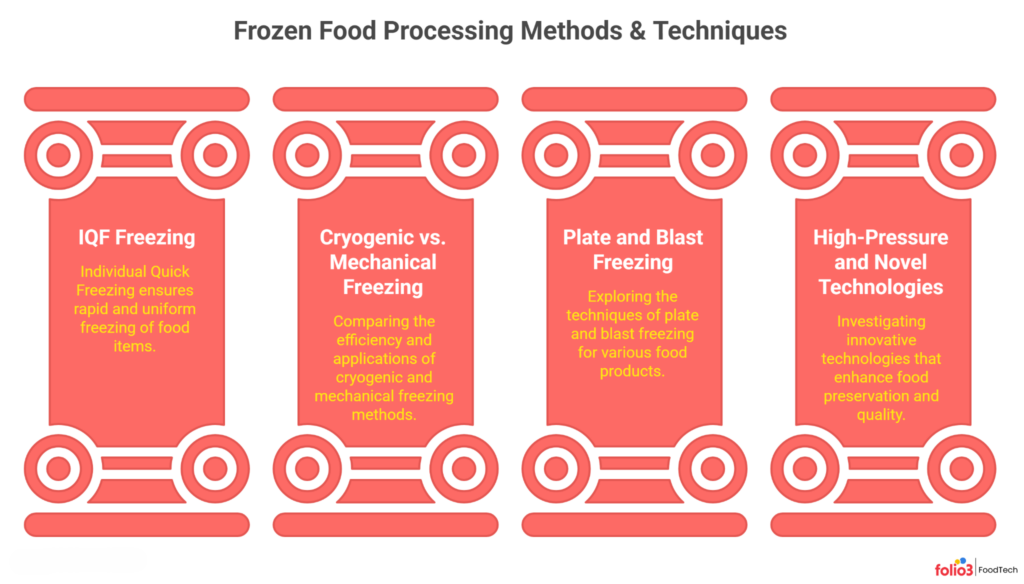
IQF is the gold standard for small, loose products. Peas, corn kernels, diced chicken, shrimp, blueberries, and sliced peppers are all typical IQF candidates.
The process works through fluidization. The product is loaded onto a mesh belt or vibrating conveyor. High-velocity cold air blasts upward from below, briefly suspending individual pieces so they separate and freeze independently, with no clumping.
Why it delivers ROI for your line:
- Portion-controlled dispensing reduces giveaway waste
- Loose-pack formats meet strong retail and foodservice demand
- Individual pieces can be weighed and bagged at speed on automated lines
- No block thawing required, reducing prep time in food service settings
Cryogenic Freezing vs. Mechanical Freezing
These two approaches represent the core technology divide in frozen food processing:
Cryogenic Freezing uses liquid nitrogen (LN₂) or liquid CO₂ to achieve surface temperatures as low as -196°C. It is best suited for fragile, premium, or small-batch products. Low capital entry but high ongoing cryogen costs.
Mechanical Freezing uses vapor compression refrigeration, typically ammonia or CO₂ cascade systems. Higher upfront cost but lower cost per unit over a high-volume production life.
| Factor | Cryogenic | Mechanical |
| Freezing Speed | Very fast | Moderate to fast |
| Capital Cost | Low | High |
| Operating Cost | High (cryogen) | Lower long-term |
| Footprint | Compact | Larger |
| Best For | Fragile or niche products | High-volume operations |
Plate Freezing and Blast Freezing
Plate freezing presses refrigerated metal plates directly against the product surface. Best for block products: fish fillets, minced meat, pureed fruit slabs, and seafood blocks. Excellent thermal contact, space-efficient, and produces clean block geometry for downstream cutting.
Blast freezing drives high-velocity cold air over products on static racks or conveyor systems. Versatile enough to handle irregular shapes, full meal trays, and a wide product mix. Learn how blast freezing technology is applied in commercial production environments.
High-Pressure and Novel Technologies
Emerging frozen food processing methods are pushing the boundaries of crystal control and freezing speed:
- High-Pressure Processing (HPP): Subjects the product to pressures up to 600 MPa during freezing, disrupting ice nucleation and forming smaller, more uniform crystals with less cellular damage
- Radio-Frequency Assisted Freezing: Electromagnetic energy generates uniform internal temperature gradients, accelerating freeze-through time
- Ultrasound-Assisted Freezing: Acoustic waves accelerate ice nucleation, reducing total freezing time while improving texture outcomes
These technologies are commercially scaling and represent where the next quality ceiling will be set in the industry.
Inside a Modern Frozen Food Processing Plant
A modern frozen food processing plant is only as good as how it runs day to day. Equipment capability means nothing if the production line process is generating bottlenecks and quality gaps.
This section helps you see your plant the way a consultant would: through the lens of flow, throughput, and preventable failure.
Optimizing the Frozen Food Production Line Process
Most losses in a frozen food production line process happen at handoff points: prep to freezer, freezer to packaging, packaging to dispatch. These transitions are where dwell time accumulates, temperature abuse starts, and throughput drops.
Practical optimization tactics:
- Align prep line output rates directly with freezer intake capacity to prevent buffer pileup
- Audit dwell times at every stage transition and target the longest gap for reduction
- Use continuous temperature data logging to catch thermal excursions before they become product loss events
For plant-wide strategies, see how leading facilities are increasing food processing efficiency. If you want to manage production scheduling, real-time inventory, cold chain monitoring, and compliance from one system, a purpose-built frozen food ERP gives your operations team the visibility to act on these issues before they become costly.
Material Handling and Conveying Systems
How the product moves between stages is as critical as the stages themselves. Frozen IQF shrimp or blanched broccoli can lose quality quickly through mechanical breakage on poorly chosen conveying systems.
Key options for frozen-environment conveying:
- Tubular drag-cable conveyors: Fully enclosed, gentle product movement that prevents breakage and eliminates cross-contamination risk between product runs
- Sanitary open-mesh belts: Ideal for high-moisture, post-wash environments; open construction supports airflow and continued cooling during transit
- Modular slat conveyors: Suited for heavier loads and packaged product movement in cold storage transition zones
All conveying systems in a frozen food plant must be rated for sub-zero temperatures, support CIP (clean-in-place) cleaning without disassembly, and handle product gently at line speed.
Production Line Troubleshooting Guide
| Common Issue | Root Cause | Plant Optimization Solution |
| Product clumping after IQF | Overcrowded belt, insufficient airflow | Reduce feed rate; increase belt speed or air velocity |
| Freezer burn on finished product | Air exposure before packaging; seal failure | Tighten packaging timing; inspect heat-seal integrity |
| Slow throughput | Bottleneck at prep-to-freezer handoff | Audit buffer zone; increase blancher or prep line output |
| Inconsistent core temperatures | Uneven sizing or belt overloading | Standardize portion size in the pre-processing stage |
| High energy consumption | Freezer door cycling; frost buildup | Enforce door discipline protocols; schedule defrost cycles |
Frozen Food Processing & Packaging: Sealing in the Quality
Packaging is the last line of defense for every quality attribute your processing line worked to preserve. The wrong material or a delayed seal can undo everything upstream.
The symbiotic relationship between freezing and packaging:
The moment the product exits the freezer, it is exposed to moisture loss, oxidation, and surface temperature rise. Time between freezer exit and final seal must be minimized. Every second of delay increases surface frost accumulation and the risk of condensation forming inside the package.
Packaging materials suited for extreme cold:
- Polyethylene (PE) films: Low-cost, moisture-resistant, widely used for vegetables, fruits, and bulk IQF formats
- Multi-layer laminate films: Combines EVOH, nylon, and PE layers to block oxygen and moisture simultaneously; used for premium products and extended shelf-life targets
- Polypropylene trays with lidding film: Chosen for ready meals and portioned products; compatible with microwave and oven reheating requirements
For products sensitive to oxidation, explore how vacuum packaging and modified atmosphere packaging (MAP) extend shelf life and protect appearance post-freeze.
Integration of automated weighing and bagging in cold environments:
- VFFS (Vertical Form-Fill-Seal) machines are the standard for high-speed bagging of loose frozen product, capable of packaging hundreds of bags per minute at consistent weights
- Multihead weighers running at -15°C to -20°C provide portion accuracy without manual handling in cold zones
- Standard-specification servos, sensors, and PLC systems often fail at freezing temperatures; always specify cold-rated components for any automated system operating below 0°C.
Frozen Food Processing Industry Standards and Food Safety
For QA managers, compliance is not an overhead function. It is the operational framework that protects your product integrity, your brand reputation, and your customers.
Regulatory requirements for frozen food processing plants center on two key frameworks: HACCP and FDA/USDA guidelines.
HACCP in freezing operations:
HACCP requires systematic identification and control of hazards at every point where they can occur or worsen. In a commercial freezing facility, the most critical control points include:
- Blanching time and temperature: Inadequate blanching is a biological hazard, CCP; under-process means active enzymes and potential pathogen survival
- Core product temperature post-freeze: Product must reach -18°C (0°F) or below before packaging, storage, or dispatch
- Metal detection and X-ray inspection: Physical hazard CCPs are placed between final processing and packaging to catch foreign material before the product is sealed
For a structured breakdown of how to build and apply HACCP controls, see our guide to HACCP principles.
FDA and USDA compliance guidelines for commercial freezing:
- FDA cGMP (21 CFR Part 110/117): Applies to all frozen food processing facilities; covers facility design, personnel hygiene, equipment sanitation, and process controls
- USDA FSIS: Governs frozen meat and poultry operations, with continuous or daily inspection requirements depending on product category
- FSMA Preventive Controls for Human Food: Requires documented food safety plans, including hazard analysis, preventive controls, monitoring procedures, and supply chain verification
Review our overview of food safety standards for manufacturers to assess where your facility stands against current requirements.
Maintaining Cold Chain Resilience
Temperature integrity from the plant floor to the end consumer cannot have gaps. A single break in the cold chain can make an entire shipment unsaleable and trigger a traceability investigation.
Key strategies to protect cold chain integrity:
- Real-time temperature monitoring: IoT-enabled sensors across blast freezers, cold stores, and transport vehicles that push automated alerts when thresholds are exceeded
- Standardized handoff SOPs: Documented procedures for every transition point, including loading docks, cold store staging areas, and dispatch zones
- Trained personnel at transition points: Most cold chain failures originate from human error, not equipment failure
- Backup contingency plans: Documented responses to compressor failure or power interruption, with defined acceptable hold times at elevated temperatures
For a complete logistics view, see our guide to cold chain management.
The Future: Next-Gen Frozen Food Processing Technology
The frozen food processing technology landscape is shifting quickly. The facilities investing now are setting themselves up for a significant competitive gap within the next five years.
Where the investment is going:
- AI and IoT in blast freezers: Smart sensor networks adjust airflow, temperature, and belt speed in real time based on product load, energy pricing, and ambient conditions. Early adopters are reporting measurable reductions in both energy use and product variability.
- Energy-efficient refrigerants: HFC phase-outs under global regulatory frameworks are accelerating the adoption of natural refrigerant systems (NH₃/CO₂ cascade). These deliver both environmental compliance and lower long-term operating costs.
- Robotics and automation in cold storage: Autonomous mobile robots (AMRs) and automated storage and retrieval systems (ASRS) are replacing manual pallet handling in sub-zero environments, reducing injury risk and improving pick accuracy at scale.
- Predictive maintenance: Compressor and motor sensors detect failure signatures before breakdowns occur, protecting continuous cold chain integrity and preventing unplanned downtime.
- Sustainable packaging automation: Modern packaging lines are being built to accommodate recyclable, paper-based, and compostable film formats without sacrificing seal speed or integrity.
The convergence of AI in food manufacturing with advanced freezing systems is redefining what an optimized plant looks like.
Future-Proof Your Facility!
Mastering frozen food processing requires the right methods, tight plant operations, and uncompromising food safety standards. The brands leading this market combine operational discipline with forward-looking technology investment. Whether you are building a new line, optimizing an existing one, or closing compliance gaps, the time to act is now. Contact our foodtech consultants for a plant audit, or explore our frozen food processing system to start identifying the gaps in your current process.
FAQs
Does Freezing Destroy Nutrients in Food?
Not significantly when done correctly. Rapid freezing locks in nutrients close to their fresh-harvest levels. Studies show frozen vegetables can retain comparable or even higher vitamin content than fresh produce that has been stored for several days before consumption.
What Is the Difference Between IQF and Blast Freezing?
IQF freezes individual pieces separately through air fluidization, preventing clumping and preserving texture for loose products like peas, shrimp, and diced meats. Blast freezing circulates high-velocity cold air over larger volumes and handles full trays, irregular shapes, and higher product weights.
What Temperature Should Frozen Food Be Stored At?
Commercial frozen food must be stored at or below -18°C (0°F) to halt microbial activity and enzyme degradation. Any consistent temperature above this point accelerates quality loss and creates food safety risk across the cold chain.
How Do You Prevent Freezer Burn in Commercial Production?
Freezer burn happens when surface moisture migrates and evaporates from the product. Preventing it requires fast packaging after freezing, verified seal integrity, correct packaging barrier selection, and consistent storage temperatures with minimal fluctuation throughout the cold chain.
What Is the Role of Blanching Before Freezing?
Blanching deactivates naturally occurring enzymes that continue to degrade color, flavor, and texture even at freezing temperatures. Without it, vegetables develop off-flavors, discoloration, and poor texture within weeks of freezing, even under ideal storage conditions.


