

If you process, pack, or sell meat in the United States, you already know how complex USDA compliance can be and labeling is just one dimension of the broader compliance and operational pressures on meat processors in 2026. Labels need to satisfy regulators, satisfy shoppers, and do both at the same time. Miss a required field, and you risk a recall. Use the wrong claim, and you risk a fine. Get it right and you earn something more valuable: consumer trust and the premium pricing that comes with it.
This guide breaks down everything you need to know about meat labeling. From the mandatory USDA requirements on every package to the optional claims that can command higher shelf prices, you will find clear, actionable information whether you are a processor, retailer, or a consumer trying to make sense of what is on the package in front of you.
Why Meat Labeling Matters
Meat labels serve two purposes at once. They protect public health through regulatory compliance, and they communicate product value to the buyer.
The Stakes for Processors and Retailers
A mislabeled product is not just a paperwork problem. According to data published by the USDA’s Food Safety and Inspection Service (FSIS), 42 recalls totaling over 71 million pounds of product were issued in 2025 alone, with undeclared allergens ranking as the second leading cause. Misbranding-related issues trigger public health alerts that damage brand reputation overnight which is why recall management software that maps product to label and lot records is a core part of any processor’s risk reduction strategy.
The risks of getting labeling wrong include:
- Product recalls that remove inventory from shelves and generate negative press
- FSIS detentions and seizures of product found in commerce
- Loss of export approvals if labels deviate from destination country requirements
- Civil penalties for repeated or willful violations under the Federal Meat Inspection Act
The rewards of getting it right are just as real. Certified claims like “USDA Organic” or “Certified Humane” consistently support premium retail pricing. Transparent food labeling builds the kind of trust that turns first-time buyers into repeat customers. For processors dealing with tight margins, that price premium can make a direct difference to the bottom line.
The Anatomy of a Meat Food Label: Mandatory USDA Requirements
Every compliant meat food label must include specific elements required by federal law. Here is what the regulations demand and which agencies enforce them.
Who Oversees Meat Labeling?
The USDA’s Food Safety and Inspection Service (FSIS) regulates labels for meat, poultry, and egg products under the Federal Meat Inspection Act and the Poultry Products Inspection Act. Products with less than the threshold meat content may fall under FDA jurisdiction instead. The USDA Agricultural Marketing Service (AMS) separately handles voluntary grading and certain certification programs.
If you want a deeper look at how these agencies govern your facility, the USDA regulations for meat processing guide covers the compliance framework in detail.
Product Name and Standard of Identity
The product name on a meat food label must accurately reflect what is in the package. FSIS maintains approved standards of identity for many products. If your ground beef contains more than 30 percent fat by weight, for example, it cannot simply be labeled “ground beef.” The name must match the product’s composition, and any added ingredients must be reflected in the name or elsewhere on the label.
Inspection Legend and Establishment Number
Every FSIS-inspected product must carry the official inspection legend, which shows the round USDA mark and the establishment number. It is your proof of federal oversight and your primary tool for traceability. If a recall is ever needed, the establishment number is what allows FSIS and your team to trace the affected product back through the supply chain quickly. Strong lot traceability systems support this process and reduce the scope of any recall event.
Ingredient Statement and Allergens
Ingredients must be listed in descending order by weight. Ingredients that make up less than 2 percent of the product may be listed at the end in any order with the phrase “contains less than 2% of.” Generic terms like “spices” or “flavorings” are permitted under FSIS rules. Allergen disclosures, however, are never optional. The nine major food allergens, including milk, eggs, fish, wheat, and soy, must be declared clearly. Undeclared allergens are one of the top triggers for FSIS recalls, making this one of the highest-risk areas on the label. For a thorough breakdown, the guide to managing food allergens is worth reviewing.
Net Weight or Quantity Statement
The net weight statement must appear on the principal display panel (the front of the package), in the lower 30 percent of the label, and in both metric and U.S. customary units for most retail products. FSIS and USDA’s Weights and Measures regulations allow a small variation, but a consistently underweight product can trigger enforcement action.
Address Line and Safe Handling Instructions
The label must identify the manufacturer, packer, or distributor with a full street address, city, state, and ZIP code. Additionally, all raw or not fully cooked meat and poultry products must include safe handling instructions. These typically include directives like “Keep Refrigerated,” “Keep Frozen,” and steps for safe cooking and storage. These instructions are not boilerplate. They are a legal requirement under 9 CFR 317.2(l).
Nutrition Facts and Exemptions
Nutrition panels are required on most retail meat products. Single-ingredient raw meat and poultry products may qualify for a voluntary nutrition labeling exemption if the retailer provides point-of-sale nutrition information. Multi-ingredient products and any product making a nutrient claim always require a full Nutrition Facts panel listing calories, fat, sodium, protein, and other mandatory nutrients.
Decoding Optional Claims and Certifications for Labeled Meat
Not all label claims are created equal. Some are tightly regulated, others are third-party certified, and some are largely marketing terms with minimal oversight.
Animal Raising and Diet Claims
- Grass Fed: The FSIS has withdrawn its official grass-fed standard, which means the term is not federally defined for labeling purposes. Products may use the claim with supporting documentation, but unless the label says “100% Grass Fed,” some grain finishing may still be permitted.
- Grain Fed: Not a regulated term. Used informally to describe conventionally raised cattle.
- Free Range / Free Roaming: Applies to poultry only under FSIS guidelines. It requires that birds have access to the outdoors but does not define the amount, duration, or quality of that access.
- Pasture Raised: Not formally defined by FSIS, but may be approved on a case-by-case basis with supporting documentation.
- Organic: Defined and certified under the USDA National Organic Program. Requires organic feed, no antibiotics or synthetic hormones, and outdoor access. Third-party certification is mandatory.
Health and Ingredient Claims
- No Antibiotics Added / Raised Without Antibiotics: FSIS-approved with documentation showing the animal was never administered antibiotics. “Antibiotic Free” is technically inaccurate because trace amounts can occur naturally, and FSIS generally does not approve that exact phrasing.
- No Hormones Administered: Acceptable for beef with supporting documentation. For pork and poultry, the claim must be followed by a statement such as “Federal regulations prohibit the use of hormones in pork,” because hormones are already banned in those species by law.
- Natural: Defined by FSIS as minimally processed with no artificial ingredients or added colors. It says nothing about how the animal was raised. Many processors use it, but savvy consumers are increasingly aware of its limitations.
Cultural and Religious Labels
- Kosher: Meat prepared according to Jewish dietary law under the supervision of a recognized rabbinical authority. FSIS allows the claim when backed by documentation from a certifying agency.
- Halal: Meat prepared in accordance with Islamic law. FSIS requires written documentation from a recognized Islamic authority certifying that the production practices meet halal requirements.
Geographic and Origin Claims
The USDA’s updated “Product of USA” rule, which took effect in 2024, requires that products bearing that label must be derived from animals born, raised, slaughtered, and processed entirely in the United States. Imported livestock processed domestically no longer qualifies. State-specific origin claims follow similar documentation requirements. Processors using these claims need detailed records of animal origin at every stage of the supply chain.
Certification Programs and Third-Party Labels
Third-party certifications add a layer of credibility that in-house claims cannot match. Key programs include:
| Certification | Administered By | Focus |
| USDA Prime | USDA AMS | Beef quality grading |
| Certified Organic | USDA NOP | Feed, practices, outdoor access |
| American Grassfed Certified | American Grassfed Association | 100% grass diet, no antibiotics/hormones |
| Animal Welfare Approved | A Greener World | Pasture-based, high welfare standards |
| Certified Humane | HFAC | Humane animal treatment throughout life |
| Non-GMO Project Verified | Non-GMO Project | Feed and ingredients free of GMOs |
For a broader overview of what certifications mean across food categories, the food and beverage certifications guide breaks them down clearly. For beef specifically, the beef grading guide explains how USDA grades affect pricing and buyer expectations.
Marketing Terms vs. Regulated Claims
Some terms appear on packages but carry little regulatory weight. Watch out for:
- “Humanely Raised” without a third-party certification
- “Hormone Free” (all living organisms contain naturally occurring hormones; the claim is technically inaccurate)
- “GMO Free” (not an FSIS-recognized term; look for Non-GMO Project Verified instead)
- “Cage Free” on chicken meat (cage restrictions apply to egg-laying hens, not meat chickens)
- “All Natural” (does not address how the animal was raised, fed, or treated)
When you see these terms without a recognizable third-party certification logo, treat them as marketing rather than verified claims.
How to Design Effective and Compliant Meat Labels
Getting the compliance right is one thing. Designing a label that also communicates value to buyers takes additional planning.
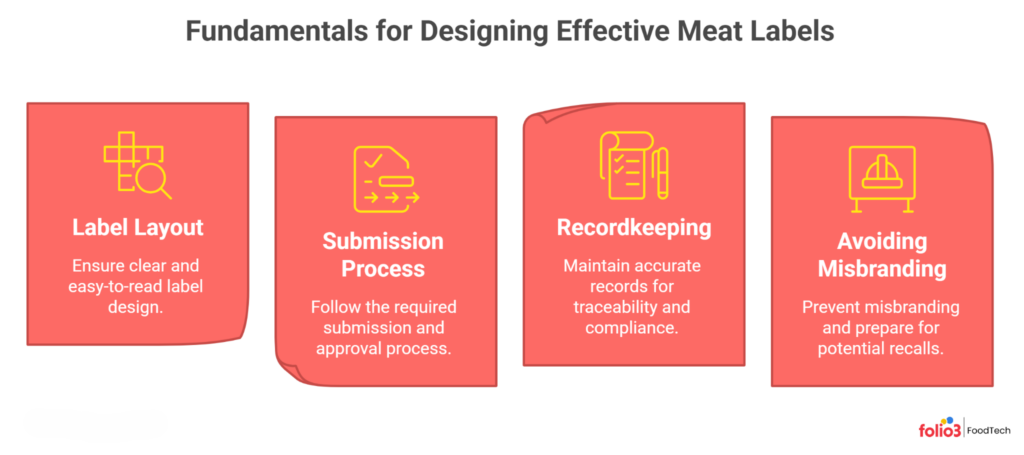
Label Layout and Readability
Every meat food label has two main panels. The principal display panel (PDP) is the main face of the package that consumers see first. It must include the product name and net weight statement in the lower 30 percent. The information panel, typically the right side of the PDP, carries the nutrition facts, ingredient list, allergen statement, and address line. Font sizes must meet FSIS minimums. Cramming required elements into illegible type is a common misbranding trigger during inspections QA systems for label inspection and non-conformance tracking help catch these issues before product leaves the facility.
Submission and Approval Process
Not all meat labels require prior FSIS approval. Most labels can be used without pre-submission under a “generic approval” process if they comply with all applicable regulations. However, labels with special statements or claims, temporary approvals, religious exemptions, or those intended for export must be submitted through FSIS’s Label Submission and Approval System (LSAS). Knowing when submission is required saves you from costly post-production label changes.
Recordkeeping and Traceability
Every label claim you make needs documentation to back it up. This includes animal origin records, feed documentation for diet claims, third-party audit reports for certifications, and allergen control records. The 2024 “Product of USA” rule raised the documentation bar significantly for origin claims. Digital traceability systems linking label claims to production records make retrieval faster and audit preparation less stressful. Food barcodes and digital traceability systems can help automate this process across the supply chain.
Avoiding Misbranding and Preparing for Recalls
Misbranding covers any false, misleading, or missing information on a label. FSIS can detain and seize misbranded products without notice. To reduce your risk:
- Verify every claim against current FSIS regulations before printing
- Train production and QA staff on labeling requirements at least annually
- Maintain a recall plan that maps every product to its label version and distribution records
- Conduct regular internal label audits
The ground beef recall guide is a useful reference for understanding how recall events unfold and what documentation FSIS expects. More broadly, a solid food recall management strategy is your safety net when things go wrong.
Meat Label Example Based on a Real-World Scenario
Seeing the rules applied to a real product makes them easier to internalize.
Retail Packaging vs. Wholesale Meat Tags
Consider a retail package of Premium Grass-Fed Ribeye Steak. Here is what a compliant label would include:
Principal Display Panel:
- Product name: “Beef Ribeye Steak, Grass-Fed”
- Net weight: “1.2 LB (544g)” in the lower 30% of the panel
- Certification logo: American Grassfed Association seal
Information Panel:
- USDA inspection legend with establishment number (e.g., EST. 1234)
- Ingredient statement: “Beef”
- Allergen statement: “Contains no major allergens”
- Nutrition Facts panel
- Safe handling instructions: “Keep Refrigerated. Cook to an internal temperature of 145°F.”
- Manufacturer address: Full street address, city, state, ZIP
Wholesale Meat Tags serve a different purpose. A carcass or primal cut tag is dense with functional data: USDA grade stamp, establishment number, date of production, lot code, primal cut designation, and net weight. There is no consumer-facing marketing language. The tag’s job is traceability and accountability through the supply chain, not brand communication. The data it carries is what connects the retail package back to the specific animal, processing date, and inspection record.
The contrast shows why labels are not one-size-fits-all. Retail packaging sells. Wholesale meat tags trace. This distinction extends further when you consider how secondary outputs are classified and labeled through the supply chain, where byproduct streams carry their own documentation and compliance requirements.
Future Trends in Meat Labeling
The regulatory and consumer landscape for meat labeling continues to shift. Here is where things are heading.
- QR Codes and Digital Labels: More processors are linking packaging to digital product passports via QR codes. Consumers can scan a code and access the full supply chain story, from farm to shelf. FSIS has been exploring digital labeling options as part of a broader modernization effort.
- Blockchain-Based Traceability: Distributed ledger technology is gaining traction for verifying origin and custody claims without relying on a single party’s records. Blockchain food traceability is moving from pilot programs into real-world deployments among larger processors.
- Sustainability Labels: Consumer interest in carbon footprint, regenerative agriculture, and water use disclosures is growing. While no mandatory federal standard for sustainability claims exists yet, voluntary frameworks are emerging. Processors who start building the data infrastructure now will be better positioned when these become market expectations or regulatory requirements.
- Expanded Country of Origin Rules: Following the 2024 “Product of USA” update, further tightening of origin claim standards is likely as trade policy and consumer demand for domestic sourcing continue to align.
For a broader view of where the industry is heading, the meat packaging industry trends article covers the packaging and technology side of this evolution.
Reading Meat Labels: A Quick Guide for Consumers and Retailers
You do not need to be a food scientist to read a meat label well. Here is what to focus on.
Where to look and what it means:
- Inspection legend: Confirms federal oversight. No legend means the product was not federally inspected.
- Product name: Should match what is actually in the package. Watch for added ingredients hidden in longer product names.
- Ingredient list: Shorter is usually simpler. Look for added water, phosphates, or sodium in what appears to be a single-ingredient product.
- Allergen statement: Critical for anyone with food sensitivities. Check even on products that seem unlikely to contain allergens.
- Date codes: “Sell By,” “Use By,” and “Best By” have different meanings. “Use By” is the most safety-relevant.
- Claims and certifications: Look for a recognized certification logo (USDA Organic, Certified Humane, etc.) rather than relying on unverified marketing language.
- Safe handling instructions: Follow them. They exist because raw meat can carry pathogens even when handled correctly at the plant.
When in doubt, the presence of a third-party certification logo is the fastest shortcut to a verified claim.
Conclusion and Key Takeaways
Meat labeling is both a compliance obligation and a business opportunity. The mandatory elements protect consumers and enable traceability. The optional claims, when they are accurate and verified, give processors and retailers a tool for building trust and commanding better prices.
For meat processors, staying current with FSIS regulations is not optional. For retailers, understanding what the labels you stock actually mean protects your brand. For consumers, the label is your primary tool for knowing what you are buying.
The bottom line: Accurate, transparent meat labeling reduces recall risk, builds consumer loyalty, and positions your product for premium pricing in an increasingly label-literate market. A meat processing ERP connecting production data to labeling and distribution is how leading facilities streamline their labeling QA and compliance processes at scale. Contact our Foodtech consultants today to see how technology can simplify your labeling workflow from production to shelf.
FAQs
What Is the Difference Between “Natural” and “Organic” on a Meat Label?
“Natural” means minimal processing and no artificial ingredients or added colors, but it says nothing about how the animal was raised. “Organic” is a federally regulated term requiring certified organic feed, no antibiotics or synthetic hormones, and outdoor access. Always look for the USDA Organic seal.
Does “No Antibiotics Added” Mean the Meat Is Antibiotic-Free?
Not exactly. “No Antibiotics Added” or “Raised Without Antibiotics” means the animal was never given antibiotics during its lifetime, verified by producer documentation submitted to FSIS. “Antibiotic Free” is a phrase FSIS generally does not approve because trace levels can occur naturally.
What Does the Establishment Number on a Meat Package Tell You?
The establishment number inside the USDA inspection legend identifies the specific federally inspected facility where the product was produced. In a recall, this number is used to trace affected products back to a production date, lot, and location.
Is “Free Range” a Regulated Term for All Meat Products?
No. “Free Range” or “Free Roaming” is only defined by FSIS for poultry products. For beef, pork, or lamb, it is not a regulated claim. If you see it on non-poultry meat, look for a third-party certification to verify what outdoor access standard actually applies.
When Does a Meat Label Need Prior FSIS Approval?
Most labels do not require pre-approval and qualify for generic approval if they comply with all regulations. Labels that include special claims, religious certifications (kosher or halal), temporary approvals, or export deviations must be submitted through FSIS’s Label Submission and Approval System (LSAS) before use.
What Is the New “Product of USA” Rule and Who Does It Affect?
The updated rule, effective 2024, requires that meat labeled “Product of USA” must come from animals born, raised, slaughtered, and processed in the United States. Imported animals processed domestically no longer qualify. This affects processors who previously sourced imported livestock and used domestic processing to justify the claim.


