

The global food robotics market was valued at around USD 2.5 billion in 2022 and is projected to grow at a compound annual growth rate of nearly 12% through 2030. That kind of sustained growth does not happen by accident. It reflects a real and growing need across food manufacturing facilities to produce more, with fewer errors, under tighter safety regulations.
If you run a food processing operation, you already know the pressure. Labor is harder to find and more expensive than it was five years ago. Regulations around food safety and traceability keep getting stricter. And consumer demand for consistent, safe products is not going anywhere.
Robotics in food processing is helping facilities meet all three challenges at once. In this blog, you will learn how these systems work across different parts of the production line, which areas they are having the biggest impact, what challenges you need to plan for, and how to think about integrating automation with the systems you already have.
What Robotics in Food Processing Actually Means
Robotics in food processing covers a wide range of automated systems used across the production line. This includes everything from robotic arms that handle raw materials to vision-guided systems that inspect finished products before packaging.
These are not just expensive conveyor belts. Modern food processing robots use sensors, cameras, and AI-driven software to make real-time decisions. They can identify a defective product, adjust their grip for a different package size, or flag a contamination risk without human intervention.
The core functions where robotics in food processing shows up most often include:
- Cutting, trimming, and portioning (especially in meat and seafood)
- Sorting and grading produce, dairy, and packaged goods
- Pick and place tasks for packaging and assembly
- Palletizing finished goods for warehouse storage or shipping
- Sanitation and cleaning in high-risk zones
- Quality inspection using computer vision
Across all of these, the goal is the same: reduce variability, reduce human error, and keep production running consistently.
Where Robotics in Food Processing Is Making the Biggest Difference
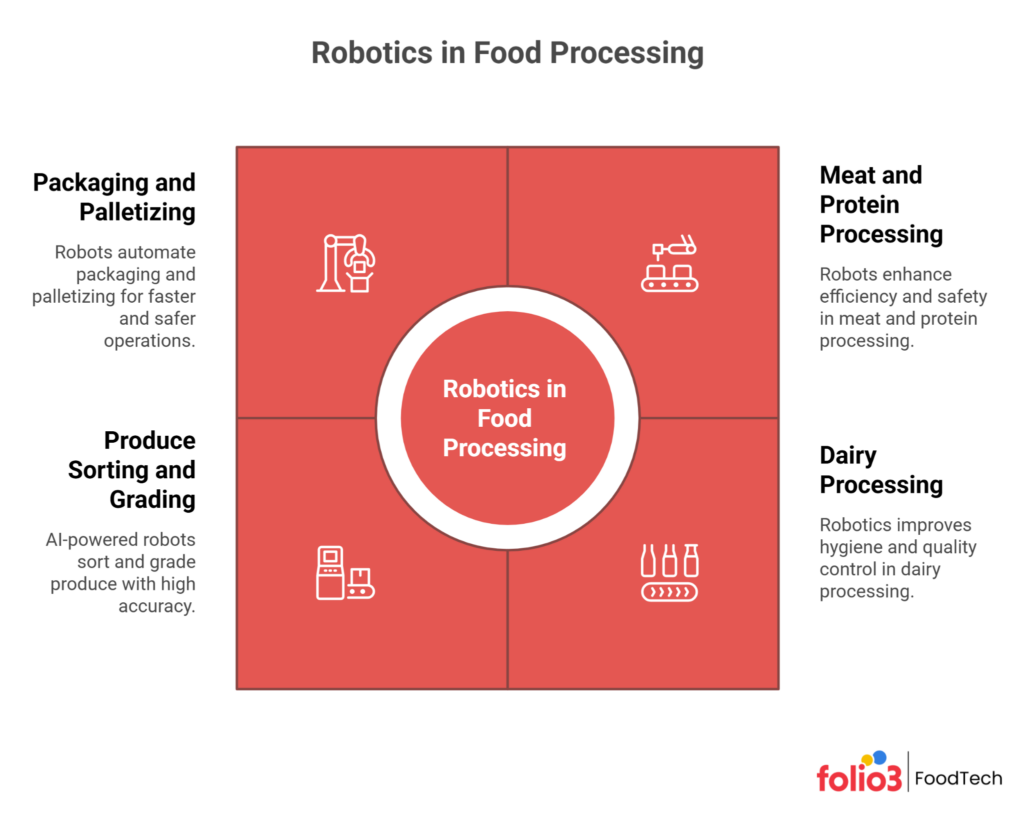
Meat and Protein Processing
Meat processing has historically been one of the most labor-intensive and hazardous segments of food manufacturing. Workers deal with sharp equipment, cold temperatures, repetitive strain, and constant contamination risks.
Robotics in food processing has changed the risk profile in this area significantly. Automated deboning systems, portion cutters, and trimming robots now handle some of the most physically demanding tasks on the line. These systems work in sub-zero environments without fatigue, and they produce more consistent cuts than manual workers can manage at volume.
If you are operating a meat processing facility, you are likely already dealing with the challenges outlined in resources like meat industry challenges and solutions. Robots help address several of those directly, particularly around yield consistency and labor dependency.
Dairy Processing
Dairy lines have been using automation for decades, but the level of precision available now through robotics in food processing is substantially higher. Robotic milking machines have been in use on large farms for years. On the processing side, automated systems handle curd cutting, cheese slicing, filling, and capping with a level of hygiene control that is difficult to match through manual work.
The dairy sector also benefits from robotic sanitation systems that clean and sanitize processing equipment between production runs. This matters a great deal when you are dealing with contamination risks in processing facilities and trying to stay ahead of pathogen control requirements.
Produce Sorting and Grading
For fresh produce, the speed and accuracy of robotic sorting systems is difficult to match through human inspection. Vision-guided robots can evaluate color, size, shape, and surface defects at rates that far exceed manual graders.
In high-volume operations, this kind of automated grading also feeds into traceability systems. Every item inspected can be logged with a timestamp and quality score, which becomes useful later if a recall or audit is triggered. The connection between robotic sorting and lot traceability in the food industry is something more operators are recognizing.
Packaging and Palletizing
Pick and place robots, case packers, and robotic palletizers are now standard in many mid-to-large food facilities. These systems handle final product packaging, carton assembly, and pallet building at speeds that manual teams cannot sustain consistently across a full shift.
Robotic palletizing in particular has become a well-documented productivity lever. If you have looked into automated palletizing in the food industry before, you know the labor savings on the back end of the production line can be substantial. The ROI on palletizing robots tends to be easier to calculate and faster to realize than some of the more complex upstream applications.
The Business Case: Why Food Manufacturers Are Investing Now
Labor Cost and Availability
Finding and retaining workers for repetitive, physically demanding food processing work is harder than it has ever been in most markets. Turnover is high, training costs are real, and some facilities simply cannot hire enough people to run at full capacity.
Robotics in food processing does not eliminate the need for human workers, but it does shift where those workers are needed. Skilled operators who monitor, maintain, and program robotic systems add more long-term value than workers doing purely repetitive tasks.
When you factor in how rising food costs affect your margins, the case for reducing labor dependency in your most repetitive processes gets stronger.
Food Safety and Compliance
Robots do not carry pathogens, do not skip sanitation steps when they are tired, and do not make contact-related contamination errors. In zones where cross-contamination risk is high, robotic systems offer a meaningful safety advantage.
Regulatory frameworks like FSMA, SQF, and HACCP place increasing demands on manufacturers to document control points throughout production. Robotic systems generate data automatically at each step, making it easier to satisfy food safety standards requirements and pass audits with confidence.
Consistency and Yield
A robot doing the same cut or fill operation 10,000 times produces the same result every time. Human workers, even skilled ones, introduce variability over long shifts. That variability affects yield, product weight, and customer satisfaction.
For manufacturers selling by weight or volume, even small improvements in portion consistency translate directly to reduced giveaway. The financial impact of robotics in food processing on yield control is often underestimated when calculating ROI.
Types of Robots Used in Food Processing
Not all robotic systems are the same. Knowing which type fits your operation matters before you start talking to vendors.
| Robot Type | Primary Use | Best For |
| Articulated robots | Multi-axis arm movement for cutting, trimming, assembly | Meat processing, complex assembly |
| Delta robots | High-speed pick and place | Packaging, confectionery, baked goods |
| Collaborative robots (cobots) | Work alongside humans safely | Mixed lines, smaller facilities |
| SCARA robots | Fast horizontal pick and place | Sorting, filling, inspection |
| Autonomous Mobile Robots (AMRs) | Internal transport and logistics | Warehouse movement, ingredient delivery |
| Vision-guided robots | Inspection, grading, defect detection | Produce, finished goods QC |
Articulated robots hold the largest share of deployments in food manufacturing today, primarily because of their versatility. Cobots are growing quickly in smaller operations where full automation is not practical or financially justifiable.
How AI and Robotics in Food Processing Work Together
The robots themselves are only part of the picture. What separates modern food processing automation from older mechanical systems is the software layer running behind it.
Machine vision systems allow robots to identify products, detect defects, and make real-time adjustments without stopping the line. Sensors feed data back continuously, which machine learning models use to optimize settings over time.
The growth of AI in the food and beverage industry is closely connected to what is happening with robotics. AI handles the decision-making layer while robots handle the physical work. Together, they create systems that can adapt to variation on the line without constant human oversight.
Predictive maintenance is another practical benefit. Robotic systems equipped with condition monitoring sensors can flag potential failures before they cause downtime, which matters significantly in a facility where stopping the line has immediate cost implications.
Integrating Robotics With Your ERP and Production Systems
One gap that often gets overlooked in robotics planning is data integration. A robotic system that operates in isolation is useful, but one that is connected to your production management and ERP platform is considerably more valuable.
When robotic systems feed data directly into your ERP, you get real-time visibility into production rates, quality control outcomes, and inventory consumption. This closes the loop between what your robots are doing on the floor and what your business needs to track for planning, compliance, and costing.
If your facility handles meat or protein, for example, a meat ERP software platform built for food manufacturing can capture yield data from automated cutting systems, track lot genealogy, and generate the compliance documentation you need for audits automatically. That kind of integration turns robotic automation from a production tool into a business intelligence asset.
This is also relevant when you look at the full scope of food processing methods across your facility. Different processing stages generate different data, and bringing that data together through an integrated system gives you the operational picture you need to make decisions.
Challenges to Plan For
Robotics in food processing is not without real-world limitations. If you are evaluating whether to invest, you need to plan for these honestly.
Upfront Capital Cost
Robotic systems require significant upfront investment. A single articulated robot arm with tooling, integration, and programming can cost anywhere from $50,000 to several hundred thousand dollars depending on complexity. For smaller operations, the ROI math does not always work.
That said, the rise of Robotics as a Service (RaaS) models is changing this calculation. Some vendors now offer robotic systems on a subscription or lease basis, which reduces the capital barrier and shifts the cost to an operating expense.
Integration Complexity
Installing a robot into an existing production line is rarely plug-and-play. Most food facilities have legacy equipment, irregular product sizes, and production schedules that do not accommodate extended downtime for integration work.
You need experienced integrators who understand both the mechanical side and the software connectivity requirements. Plan for longer timelines than your vendor will initially suggest.
Handling Irregular or Delicate Products
Robots excel at consistent, repeatable tasks with uniform products. They struggle with irregularly shaped items, products that vary significantly in size, or anything that requires the kind of intuitive handling a skilled human worker applies naturally.
Progress is being made on this front through advances in soft robotics and improved gripper technology, but it remains a real constraint in categories like fresh produce, artisan bakery, and certain seafood products.
Workforce Transition
Robotics in food processing changes job roles rather than simply eliminating them. Facilities that handle this transition well tend to retrain workers as robot operators, maintenance technicians, and quality data analysts. Those that do not plan for it face morale and retention issues that can undercut the benefits of automation.
What to Evaluate Before You Buy
If you are seriously considering robotics in food processing for your operation, work through these questions before talking to vendors:
- What is your production volume? Robotic systems make financial sense at medium to high volumes. Low-volume or highly customized production may not justify the cost.
- How much variability is in your products? High variability makes automation harder and more expensive. Standardized products are much easier to automate.
- Which bottlenecks cost you the most? Focus your first robotics investment on the part of the line where labor cost, throughput loss, or quality failures are highest. That is where ROI is fastest.
- What does your facility layout allow? Space constraints, ceiling height, and existing equipment placement all affect what you can install and where.
- Who will maintain the systems? Robots require scheduled maintenance and occasional technical support. Make sure you have either internal capability or a strong service agreement in place before you commit.
The Road Ahead for Robotics in Food Processing
The trajectory is clear. Robotics in food processing will continue to expand into more complex tasks as sensor technology, AI, and mechanical design improve. Systems that today can only handle straightforward tasks will within a few years be capable of handling more nuanced operations that currently require human judgment.
The operators who will gain the most are those who plan the integration thoughtfully, connect robotic systems to their broader production and business software, and build internal capability to manage and optimize automation over time.
This is not about replacing your workforce overnight. It is about making your facility more consistent, more safe, and more competitive in a market where margins are tight and expectations are high.
Conclusion
Robotics in food processing has moved well past the early adopter phase. Across meat, dairy, produce, and packaging, automated systems are helping manufacturers improve consistency, reduce contamination risk, and manage labor costs more effectively.
The key is not just buying robots. It is making sure those robots are connected to the right systems, maintained properly, and deployed where they will actually move the needle on your operation’s performance. Start with your highest-cost bottlenecks, plan your integration carefully, and build from there.
FAQs
What Is Robotics in Food Processing?
Robotics in food processing refers to the use of automated machines to perform tasks on the food production line. This includes cutting, sorting, packaging, palletizing, quality inspection, and sanitation. These systems use sensors, vision technology, and software to operate with high precision and consistency.
How Does Robotics in Food Processing Improve Food Safety?
Robotic systems reduce direct human contact with food during production, which lowers the risk of contamination. They also operate consistently without fatigue, follow programmed hygiene protocols, and generate data automatically for traceability and audit compliance.
What Types of Robots Are Used in Food Processing?
Common types include articulated robots, delta robots, collaborative robots (cobots), SCARA robots, autonomous mobile robots (AMRs), and vision-guided inspection systems. Each type suits different tasks depending on speed, precision, and product handling requirements.
Is Robotics in Food Processing Cost-Effective for Smaller Operations?
It depends on production volume and which tasks you are automating. Full robotic lines may not make financial sense at small scale, but targeted automation of specific bottlenecks can still deliver measurable ROI. Robotics as a Service (RaaS) models are making entry more accessible for smaller facilities.
What Are the Biggest Challenges With Robotics in Food Processing?
The main challenges are high upfront capital cost, integration complexity with existing equipment, limited ability to handle irregular or delicate products, and the need to retrain staff for new roles. Careful planning and phased implementation help manage all of these.
How Does Robotics in Food Processing Connect With ERP Systems?
Modern food processing robots can feed production data, quality outcomes, and yield figures directly into ERP platforms. This integration gives operators real-time visibility into their operations, supports compliance documentation, and connects production performance to business planning and cost management.
Which Food Sectors Are Adopting Robotics in Food Processing Most Aggressively?
Meat and poultry processing, dairy, packaged goods, and produce sorting have seen the highest adoption rates. These sectors share common traits: high production volumes, repetitive tasks, strict hygiene requirements, and significant labor cost exposure.


