
For many manufacturers, existing ERP systems still appear to be working. Production orders are processed, inventory moves through the facility, and financial reports are generated at month-end.
The challenge is that operational expectations have changed.
Retailers expect greater transparency across the supply chain. Multi-site operations need real-time visibility across production, inventory, quality, and distribution. At the same time, legacy ERP environments often rely on customizations, spreadsheets, disconnected systems, and aging infrastructure that become more difficult and expensive to maintain every year.
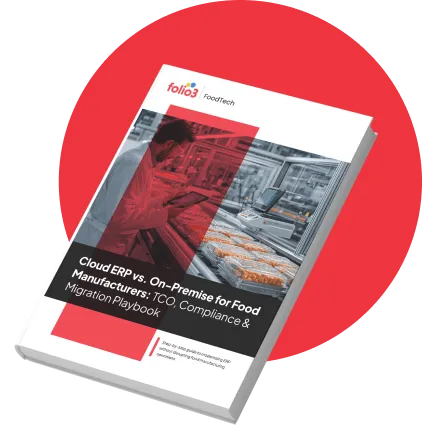
This guide provides a framework for evaluating those decisions with a clear understanding of both costs and consequences.
Food manufacturers are facing growing operational and compliance demands that older ERP environments were never designed to support. This section explores the factors driving modernization efforts, including traceability requirements, retailer mandates, reporting expectations, multi-site visibility challenges, and the increasing cost of maintaining legacy infrastructure.
Not every manufacturer should move entirely to the cloud, and not every on-premise environment should remain unchanged.
The guide examines the strengths, limitations, and operational implications of each deployment model, helping manufacturers understand where cloud, on-premise, and hybrid strategies fit within different business environments.
ERP costs extend far beyond licensing fees.
This section breaks down the financial realities often overlooked during ERP evaluations, including infrastructure investments, cybersecurity spending, disaster recovery planning, IT staffing, software upgrades, hardware refresh cycles, and ongoing maintenance costs.
The result is a more accurate understanding of the total cost of ownership across different ERP deployment models.
In food manufacturing, ERP downtime impacts more than reporting.
Production scheduling, inventory allocation, traceability records, shipping activities, and quality management processes often depend on ERP data being available when needed.
The guide explores the relationship between system availability, regulatory compliance, operational continuity, and business risk in high-volume manufacturing environments.
Modernizing ERP does not require a high-risk "rip and replace" approach.
Learn how leading manufacturers are using phased migration strategies, controlled pilots, staged rollouts, parallel operations, and structured change management programs to modernize systems while maintaining production continuity and minimizing operational disruption.
While cloud and on-premise discussions often focus on technology, the real decision involves operational realities that affect every department.
Traceability, audit readiness, lot genealogy, allergen controls, labeling accuracy, and retailer requirements continue to increase the burden on outdated systems.
Customizations, workarounds, unsupported software, and aging infrastructure create ongoing costs that are often hidden inside annual IT budgets.
System outages can impact production schedules, inventory visibility, shipping operations, and compliance activities, creating consequences that extend far beyond IT.
Maintaining secure, resilient infrastructure requires investments in monitoring, disaster recovery, backups, access controls, and threat response capabilities.
Many manufacturers still struggle to connect production, quality, inventory, procurement, and financial data into a single operational view.
As organizations expand into new facilities, product lines, markets, or business models, ERP systems must support growth without creating additional operational complexity.
This guide was developed for decision-makers responsible for technology, operations, compliance, and business performance across food manufacturing organizations.
Including:
Whether you're planning an ERP replacement, evaluating cloud readiness, or building a long-term modernization roadmap, this guide provides a practical framework for making informed decisions.
The cloud versus on-premise discussion is no longer simply a technology decision.
It influences compliance readiness, cybersecurity posture, operational resilience, reporting capabilities, scalability, and long-term business performance.
Download this guide to understand the true costs, risks, and opportunities associated with each ERP deployment model and build a modernization strategy aligned with your organization's operational reality.


