

Around 1.3 billion tons of food is wasted globally every year, much of it linked to poor handling, inefficient storage, and gaps in food quality control systems. For food businesses, this is not only an operational issue but a direct threat to profitability and long-term sustainability.
Food manufacturers today operate in a highly regulated and competitive environment where maintaining consistent product quality is non-negotiable. Any lapse in standards can lead to product recalls, financial losses, supply chain disruptions, and damage to brand credibility. This is where food quality control plays a central role. It ensures that products meet defined safety and quality benchmarks at every stage, from raw material sourcing to final distribution.
Alongside this, quality assurance frameworks establish preventive systems that reduce the risk of defects and contamination before they occur. Together, these processes form the foundation of a reliable and sustainable food operation. Effective food quality control not only protects consumers but also minimizes waste, improves efficiency, and supports compliance with industry regulations.
In this blog, we will examine how food quality control and assurance contribute to a sustainable food business, the differences between the two, and the practical steps companies can take to strengthen their quality systems.
Understanding Food Quality Control and Its Significance
The term “Food quality control” refers to the set of procedures that a business follows to ensure that the quality of the Food product manufactured is maintained or improved. Food quality control involves testing and inspecting products at different manufacturing stages to meet food safety standards and customer requirements.
It includes monitoring ingredients, storage conditions, processing methods, and packaging to prevent any potential contamination.
Importance of Quality Control
In the modern food industry, food quality control is not limited to inspection at the end of production. It is a continuous, system-driven process that influences every stage of the supply chain, from sourcing raw materials to final product distribution. As food businesses scale operations and expand into global markets, maintaining consistent quality becomes both more complex and more critical.
Effective food quality control helps businesses reduce waste, maintain product consistency, and ensure compliance with regulatory standards. It also plays a direct role in protecting brand reputation and building long-term consumer trust. Poor quality management can lead to recalls, financial losses, and operational inefficiencies, all of which impact sustainability.
Beyond compliance, Food quality control supports better resource utilization by minimizing errors, spoilage, and rework. This makes it a key driver not only of food safety but also of cost efficiency and responsible production practices.
The following points highlight why investing in strong quality control systems is essential for any food manufacturing business aiming for sustainable growth.
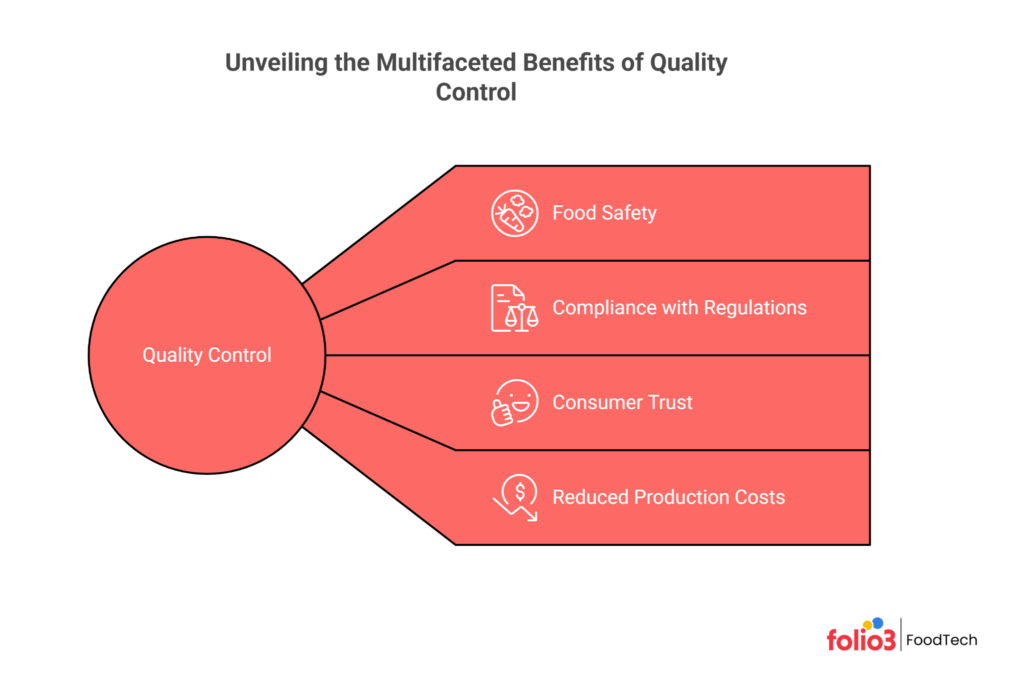
1. Food Safety:
Quality control in food industry helps identify food safety hazards, which can be of three types: physical, biological, and chemical. By applying the right food quality control procedures, businesses can identify defects and take action on time. If these steps are not taken, foodborne diseases might develop, harming consumers and damaging the company’s reputation.
2. Compliance with Regulations:
The food industry is heavily regulated by different government organizations operating in every country. For example, in the United States, the FDA sets quality standards for food businesses. Compliance with food safety standards is very important; otherwise, it could lead to monetary fines and penalties. Hence, food quality control measures involve the business complying with the regulations and standards set by food regulatory bodies.
3. Consumer Trust:
By maintaining food quality control measures, the products produced are consistent, and consumers receive high-quality products every time. This builds up brand loyalty in the consumer’s mind, and he trusts that he will get it of the same quality whenever he buys a food product from that brand.
Hence, delivering high-quality products consistently can help the brand retain its customers and build a loyal customer base. This could be a great competitive edge for any food company in today’s highly competitive market.
4. Reduced Production Costs:
Food quality control procedures can help identify defects early in the production process. This can reduce wastage and prevent low-quality products from entering the market. It can also help identify areas for process improvement, which can lead to production efficiency. Thus, implementing measures for quality control in food industry can ultimately lead to cost savings for the business.
Examples of Quality Control in the Food Industry
There are various food quality contol measures that companies operating in the food industry can take in order to maintain the quality standards of their products. Here are examples of some of the procedures to assure food quality:
Ingredient Specifications
If a company wants the final product it supplies in the market to meet quality standards, the first step is to get the right raw materials. Each ingredient used in the product should have proper specifications, including its source, purity, and any other requirements.
For example, a company that produces tomato sauce must specify the level of ripeness, acidity, and sugar content of tomatoes.
Approved Supplier List
Apart from ingredient specifications, the food business must have an approved list of suppliers from which it procures raw materials for production. The quality assurance and procurement team must work together to review and update the supplier list on a regular basis. The approved suppliers must meet specific quality standards and have proper certifications and documentation to ensure the safety of their products.
Product Formulation/Recipe
Once the right set of raw materials is on the table, the production team should formulate a product recipe. The primary purpose of having a recipe is to make sure that the product manufactured every time is of the same quality. The team needs to follow proper instructions, which include the recommended weights, batch size, and process time. The production team must document everything they do and in such cases a food recipe management software helps.
Manufacturing Procedures
Manufacturing procedures are documents with all the steps involved in the production process. Every bit of detail related to the production of food is documented. For example, a dairy plant has detailed procedures for pasteurization, homogenization, and milk packaging. These procedures include time and temperature controls to ensure the milk is free from harmful bacteria.
The documents should be easy to read, and every step must have a specific purpose. This is essential as it provides guidelines and instructions on consistently producing high-quality products in large quantities.
In-Process Records
In-process records, again, are documents that contain all the processing details of a product during its manufacturing. Recording details like batch size, process time, temperatures, product weights, etc., can help identify any issues that may arise later on. Moreover, having such details can help maintain the consistency of manufacturing products.
Labeling & Packaging
One of the most important components of food quality control is accurate food labeling and packaging. This is important for maintaining product quality and communicating the right information to the consumers about the ingredients, nutrition, and usage information.
For example, a juice company ensures each bottle has an accurate label with information about ingredients, allergens (if any), nutritional facts, and expiration date.
Technology Integration
Implementing advanced technological tools can enhance the food quality control process. IoT devices like sensors and scanners can monitor the production process in real-time and detect any issues or deviations from quality standards. Record-keeping software can also be connected to the devices to digitize data collection and perform analysis.
For example, Folio3 FoodTech food safety software can help companies maintain QC by digitizing food safety with automated HACCP plans and templates that can save up to 30% more time on food safety tasks.
Developing and Implementing an Effective Quality Control Program
So far, we have seen the importance of quality control in the food business and have gone through a few examples of quality control measures. To consolidate all these details, we will now have a look at the 5-step model of building a food quality control program that any business can implement:
Step 01: Create a Quality Control Plan
The first step is to create a QC plan. This plan should entail the specific quality standards that the company wants to meet, how it will do so, what tools and measures will be used, and who will be responsible for implementing them. It must also include details on materials and equipment used and their SOPs.
Step 02: Establish a System for Inspection and Testing
The next step is to build a quality management system for regular inspection. Everything in the production facility should be constantly monitored and tested, be it the raw materials, the equipment, or the product itself. Documentation must be done in order to review if everything is up to the QC standards.
For example, if a company uses raw milk, it must be tested daily for bacterial contamination, and the results should be documented to ensure it meets safety standards before processing.
Step 03: Conduct Regular Audits and Reviews
While daily checks are necessary, businesses should schedule periodic audits and reviews to verify compliance with QC procedures. The audit team can use checklists to review documentation, inspect processes, and interview employees. Any non-conformities or deviations from standard procedures must be reported, and corrective action must be taken.
For example, if an audit reveals improper cleaning practices, the business should implement revised protocols and training. This will also help the company prepare better for external audits.
Step 04: Establish a Customer Complaint Response System
The quality control program must also develop a system for handling customer complaints. Without this, quality control in food industry cannot be effectively performed. A process must be made to ensure these complaints are resolved on time and required action is taken promptly.
For example, if a consumer reports finding foreign objects in a packaged food item, the company should investigate and manage food recall for any affected products.
Step 05: Track and Analyze Product Quality Data
Last but not least, tracking product quality data is important to identify trends and make necessary changes in the production process. Companies can use data analytics tools to analyze the collected data, identify potential issues, and improve the overall QC program.
To perform this step in the best possible way, companies can use food safety software systems that help them avoid using paper-based forms and manual data entry. The software allows tasks to be monitored 24/7, and all compliance documents/checklists can be stored or updated digitally.
Quality Control vs. Quality Assurance: Major Differences and Challenges
Businesses often use quality control and quality assurance interchangeably, but it is important to understand the difference between them. Both quality control and quality assurance are part of quality management processes that businesses adopt in order to make sure the products they supply in the market are free of any contamination or hazards.
QC, however, is a subset of quality assurance. It is often regarded as a reactive process that identifies and corrects defects or deviations from standards during production. On the other hand, quality assurance is a proactive process that focuses on preventing issues before they occur.
Food quality assurance is a set of activities designed to ensure that a company’s processes are adequate for producing quality products. The first step in achieving QA in food processing is to have an effective Hazard and Critical Control Points (HACCP) plan.
This plan helps establish critical points to monitor the flow of food, identify potential hazards in the production process, and develop preventive measures to eliminate them. It is also important to have an Equipment Maintenance Plan that ensures all equipment is functioning correctly and safe for use.
Challenges of Maintaining High Standards of Quality Assurance and Quality Control
While we have discussed quality control and quality assurance in detail, managing these two processes is not quite easy. Companies face many challenges while maintaining food quality control and assurance. Here are some of the challenges discussed:
- Inconsistent Regulations: The food industry is highly regulated. However, these regulations differ from country to country. In such circumstances, a business operating globally might find it difficult to maintain QA and QC as per each country’s standards.
- Lack of Resources: Maintaining food quality assurance is a huge task that requires separate teams with specific expertise. However, not all businesses can afford to have such resources. Smaller companies may find it difficult to maintain quality standards because they often cannot afford to allocate resources for this.
- Cost Constraints: To have a proper quality control management system, companies need software solutions to maintain all the data and documentation in one place. However, implementing such systems can be expensive for some businesses, making it challenging to maintain high standards.
- Human Error: Despite having strict quality control measures and protocols in place, human error is inevitable. With the large amount of data that needs to be collected and monitored, it is common for employees to mistakenly enter incorrect information or miss critical points during inspections.
How Food Safety and Compliance Software Helps in Maintaining Quality Control
Food safety and compliance software, such as the one offered by Folio3 FoodTech, can help companies digitize their record-keeping process. This is the biggest pain point of companies operating in the food industry. Most inspection and QC teams use paper-based forms to review the production processes and perform audits.
To digitize this process, Folio3 FoodTech’s food safety and compliance software comes with features such as digital checklists, automated data collection and analysis, an online complaint management system, and HACCP plan templates. This helps companies maintain all the records in one place and ensures accurate data collection, which is essential for effective QC. Also, when external audit teams visit the food processing facility, the business can have all the necessary documents and checklists readily available for review, saving time and effort.
Conclusion
All in all, to achieve quality management success, food companies need to make sure that their production process is up to quality standards and that food safety and quality are not compromised at any level. High-quality raw materials must be used, everything happening during production must be documented, and food safety audits and reviews must be conducted to maintain quality standards.
Additionally, investing in food safety and compliance software can go a long way in ensuring an efficient and effective quality control process, which makes it easier for businesses to comply with regulations and ensure customer satisfaction. By following the steps discussed in this article, companies can establish an effective quality management system and mitigate potential risks associated with production.
FAQs
What Is Food Quality Control In The Food Industry?
Food quality control refers to the processes used to ensure that food products meet defined safety and quality standards. It involves inspecting raw materials, monitoring production, and verifying final products to prevent defects, contamination, and inconsistencies.
Why Is Food Quality Control Important For Sustainability?
Food quality control helps reduce waste, improve resource efficiency, and maintain consistent product standards. By minimizing errors and spoilage, it supports more sustainable production practices and reduces the environmental and financial impact of food loss.
What Is The Difference Between Quality Control And Quality Assurance In Food?
Quality control focuses on identifying defects in finished products, while quality assurance is a preventive approach that ensures processes are designed to avoid issues. Together, they strengthen food quality control systems and improve overall operational reliability.
How Does Food Quality Control Reduce Food Waste?
Effective food quality control identifies issues early in the production process, preventing large batches of defective products. It also ensures proper handling and storage, which reduces spoilage and extends shelf life.
What Are The Key Components Of A Food Quality Control System?
A strong food quality control system includes raw material inspection, process monitoring, hygiene standards, compliance checks, and final product testing. These components work together to maintain safety and consistency.
Can Small Food Businesses Benefit From Quality Control Systems?
Yes, even small businesses benefit from food quality control by improving consistency, reducing waste, and meeting regulatory requirements. It helps them scale operations while maintaining product quality and safety.


