

Every year, around 600 million people fall ill due to foodborne diseases, and approximately 420,000 people die globally as a result of unsafe food consumption (WHO). This scale alone makes one thing clear: food contamination is not an occasional problem, it is a systemic issue that affects every stage of the food supply chain, especially within processing environments where control should be strongest.
In food processing facilities, food contamination is one of the most critical operational risks because a single lapse in hygiene, equipment handling, or storage conditions can compromise entire production batches. Despite advancements in automation and safety protocols, food contamination continues to occur due to complex workflows, human error, and environmental exposure. This persistence makes it a constant concern for food safety teams and quality assurance departments.
The implications go far beyond the facility floor. Contaminated outputs can lead to severe health consequences for consumers, including foodborne illnesses that may require hospitalization. At the same time, businesses face regulatory penalties, product recalls, reputational damage, and significant financial losses. In highly competitive food markets, even a single contamination incident can erode consumer trust built over years.
This blog breaks down the common causes of food contamination in food processing facilities, helping you understand where risks originate and how they develop across operations. It will also explore contamination types, key hazard points, and the operational failures that typically lead to food contamination, giving you a structured view of how to identify and address these issues before they escalate.
Understanding Food Contamination
To effectively manage risks in food processing environments, it is essential to first understand what is actually meant by food contamination. In simple terms, food contamination refers to the presence of harmful substances or organisms in food that make it unsafe for consumption. These contaminants can be biological, chemical, or physical in nature, and they often enter the food system at multiple points during production and handling.
To answer ‘what is food contamination’, it is the unintended introduction of harmful agents into food that can compromise its safety, quality, or suitability for consumption. This can happen at any stage, from raw material sourcing to final packaging. Similarly, ‘what is contamination’ in a broader sense refers to the unwanted presence of impurities in any substance, whether in industrial systems, biological environments, or food production lines. In the context of food systems, contamination in food becomes particularly critical because even small traces of harmful agents can lead to large-scale health risks.
In food processing facilities, food contamination typically occurs during handling, processing, cutting, mixing, storage, or packaging. Poor hygiene practices, unclean equipment, and improper temperature control are some of the most common contributors. Cross-contact between raw and processed ingredients is another frequent source of contamination, especially when workflows are not properly separated or sanitized.
From a systems perspective, food contamination is not an isolated issue but a reflection of how well food safety hazards are managed within a facility. Strong control over food sanitation and safety practices plays a direct role in preventing contamination from occurring and spreading through production lines. When these controls fail, contamination becomes not just possible but predictable in high-volume processing environments.
Understanding these foundational concepts is critical before exploring the specific types and causes of contamination in food processing facilities.
Types of Contamination in Food Processing
In food production environments, food contamination does not occur in a single form. It appears in different categories, each with its own source, behavior, and level of risk. Understanding these distinctions is essential for controlling food contamination at scale and preventing it from spreading across processing lines.
To understand ‘what types of contamination can occur in food’, it is generally classified into three main categories: biological, chemical, and physical contamination. Each of these plays a different role in how food contamination develops within processing facilities, and each requires specific control measures to manage effectively.
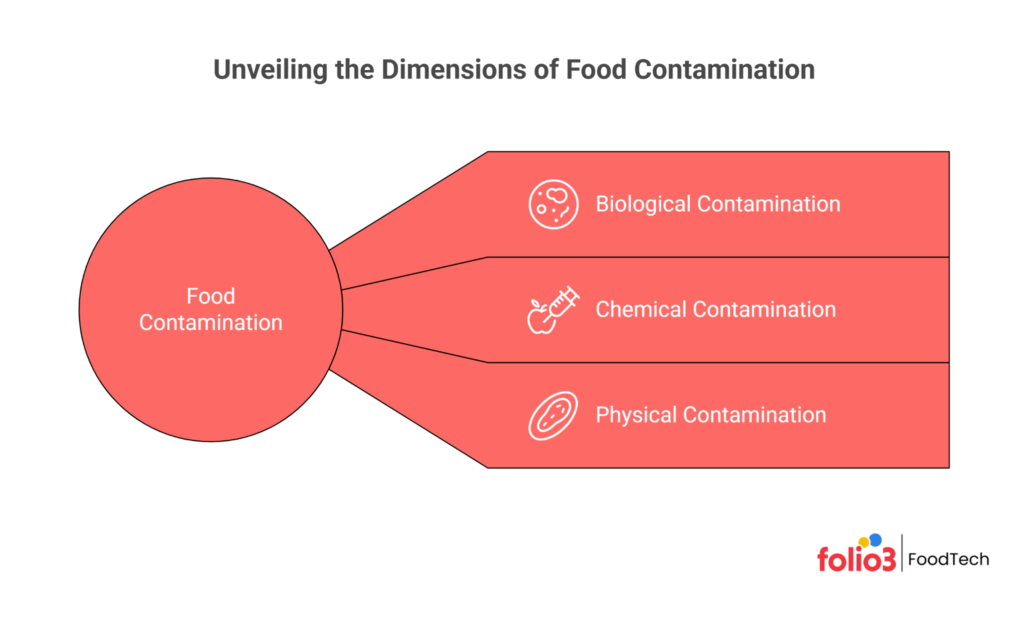
Three Types Of Food Contamination
The three types of food contamination are:
- Biological contamination
- Chemical contamination
- Physical contamination
These categories form the foundation of food safety systems and are central to how facilities identify and manage food contamination risks during production.
Biological Contamination
Biological contamination is the most common and often the most dangerous form of food contamination. It involves microorganisms such as bacteria, viruses, and parasites entering food products. In processing facilities, this typically occurs due to improper hygiene, contaminated surfaces, or exposure to raw materials.
For example, improper handling of raw meat contamination can introduce pathogens like Salmonella or E. coli into processing lines, which can then spread to finished products if sanitation controls fail.
Chemical Contamination
Chemical contamination occurs when harmful substances such as cleaning agents, pesticides, or industrial chemicals enter food products. In processing environments, food contamination of this type often results from improper storage of chemicals or incorrect use of sanitation materials near production lines.
Even small residues can lead to serious safety violations, making chemical control a critical part of operational compliance.
Physical Contamination
Physical contamination refers to foreign objects entering food during processing. This can include metal fragments, plastic pieces, glass, or packaging materials. Such food contamination is usually linked to equipment failure, poor maintenance, or human error during handling.
In large-scale facilities, even a minor equipment breakdown can lead to widespread product recalls if physical contaminants are not detected early.
Together, these three categories explain how food contamination manifests across different stages of food processing. Each type requires targeted prevention strategies to ensure safe and consistent production outcomes.
Contamination Hazards in Processing Facilities
In food production environments, a contamination hazard refers to any condition, practice, or source that increases the likelihood of food contamination. These hazards are not limited to one area of operations. Instead, they exist across equipment, people, and the environment, often interacting in ways that make food contamination harder to control once it begins.
Within processing facilities, understanding these risks is essential because even small oversights can escalate into large-scale safety failures.
Equipment-Based Risks
One of the most common sources of a contamination hazard comes from machinery and processing equipment.
- Poorly cleaned equipment can retain residues that contribute to food contamination
- Damaged or worn-out machinery may introduce metal or plastic fragments
- Improper calibration can lead to unsafe processing conditions
- Hard-to-reach components often become hidden contamination points
When equipment hygiene is not maintained, it becomes a direct driver of food contamination across production batches.
Environmental Hazards
The surrounding environment of a processing facility also plays a major role in contamination risk.
- Dust, moisture, and airborne particles can introduce food contamination
- Pest infestations create continuous contamination pressure
- Poor airflow or ventilation increases microbial growth risks
- Inadequate temperature control can accelerate spoilage and contamination
These environmental conditions often work silently, making them harder to detect until food contamination has already occurred.
Human-Related Hazards
Human activity is another major contributor to a contamination hazard.
- Poor hygiene practices such as unwashed hands or improper clothing
- Cross-contact between raw and processed materials
- Lack of training on sanitation protocols
- Mishandling of ingredients during transfer or packaging
In many facilities, human error remains one of the most unpredictable causes of food contamination.
Role Of Sanitation Failures In Food Contamination
Sanitation breakdowns are often the final trigger that allows hazards to turn into full contamination events. When cleaning schedules are inconsistent or improperly executed, residues and microbes accumulate across surfaces, equipment, and storage areas. This significantly increases the risk of food contamination, especially in high-volume production lines.
Strong systems designed to prevent biological hazards in food are essential at this stage. Without them, even minor sanitation failures can quickly escalate into widespread contamination incidents that affect entire production cycles.
Overall, contamination hazards are interconnected, and controlling them requires consistent monitoring across every stage of processing.
Common Causes Of Food Contamination In Facilities
In most processing environments, food contamination is rarely the result of a single failure. It is usually the outcome of multiple operational gaps that build up over time. Understanding these causes is essential for identifying weak points in production systems and preventing repeated food contamination events.
Poor Hygiene Practices And Cross-Contact
One of the most frequent drivers of food contamination is poor hygiene control across staff and workflows.
- Inadequate handwashing before handling materials
- Reuse of unclean tools between raw and processed food
- Improper protective clothing in production areas
- Cross-contact between allergenic and non-allergenic ingredients
These practices directly increase the likelihood of food contamination, especially in high-throughput facilities where multiple product lines operate simultaneously.
Equipment Failure And Maintenance Gaps
Processing equipment plays a central role in maintaining safety standards, but when maintenance is neglected, it becomes a major source of food contamination.
- Worn-out seals and joints trapping residues
- Infrequent cleaning of internal machinery components
- Calibration errors affecting processing accuracy
- Breakdown of metal detectors or safety sensors
Each of these issues can introduce contaminants into the production line and compromise batch integrity.
Environmental Exposure And Storage Issues
Environmental conditions and storage practices also contribute significantly to food contamination.
- Improper temperature control in storage areas
- Exposure to dust, moisture, or airborne particles
- Poorly sealed storage containers
- Pest access due to weak facility controls
When raw or processed materials are exposed to unstable environments, the risk of food contamination increases sharply across the supply chain.
Process Breakdown Points In Modern Facilities
Modern processing systems are designed to minimize risk, but food contamination still occurs when process controls break down.
Common breakdown points include:
- Inconsistent sanitation scheduling
- Lack of real-time monitoring systems
- Weak segregation between raw and finished goods
- Human error during automated system overrides
These breakdowns highlight deeper issues in food safety failures, often linked to weak food safety compliance or incomplete food safety risk assessment frameworks.
Ultimately, food contamination in facilities is rarely accidental in isolation. It is typically the result of multiple small failures aligning across hygiene, equipment, and environmental control systems.
Product Contamination And Characteristics
In food processing environments, food contamination becomes most critical when it reaches the final product stage. At this point, the issue is no longer theoretical or contained within systems, it directly impacts consumer safety, regulatory compliance, and brand integrity.
Product contamination refers to the presence of harmful biological, chemical, or physical agents in finished food items after processing. This form of food contamination typically indicates that earlier control points in the production chain have failed.
Once contamination reaches the final product, it becomes significantly harder to correct, often resulting in recalls, disposal of batches, or regulatory action.
Contaminated Food Characteristics
Understanding contaminated food characteristics is essential for early detection and quality control.
Common indicators include:
- Unusual odor or taste
- Discoloration or texture changes
- Presence of foreign particles
- Slimy or abnormal surface formation
- Unexpected spoilage before shelf life expiry
These characteristics often signal underlying food contamination, even when it is not immediately visible.
Visual, Chemical, And Biological Indicators
Contaminated products can be identified through different types of indicators:
- Visual indicators: mold growth, discoloration, or foreign objects
- Chemical indicators: abnormal pH levels, residue from cleaning agents, or off-flavors
- Biological indicators: microbial growth, including bacteria such as Listeria or Salmonella
Each of these indicators reflects a different pathway of food contamination, requiring specific detection and testing methods.
Impact On Product Quality And Compliance
Once food contamination affects finished goods, the consequences extend beyond safety concerns:
- Loss of product quality and shelf stability
- Regulatory non-compliance and audit failures
- Large-scale recalls and financial losses
- Damage to brand reputation and consumer trust
In many cases, even a single contaminated batch can trigger extensive compliance reviews across the entire facility.
High-risk products such as processed meats are particularly vulnerable, especially when dealing with meat contamination risks. Similarly, controlling microbial hazards is critical when focusing on preventing Listeria in food, as it is one of the most common causes of post-processing contamination.
Ultimately, product-level food contamination represents the final failure point in the production chain, where earlier weaknesses become fully visible and operationally costly.
Prevention And Control Measures
Preventing food contamination in processing facilities requires a structured approach that focuses on consistency, discipline, and continuous monitoring. Most incidents of food contamination are not sudden failures but the result of weak or inconsistent control systems that allow risks to accumulate over time. Effective prevention depends on combining hygiene, equipment management, and monitoring into a unified operational strategy.
Sanitation Protocols And Compliance Systems
Strong sanitation protocols form the backbone of any contamination prevention strategy. Facilities must maintain scheduled cleaning routines for equipment, surfaces, and storage areas to reduce the risk of food contamination. Compliance systems ensure that these protocols are consistently followed and properly documented during audits and inspections. Without structured sanitation enforcement, even well-designed processes can fail.
Employee Training And Hygiene Enforcement
Human handling remains one of the most common sources of food contamination. Proper training ensures that employees understand hygiene standards, cross-contact risks, and correct handling procedures. Enforcing strict hygiene rules such as handwashing, protective clothing, and restricted movement between raw and finished product zones significantly reduces contamination risks within the facility.
Equipment Cleaning And Maintenance Cycles
Processing equipment must be regularly cleaned and maintained to prevent buildup of residues and mechanical failures. Neglected machinery can quickly become a source of food contamination, especially in high-volume production environments. Scheduled maintenance cycles help identify worn components, reduce breakdown risks, and ensure consistent operational safety.
Monitoring Systems For Early Detection
Modern facilities rely on monitoring systems to detect contamination risks before they escalate. These systems track temperature, humidity, processing conditions, and hygiene compliance in real time. Early detection plays a critical role in minimizing food contamination incidents by allowing corrective actions before products are affected.
Together, these prevention strategies form a layered defense system. When properly implemented, they strengthen overall food safety practices and ensure effective food safety control across all stages of production, reducing the likelihood of contamination reaching final products.
How Folio3 FoodTech Helps Prevent Food Contamination in Processing Facilities
Managing food contamination in processing facilities requires more than manual checks and routine sanitation. It demands a connected system that can monitor, record, and control food safety risks in real time. Folio3 FoodTech supports this by centralizing food safety operations and giving processors better visibility across their entire workflow. This reduces gaps that often lead to food contamination and helps ensure consistent compliance across production lines.
Key features include:
- Real-time monitoring of critical control points to reduce food contamination risks
- Automated compliance tracking for food safety standards and audit readiness
- Centralized record-keeping for sanitation, inspections, and quality checks
- Traceability tools to quickly identify and isolate sources of food contamination
- Alert systems for deviations in temperature, hygiene, or process conditions
- Digital reporting to improve transparency and decision-making
By integrating these capabilities, facilities gain tighter control over operations and reduce the chances of contamination going undetected.
Ultimately, technology-driven oversight strengthens everyday food safety execution and helps processors maintain consistent control over food contamination risks before they escalate into larger operational or compliance issues. This sets the foundation for the final discussion on overall prevention strategies and key takeaways.
Conclusion
Food contamination in processing facilities is rarely the result of a single failure. As discussed throughout this blog, it typically emerges from a combination of factors, including poor hygiene practices, equipment failures, environmental exposure, and breakdowns in process control. Each stage of production carries its own risks, and when these risks are not properly managed, they can quickly escalate into serious safety and compliance issues.
This makes consistent monitoring and structured control systems essential. Regular sanitation, employee discipline, equipment maintenance, and real-time oversight all play a critical role in reducing the likelihood of contamination events and ensuring product integrity.
Ultimately, preventing food contamination is far more effective and less costly than addressing it after it occurs. Strong prevention systems not only protect consumers but also safeguard operational efficiency, regulatory compliance, and long-term business trust.
FAQs
What Are The 4 Types Of Food Contamination?
The four types of food contamination are biological, chemical, physical, and allergenic contamination. Biological contamination involves harmful microorganisms such as bacteria, viruses, and parasites. Chemical contamination occurs when food is exposed to cleaning agents, pesticides, or industrial chemicals. Physical contamination refers to foreign objects like metal, glass, or plastic entering food during processing. Allergenic contamination happens when allergen-free food is exposed to allergen-containing ingredients, posing serious risks to sensitive consumers.
What Is The Meaning Of Food Contamination?
Food can be contaminated in several ways, including poor personal hygiene of workers, cross-contamination between raw and processed foods, improper cleaning of equipment, exposure to contaminated water or air, and incorrect storage conditions such as inadequate temperature control. These failures can introduce harmful agents into food and increase the risk of foodborne illness.
What Is Cross Contamination In Food Processing?
Cross contamination is the transfer of harmful bacteria or substances from one surface, ingredient, or product to another. In food processing facilities, this often occurs when raw food comes into contact with cooked or ready-to-eat products, unclean equipment, or contaminated hands and tools. It is one of the leading causes of food contamination and is typically prevented through strict hygiene practices and proper workflow separation.
Why Is Food Contamination A Serious Concern In Food Processing Facilities?
Food contamination is a serious concern because it directly impacts consumer health, product safety, and regulatory compliance. Even small contamination incidents can lead to large-scale recalls, financial losses, and damage to brand reputation. In processing facilities, the risk is amplified due to high production volumes and complex workflows, making prevention and monitoring essential.


