

The global fruit juice market reached USD 165.4 billion in 2025 and is projected to hit USD 226.9 billion by 2034. That growth sounds exciting until you realize how much precision sits behind every bottle on the shelf.
Getting juice from raw fruit to a retail-ready product is not a simple squeeze operation. It involves controlled storage environments, enzymatic treatments, deaeration systems, pasteurization lines, and airtight packaging protocols. Every step either protects quality or kills it.
Whether you run a fruit juice processing plant, manage production for a beverage brand, or are building a facility from scratch, this guide walks you through the full process. You will learn every core stage, understand the engineering decisions behind them, and know what separates a tight operation from a costly one.
The Scale and Economics of Fruit Juices Manufacture
Understanding the economics of fruit juice manufacturing helps you make smarter production decisions. The format you choose affects your cost structure, distribution reach, and target market.
Commercial juice production runs in four primary formats:
- Not From Concentrate (NFC): Juice extracted and packaged without removing water. It carries a premium price and consumer appeal but requires cold-chain logistics and has a shorter shelf life.
- Concentrate (FC): Water is removed after extraction, reducing volume by up to 6:1. This slashes shipping and storage costs. The juice is reconstituted with water before sale.
- Puree: Common for thick fruits like mango, guava, or banana. Used in blended drinks, baby food, and dairy products.
- Clarified Juice: Filtered to remove all pulp and turbidity. Used in clear juice drinks, flavored water, and pharmaceutical applications.
The economic logic here is straightforward. Concentrate is cheaper to ship internationally because you move a fraction of the volume. NFC commands a 15 to 30% price premium in retail, driven by the clean-label, minimally processed perception. Your choice of format shapes everything downstream, from equipment selection to cold-chain investment.
Understanding how food processing methods translate to commercial ROI is critical before you commit to a production model.
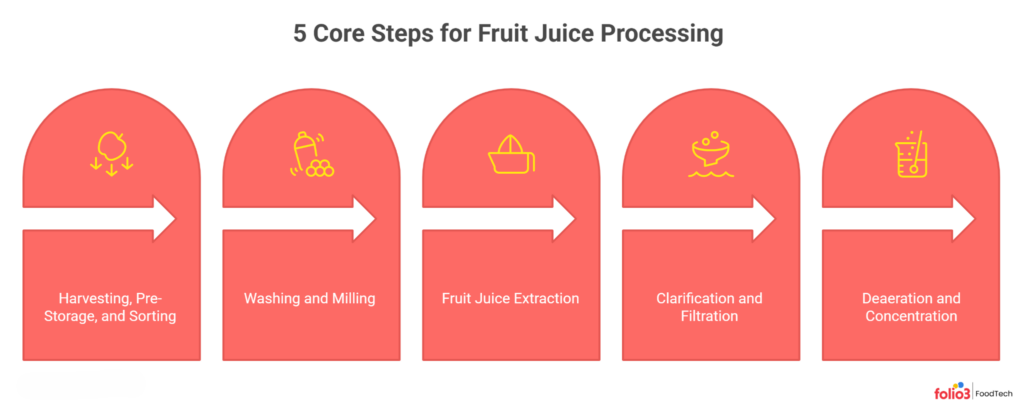
Core Fruit Juice Processing Steps
Each stage of the fruit juice processing line builds on the last. Skip one or do it poorly, and the quality issues compound quickly.
1. Harvesting, Pre-Storage, and Sorting
The quality of your juice is set before the fruit ever reaches your plant. Brix levels, acidity, and microbial load all depend on when and how the fruit was picked.
Post-harvest, most commercial operations use controlled atmosphere (CA) storage to extend the processing window. It means managing:
- Oxygen levels (typically reduced to 1 to 3%)
- Carbon dioxide (elevated to 1 to 5%)
- Ethylene (managed or scrubbed to slow ripening)
- Temperature (fruit-specific, usually 1 to 4°C for pome fruits)
CA storage lets you balance plant throughput against seasonal supply without compromising raw material quality.
Once intake begins, sorting is non-negotiable. Modern facilities use a combination of:
- Optical sorting machines that scan for color deviations, rot spots, and foreign objects using NIR and hyperspectral imaging
- Mechanical graders that remove undersized or overweight fruit
- Water flotation tanks that separate fruit by density
Substandard raw material entering your line is the single biggest avoidable cost in juice production.
2. Washing and Milling
Clean fruit means clean juice. It is your first contamination control point, and it needs to be taken seriously, given the range of food safety hazards that raw produce carries.
Washing typically involves:
- Flume washing: Fruit moves through water channels that remove soil, debris, and surface microbes
- Brush washers: Rotating brushes with water jets scrub firm-skinned fruit like apples and oranges
- Spray rinse: Final high-pressure rinse before milling
After washing, the fruit is milled or crushed. The equipment depends heavily on fruit type:
- Pome fruits (apple, pear): Hammer mills or centrifugal graters shred tissue to maximize juice release
- Citrus fruits: Cup-and-tube extractors or reamer-style machines separate juice from peel, preventing bitter limonin compounds from contaminating the juice
- Stone fruits and berries: Paddle crushers or screw presses break tissue without destroying seeds (which can release off-flavors)
Getting the milling stage right is about maximizing juice yield without releasing compounds that will damage flavor or color downstream.
3. Fruit Juice Extraction
After milling, you need to separate the juice from the pomace (skins, seeds, and fiber). Industrial extraction methods vary by scale and fruit type:
- Belt presses: Continuous and high-throughput. A mash layer is squeezed between porous belts under gradually increasing pressure. Ideal for high-volume apple and grape juice operations.
- Hydraulic rack-and-frame presses: Batch-based and used for premium or specialty juice production. Higher pressure and juice yield but slower cycle times.
- Citrus extractors (FMC-style): Cup-based systems that pierce and press the fruit simultaneously, separating juice and essential oils in a single pass.
A step that many operations skip or underfund is enzymatic pretreatment. Before pressing, adding pectinase enzymes to the mash breaks down pectin in the cell walls. It reduces viscosity, releases more intracellular juice, and can increase yield by 10 to 20% depending on the fruit. For high-pectin fruits like apples, guava, and mango, it makes a significant commercial difference. Yield management in food production is directly tied to how well you control this stage.
4. Clarification and Filtration
Raw extracted juice is cloudy. Whether you want a clear product or a stable cloudy juice depends on your product spec, but either way, you need controlled clarification.
For clear juice production, the process typically follows this sequence:
- Enzymatic treatment (pectinase/amylase): Breaks down residual pectin and starch, which would otherwise cause haze or gelation
- Centrifugation: High-speed centrifuges spin out coarse solids, pulp cells, and microbes
- Fining: Agents like bentonite or gelatin are added to bind fine particles and facilitate settling
- Membrane filtration: Microfiltration (0.1 to 1.0 micron) or ultrafiltration (0.01 to 0.1 micron) polishes the juice to near-crystal clarity
For stable cloudy juice (like NFC orange juice), the goal is different. You want to preserve natural turbidity from suspended pulp cells while removing only contaminants. Controlled centrifugation and light filtration achieve this without stripping the product of its fresh-juice character.
5. Deaeration and Concentration
Deaeration is often overlooked, but it is one of the most critical steps for product quality and shelf life. When juice leaves the press, it contains significant dissolved and entrained oxygen. That oxygen drives:
- Oxidative browning (color degradation)
- Vitamin C loss
- Off-flavor development
- Shorter shelf life
Deaerators remove oxygen by exposing the juice to vacuum conditions (typically 50 to 100 mbar) in a spray or film evaporator system. Proper deaeration at this stage protects everything downstream.
For concentrate production, the next step is water removal. Three main methods are used:
- Vacuum evaporation (most common): Heat is applied under reduced pressure, lowering the boiling point to around 40 to 60°C. This removes water while minimizing heat damage to flavor and nutrients.
- Reverse osmosis (RO): A membrane-based process that removes water without heat. Energy-efficient but limited in concentration ratio.
- Freeze concentration: Water is removed as ice crystals at low temperatures. Produces the highest-quality concentrate but is capital-intensive.
One critical step during evaporation is essence recovery. Volatile aromatic compounds (responsible for the “fresh” smell and taste) evaporate first. Modern plants capture these volatiles separately and add them back to the concentrate or NFC juice, maintaining flavor integrity.
Thermal Processing of Fruit Juice vs. Non-Thermal Alternatives
How you handle preservation determines your product’s shelf life, safety profile, and market positioning. The choice matters more than most operations realize.
Traditional Thermal Pasteurization
Thermal pasteurization remains the backbone of commercial juice safety. Two main systems are used:
HTST (High-Temperature Short-Time): Juice is heated to 72°C (161°F) for a minimum of 15 seconds, then flash-cooled. It deactivates enzymes like polyphenol oxidase (which causes browning) and kills pathogens, including E. coli O157:H7 and Salmonella. It is fast, energy-efficient, and suited for high-volume lines.
UHT (Ultra-High Temperature): Juice is heated to 135 to 150°C (275 to 302°F) for 2 to 4 seconds. UHT enables an ambient shelf life of 9 to 12 months for aseptically packaged juice without refrigeration. However, heat-sensitive vitamins and delicate flavor compounds can degrade.
To understand the broader context of thermal processing in the food industry and how it applies beyond juice, it is worth exploring the full range of techniques used commercially.
High-Pressure Processing (HPP) and Cold Pressing
HPP has become the gold standard for premium, clean-label juice. The process applies isostatic pressure of up to 600 MPa (approximately 87,000 psi or 6,000 bar) to sealed, pre-packaged juice. That pressure destroys the cell walls of pathogens and spoilage organisms without heat.
The result: a microbiologically safe product with a fresh flavor profile, vibrant color, and significantly better vitamin retention compared to pasteurized equivalents. Shelf life with refrigeration typically reaches 30 to 60 days for cold-pressed HPP juice.
The trade-off is capital cost. HPP systems require a significant upfront investment, which is why the technology is concentrated in premium NFC and functional juice segments.
Comparison: Thermal Pasteurization vs. HPP
| Parameter | HTST Pasteurization | UHT Processing | High-Pressure Processing |
| Shelf Life | 14 to 21 days (refrigerated) | 9 to 12 months (ambient) | 30 to 60 days (refrigerated) |
| Nutritional Retention | Moderate | Lower (heat-degraded) | High |
| Flavor Impact | Slight cooked note possible | Noticeable heat-altered flavor | Fresh, minimal impact |
| Capital Cost | Low to moderate | Moderate | High |
| Best For | Mainstream NFC, bulk production | Aseptic carton, export-grade | Premium cold-pressed, clean-label |
Understanding the full range of food pasteurization methods and their benefits helps you match the right technology to your product and margin requirements.
How to Set Up a Fruit Juice Processing Plant
Designing and running a fruit juice processing plant requires more than the right equipment. Facility design and quality control systems determine your compliance, uptime, and product consistency.
Hygienic Design and Automation
Your facility design must comply with food-grade hygienic engineering principles:
- 316L stainless steel for all product-contact surfaces: superior corrosion resistance against acidic juices
- CIP (Clean-in-Place) systems: Automated caustic and acid rinse cycles clean pipework and vessels without disassembly, critical for minimizing downtime and microbial risk
- PLC (Programmable Logic Controller) automation: Controls and monitors temperature, flow rates, pressure, and valve sequences in real time
- Sanitary fittings and sloped drainage: Prevents pooling and bacterial harbourage points in the processing environment
The right beverage ERP system integrated with your PLC infrastructure gives you real-time production data, batch traceability, and automated quality alerts.
Quality Control Specifications
Your QC program should routinely measure and log:
- Brix (°Bx): Measures dissolved sugars. The standard for reconstituted orange juice is 11.2 °Bx. Concentrates typically range from 60 to 70 °Bx.
- Brix/Acid Ratio: Critical for flavor balance. Codex Alimentarius sets the minimum Brix/acid ratio for single-strength citrus juices (e.g., 7:1 to 10:1 for orange depending on variety).
- Titratable Acidity: Usually expressed as % citric acid for citrus juices
- Microbiological limits: Total Plate Count (TPC), yeast, mold, and pathogen-specific testing
- Authenticity markers: AIJN Code of Practice compliance tests for added sugars, foreign juice adulteration, and isotope ratios (SNIF-NMR, IRMS)
Building a strong food quality control program from day one prevents costly recalls and regulatory action later.
Packaging, Storage, and Distribution
Packaging protects everything you invested in processing. The wrong choice can undo months of production planning.
The main packaging formats for juice each have distinct barrier properties:
- Glass: Best oxygen and light barrier. Premium perception. Heavy, fragile, and costly to ship.
- PET bottles: Lightweight, shatterproof, and dominant in retail. OxThe oxygenarrier is limited for long shelf-life products unless a multi-layer or coated PET is used.
- HDPE containers: Used mainly for refrigerated NFC juice in foodservice sizes. Lower oxygen barrier than glass.
- Composite aseptic cartons (Tetra Pak / SIG): Multi-layer structures (paperboard, aluminum, PE) provide excellent oxygen and light barrier for ambient UHT products. Dominant in concentrate-based and long-life juice markets.
For NFC juice, cold-chain integrity is non-negotiable. Refrigerated storage at 1 to 4°C is required from filling through to the retail shelf. Any cold-chain break accelerates microbial growth and enzymatic degradation. Solid cold chain management and logistics practices are essential.
Modified Atmosphere Packaging (MAP) extends shelf life for fresh-pressed or lightly processed juices by replacing headspace oxygen with nitrogen or CO2. Intelligent packaging innovations, including oxygen-scavenging labels and time-temperature indicators, are gaining traction in premium cold-pressed segments.
Concentrates, by contrast, are typically stored at -18°C in bulk aseptic bags or drums, enabling export without refrigerated shipping and providing supply chain flexibility.
Quality Control and Food Safety Compliance
Compliance is not a box-ticking exercise. A single failure can trigger a recall, a regulatory shutdown, or permanent brand damage.
Regulatory Frameworks
Two frameworks govern most commercial juice operations:
- HACCP (Hazard Analysis and Critical Control Points): Systematic identification and control of biological, chemical, and physical hazards at defined critical control points. The U.S. FDA’s juice HACCP regulation (21 CFR Part 120) mandates a 5-log reduction in the pertinent pathogen for all juice sold commercially.
- GMP (Good Manufacturing Practices): Cover facility hygiene, personnel practices, pest control, equipment maintenance, and record-keeping.
A thorough understanding of HACCP principles is foundational before building any juice compliance program.
Key Analytical Parameters
Your lab should be testing every production batch for:
- Brix, titratable acidity, and Brix/acid ratio
- pH (typically 3.0 to 4.5 for most fruit juices)
- Color (spectrophotometric measurement)
- Turbidity (NTU for clear juice)
- Microbial counts: TPC, yeast, mold, E. coli, and pathogens
Authenticity and Adulteration
Juice adulteration is a persistent commercial fraud. Sugar additions, dilution, and foreign juice substitution are tested using:
- SNIF-NMR (Site-specific Natural Isotopic Fractionation): Detects added beet or cane sugar
- IRMS (Isotope Ratio Mass Spectrometry): Identifies carbon isotope ratios inconsistent with the declared fruit source
- Flavor compound profiling: GC-MS analysis identifies off-notes from foreign juice sources
Alignment with the food safety standards that apply to your target markets, including Codex Alimentarius, FDA, and EU Directive 2001/112/EC, is mandatory for both domestic and export compliance.
Conclusion
Fruit juice processing is a technically demanding discipline. Every stage, from CA storage to HPP to aseptic filling, exists for a reason: to protect the quality and safety of a perishable product across a complex supply chain.
The industry is moving fast. Cold-pressed and functional juices are growing. Smart factories with real-time PLC data and integrated ERP systems are replacing manual processes. Sustainable packaging and clean-label formulations are reshaping product development pipelines.
If you want to build or upgrade a juice production operation that is efficient, compliant, and commercially competitive, the engineering and QA decisions you make now will define your margins for years. Want to discuss how technology can support your juice production goals? Contact our team for a consultation.
FAQs
What Is the Difference Between NFC and Reconstituted Juice?
NFC (Not From Concentrate) juice is extracted and packaged without removing water. Reconstituted juice is made from concentrate by adding back the water removed during evaporation. NFC carries a premium, but reconstituted juice is more cost-effective for large-scale production.
How Long Does Fruit Juice Processing Take from Intake to Filling?
For a standard HTST-pasteurized NFC line, total processing time from fruit intake to filled product typically runs 4 to 8 hours. Concentrate production takes longer due to the evaporation stage. HPP adds 3 to 6 minutes per batch at the filling stage.
What Causes Juice to Turn Brown During Processing?
Browning is mainly caused by polyphenol oxidase (PPO) activity when juice is exposed to oxygen. Proper deaeration, rapid thermal inactivation of PPO during pasteurization, and airtight packaging prevent browning and protect color stability throughout shelf life.
Is HPP Juice Safer Than Pasteurized Juice?
Both HPP and pasteurized juice meet the FDA’s required 5-log pathogen reduction when processed correctly. HPP achieves this without heat, which means better flavor and nutrient retention. However, HPP juice requires continuous refrigeration and has a shorter shelf life than UHT-pasteurized products.
What Brix Level Should Freshly Squeezed Orange Juice Have?
Freshly squeezed orange juice typically measures between 10 and 13 °Bx depending on variety, growing region, and harvest season. Codex Alimentarius sets a minimum Brix of 11.2 °Bx for single-strength orange juice for commercial compliance in most markets.
How Do You Test Juice for Adulteration?
Common adulteration detection methods include SNIF-NMR for added sugars, IRMS for carbon isotope profiling, and GC-MS for flavor compound analysis. These tests can identify undeclared sugar additions, dilution, and substitution with lower-cost foreign juices not matching the declared fruit source.


