

The global fruit juice market was valued at over $147 billion in 2023 and continues to grow as consumers pay closer attention to what goes into their drinks. With that growth comes higher scrutiny, stricter regulations, and a lower tolerance for product failures. One contaminated batch or a shelf life issue can cost you a recall, a compliance penalty, and customer trust that takes years to rebuild.
If you run or manage a fruit juice processing plant, you already know that quality does not happen by accident. It is the result of deliberate processes applied at every stage, from the fruit arriving at your facility to the sealed bottle leaving your warehouse.
This blog walks you through how quality control in fruit juice processing works in practice. You will find coverage of the key quality parameters, testing methods, sanitation requirements, HACCP application, regulatory standards, and the role of technology in keeping your operation consistent and compliant.
What Quality Control in Fruit Juice Processing Actually Means
Quality control in fruit juice processing is not just lab testing at the end of the line. It is a structured system of checks that runs throughout the entire production process, beginning with raw material sourcing and ending with finished product verification.
The goal is to ensure every batch meets your defined quality standards, including taste, appearance, nutritional value, microbial safety, and shelf life, consistently and without exception.
For plant managers and quality teams, this means monitoring specific parameters, documenting results, responding to deviations, and maintaining compliance with applicable food safety regulations. It also means building a culture where quality checks are not treated as optional steps that slow down production, but as built-in controls that protect both the consumer and the business.
Poor quality control in juice production translates directly into financial loss. Product recalls, regulatory fines, rejected export shipments, and brand damage all trace back to quality failures that a proper monitoring system would have caught early.
Key Quality Parameters to Monitor in Fruit Juice Production
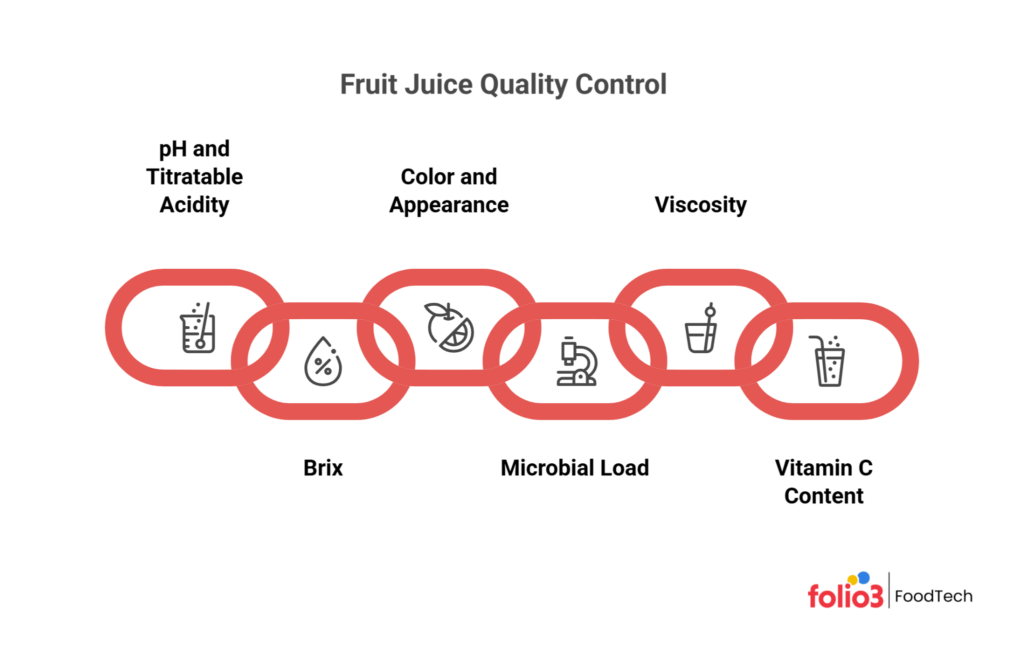
Effective quality control in fruit juice processing starts with knowing exactly what to measure. Each parameter below gives you a different window into the quality and safety of your product.
pH and Titratable Acidity
pH is one of the most fundamental quality control parameters in juice processing. Most fruit juices have a natural pH between 2.5 and 4.5, depending on the fruit type. This acidic environment inhibits the growth of many pathogens and contributes directly to taste and shelf life.
Titratable acidity measures the total acid content in the juice and gives a more complete picture than pH alone. You should be checking both at intake, during blending, and before packaging. A shift in either value during processing often signals a problem, whether that is raw material variability, equipment contamination, or a fermentation issue starting in your tanks.
Brix (Soluble Solids Content)
Brix measures the sugar concentration in the juice, expressed as a percentage. It is directly tied to taste, label claim compliance, and product consistency. If your orange juice is labeled at a certain sugar level or Brix range, your quality testing in fruit juice production needs to verify this before every batch ships.
Refractometers are commonly used on the line for quick Brix checks, while more precise laboratory-grade instruments are used for final verification.
Color and Appearance
Color is often the first thing a consumer judges. For clear juices, you want consistent transparency. For cloudy juices, uniform turbidity matters. Deviation in color can signal oxidation, heat damage, microbial activity, or inconsistent raw material quality.
Spectrophotometric analysis gives you objective color measurements that remove subjectivity from visual inspections. For high-volume operations, inline color sensors allow continuous monitoring without stopping production.
Microbial Load
Microbial testing is non-negotiable in juice production quality assurance. Common targets include total aerobic plate count, yeast and mold count, coliforms, and specific pathogens like E. coli and Salmonella. According to the FDA, unpasteurized juice must carry a warning label, and HACCP-regulated operations must demonstrate pathogen reduction of at least 5-log through their process (FDA Juice HACCP Regulation, 21 CFR Part 120).
Routine microbial testing at raw material intake, post-processing, and finished product stages is standard practice in any serious quality management in the fruit juice industry.
Viscosity
Viscosity matters particularly for nectars, pulpy juices, and concentrates. It affects mouthfeel, pourability, and whether the product behaves consistently through your filling equipment. Significant changes in viscosity between batches can indicate variations in pulp content, pectin levels, or processing temperature.
Vitamin C (Ascorbic Acid) Content
Vitamin C is heat-sensitive and degrades during processing and storage. For products making nutritional claims, you need to verify ascorbic acid levels at multiple points in the process. This is also a useful indirect marker for process quality, since high vitamin C retention generally indicates that oxidation and thermal degradation were well controlled.
Where Quality Control Applies in the Fruit Juice Processing Line
Quality control in fruit juice processing is not a single checkpoint. It is a series of controls applied at each critical stage of production.
Raw Material Inspection
Everything starts with the fruit. Incoming produce must be inspected for ripeness, physical damage, pest infestation, mold, and foreign matter. Overripe or damaged fruit introduces higher microbial loads and enzymatic activity, both of which create downstream quality problems.
You should also be testing for pesticide residues at intake, particularly for imported fruit. Pesticide contamination is one of the more common causes of food contamination in processing facilities and one that is often overlooked in plants that rely solely on supplier documentation.
Supplier verification programs, certificates of analysis, and periodic third-party testing of incoming raw materials are all part of a sound fruit juice quality control methods approach.
Washing and Sorting
The washing stage removes surface dirt, bacteria, and chemical residues. Water quality at this stage is critical. Chlorinated water or food-grade sanitizing agents are commonly used, but their concentration and contact time must be monitored and documented. Using water that is too lightly treated risks insufficient microbial reduction. Using concentrations that are too high can introduce chemical residues.
Sorting, whether done manually or by optical sorting equipment, removes defective or diseased fruit before it enters the extraction line. Any diseased fruit that gets through at this stage risks contaminating an entire batch.
Juice Extraction and Processing
Extraction methods, including pressing, centrifugal separation, and enzyme-assisted processing, each carry their own quality implications. Over-extraction can pull bitter compounds from peel and seeds into the juice. Inadequate pressing may result in lower yield without improving quality.
During extraction and blending, temperature, processing time, and oxygen exposure are the three variables most likely to cause quality loss. Heat accelerates enzymatic browning through the action of polyphenol oxidase, which converts natural phenolic compounds into brown-colored products. This is why many plants use a brief pre-heating or blanching step before extraction to deactivate these enzymes.
Oxygen contact drives oxidation reactions that degrade color, flavor, and vitamin C. Closed-system processing, inert gas blanketing, and minimizing air pockets in tanks and pipelines all reduce this risk.
Pasteurization
Pasteurization is the primary thermal treatment used in fruit juice safety and quality control to eliminate pathogens and extend shelf life. The most common methods are High-Temperature Short-Time (HTST) and Ultra-High Temperature (UHT) treatment. HTST typically operates at around 85 to 95°C for 15 to 30 seconds, while UHT exceeds 130°C for a few seconds, enabling ambient-temperature shelf life.
The challenge with pasteurization is balance. Under-processing leaves pathogens alive. Over-processing degrades flavor compounds, vitamin C, and color. Temperature and holding time must be validated during line setup and monitored continuously during production. Detailed coverage of how these methods work and where they apply is available in this overview of pasteurization methods and benefits.
Filling and Packaging
Packaging integrity is a final but critical layer of quality control in fruit juice processing. The packaging material must be food-grade, free from migration risks, and capable of protecting the juice from light, oxygen, and moisture. Glass, PET, cartons, and pouches all behave differently and require specific quality checks.
Seal integrity testing, headspace oxygen measurement, and fill weight verification should all be part of your finished goods quality protocol. A faulty seal does not just cause leakage. It allows oxygen ingress that accelerates spoilage and can permit microbial entry.
Enzymatic and Non-Enzymatic Browning: A Specific Challenge in Juice QC
Browning is one of the most visible quality defects in fruit juice and one of the more technically complex to control.
Enzymatic browning occurs when polyphenol oxidase (PPO) and other oxidoreductases react with phenolic compounds in the presence of oxygen. It is particularly problematic in apple, pear, and tropical fruit juices. The moment cell structure is disrupted during extraction, these enzymes activate. Speed matters here. The faster you process the fruit after crushing and the less oxygen exposure you allow, the lower the browning risk.
Non-enzymatic browning, also called the Maillard reaction, involves amino acids and reducing sugars reacting under heat. This tends to occur during pasteurization or concentrated storage if temperature and time are not precisely controlled. Sulfur dioxide treatment at low doses can inhibit this reaction, but its use is strictly regulated and must be declared on product labels.
Your industrial juice quality control process should include color monitoring at key points, specifically before and after pasteurization, to catch either type of browning early.
Applying HACCP to Juice Processing
HACCP (Hazard Analysis and Critical Control Points) is the internationally recognized framework for managing food safety hazards in processing operations. In the US, juice processors are legally required to follow HACCP under FDA 21 CFR Part 120. Many international markets and retail buyers also require HACCP certification.
For fruit juice, the typical critical control points (CCPs) identified in a HACCP plan include pasteurization (to address biological hazards), metal detection (physical hazard), and chemical treatment control at the washing stage. Each CCP needs defined critical limits, monitoring procedures, corrective actions, verification steps, and documentation.
Understanding the principles of HACCP in depth is essential for any quality manager in a juice plant. A plan that exists on paper but is not actively monitored and updated provides no real protection.
One area where many smaller processors fall short is verification. Running the line within critical limits is not enough. You need to periodically verify that your critical limits are actually sufficient through validation studies, third-party audits, and environmental monitoring.
Regulatory Standards Governing Juice Quality Control
Quality control in fruit juice processing does not happen in a vacuum. It happens within a framework of regulations and standards that your facility must meet to sell products legally and commercially.
Key standards relevant to fruit juice operations include:
- The FDA Juice HACCP rule (21 CFR Part 120) applies to juice processors in the US and requires a written HACCP plan, 5-log pathogen reduction verification, and specific labeling for unpasteurized juice.
- The Codex Alimentarius standards for fruit juices and nectars (Codex Stan 247-2005) set international benchmarks for identity, composition, and labeling that most export markets reference.
- ISO 22000 and FSSC 22000 are management system standards that many large retailers and food service buyers require as a condition of supply. They go beyond HACCP to cover the broader food safety management system, including prerequisite programs, internal audits, and management review.
A working understanding of applicable food safety standards gives your quality team the ability to prioritize compliance investments and prepare for audits before they happen.
Sanitation and Hygiene: The Foundation of Juice Quality
No quality control system functions without solid sanitation underneath it. Microbial contamination in juice processing most commonly originates from three sources: the raw fruit, the processing environment, and the equipment.
Cleaning in Place (CIP) Systems
CIP systems allow tanks, pipelines, and heat exchangers to be cleaned without disassembly. A well-designed CIP cycle uses a defined sequence of pre-rinse, caustic wash, water rinse, acid wash, and final sanitizing rinse at documented concentrations, temperatures, and contact times. Each parameter must be verified, not assumed.
Inadequate CIP is one of the most common root causes of recurring microbial failures in juice plants. If your microbial counts are inconsistent batch to batch with no obvious raw material explanation, your CIP system is the first place to investigate.
Equipment Design and Maintenance
Dead legs in pipework, gaskets that cannot be properly cleaned, and surfaces that allow pooling are all design issues that create harboring points for bacteria. Equipment specification and preventive maintenance schedules directly support your quality management in the fruit juice industry.
Any filling equipment that contacts the product after pasteurization is especially critical. Contamination introduced at the filling stage bypasses your primary kill step and goes directly into the finished product.
Personnel Hygiene
Worker hygiene is a basic but frequently underestimated risk in juice processing. Handwashing protocols, PPE use, illness reporting policies, and training on cross-contamination prevention all need to be documented and actively enforced. Periodic refresher training is not optional.
Food Testing Methods Used in Juice Quality Control
Fruit juice quality testing uses a combination of rapid on-line tests and more detailed laboratory analysis. Understanding which test to apply at which stage is part of building an efficient quality control system in the beverage industry.
Common testing methods include:
- Refractometry for Brix measurement, used inline or at lab benches for fast feedback during production.
- pH meters for acidity monitoring, calibrated before each use and verified against reference standards.
- Turbidity meters (nephelometers) for measuring clarity in clear juice products.
- HPLC (High-Performance Liquid Chromatography) for precise measurement of organic acids, sugars, vitamin C, and preservative levels.
- PCR-based pathogen detection for rapid microbial testing of Salmonella, E. coli O157:H7, and other pathogens is increasingly replacing traditional culture methods due to speed.
- Near Infrared (NIR) spectroscopy is increasingly used in large-scale operations for real-time compositional analysis without destroying the sample.
A deeper review of food testing methods and how they apply across different product types can help you decide which technologies fit your operation’s volume and risk profile.
Shelf Life Considerations in Juice Quality Assurance
Shelf life is the practical output of your entire quality control effort. If your quality control parameters in juice processing are well managed, you should be able to predict and consistently deliver the declared shelf life of your products.
Shelf life is influenced by pasteurization intensity, packaging barrier properties, storage temperature, and initial microbial load. For products making 12-month ambient shelf life claims, the entire thermal and packaging process must be validated through real-time and accelerated shelf life studies.
The most common causes of premature shelf life failure in juice products are insufficient pasteurization, compromised seal integrity, and post-process contamination at the filling stage. Understanding how to properly conduct shelf life testing and interpret results helps you set realistic specifications and catch process drift before it becomes a consumer complaint.
The Role of Technology in Modern Juice Quality Control
Technology is changing how quality control in fruit juice processing gets done. Manual paper-based systems make it difficult to catch trends, respond quickly to deviations, or demonstrate compliance in an audit.
Digital quality management systems let you capture test results in real time, set automated alerts when parameters go out of range, and maintain a searchable audit trail that regulators and buyers can review. They also make batch traceability significantly faster, which matters when you are dealing with a potential recall situation.
Many operations are also adopting inline sensors for continuous pH, Brix, color, and turbidity monitoring, replacing periodic grab samples with continuous data streams. This reduces the risk of releasing out-of-spec product between sampling intervals.
Food safety software built specifically for food and beverage operations gives quality teams visibility across the entire production process, from supplier documentation and incoming material results to in-process checks and finished goods release. For juice processors managing multiple product lines or operating across more than one facility, this kind of visibility is difficult to achieve with spreadsheets and paper forms.
Technology does not replace the need for trained, quality staff or sound process design, but it does make it far easier to maintain consistency, respond to problems faster, and demonstrate compliance with documented evidence. This is especially relevant as food quality control in businesses increasingly depends on data-driven decision-making rather than manual spot checks.
Automation also supports better compliance with the quality assurance in beverage processing standards that major retailers and export markets require, making it a business investment, not just a technical upgrade.
Ways to Prevent Quality Loss at Each Processing Stage
Here is a practical summary of quality loss prevention applied across the juice processing line:
| Processing Stage | Key Risk | Prevention Measure |
| Raw material intake | Pesticide residue, microbial load | Supplier QA programs, COA verification, periodic testing |
| Washing and sorting | Inadequate microbial reduction | Monitor sanitizer concentration and contact time |
| Extraction | Enzymatic browning, oxygen exposure | Pre-heat fruit, use closed-system processing |
| Pasteurization | Under/over-processing | Validate and continuously monitor time-temperature |
| Blending | Inconsistent Brix/acidity | Real-time Brix and pH checks, calibrated dosing |
| Filling and packaging | Post-process contamination, seal failure | Sterile filling zones, seal integrity testing |
| Storage and dispatch | Temperature abuse, physical damage | Cold chain compliance, packaging durability checks |
Using ways to maintain food and beverage quality as a complementary resource can help you identify gaps in your current quality assurance structure and prioritize corrective actions.
Conclusion
Quality control in fruit juice processing is a multi-stage discipline that spans raw material selection, process monitoring, microbial testing, packaging validation, and regulatory compliance. For your operation to produce consistently safe, on-spec juice, you need defined parameters with validated limits, documented testing protocols applied at every critical stage, a functioning HACCP plan, effective sanitation systems, and the technology to capture data and respond quickly when something drifts.
The cost of getting quality control wrong in juice production is real: recalls, regulatory action, lost customer contracts, and long-term brand damage. The cost of getting it right is a structured investment in the systems, training, and tools that protect every batch you produce.
If your current quality management approach relies heavily on end-of-line testing and manual documentation, it is worth reviewing whether that approach gives you enough visibility to catch problems before they become failures.
FAQs
What Are The Most Important Quality Control Parameters In Fruit Juice Processing?
The most critical parameters are pH, titratable acidity, Brix (sugar content), color, microbial load (total plate count, yeast, mold, and pathogens), and vitamin C content. Each parameter reflects a different aspect of product quality and safety. Together they determine whether a batch meets label specifications, regulatory requirements, and consumer expectations.
How Does HACCP Apply To Fruit Juice Production?
HACCP is legally required for juice processors in the US under FDA 21 CFR Part 120. It requires identifying all food safety hazards, defining critical control points (such as pasteurization), setting critical limits, and maintaining documented monitoring and corrective action records. The process must demonstrate at least a 5-log reduction of the most resistant relevant pathogen.
What Causes Browning In Fruit Juice And How Can It Be Prevented?
Browning can be enzymatic, caused by polyphenol oxidase reacting with oxygen after cell disruption during extraction, or non-enzymatic (Maillard reaction), caused by amino acids and sugars reacting under heat. Prevention includes minimizing oxygen contact during processing, pre-heating fruit to deactivate enzymes, controlling pasteurization time and temperature, and using food-grade antioxidants like ascorbic acid where permitted.
What Microbial Testing Is Required In A Juice Processing Plant?
Standard microbial testing includes total aerobic plate count, yeast and mold count, coliform testing, and pathogen-specific tests for organisms like Salmonella and E. coli O157:H7. Testing should be conducted at raw material intake, in-process at critical stages, finished product release, and environmental monitoring of the processing facility.
How Do You Validate Shelf Life For A Processed Fruit Juice?
Shelf life validation involves both real-time and accelerated stability studies. You test samples under controlled storage conditions, measuring microbial, chemical, and sensory parameters at defined intervals until the product fails to meet spec. Packaging integrity, pasteurization validation data, and initial microbial load results all feed into shelf life prediction. Claims on packaging must be supported by documented validation data.
What Role Does Packaging Play In Fruit Juice Quality Control?
Packaging protects the juice from oxygen, light, moisture, and microbial entry after processing. For ambient products, packaging barrier properties are a primary determinant of shelf life. Seal integrity, headspace oxygen levels, and fill weight verification are all part of final quality checks. Poor packaging can negate an otherwise well-controlled process by allowing post-pasteurization contamination or oxidative degradation.


