

If you process juice commercially in the U.S., compliance is not optional. An HACCP plan is your frontline defense against contamination, costly recalls, and FDA enforcement action.
A Juice HACCP plan is a documented food safety system that identifies potential hazards in juice production and establishes controls at specific steps to prevent, eliminate, or reduce those hazards to safe levels. It is required by federal law and forms the backbone of any responsible juice processing operation.
The stakes are real. A single contamination event can trigger a product recall, regulatory fines, and lasting damage to your brand. Whether you run a small cold-press operation or a large-scale bottling facility, understanding what the law requires and how to meet it is essential for staying in business.
Understanding the Juice HACCP Regulations
The FDA’s 21 CFR Part 120 requires every juice processor to implement a Hazard Analysis and Critical Control Point (HACCP) system. The regulation defines “juice” broadly to include liquids, purees, and concentrates extracted from fruits or vegetables. If your product falls under that definition, you are subject to the rule.
The Food Safety Modernization Act (FSMA) added a layer on top of these existing requirements. FSMA introduced preventive control requirements that complement the HACCP framework by requiring processors to proactively address food safety risks across their supply chain.
Key Requirements and Deadlines
Failure to comply with 21 CFR Part 120 renders your juice legally adulterated under federal law. That is not a technicality. It means your product can be seized, and your facility can face an injunction.
Key obligations include:
- All employees who perform HACCP activities must receive job-appropriate training, either through a recognized HACCP training program or supervised on-the-job experience.
- Records must be accessible for FDA inspection. Refrigerated juice records must be kept for at least one year. Frozen and shelf-stable product records must be maintained for two years.
- Untreated juices that have not achieved the required pathogen reduction must carry an FDA-mandated warning label at the point of sale.
Certain products are exempt from the pathogen reduction standard. Shelf-stable juices and low-acid canned juices processed to achieve commercial sterility are not subject to the 5-log reduction requirement.
The 5 Log Pathogen Reduction Standard
The FDA performance standard at the core of juice HACCP requires processors to achieve at least a 5-log (100,000-fold) reduction of the most resistant pathogen likely to occur in a specific juice. For apple juice, the target pathogen is E. coli O157:H7. For citrus juices, it is Salmonella.
This reduction must be achieved in a single facility. You cannot split processing steps across two sites and combine the log reductions to meet the standard. Citrus juice does have special provisions: surface-treated whole citrus fruits that are squeezed directly can meet the standard through the natural antimicrobial properties of the peel, combined with approved surface treatments, under specific conditions.
If your juice is sold fresh, refrigerated, or frozen, you need to validate your process to demonstrate it achieves the required log reduction. If it is shelf-stable or low-acid canned, the standard does not apply, but a warning label is required if the product has not undergone pathogen reduction.
The 7 Principles of a Juice HACCP Plan
HACCP is not a checklist. It is a science-based system designed to control hazards before they become costly problems. Each of the seven principles builds on the last.
For a deeper overview of the foundational framework, see our guide to HACCP principles explained.
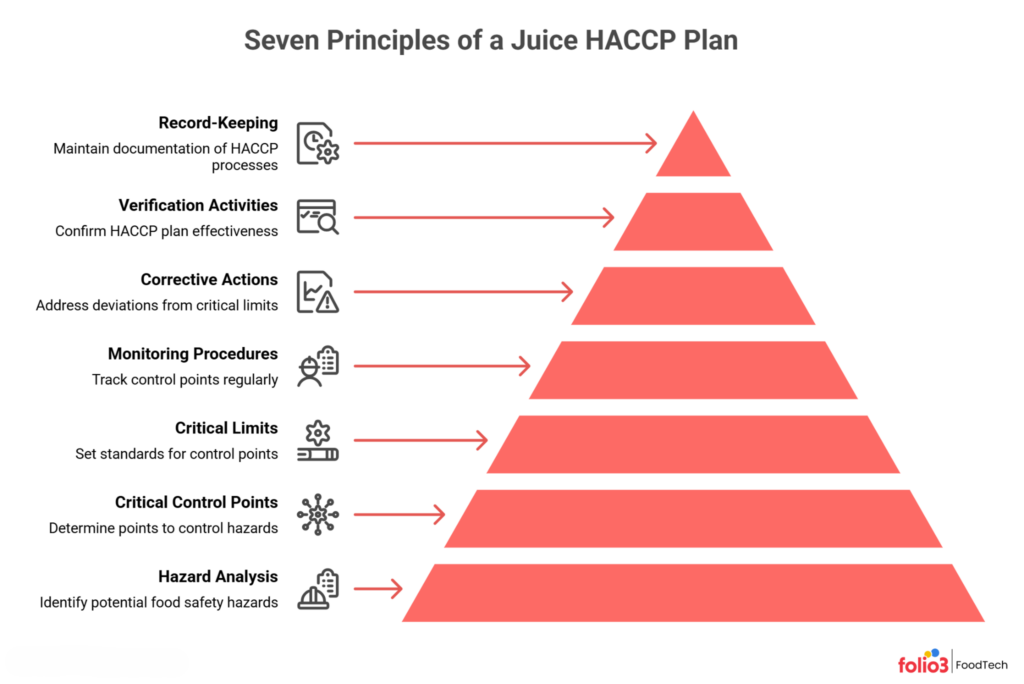
Principle 1: Conduct a Hazard Analysis
Start by identifying every biological, chemical, and physical hazard at each processing step.
- Biological hazards: E. coli, Salmonella, and Cryptosporidium are common targets in juice. Cryptosporidium is particularly concerning in apple cider due to its resistance to standard chlorine treatments.
- Chemical hazards: Patulin (a mycotoxin from mold on damaged apples), heavy metals like lead, and allergens such as tree nuts or sulfites used as preservatives.
- Physical hazards: Glass fragments from broken containers, metal fragments from processing equipment, and fruit pits or stones.
Principle 2: Identify Critical Control Points
A Critical Control Point (CCP) is a step in your process where a specific control measure can prevent, eliminate, or reduce a hazard to an acceptable level. Pasteurization is the most common CCP in juice production. Other examples include pH adjustment and inline metal detection.
Principle 3: Establish Critical Limits
Each CCP needs a measurable critical limit. For pasteurization, that typically means reaching a minimum temperature for a defined holding time, calibrated to achieve the 5-log reduction for your target pathogen. For pH control, the limit may specify a maximum pH value below which pathogen growth is inhibited.
Principle 4: Monitoring Procedures
You need a documented system for regularly measuring and recording process parameters at each CCP. For pasteurization, that means continuous temperature logging on calibrated equipment. For metal detection, it means documented challenge tests using certified test pieces of known size.
Principle 5: Corrective Actions
When monitoring shows a deviation from a critical limit, you must act immediately. It includes isolating and placing on hold the affected batch, investigating the root cause of the deviation, and documenting everything before any affected product is released.
Principle 6: Verification Activities
Verification confirms that your HACCP system is working as intended. It includes periodic equipment calibration, microbial testing of finished product, and scheduled internal HACCP audits. Verification is separate from monitoring and must be documented in its own records.
Principle 7: Record-Keeping and Documentation
The FDA will review your records during any inspection. Refrigerated juice records must be retained for at least one year. Frozen and shelf-stable product records require two years. Monitoring logs, corrective action records, calibration documents, and HACCP plan revision history are all required.
Hazard Categories and How to Control Them
Not all food safety hazards look the same. Understanding each category helps you assign the right controls at the right process steps and build a food safety program that holds up under scrutiny.
Biological Hazards
Bacteria, viruses, and parasites are the primary concern in juice processing. The key controls are validated thermal pasteurization and hygienic facility design that prevent post-process re-contamination. Salmonella and E. coli are heat-sensitive and respond well to validated thermal processes. Cryptosporidium is more resistant to UV treatment, but is controlled effectively through pasteurization. To understand biological hazards in depth, our team covers identification and control across food categories.
Chemical Hazards
Patulin is a mycotoxin produced by mold on damaged or rotting apples. It cannot be destroyed by heat, so your control strategy must focus on sourcing: only accept fruit that meets defined quality and visual standards, and implement a documented supplier verification program. Heavy metals like lead can enter through contaminated irrigation water or soil. Testing source materials and maintaining supplier qualification records are your primary defenses. Allergen management is a shared responsibility across production scheduling, cleaning protocols, and labeling. Our food allergen management guide covers this in detail.
Physical Hazards
Glass and metal contamination can be prevented through equipment maintenance, in-line filtration, and validated metal detection. Regular detector tests using certified challenge pieces create the records your auditor will expect to see.
Sanitation programs that address allergen carry-over and microbial cross-contamination are part of your Sanitation Standard Operating Procedures (SSOPs), which support but do not replace your HACCP plan.
Critical Control Points and Process Controls
Your CCPs are where food safety is actually won or lost in juice production. Choosing and validating the right controls is where compliance becomes operational.
Thermal Processing
Pasteurization is the most widely used CCP in juice production. High-temperature short-time (HTST) pasteurization typically targets temperatures between 95 and 105°C with defined holding times. The exact time-temperature combination must be scientifically validated against your target pathogen. Our resource on food pasteurization methods and benefits covers this in more depth.
Non-Thermal Methods
High-pressure processing (HPP), ultrasound, and pulsed electric field (PEF) are recognized non-thermal alternatives that can achieve the required pathogen reduction while preserving heat-sensitive nutrients and fresh flavor profiles. All require the same level of scientific validation as thermal methods before they qualify as a CCP.
pH Control and Storage
Low-acid juices with a pH above 4.6 present a higher biological risk and may require acidification as a CCP. Refrigerated products must maintain cold chain integrity throughout distribution to prevent pathogen growth after processing. Our guide on cold chain management logistics outlines the controls that protect product integrity from the processing floor to the retail shelf.
Filtration and Clarification
Membrane filtration and enzymatic clarification remove physical particulates and improve product clarity. These steps can also function as supporting controls for physical hazards when placed after high-risk extraction points.
The 5-log reduction must always be achieved in a single facility. Any post-process handling step that could reintroduce contamination must be addressed explicitly in your HACCP plan.
Step-by-Step Guide to Developing Your Juice HACCP Plan
Building a defensible juice HACCP plan follows a structured process. These steps will help ensure your system stands up during an FDA inspection.
- Assemble a multidisciplinary HACCP team. Include people with expertise in production, quality assurance, sanitation, and regulatory compliance. No single person can adequately cover all areas.
- Describe the product and its intended use. Document the juice type, composition, packaging format, shelf life, storage requirements, and the expected consumer. If the product is intended for vulnerable populations such as children or the elderly, adjust your risk assessment accordingly.
- Construct a detailed process flow diagram. Map every step from raw material receiving to finished product shipping. Walk the production floor to verify the diagram reflects what actually happens, not just what should happen.
- Conduct a hazard analysis. For each process step, evaluate which biological, chemical, and physical hazards are reasonably likely to occur, and what their potential severity would be. This analysis is the foundation of the entire plan.
- Identify CCPs and establish critical limits. Use a formal decision tree to determine which hazard control points qualify as CCPs, and set measurable critical limits for each.
- Establish monitoring, corrective action, verification, and record-keeping procedures. Document who does what, when they do it, and how they record it.
- Review and update regularly. Your HACCP plan must be reassessed whenever there is a change in process, ingredients, equipment, facility layout, or relevant regulatory guidance.
Example Hazard Analysis and CCP Table
Use this table as a reference when organizing documentation for your juice HACCP plan. Keep entries concise and verifiable.
| Process Step | Potential Hazard | Control Measure | Critical Limit | Monitoring & Record |
| Washing | Chemical residues | Potable water with sanitizer; inspect fruit | Sanitizer concentration within specified range | Document concentration checks per batch |
| Extraction | Physical hazards | Install metal detector; remove foreign matter | Detector sensitivity meets specification | Record daily detector tests |
| Pasteurization | Biological hazards | Heat juice to ≥95°C for ≥30 seconds | Time/temperature verified per batch | Log time-temperature data per batch |
| Filling | Physical hazards | Use filters; maintain equipment integrity | Filter pore size meets standard | Monitor filter integrity; document replacement |
FDA Juice Labeling Regulations: What Must Be on the Bottle?
Label compliance is part of your legal obligation. Getting it wrong can trigger FDA action even if your HACCP plan is otherwise solid.
Warning Statement for Unpasteurized Juices
If your juice has not been processed to achieve the 5-log pathogen reduction, federal regulations require a specific warning statement on the label. The statement must appear prominently and conspicuously in a size that is likely to be read by the consumer. It applies at retail and in food service settings.
Percent Juice Declaration
Any beverage that contains juice must declare the percentage of juice it contains. It applies to diluted juices and juice-based beverages. The declaration must appear on the principal display panel or information panel.
Nutrition Facts vs. Supplement Facts
Standard juices use a Nutrition Facts panel. If your product makes a structure or function claim or is marketed as a functional beverage with added supplements, it may require a Supplement Facts panel, along with the appropriate regulatory classification. Understanding your food labeling obligations early in product development can prevent expensive reformulations down the line.
Emerging Technologies and Sustainability Trends
The juice industry is evolving fast. New processing and packaging technologies are reshaping both compliance strategy and consumer expectations at the same time.
- High-Pressure Processing (HPP): HPP uses cold water pressure of up to 600 MPa to inactivate pathogens without heat. It achieves the 5-log reduction for most juice pathogens while preserving fresh flavor, color, and heat-sensitive vitamins. It is increasingly common among premium and cold-pressed juice brands looking to meet clean label demand.
- Ultrasound and Pulsed Electric Field (PEF): Both technologies reduce microbial loads while minimizing thermal damage to nutrients. PEF in particular shows strong results against E. coli and Salmonella in fruit juices and is advancing through regulatory validation processes.
- Intelligent and Modified Atmosphere Packaging: Smart packaging with time-temperature indicators and modified atmosphere systems helps monitor product quality throughout the cold chain. Our look at modified atmosphere packaging covers how these technologies are used across perishable categories.
- Aseptic Packaging and Recyclability: Aseptic systems allow shelf-stable juice to be packaged without preservatives. Consumer pressure for sustainable packaging is pushing the industry toward recyclable cartons and reduced plastic use.
- Clean Label Demand: Shoppers increasingly want short ingredient lists and no artificial preservatives. Non-thermal technologies directly support clean label positioning by reducing the need for added antimicrobials while still meeting pathogen reduction requirements.
Common Pitfalls in Juice HACCP Audits (and How to Avoid Them)
Even well-intentioned processors make predictable mistakes. Knowing what auditors look for is your best preparation.
Inadequate record-keeping is the most common reason the FDA issues warning letters to juice processors. Your records are the proof that your HACCP system is operating as designed. Missing logs, incomplete entries, or records that do not match the actual process flow will raise immediate flags during an inspection.
Failure to validate the 5-log reduction for your specific equipment and process is the second most frequently cited issue. Claiming your pasteurizer is set to the right temperature is not enough. You need documented scientific validation, using the actual target pathogen, demonstrating that your process achieves the required reduction under real production conditions.
Investing in food safety software that automates monitoring records and flags deviations in real time can significantly reduce your audit exposure. For a broader look at how to strengthen your overall compliance posture, our guide to food safety standards covers the key frameworks juice processors should understand.
Conclusion
A compliant juice HACCP plan is not a one-time document you file and forget. It is a living system that must reflect how your facility actually operates every day.
Review your plan whenever your process changes. Stay current with FDA guidance updates. Embrace emerging technologies where they can strengthen your pathogen controls and improve product quality at the same time. Most importantly, build a team culture where food safety is everyone’s job, not just the quality manager’s responsibility.
The cost of getting HACCP right is far lower than the cost of a recall, a warning letter, or a consumer illness connected to your product.Ready to strengthen your juice safety program? Contact our Foodtech Consultants to get expert guidance tailored to your operation.
FAQs
Does the Juice HACCP Regulation Apply to Farms That Press and Sell Their Own Juice?
Small farms selling juice directly to consumers may qualify for a retail exemption under 21 CFR Part 120. However, farms selling to distributors, retailers, or food service operators are generally subject to the full HACCP requirements. Confirm your status with a qualified FDA regulatory consultant.
What Is the Difference Between a HACCP Plan and a Food Safety Plan Under FSMA?
A HACCP plan addresses hazard identification and CCP-level controls for processing steps. An FSMA Food Safety Plan is broader and adds supply chain controls, recall procedures, and sanitation preventive controls. Juice processors subject to both must ensure their documents are aligned and do not create conflicting requirements.
How Often Should a Juice HACCP Plan Be Reviewed?
Your plan should be reviewed at least once per year and any time there is a change in ingredients, process, equipment, packaging, or facility layout. New scientific information about pathogens relevant to your product category also triggers a mandatory reassessment.
Can One Pasteurization Process Cover Multiple Juice Types?
Not always. Your validation must cover the most resistant target pathogen for each specific juice type. Apple, citrus, and tropical juices each have different target pathogens, and a single validation study may not cover all of them. Consult your process authority before assuming one study qualifies for multiple products.
What Records Are Required for a Juice HACCP Plan?
Required records include the HACCP plan itself, CCP monitoring logs, corrective action records, verification and calibration logs, and supplier verification documents. Refrigerated juice records must be retained for one year. Frozen and shelf-stable product records must be kept for two years.
Are Imported Juices Subject to the Same HACCP Requirements?
Yes. Imported juices sold in the U.S. must comply with 21 CFR Part 120. U.S. importers are responsible for verifying that their foreign suppliers meet FDA HACCP requirements. Under FSMA’s Foreign Supplier Verification Program (FSVP), importers must have documented evidence that the pathogen reduction standard is being achieved at the foreign facility.


