

Coffee fermentation is no longer an afterthought in post-harvest processing. It is the single biggest lever you have for shaping cup quality, commanding premium prices, and differentiating your lots in a crowded market.
For decades, fermentation in coffee was treated as a necessary step to strip mucilage before drying. Today, it is the frontier of flavor innovation. Producers who control their fermentation protocols are consistently scoring 85+ on SCA evaluations and earning two to three times the commodity price for their green coffee. The fermented coffee market alone is projected to grow from $330.6 million in 2025 to roughly $766.8 million by 2035, reflecting an 8.8% compound annual growth rate.
This guide is built for commercial processors, quality managers, and farm operators who want to move beyond guesswork. You will find practical frameworks for every major coffee fermentation method, a clear breakdown of co-fermentation trends, and an actionable step-by-step process you can implement on your next harvest. Whether you are running a 50-bag micro-lot program or scaling to container volumes, the principles here apply.
What Is Coffee Fermentation? Unpacking the Science Behind the Bean
Coffee fermentation is the biochemical breakdown of sugars and mucilage by microorganisms. Understanding the science behind it helps you control flavor outcomes and reduce batch losses.
At its simplest, the fermentation of coffee is a metabolic process. When you harvest a ripe cherry, the sticky mucilage surrounding the bean is rich in sugars, pectin, and organic acids. Microorganisms, primarily wild yeasts and bacteria, colonize this environment and start converting those sugars into ethanol, lactic acid, acetic acid, and a wide range of aromatic esters.
So, can coffee ferment? Absolutely. It begins fermenting the moment the cherry is picked, because the microbial communities on the fruit surface immediately start metabolizing available sugars. Your job as a processor is to control that activity rather than let it happen randomly.
The Microbial Mechanics: Yeasts, Bacteria, and Enzymes
The breakdown of mucilage during fermentation in coffee involves several groups of microorganisms working together. Managing these biological hazards and microbial populations is key to a clean fermentation:
- Wild yeasts (especially Hanseniaspora uvarum and Saccharomyces cerevisiae) metabolize sugars to produce ethanol and fruity esters. These esters are directly responsible for the tropical and stone-fruit notes prized in specialty lots.
- Lactic acid bacteria (LAB), including Lactobacillus and Leuconostoc species, convert sugars into lactic acid. This lowers the pH of the fermentation mass and contributes a creamy, yogurt-like body to the final cup.
- Pectinolytic enzymes break down the pectin chains that hold mucilage to the parchment. This enzymatic degradation is what allows you to wash the beans clean after fermentation.
- Acetic acid bacteria (AAB) can also appear, especially in extended or warmer ferments. In small quantities, they add complexity; in excess, they cause vinegar-like off-flavors.
The interplay between these groups determines the final chemical profile of your fermented coffee beans. Temperature, pH, oxygen availability, and sugar concentration all influence which organisms dominate.
Why Do We Ferment Coffee? (Processing vs. Flavor Modulation)
Historically, the purpose of coffee bean fermentation was purely functional: to remove the sticky mucilage layer so beans could be dried and milled cleanly. Washed-process producers would soak depulped parchment in water tanks for 12 to 36 hours, let microbes break down the pectin, and then rinse the beans. Flavor was a byproduct, not a goal. It was simply one of several standard food processing methods applied to agricultural commodities.
That changed as the specialty coffee market expanded. The global specialty coffee market was valued at approximately $111.5 billion in 2025 and is projected to reach $251.7 billion by 2033, growing at a 10.8% CAGR. This growth has created massive price premiums for differentiated lots, and fermentation is the primary tool producers use to achieve those differentiated profiles.
Modern fermentation in coffee is about flavor modulation. You are not just cleaning the bean. You are building specific sensory profiles by managing which microbes thrive, how long they work, and what metabolic pathways they follow. The same green coffee can taste like blueberry jam or dark chocolate, depending entirely on how you ferment it.
Classic Coffee Fermentation Methods
If you have been in the coffee fermentation process for any length of time, you already know these three methods. The value here is understanding how fermentation behaves differently in each environment, because that knowledge is what separates consistent lots from unpredictable ones.
Washed (Wet) Process
In the washing process, cherries are depulped to expose the mucilage-coated parchment, which is then submerged in water tanks. Fermentation happens in a semi-aquatic environment where LAB and yeasts break down pectin over 12 to 48 hours. The water buffer moderates temperature swings, making this one of the more predictable coffee fermentation methods.
You should track the pH drop speed closely. A healthy washed fermentation typically sees pH fall from around 5.5 to 3.8 to 4.2 within 18 to 36 hours. If the drop stalls or reverses, you have a contamination issue. Washed coffees tend to produce clean, high-acidity cups with pronounced citric and malic acid notes.
Natural (Dry) Process
Natural processing skips depulping entirely. Whole cherries are spread on drying beds, and fermentation happens inside the intact fruit. This means the bean sits in direct contact with the sugar-rich mucilage and fruit pulp for an extended period, sometimes weeks.
The challenge here is managing risk. Without the water buffer of washed processing, temperature and moisture fluctuations can encourage mold growth (especially Aspergillus) and unwanted fungal activity. You need consistent turning schedules, controlled airflow, and ideally covered raised beds to prevent over-fermentation. Understanding shelf life constraints and spoilage factors helps you set realistic drying timelines. When done well, natural-process fermented coffee produces a heavy body, low acidity, and intense berry and wine-like flavors.
Honey (Semi-Washed) Process
Honey processing is all about tactile control. After depulping, a specific percentage of mucilage is left on the parchment before drying. The amount of remaining mucilage, ranging from roughly 20% (yellow honey) to 80% or more (black honey), determines the fermentation intensity and final sweetness of your cup.
Moisture management is your primary concern with honey processing. Because the sticky mucilage layer is exposed to air, you need to monitor drying rates carefully to prevent mold and uneven fermentation. The reward is a balanced cup that sits between the clean brightness of washed coffee and the full-bodied sweetness of naturals.
Advanced Types of Coffee Fermentation: Pushing Sensory Boundaries
Advanced fermentation techniques are where you unlock premium pricing. These methods give you precise control over microbial activity and flavor compound development.
The types of coffee fermentation covered here are what producers use to push cup scores above 88 and command prices that justify the extra labor and equipment. If your operation is ready to invest in precision, these methods will pay for themselves.
Anaerobic Fermentation (Oxygen-Free Bioreactors)
Anaerobic fermentation shifts the entire microbial ecosystem by removing oxygen from the equation. Instead of open-air tanks, you seal depulped (or whole cherry) coffee in airtight vessels fitted with one-way CO2 release valves.
Without oxygen, aerobic bacteria are suppressed, and the fermentation is dominated by LAB and specific yeast strains that produce intense, complex esters under anaerobic conditions. The result is coffee with dramatically amplified fruit and floral notes, often described as having a “winey” or “boozy” quality. Fermentation times in anaerobic setups typically range from 48 to 120 hours, depending on your target profile. Temperature control is critical, as sealed tanks can build up heat quickly.
Carbonic Maceration
Borrowed directly from the wine industry, carbonic maceration involves placing intact coffee cherries in a sealed tank and injecting CO2 to create a pressurized, oxygen-free environment. The key difference from standard anaerobic fermentation is that the pressurized CO2 forces intracellular fermentation to occur inside the intact cherry before external microbial activity begins.
This produces coffees with exceptionally vibrant acidity, candy-like sweetness, and a distinctive effervescent quality. It is one of the most talked-about types of coffee fermentation in specialty circles, and consistently fetches premium prices at auction. The downside is equipment cost and the precision required to manage pressure levels without rupturing the cherries.
Inoculated Fermentation (Using Starter Cultures)
Inoculated fermentation is the tech edge of modern coffee bean fermentation. Instead of relying on whatever wild microbes happen to be present on your cherries, you pitch specific commercial yeast strains or LAB cultures into the fermentation tank.
This approach gives you two major advantages: consistency and speed. A known inoculum outcompetes wild spoilage organisms (like Enterobacteriaceae), reducing the risk of off-flavors. It also makes your fermentation timeline more predictable, which matters enormously when you are processing high volumes. Commercial cultures from companies in the wine and brewing industry are increasingly being adapted for coffee.
Spontaneous vs. Inoculated Fermentation
| Variable | Spontaneous Fermentation | Inoculated Fermentation |
| Consistency | Low; varies by harvest, altitude, and season | High; reproducible profiles batch to batch |
| Fermentation Speed | Variable; 24 to 96+ hours depending on conditions | Faster and more predictable; typically 18 to 72 hours |
| Risk of Spoilage | Higher, uncontrolled microbial diversity increases off-flavor risk | High, reproducible profiles batch to batch |
| Flavor Predictability | Unique, terroir-driven; hard to replicate exact profiles | Targeted and repeatable; designed for specific sensory goals |
The Rise of Co-Fermentation Coffee: Market Trends and Definitions
Co-fermentation coffee is the biggest trend shaping specialty processing right now. Understanding what it is, and what it is not, gives you a competitive edge in a fast-moving market.
If you follow specialty coffee auctions or trade publications, you have noticed the explosion of co-fermentation lots commanding eye-watering prices. But there is also a lot of confusion around what co-fermentation actually means, especially as it bumps up against flavored coffee regulations in certain markets.
What Is Co-Fermentation?
Co-fermentation coffee is produced by adding external organic substrates into the fermentation tank alongside the coffee. These substrates can include fruit purees (mango, passion fruit, lychee), spices (cinnamon, cardamom), sugar cane juice, or even yeast cakes.
The critical distinction is that these additions are not simply soaking the beans in flavoring. The microbes in the fermentation tank metabolize both the coffee mucilage and the added substrate simultaneously. This creates entirely new chemical compounds, including esters, alcohols, and acids, that would not exist in a standard fermentation. The result is a genuinely transformed flavor profile, not a coating.
Co-Fermentation vs. Infused Coffee: The Scientific Difference
This distinction matters for both your marketing and your regulatory compliance:
- Co-Fermentation is a biological, metabolic process. Microorganisms break down the added substrate and the coffee mucilage together, producing new flavor compounds through biochemical reactions. The coffee’s internal chemistry is altered at the molecular level.
- Infusion or flavoring is a mechanical, post-fermentation process. It involves spraying essential oils, soaking beans in extracts, or barrel-aging after processing. The coffee’s internal chemistry is unchanged; flavor sits on the surface.
For specialty grading purposes, co-fermented coffees are generally treated as a processing method, while infused coffees are classified as flavored products and judged under different standards.
Why Producers Are Scaling Co-Ferments
The economics tell the story. Co-fermentation coffee allows producers to rescue lower-grade lots by adding complexity through the substrate. A lot that might score 82 with standard washed processing can jump to 87 or higher with a well-executed co-ferment, moving it from commercial to specialty pricing.
There is also surging demand in Asian and Middle Eastern markets for intense, fruit-forward flavors. Buyers in South Korea, Japan, China, and the UAE are paying premiums for co-fermented lots with pronounced tropical and floral profiles. For producers looking to access these growing markets, mastering co-fermentation is quickly becoming a required capability, not an optional experiment. Managing your food and beverage supply chain effectively is critical to getting these specialty lots to international buyers on time and in spec.
Step-by-Step Coffee Fermentation Process for Commercial Producers
A repeatable coffee fermentation process is essential for consistent quality at scale. Whether you are running a washed, anaerobic, or co-fermentation program, these steps form the backbone of how coffee is fermented at a commercial level. Solid batch management practices ensure you can trace every lot from cherry intake to export.
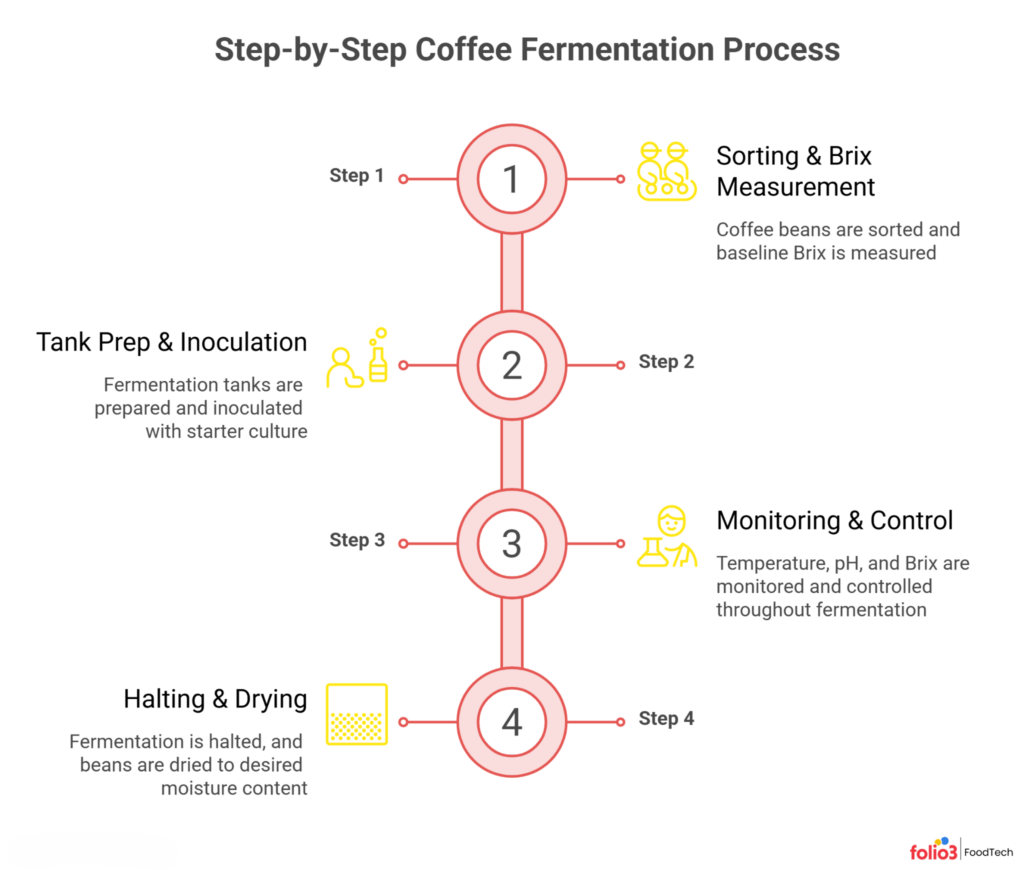
Step 1: Sorting and Baseline Brix Measurement
Before any coffee hits the fermentation tank, sort your incoming cherries by ripeness. Underripe and overripe cherries introduce inconsistent sugar levels that will throw off your entire fermentation curve.
After sorting, measure the Brix level of your mucilage using a refractometer. Brix tells you how much fermentable sugar is available. For washed Arabica, a starting Brix between 18 and 22 is typical. For naturals, you are measuring the juice of the intact cherry, which may read higher. This baseline number dictates your expected fermentation speed and potential alcohol/acid production.
Step 2: Tank Preparation and Inoculation
Clean and sanitize all fermentation tanks before each batch. Residual microbes from a previous fermentation can dominate your new batch and override your intended profile. Use food-grade sanitizers and rinse thoroughly.
If you are running inoculated fermentation, hydrate your chosen yeast or LAB culture according to the manufacturer’s instructions and pitch it into the tank at the recommended rate, typically 0.5 to 2 grams per kilogram of coffee. Ensure even distribution by mixing gently. For spontaneous fermentation, simply load the tank and let the native microflora take over. In both cases, seal anaerobic tanks with one-way valves, or leave washed tanks open with a cover to reduce airborne contamination.
Step 3: Monitoring Temperature, pH, and Brix (The Golden Rules)
This is where batches are won or lost. Your three key variables during the coffee fermentation process are:
- Temperature: Keep the fermentation mass below 30°C (86°F). Above this threshold, yeast activity spikes uncontrollably, producing harsh alcohols and increasing the risk of off-flavors. If ambient temperatures are high, consider water jackets or nighttime fermentation starts.
- pH: Track the pH drop using a calibrated digital meter. A healthy fermentation drops from roughly 5.5 to a target ending pH of 3.8 to 4.2. If pH drops below 3.5, you risk vinegar-like acetic acid buildup. If it stalls above 4.5, microbial activity may be insufficient.
- Brix: Monitor the Brix drop to confirm sugar consumption. A steady decline in Brix over the fermentation window tells you the microbes are active. A sudden stop may indicate a stalled fermentation that needs intervention (warming, gentle agitation, or re-inoculation).
Document every reading with timestamps. This data becomes your recipe for replicating successful batches in future harvests.
Step 4: Halting and Drying
Once your pH and Brix readings hit the target range, halt fermentation immediately. For washed lots, this means draining the tank and washing the parchment with clean water to strip residual mucilage and stop microbial activity.
For naturals and honey-process lots, move the coffee promptly to raised drying beds with good airflow. Some producers use crash-cooling (submerging in cold water briefly) to arrest metabolic activity before transferring to beds. The goal is to prevent over-fermentation, which produces the phenolic, medicinal, or “stinky cheese” defects that destroy cupping scores.
Speed matters here. Every hour of delay between reaching your target parameters and halting the fermentation is a risk to quality. Integrating lot traceability in your food operations helps your team track every batch from tank to drying bed to warehouse.
Quality Control: Overcoming Processing Challenges at Scale
Scaling coffee fermentation without losing quality is the primary challenge for commercial producers. Proactive quality control in food production turns fermentation from a gamble into a repeatable system.
Preventing Off-Flavors and Spoilage
The most common defects from poor fermentation are phenolic off-flavors (medicinal, rubbery), acetic acid overload (vinegar), and butyric acid production (rancid, cheesy). These almost always result from one of three causes: excessive temperature, extended fermentation time, or contamination by Enterobacteriaceae or Clostridium species.
Prevention comes down to hygiene and timing. Sanitize tanks between batches. Monitor temperature continuously. Hit your target pH and Brix windows and halt immediately. When running anaerobic fermentation, ensure one-way valves are functioning, as a stuck valve can build dangerous pressure or allow oxygen ingress that shifts the microbial balance.
Data Logging and Repeatability
Invest in digital pH meters, temperature data loggers, and Brix refractometers with recording capability. Every batch should have a lot card that includes cherry ripeness level, starting Brix, hourly (or bi-hourly) pH and temperature readings, fermentation duration, and sensory cupping notes after drying and roasting.
This data is your intellectual property. It allows you to replicate winning profiles year after year, diagnose failures quickly, and prove process consistency to buyers. Platforms like coffee roasting and processing management software centralize this data, connecting your fermentation logs to roasting profiles, inventory, and order management in one system. In specialty coffee, lot traceability and process transparency are becoming table-stakes requirements, not differentiators.
Conclusion
Mastering coffee fermentation is no longer an experiment reserved for micro-lot hobbyists. It is a required baseline for farm profitability in a market that increasingly rewards precision, transparency, and sensory excellence.
The tools are accessible: digital monitoring equipment, commercial starter cultures, sealed bioreactors, and data logging systems are all within reach for mid-scale operations. Integration with platforms like the coffee roasting system allows you to connect roasting data with green coffee processing records for full lot visibility. The knowledge is available in published research and shared through producer networks. What separates the producers who capture premium prices from those stuck at commodity rates is the willingness to treat fermentation as a science, not a tradition.
Whether you are optimizing your washed process, experimenting with anaerobic techniques, or scaling a co-fermentation program, the fundamentals are the same: control your variables, document your process, and build repeatability into every batch. Your buyers and your bottom line will reflect the difference.
Ready to bring data-driven precision to your coffee processing operation? Get in touch with our team to discuss how integrated ERP and quality management solutions can help you scale fermentation consistency across your facility.
FAQs
How Long Should Coffee Ferment Before Drying?
Fermentation duration depends on your method and ambient temperature. Washed coffees typically ferment for 12 to 36 hours, while anaerobic and co-fermentation protocols may extend to 48 to 120 hours. Always use pH and Brix readings rather than time alone to decide when to halt.
Does Fermentation Affect Caffeine Levels in Coffee?
Fermentation has minimal impact on caffeine content. Caffeine is chemically stable and not significantly metabolized by the yeasts and bacteria involved in coffee fermentation. The changes are primarily in flavor-active compounds like organic acids, esters, and alcohols.
Can You Ferment Coffee at Home for Better Flavor?
Home-scale fermentation experiments are possible with green coffee and basic equipment, but controlling variables like temperature, pH, and microbial balance is significantly harder without commercial tools. Results are inconsistent, and the risk of spoilage is high without proper monitoring.
What Is the Difference Between Anaerobic and Carbonic Maceration in Coffee?
Both are oxygen-free methods, but the mechanism differs. Anaerobic fermentation uses sealed tanks where CO2 builds naturally from microbial activity. Carbonic maceration injects external CO2 to pressurize the tank, forcing intracellular fermentation inside the intact cherry before external microbes take over.
Is Co-Fermented Coffee Considered Flavored Coffee by SCA Standards?
The distinction is still debated, but most specialty buyers treat co-fermentation as a processing technique because the flavor compounds are created through biological metabolism. Infused or flavored coffees, where additives are applied after processing, are categorized separately and typically excluded from specialty scoring.


