

At an industrial scale, it is the intentional use of microbial cultures to biochemically alter raw substrates. The goal is preservation, flavor synthesis, or molecular production, depending on the end product and processing method.
If you work in food manufacturing, R&D, or brand development, fermentation is no longer just about yogurt and pickles. It is a core technology platform driving some of the biggest shifts in modern food production.
Clean-label demands are accelerating. Alternative protein investments are climbing. And fermentation sits at the center of both trends. The global fermented ingredients market was valued at $35.3 billion in 2023 and is projected to reach $73.5 billion by 2030, growing at a CAGR of 11.1%. Meanwhile, the precision fermentation segment alone is projected to expand from $5.02 billion in 2025 to $36.31 billion by 2030 at a 48.6% CAGR.
Whether you are scaling a legacy fermentation line or evaluating precision fermentation for a new ingredient, this guide breaks down what matters: the science, the types, the preservation mechanics, the CPG applications, and the economic realities of scaling up.
What Is Fermentation in Food? Defining the Modern Regulatory and Scientific Meaning
The term “fermentation” gets used loosely in the food industry, and that creates real confusion. A biochemist, a process engineer, and a regulatory specialist will each give you a different definition. If you are developing or scaling fermented products, you need to understand all three perspectives.
The Scientific Definition
In strict biochemistry, fermentation is anaerobic catabolism of carbohydrates to generate energy (ATP) through substrate-level phosphorylation. It is what happens when microorganisms break down sugars without oxygen, producing metabolites like lactic acid, ethanol, or acetic acid.
But in industrial food production, the definition is broader. Any controlled microbial growth process, whether aerobic or anaerobic, used to create commercial food products, qualifies as fermentation. It includes aerobic processes like vinegar production and mycoprotein cultivation.
The Regulatory Distinction
The International Scientific Association for Probiotics and Prebiotics (ISAPP) published a consensus definition that the food industry widely references: fermented foods are those made through desired microbial growth and enzymatic conversions of food components.
But here is where it gets nuanced. Some fermented foods contain live cultures at the point of consumption. Think raw yogurt or unpasteurized kombucha. Others go through downstream processing that kills the cultures. Sourdough bread, pasteurized soy sauce, and beer all fall into this category. Both are legally and scientifically categorized as fermented foods.
Fermented Foods vs. Probiotics
A common misconception in both B2B and consumer contexts: not every fermented food is a probiotic. For a product to carry a probiotic claim, it must contain a clinically validated, quantified strain delivered at a specific CFU (colony-forming unit) count. A generic “live and active cultures” label on yogurt does not automatically make it a probiotic.
This distinction matters for product managers and R&D leads. If your food product development strategy involves a probiotic claim, you will need clinical validation data, not just a fermentation process.
Types of Food Fermentation: The Three Pillars of Modern Fermented Food
Modern food tech has moved well beyond traditional fermentation. Today, the industry recognizes three distinct categories, each with different infrastructure needs, cost profiles, and regulatory pathways. If you are evaluating fermentation for your product pipeline, this framework will help you understand where each type fits.
Traditional Fermentation of Food Matrices
Traditional fermentation uses wild or starter cultures to transform a whole, existing food matrix. The cultures work on the carbohydrates, fats, and proteins already present in the raw material.
The primary focus here is sensory transformation. Cultures drive pH reduction, develop flavor compounds, and modify texture. It is the oldest form of food fermentation, and it remains the largest by production volume.
Industrial examples include cheese ripening with Lactococcus species, cacao pod bean fermentation for chocolate production, and large-scale vegetable pickling using lactic acid bacteria. These are processes where the culture modulates an existing food, not where it creates a new ingredient from scratch.
For food manufacturers running traditional fermentation at scale, the key operational challenges are culture consistency, temperature control, and batch-to-batch reproducibility. Getting these right determines whether your final product meets spec every time or introduces variability that erodes consumer trust. Proper quality control systems are essential for maintaining consistency across production runs.
Biomass Fermentation in Food Production
Biomass fermentation takes a fundamentally different approach. Instead of transforming an existing food, it leverages the rapid growth rate and high protein content of specific microorganisms. The cell mass itself becomes the final ingredient.
This category focuses on high-yield protein production that is independent of traditional livestock farming or large land footprints. The microorganisms used include specific yeasts, filamentous fungi, and microalgae, each selected for its nutritional profile and growth efficiency.
The most commercially advanced example is mycoprotein production using Fusarium venenatum, a filamentous fungus grown in large-scale fermenters. Single-cell proteins (SCPs) grown on side-stream carbohydrates represent another growing segment, where waste substrates from other food processes become the feedstock for protein production.
The capital expenditure for biomass fermentation is considerably higher than that for traditional fermentation. Deep-tank, gas-lift bioreactor systems are required for the continuous aerobic cultivation of these organisms. However, the yield per square meter of facility space far exceeds what traditional protein production can achieve, making the economics compelling at scale.
Precision Fermentation Food Systems
Precision fermentation is the newest and fastest-growing category. It deploys genetically engineered microbial hosts, often called cell factories, to express specific target molecules. Common hosts include Pichia pastoris and Saccharomyces cerevisiae.
The focus here is on creating bio-identical functional ingredients with extreme purity. You are not growing the organism for its own protein content. You are programming it to produce a specific molecule, then extracting and purifying that molecule.
The most established commercial example is recombinant chymosin, the enzyme used in cheese making. By 2017, fermentation-produced chymosin had captured 90% of the global market share for rennet, replacing traditional animal-derived rennet. Other precision fermentation products now entering the market include animal-free whey proteins (beta-lactoglobulin) and precision-grown egg white proteins (ovalbumin).
Commercial Comparison Matrix for Product Managers
| Evaluation Metric | Traditional Fermentation | Biomass Fermentation | Precision Fermentation |
| Primary Objective | Matrix & flavor modulation | Mass protein tonnage | Pure ingredient/protein isolation |
| Capex Profile | Low to Moderate | High (deep-tank gas-lift systems) | Ultra-High (aseptic fermenters & DSP) |
| Downstream Processing | Low (whole product packaging) | Moderate (dewatering, drying) | High (cell lysis, purification, isolation) |
| Regulatory Framework | Generally Recognized as Safe (GRAS) | Novel Food / Substantial Equivalence | Recombinant DNA / Explicit FDA Approval |
Fermentation Food Preservation: How Does Fermentation Preserve Food Safely?
If you are in R&D, quality assurance, or food processing operations, you have likely heard that fermentation preserves food. But understanding the precise mechanisms matters when you are designing a process, validating shelf life, or working through a food safety compliance program.
The Mechanics of Preservation
The food fermentation process preserves food through three specific microbial actions working together:
Controlled Acidification: It is the primary preservation mechanism. Microbial cultures rapidly convert free sugars into organic acids, mainly lactic acid and acetic acid. It drops the pH below 4.6, which is the critical threshold for inhibiting pathogenic bacteria like Clostridium botulinum. Below this pH, most dangerous pathogens simply cannot grow.
Competitive Exclusion: Fermentation cultures do not just produce acids. They are also rapidly consuming available simple sugars, nitrogen sources, and micronutrients. By outcompeting spoilage organisms for nutrients, the starter cultures effectively starve them out. This biological competition makes the food environment hostile to unwanted microbes.
Antimicrobial Metabolites: During the food fermentation process, beneficial microbes secrete natural biopreservatives. These include bacteriocins (like nisin, which is widely used in dairy preservation), hydrogen peroxide, and ethanol. These metabolites provide an additional layer of protection beyond acidification alone.
Enzymatic Improvements in Processing
Beyond preservation, fermentation also improves the nutritional profile of food products. Microbial enzymes naturally break down anti-nutrients like phytic acid and saponins during processing. It elevates digestibility and increases the bioavailability of minerals and vitamins in the final product. For brands focused on clean-label nutrition claims, this enzymatic improvement is a valuable added benefit of fermentation.
Understanding these preservation mechanics is especially important when you are working with products that require extended ambient shelf life or when you are replacing chemical preservatives with biological alternatives. Each mechanism contributes a different layer of protection, and the most robust fermentation-based preservation systems leverage all three simultaneously.
Application of Fermentation in the Food Industry: Upgrading Modern CPG Categories
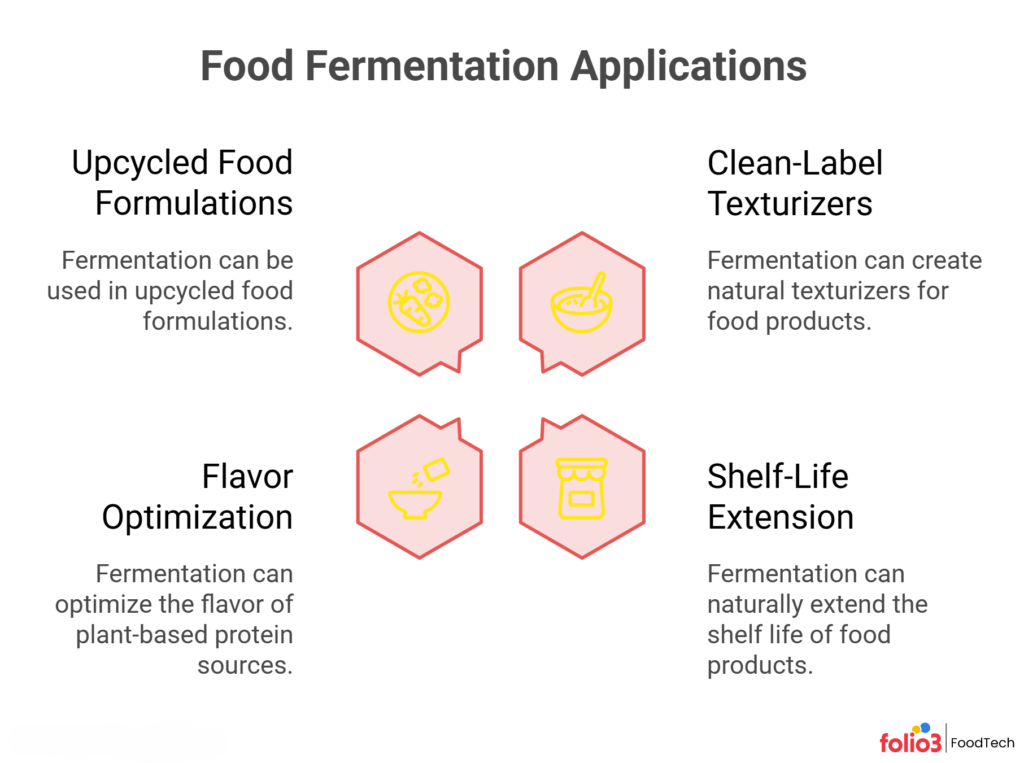
For commercial R&D leads and brand founders, fermentation opens up product development possibilities that go well beyond preservation. Here are four high-impact applications that you can evaluate for your product pipelines.
Clean-Label Texturizers
If you produce plant-based milks or yogurts, you are likely dealing with texture challenges. Fermentation using Leuconostoc or Xanthomonas species can synthesize clean-label exopolysaccharides (EPS) that replace synthetic stabilizers or gums. The result is a texture that consumers expect, with an ingredient label that reads as natural rather than chemical.
Natural Shelf-Life Extension
Industrial bakeries commonly use chemical preservatives like calcium propionate to prevent mold growth. Specific propionic acid bacteria cultures can replace these chemical additives, extending shelf life through biological preservation. For brands positioning on clean-label claims, this switch can be a significant competitive advantage. Consistent food shelf life testing validates the efficacy of these biological alternatives.
Flavor Optimization in Plant Proteins
One of the biggest barriers to plant-based protein adoption is off-flavors. Pea, soy, and chickpea isolates commonly carry “beany” flavors from hexanal and other volatile compounds. Solid-state fermentation metabolizes these off-flavor compounds directly, eliminating the need for expensive masking agents and creating a cleaner-tasting protein ingredient. It is a practical application of food processing methods that directly improves consumer acceptance.
Upcycled Food Formulations
Industrial side-streams like cheese whey, spent brewer’s grain, and fruit pomace are traditionally treated as waste. Targeted fermentation using specific yeast or bacterial strains converts these side-streams into high-value functional ingredients. This approach creates revenue from waste while supporting sustainability goals, and it aligns well with emerging consumer interest in upcycled ingredients. For food manufacturers managing complex supply chains, integrating fermentation-based upcycling into your operations also strengthens your food supply chain management by turning cost centers into margin contributors.
Advantages of Fermentation: The B2B Scale-Up and Economic Reality Check
The advantages of fermentation for food production are well documented: it reduces dependency on seasonal raw materials, enables clean-label formulations, and creates functional ingredients that are difficult to produce through conventional chemistry. But if you are building a business case for scaling fermentation, you need to look beyond the benefits and confront the real economic and regulatory challenges.
Core Commercial Advantages
The first major advantage is supply chain resilience. Fermentation decouples your raw material sourcing from seasonal agricultural fluctuations and unpredictable supply chains. When your ingredient comes from a bioreactor, you are not exposed to drought, disease, or geopolitical disruptions in the same way traditional sourcing exposes you.
The second advantage is clean-label compliance. Fermentation allows you to replace synthetic chemical additives with a consumer-friendly “fermented ingredient” on the label. For brands competing in the natural and organic CPG space, this is a real differentiator.
The Techno-Economic Reality (The Scaling Gap)
Here is where the industry narrative and the economics diverge. The current macro-bottleneck in food tech fermentation is not the science. It is the lack of global contract manufacturing (CMO) capacity for precision fermentation scale-up. There are simply not enough large-scale fermentation facilities available for contract production, and building them requires significant capital investment.
The downstream processing (DSP) cost is the single biggest driver of production cost in precision fermentation. While strain engineering and culture optimization happen in the lab, your actual production cost is determined by separation, filtration, and drying efficiency. For many precision fermentation products, DSP accounts for 50% to 80% of total production cost. This is the number your financial model needs to get right before you commit to scaling.
Regulatory Frameworks for Scaling Brands
If you are bringing a fermented ingredient to market in the United States, you have two main regulatory pathways. Self-affirmed GRAS (Generally Recognized as Safe) is faster and less expensive, but it carries reputational risk because it does not involve a formal FDA review. A formal FDA GRAS No-Questions letter provides stronger market credibility but requires more time and investment.
For European markets, the European Food Safety Authority (EFSA) novel food application pathway applies to biomass and precision-derived ingredients. This process is typically longer and more data-intensive than the U.S. pathway. Planning for regulatory timelines early in your product development process is critical. Having proper food safety compliance systems and traceability infrastructure in place from day one simplifies both pathways.
For brands targeting both U.S. and EU markets simultaneously, dual-track regulatory planning is essential. The data packages required for FDA and EFSA have overlapping but distinct requirements, and structuring your safety studies to satisfy both regulators from the outset saves significant time and cost compared to sequential submissions. Ingredient-level lot traceability systems also become critical here, as both regulatory bodies require full documentation of your fermentation inputs, process parameters, and final product specifications.
Conclusion: The Strategic Future of Food Fermentation
Food fermentation is no longer a single-purpose preservation tool. It is a technology platform that spans flavor development, protein production, ingredient isolation, and clean-label formulation. From traditional cheese cultures to precision-engineered cell factories, the scope of what fermentation can accomplish continues to expand.
But scaling food fermentation successfully requires balancing molecular biology with practical process engineering and regulatory foresight. Science is advancing rapidly, but the infrastructure, economics, and regulatory pathways still need to catch up. Companies that invest in understanding DSP cost structures and regulatory timelines now will be better positioned when production capacity becomes available.
If you are an R&D manager evaluating fermentation strain selection, an operations lead assessing scaling viability, or a food brand founder exploring clean-label formulation goals, the right time to start planning is now. Auditing your fermentation strategy early, from culture selection to DSP cost modeling to regulatory pathway planning, reduces risk and accelerates your time to market. Connect with experienced food technology partners who can help you evaluate your fermentation process, optimize your scaling plan, and navigate the compliance landscape with confidence.
FAQs
What Is the Difference Between Traditional and Precision Fermentation?
Traditional fermentation uses microbial cultures to transform an existing food matrix, like turning milk into cheese. Precision fermentation engineers microorganisms to produce a specific target molecule, like whey protein, in a bioreactor. The end products and infrastructure requirements are fundamentally different.
Can Fermented Foods Replace Probiotics for Gut Health?
Not automatically. While many fermented foods contain live microorganisms, a product is only a probiotic if it delivers a clinically validated strain at a specific dose. Fermented foods support gut health, but they do not substitute for verified probiotic supplements without proper strain validation.
Why Is Downstream Processing the Biggest Cost in Precision Fermentation?
Because extracting and purifying the target molecule from the fermentation broth requires multiple energy-intensive steps: cell lysis, filtration, chromatography, and drying. These steps can account for 50% to 80% of total production cost, far exceeding the cost of the fermentation step itself.
How Does the FDA Regulate New Fermented Ingredients?
New fermented ingredients in the U.S. typically go through either a self-affirmed GRAS process or a formal FDA GRAS petition. Precision fermentation products made with genetically engineered organisms may require explicit FDA review under recombinant DNA guidelines. The pathway depends on the organism, the target molecule, and the intended food application.
What Role Does Fermentation Play in Sustainable Food Production?
Fermentation reduces reliance on traditional agriculture by producing proteins and functional ingredients in bioreactors. It lowers land use, water consumption, and greenhouse gas emissions compared to conventional animal farming. It also enables upcycling of industrial food waste into high-value ingredients, turning cost centers into revenue streams.


