

Over 20% of global seafood products carry fraudulent labels, according to a 2026 FAO report. At the same time, the global seafood market is projected to hit $409.1 billion in 2026, growing at a CAGR of 5.9% through 2033. Consumers, retailers, and regulators are all pushing harder for traceable, safe, and sustainably sourced seafood.
For processors, manufacturers, and startups, this shift creates both pressure and opportunity. The certification landscape is crowded with acronyms, overlapping standards, and evolving regulations.
This guide breaks down the full seafood certification landscape. From mandatory food safety standards to voluntary sustainability labels, you will learn what each certification requires, who needs it, and how to build a compliance path that drives real business results.
Why a Robust Fish Certification Strategy is Non-Negotiable in 2026
Fish certification is no longer just a compliance checkbox. It is a competitive tool that directly impacts your bottom line.
Retailers like Whole Foods, Walmart, and Costco now require sustainability and safety certifications as a basic condition for shelf placement. Without the right certifications, your products simply do not get considered. With them, you unlock premium pricing, reduce recall risk, and position your brand as a trusted name in a market that increasingly rewards transparency.
Nearly 4 in 10 consumers are willing to pay more for responsibly sourced seafood, even during periods of rising food costs. That willingness translates directly into margin gains for certified brands.
Here is where sustainable seafood certification delivers the most value:
- Brand Trust and Reputation Management: Certification signals to buyers and end consumers that your products meet verified standards. In an industry where up to 30% of restaurant seafood may be mislabeled, certified brands stand apart. Trust compounds over time into repeat contracts and stronger retailer relationships.
- Regulatory Compliance and Recall Prevention: The regulatory environment is getting tighter. The EU’s updated IUU fishing regulations took effect in January 2026, requiring more detailed catch documentation for all seafood imports. In the U.S., NOAA’s Marine Mammal Protection Act import provisions now prohibit products from fisheries that fail comparability findings. Certification keeps you ahead of these requirements and helps prevent costly recalls tied to food safety failures.
- Global Supply Chain Resilience: Certified supply chains are audited, documented, and traceable. When disruptions happen, whether from trade disputes, environmental events, or supplier issues, certified operations recover faster because their systems are already built for accountability.
Regulatory vs. Voluntary: Decoding the Seafood Certification Landscape
Seafood certifications fall into two tiers: safety certifications that are legally mandatory, and sustainability certifications that are voluntary but increasingly essential for market access.
Seafood HACCP Certification (The Foundation of Food Safety)
Hazard Analysis Critical Control Point (HACCP) is the baseline. If you process, pack, or hold seafood in the United States, FDA regulations require a HACCP plan specific to your operation. It is not optional.
For seafood processors, HACCP focuses on preventing hazards unique to the industry. These include histamine buildup in species like tuna and mackerel, biological hazards such as parasites in raw fish, and chemical contaminants like mercury. Your HACCP plan must identify every critical control point where these hazards can be prevented, eliminated, or reduced to safe levels.
But HACCP alone is just the floor. To compete globally, most processors layer GFSI-benchmarked standards on top. Programs like SQF, BRCGS, and IFS Food go beyond HACCP by adding requirements for supplier management, allergen control, environmental monitoring, and management accountability. These seafood quality control certification programs are what major retailers and food service companies look for when qualifying new suppliers.
Think of it this way: HACCP keeps you legal. GFSI-benchmarked certifications keep you competitive.
Sustainable Seafood Certification (The Growth Engine)
Once your food safety foundation is solid, sustainability certifications become your growth lever.
Sustainable seafood certification tells buyers that your product comes from responsibly managed fisheries or farms. It opens doors to eco-conscious retailers, food service chains with sustainability pledges, and export markets with strict environmental standards.
The major programs, which we break down in the next section, each target different parts of the supply chain. Some focus on wild-caught fisheries. Others cover aquaculture operations from feed mills to processing plants. Choosing the right one depends on where you sit in the supply chain and which markets you are targeting.
Top Sustainable Seafood Certifications Explained (A B2B Breakdown)
Not all sustainability labels are equal. The table below compares the four most recognized sustainable seafood certifications by focus area, target audience, and the effort required to achieve them.
Seafood Certifications Comparison Matrix
| Certification | Focus Area | Best For | Time/Cost Complexity |
| MSC (Marine Stewardship Council) | Wild-Caught Fisheries | Processors, brands sourcing wild seafood | High |
| ASC (Aquaculture Stewardship Council) | Farmed Seafood | Aquaculture farms, feed suppliers | High |
| BAP (Best Aquaculture Practices) | Aquaculture (Full Chain) | Farms, processors, feed mills, hatcheries | Medium |
| Fair Trade USA | Social and Environmental Standards | Brands targeting ethically conscious consumers | Medium |
MSC is the gold standard for wild-caught seafood. It certifies that a fishery operates sustainably, maintains healthy fish stocks, and minimizes environmental impact. For processors, the MSC Chain of Custody certification ensures your handling and traceability systems meet the standard. The audit process is rigorous and can take 12 to 18 months, but MSC-labeled products consistently command shelf priority with major retailers.
ASC focuses exclusively on farmed seafood. It sets strict standards for water quality, feed sourcing, disease management, and social responsibility. If you operate or source from aquaculture farms, ASC certification signals responsible farming practices to buyers across Europe and North America.
BAP takes a broader approach by certifying every link in the aquaculture chain, from feed mills and hatcheries to farms and processing plants. In 2025, BAP- and BSP-certified producers made 7,808 documented improvements across food safety, social accountability, environmental responsibility, and animal welfare. Its star rating system (1 to 4 stars) gives buyers a quick read on how deep your supply chain commitment goes.
Fair Trade USA adds a social equity layer. It covers fair wages, safe working conditions, and community investment. For brands selling directly to consumers who care about the human side of seafood sourcing, Fair Trade certification is a strong differentiator.
How to Achieve Seafood Certification: A 5-Step Roadmap for Processors
Getting certified can feel overwhelming. This roadmap simplifies the process into five clear steps you can start acting on today.
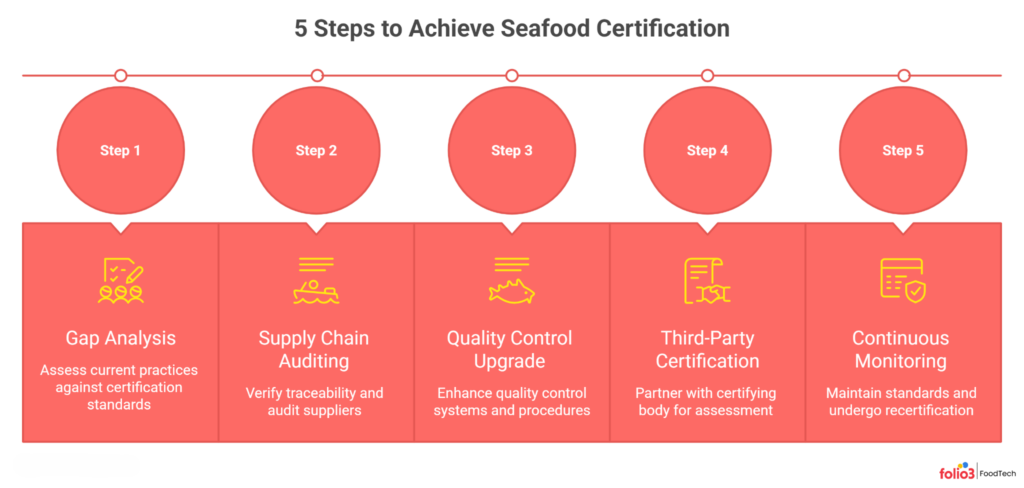
Step 1: Conduct an Internal Gap Analysis
Start by mapping your current operations against the certification standards you are targeting. Separate your assessment into two categories: safety gaps (HACCP and GFSI compliance) and sustainability gaps (MSC, ASC, BAP, or Fair Trade requirements).
Document where you already comply and where you fall short. This gap analysis becomes your project plan. Without it, you risk spending money on fixes that do not move the needle.
Step 2: Audit Your Supply Chain and Implement Traceability
Certification bodies want to see that you can trace every product from source to shelf. This means auditing your suppliers, verifying their documentation, and building a traceability system that captures catch data, processing records, and chain of custody at every handoff.
The EU’s updated IUU regulations now require digital catch certificates through the CATCH system for all seafood imports. If you export to the EU, your traceability infrastructure needs to support these digital documentation requirements. Compliance with FSMA 204 traceability requirements is equally critical for U.S. operations.
Step 3: Upgrade Your Quality Control Systems
Manual quality control processes will not pass most certification audits. Invest in digital QA tools that automate temperature logging, hazard monitoring, and corrective action tracking. These systems create the audit trail that certifiers need to see and reduce human error that leads to food contamination incidents.
Integrated seafood ERP software can centralize your HACCP records, supplier documentation, and quality metrics in one platform, making audits faster and less disruptive.
Step 4: Partner with Third-Party Certifying Bodies
Choose an accredited certifying body (CB) that specializes in seafood. Not all CBs have the same expertise. Look for ones with a strong track record in your specific product category, whether that is wild-caught, farmed, or processed seafood.
Engage your CB early. Many offer pre-assessment audits that identify issues before the formal certification audit. This step alone can save months of back-and-forth and prevent failed audits that delay market entry.
Step 5: Build a System for Continuous Monitoring and Recertification
Certification is not a one-time event. MSC, ASC, and BAP all require annual surveillance audits, with full recertification every three to five years. Build internal monitoring systems that track compliance metrics in real time. Assign clear ownership for maintaining records, updating HACCP plans, and addressing non-conformities before they become audit findings.
Seafood Certification News and Emerging Traceability Trends
The seafood certification landscape is evolving fast. Here are the trends that will shape compliance strategy in the coming years.
Blockchain and IoT Are Transforming Certification Verification
Blockchain-based traceability systems are moving from pilot projects to real-world deployment. Today, blockchain technology enhances trust through immutable record-keeping, smart contracts, and decentralized verification in the fisheries sector. When combined with IoT sensors that track temperature, location, and handling conditions in real time, these systems can verify seafood HACCP certification data without relying on paper-based documentation that is vulnerable to fraud.
Stricter IUU Fishing Laws Are Raising the Import Bar
The EU’s updated IUU fishing regulations, effective since January 2026, now require more detailed digital catch certificates through the CATCH system. There is no grace period. Meanwhile, the WTO Agreement on Fisheries Subsidies entered into force in September 2025, prohibiting government subsidies to fisheries engaged in IUU fishing. For processors importing raw material, these changes mean your supplier documentation must be tighter than ever.
AI Is Streamlining Certification Compliance
AI tools are entering the seafood industry to automate data analysis, quality control inspections, and compliance documentation. Companies are using AI-powered platforms to shift from traditional dashboard-based monitoring to conversational data analysis, making it faster to identify compliance gaps and generate audit-ready reports. This reduces the administrative burden that has traditionally made certification expensive and slow for smaller processors.
Future-Proof Your Seafood Supply Chain
Seafood certification is an investment that pays dividends in market access, premium pricing, and supply chain resilience. The processors and brands that treat it as a strategic priority are the ones winning contracts and building lasting buyer relationships.
The regulatory landscape is only getting stricter. Consumer expectations for transparency keep growing. And the technology to make compliance easier improves every year. The best time to build your certification strategy was yesterday. The second-best time is now.
Navigating the complexities of Seafood HACCP or MSC certification? Contact our Foodtech consulting team today to streamline your compliance and unlock new markets.
FAQs
How Long Does It Take to Get MSC Certification?
The full MSC certification process typically takes 12 to 18 months for fisheries, including pre-assessment, full assessment, and peer review stages. Chain of Custody certification for processors is faster, usually completing within three to six months.
Can Small Seafood Processors Afford Sustainability Certification?
Yes. Programs like BAP offer tiered pricing and group certification options that reduce costs for smaller operations. Many processors find that the premium pricing and new market access gained through certification offset the initial investment within the first year.
What Is the Difference Between HACCP and SQF for Seafood?
HACCP is a regulatory requirement that focuses specifically on identifying and controlling food safety hazards. SQF is a GFSI-benchmarked standard that includes HACCP principles but adds requirements for quality management, supplier controls, and continuous improvement.
Do I Need Separate Certifications for Wild-Caught and Farmed Seafood?
Yes. MSC covers wild-caught fisheries, while ASC and BAP focus on aquaculture. If your product line includes both, you will need certifications from both categories to cover your full portfolio.
How Do New EU IUU Regulations Affect U.S. Seafood Exporters?
Since January 2026, the EU has required all seafood imports to include digital catch certificates through the CATCH system. U.S. exporters must ensure their supply chain documentation meets these stricter traceability requirements, or risk having shipments rejected at EU borders.


