

Coffee is one of the most traded commodities in the world, and roasting is the step that turns a raw agricultural product into something people pay a premium for. According to the Specialty Coffee Association, the specialty coffee market alone has grown into a multi-billion-dollar segment, driven by consumers who are increasingly aware of roast level, origin, and flavor. Yet for all the attention the final cup gets, roasting coffee beans is often treated as an art when, at a commercial scale, it also has to be a science.
If you run or manage a commercial coffee operation, the decisions you make during roasting directly affect product consistency, yield, shelf life, and your bottom line. A batch that goes even slightly off-profile can mean waste, customer complaints, or both.
This guide walks you through everything that matters in commercial coffee bean roasting: the stages your beans pass through, how to read and use a roasting profile, the roast levels and what they mean for flavor, the key coffee roasting techniques and methods used at scale, and the tips that separate high-output consistency from hit-or-miss batches. By the end, you will have a clear, practical picture of what it takes to roast coffee beans well when volume and repeatability are on the line.
What Happens When You Roast Coffee Beans
Before you can master the process, you need to understand what is actually happening inside the drum. Roasting coffee beans is a series of chemical and physical transformations triggered by heat. The green bean you start with looks, smells, and tastes nothing like the roasted coffee bean you end with.
Green coffee beans contain roughly 10 to 12 percent moisture. As heat builds in the roaster, that moisture evaporates. The bean turns yellow, then tan, then brown. Sugars caramelize. Hundreds of volatile aroma compounds develop. The bean expands to nearly twice its original size and loses 15 to 20 percent of its weight.
Two physical events mark the roasting process clearly:
• First crack: Around 196 to 204 degrees Celsius (385 to 400°F), moisture and CO2 build up inside the bean until it audibly cracks. This is the earliest point at which coffee is considered drinkable. Light roasts are typically finished shortly after or around first crack.
• Second crack: At roughly 224 to 230 degrees Celsius (435 to 446°F), the cellular structure of the bean begins to break down further. This is where dark roasts live. Push past second crack without control, and you risk char, not coffee.
Understanding these physical markers is the foundation of any coffee roasting guide. They are how experienced roasters orient themselves in real time, regardless of what the temperature probe says.
Coffee Roast Levels: What They Mean and Why They Matter
Roast level is the single variable your customers notice most. It affects flavor, acidity, body, and caffeine perception. Getting it right consistently is the whole game.
Here is a practical breakdown of the main coffee roast levels used in commercial production:
| Roast Level | Color | Drop Temperature | Flavor Profile |
| Light Roast | Light brown | 196 – 205°C (385 – 401°F) | Bright acidity, floral and fruity notes, complex origin character |
| Medium Roast | Medium brown | 210 – 220°C (410 – 428°F) | Balanced body and acidity, caramel, light nuttiness |
| Medium-Dark Roast | Dark brown | 225 – 230°C (437 – 446°F) | Fuller body, low acidity, slight bittersweet edge, chocolate notes |
| Dark Roast | Very dark, oily surface | 230°C+ (446°F+) | Low acidity, bold body, smoky, bitter, roasted character dominant |
Most commercial coffee roasters serve the medium to medium-dark range because it appeals to the widest customer base. But the right roast for your operation depends on your target market, your equipment, and the green coffee you source.
Consistency across batches at any roast level requires more than a good eye. This is where dedicated coffee roasting software becomes a practical tool, not just a nice-to-have.
Understanding the Roasting Profile
A roasting profile is a data map of how temperature changes over the course of a roast. It tracks bean temperature and usually environmental temperature (the air inside the drum) against time. Most commercial roasters log this automatically.
The roasting profile tells you three things:
• Where you are in the roast: What temperature the beans are at and how much time has elapsed.
• How fast you are moving: The Rate of Rise (RoR) measures how quickly the bean temperature is climbing per minute. A declining RoR that crashes too fast produces flat, baked-tasting coffee.
• Where the batch should end: The drop point, the temperature at which beans are released into the cooling tray, determines final roast level and locks in the flavor compounds.
A well-structured roasting profile should show a declining but smooth RoR curve. Sudden spikes or crashes in RoR are signs that heat input and airflow are not balanced. For commercial operations running multiple batches per day, a stable roasting profile is what makes each bag taste the same as the last.
Logging profiles per batch also creates a record you can reference when quality shifts. If a batch comes out wrong, you can pull the log, compare it against your target profile, and find out exactly where it deviated.
This kind of data discipline sits at the intersection of food production and food quality control. When you treat each roasting profile as a production standard, quality becomes repeatable rather than operator-dependent.
Coffee Roasting Techniques Used in Commercial Production
There is no single correct way to roast coffee beans. The right coffee roasting technique depends on your equipment, batch size, green coffee origin, and the flavor profile you are targeting. Here are the main approaches used at scale.
Drum Roasting
Drum roasting is the dominant method in commercial coffee production. Green beans are loaded into a rotating metal drum that is heated externally, usually by gas. Heat is transferred primarily through conduction (beans touching the drum) and convection (hot air circulating through the drum).
Drum roasters handle large batch sizes well and give roasters a high degree of control over time and temperature. The main variable is airflow: too little and roast development is uneven; too much and you pull heat away too fast. Most commercial operations running medium to dark profiles use drum roasters because of their consistency and capacity.
Air Roasting (Fluid Bed Roasting)
Air roasters suspend the beans in a column of hot air, removing the drum entirely. Heat transfer is almost entirely convective. This produces faster roasts, cleaner flavor profiles, and better chaff separation since the airstream carries debris away continuously.
Air roasting is popular for lighter roasts where origin clarity matters, but batch sizes are typically smaller. For specialty-focused commercial production, fluid bed roasters offer precise control over development time, but they require careful calibration of airflow and temperature together.
Centrifugal Roasting
Centrifugal roasters are less common but worth knowing. They use a spinning disc to spread beans in a thin layer under intense heat, allowing very fast roasts. This minimizes the time beans spend at lower temperatures before reaching development, which can preserve more volatile aromatic compounds.
These machines are typically expensive and suited to operations that prioritize throughput and a specific cup profile, particularly for espresso-focused roasters.
Choosing the Right Method
For most commercial coffee producers, drum roasting is the practical starting point. Air roasting makes sense if your product line leans toward light roasts and you have the volume to justify the smaller batch constraint. The roasting method is a fixed decision tied to your equipment investment, but the roasting technique you apply within it, things like charge temperature, turning point timing, and drop point selection, is where daily decisions are made.
This mirrors broader decisions in any food manufacturing environment. Choosing a production method is foundational, while day-to-day execution relies on consistent process controls, much like how food processing methods must be matched to product type and scale.
The Commercial Roasting Process: Stage by Stage
Roasting coffee beans at a commercial scale follows a repeatable sequence. Knowing what is happening at each stage helps you intervene at the right moment rather than react after the damage is done.
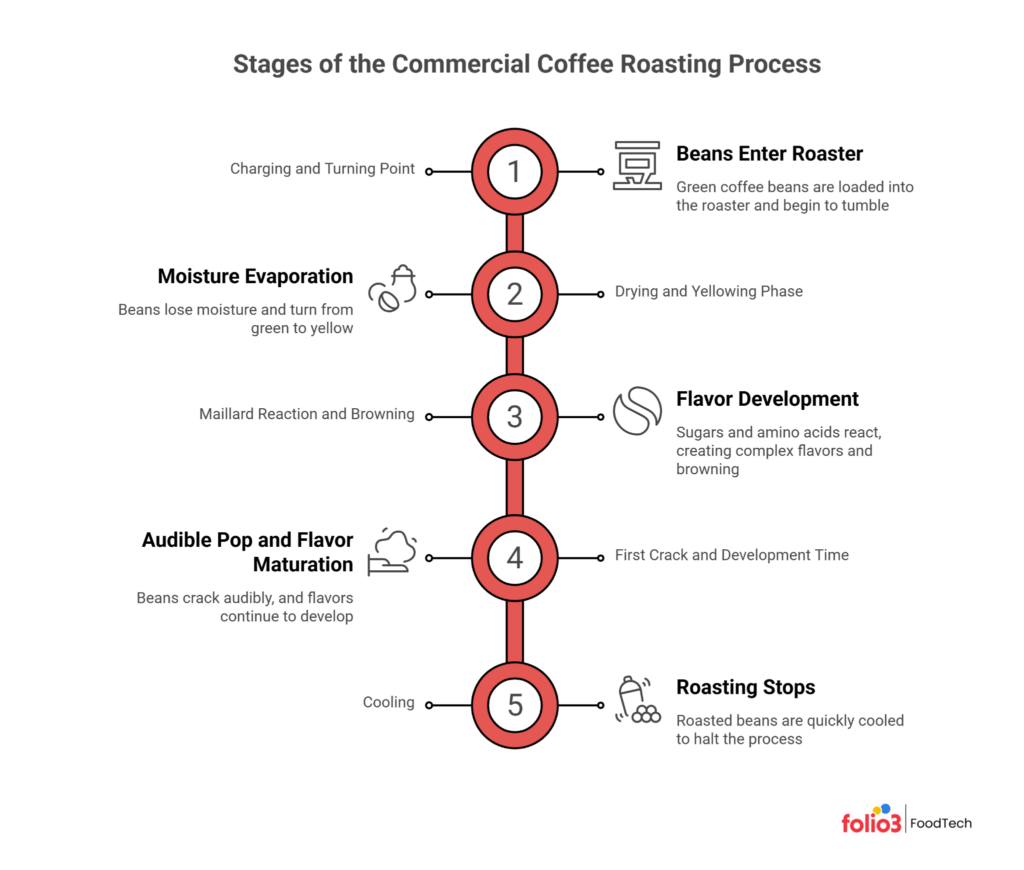
Charging and the Turning Point
Charging is loading green beans into a preheated roaster. The charge temperature, the drum temperature at the moment beans drop in, has a direct effect on how the early roast develops. Too hot and beans develop too fast on the outside before the core has caught up. Too cool, and you lose time building toward the first crack.
After charging, the drum temperature drops as the cold beans absorb heat. The lowest point the drum temperature reaches before climbing again is called the turning point. Roasters track this as a reference marker. If your turning point arrives later or earlier than expected, it signals that your charge temperature or batch size was off.
Drying and Yellowing Phase
In the first few minutes, the beans lose most of their remaining moisture. Visually, they move from green to yellow. The smell shifts from grassy and vegetable-like to something closer to hay, then bread. This phase is the slowest part of the roast and should not be rushed. Under-dried beans carry moisture into the development phase, which dulls flavors and makes the final cup taste flat.
The control of temperature during this phase is directly linked to how well yield management in food production principles apply to coffee. Every percentage point of moisture lost correctly in drying pays off in a better development stage and higher-quality roasted output.
Maillard Reaction and Browning
As the bean moves through the 140 to 165 degree Celsius range, the Maillard reaction kicks in. This is the same reaction responsible for the browning of bread and the crust on a seared steak. Reducing sugars and amino acids combine under heat to create hundreds of flavor and aroma compounds.
This phase is where a significant portion of a coffee’s complexity is built. Roasters who manage this phase well, keeping a steady and controlled RoR through it, produce coffee with more depth and sweetness. Rushing this phase by applying too much heat forces the beans into first crack before the Maillard reaction can fully develop.
First Crack and Development Time
First crack signals that the bean has reached a drinkable roast level. The development phase begins here. This is the window between first crack and the drop point, and it is the most important interval in the entire roasting process.
Development Time Ratio (DTR) measures development time as a percentage of total roast time. A DTR that is too short produces underdeveloped, grassy-tasting coffee. A DTR that is too long can lead to flat, hollow-tasting results. The right DTR varies by roast level and machine, which is why no single number applies universally.
What matters is that you track it. Like any critical control point in a production process, development time is a variable that should be logged and reviewed, especially if you notice quality shifts. This is a core principle in HACCP-based food safety thinking, where identifying critical control points and monitoring them is the foundation of consistent, safe food production.
Cooling
Once the beans drop from the drum, cooling must happen quickly. Commercial cooling trays use a combination of airflow and stirring paddles to bring the bean temperature down within four to five minutes. If cooling is too slow, the beans continue roasting from residual heat. This is called carry-over development and can push a batch darker than intended.
Fast, consistent cooling is not a detail. It is the final control point in every roast, and skipping over it in quality review is a mistake.
Coffee Roasting Basics: Variables That Affect Every Batch
Beyond technique and stage awareness, several environmental and material variables affect every batch of roasting coffee beans. Ignoring them leads to inconsistency even when the operator is doing everything else right.
Green Coffee Variability
Green coffee is an agricultural product. Moisture content, density, and processing method (washed, natural, or honey) all affect how beans absorb and respond to heat. A washed Ethiopian and a natural Brazilian will not roast the same way at the same settings, even if they are nominally the same batch size.
This is why incoming green coffee should be tested for moisture and density before it enters the roaster. Treating raw material quality as a managed input rather than an assumption is fundamental to good food production management.
Ambient Temperature and Humidity
A roaster pulling cold air through the drum on a winter morning will behave differently from the same roaster on a hot summer afternoon. Temperature and humidity affect how the drum heats up, how quickly beans dry, and how the roasting profile progresses. Commercial roasters often keep logs by season to account for this.
Batch Size
Running a drum roaster at 60 percent capacity versus 90 percent capacity changes how heat is distributed across the bean bed. Under-loaded drums can roast beans unevenly because there is not enough mass to maintain consistent contact with the drum surface. Overloaded drums restrict airflow. Most drum roasters perform best within a recommended batch weight range that is typically 60 to 90 percent of rated capacity.
Equipment Calibration and Maintenance
A probe that reads two degrees off will give you a roasting profile that looks correct but produces coffee that does not match the target. Regular calibration of temperature probes and regular cleaning of the drum, chaff collector, and afterburner are not just maintenance tasks. They are food safety practices that directly affect product quality and consistency.
Coffee Roasting Tips for Commercial Consistency
The coffee roasting basics and techniques above give you the foundation. These roasting tips address the operational side, which is where consistency actually breaks down in practice.
• Log every batch: Roasting profiles without batch logs are just data. Record green coffee lot, batch weight, charge temperature, turning point, first crack timing, development time, drop point, and any adjustments you made. When quality shifts, the log is your first diagnostic tool.
• Preheat consistently: Start each session with the same drum temperature and run a conditioning batch if your first commercial batch of the day is critical. The drum from a cold start behaves differently than the same drum after several back-to-back batches.
• Cup every batch or lot: Cupping is the quality control step most operations undervalue. Regular cupping against a reference sample is how you catch roast drift before it reaches the customer.
• Track RoR, not just temperature: Absolute bean temperature is useful, but Rate of Rise tells you the direction and speed of change. A flat or rising RoR after first crack is a sign of trouble. A smooth, gently declining RoR through development is the target.
• Set drop criteria, not just drop temperatures: Aroma, color, and the sound of the crack are equally valid drop signals, especially when probe calibration is uncertain. Use multi-sensory drop criteria in your standard operating procedures.
• Standardize rest time before bagging: Freshly roasted coffee releases CO2 for 24 to 72 hours. Packaging too soon creates pressure issues and can affect flavor. Build a degassing rest window into your production schedule as a fixed step.
These roasting tips share something in common with sound practice across any food production facility: the ones who win on consistency are the ones who systematize the details. The same principle drives better outcomes in areas like food and beverage inventory management, where standard procedures prevent small gaps from becoming costly problems.
Roasting Coffee Beans at Scale: Where Technology Fits
Manual roasting logs and cupping sessions work at small volumes. As production grows, the gap between what a skilled operator can track in their head and what the process actually requires widens. This is where technology supports the roasting operation without replacing the skill of the roaster.
Roasting software connected to your drum captures bean and environmental temperatures in real time and overlays your actual curve against a saved target profile. When a batch drifts, the roaster sees it visually and can adjust gas or airflow before it becomes a problem. Over time, these logs become a library of successful profiles for each green coffee lot you run.
Beyond the roaster itself, production-scale operations benefit from integrated systems that connect roasting output to inventory, batch records, labeling, and traceability. For commercial coffee producers, that means knowing exactly which green coffee lot went into which roasted batch, what the roasting profile looked like, and when it shipped.
This level of traceability is not just an operational efficiency. It is increasingly a compliance requirement. Regulations around food traceability in the food industry continue to tighten, and coffee producers who already have batch-level records in place are better prepared to respond when a supplier issue or recall scenario arises.
For operations looking to manage roasting alongside the broader business, including procurement, production scheduling, and sales, an ERP built for the food and beverage space can bring these pieces together. The Folio3 FoodTech coffee roasting software is built for exactly this kind of production environment, connecting roast batch data with the rest of the business in a single system.
Integrating production and operations tools is also closely aligned with how leading companies use food data analytics to make better decisions across the value chain, from raw material intake through to finished product distribution.
Common Roast Defects and How to Avoid Them
Understanding what can go wrong with roasting coffee beans is as important as knowing what to aim for. These are the most common defects that affect commercial batches.
Baked Coffee
Baked coffee is the most misunderstood roast defect. It does not come from slow roasting. It comes from a Rate of Rise that drops too steeply after first crack. The result is coffee that tastes flat, hollow, and slightly straw-like, with muted sweetness and dull acidity. In a blind cup, most people just say it tastes ‘off’ without being able to name the problem.
The fix is smoother heat management through development. Avoid aggressive gas reductions right before or right after first crack.
Underdevelopment
Underdeveloped coffee is pulled too early. It tastes grassy, sour, or astringent. Bean color appears lighter on the outside than the inside when you grind it. The cause is either too short a development time or too aggressive a roast that moves through the Maillard phase too quickly.
Scorching and Tipping
Scorching happens when the drum is too hot at charge, burning the outside of the bean before the interior has time to develop. Tipping is when the tips of the beans show dark spots or burn marks from the same cause. Both result in harsh, bitter flavor notes that no amount of calibration downstream can correct.
Lower charge temperature and slower heat application in the first two minutes of a roast resolves most scorching and tipping issues.
Inconsistent Color Within a Batch
When beans in the same batch roast to different colors, the issue is usually airflow, drum loading, or both. Insufficient airflow means beans in some parts of the drum are getting more heat through conduction than convection, creating uneven development. Check drum loading weight and airflow settings together when this defect appears.
Defect detection and correction follow the same logic as managing food safety hazards in any processing facility. You identify the likely cause, trace it to a controllable variable, and standardize the correction into your process. The roasting drum is just the specific environment where those principles play out.
Conclusion
Roasting coffee beans at a commercial level is not just about heat and time. It is a production process that requires understanding the chemistry of what is happening in the drum, the physical markers that guide decisions in real time, and the operational discipline to repeat successful batches at volume.
The key takeaways from this guide:
The stages of roasting, from drying and Maillard reaction through first crack, development, and cooling, are all controllable variables, not random events.
Roast level determines flavor profile. Knowing where to drop a batch requires both data and sensory skill.
A well-designed roasting profile is the foundation of batch consistency. Log it, review it, and use it as the benchmark for every roast.
Coffee roasting techniques, whether drum, air, or centrifugal, determine your equipment baseline. Execution within that method is where daily quality is made.
Common defects like baked coffee, underdevelopment, and scorching are all preventable with the right process controls in place.
As volume grows, software and integrated systems turn individual roasting skill into a scalable, repeatable operation.
If your operation is at the point where manual batch tracking is becoming a bottleneck, or where consistency gaps are showing up in the cup, it is worth looking at what a purpose-built production and traceability system can do for your roasting workflow.
FAQs
What Is the Ideal Temperature for Roasting Coffee Beans?
There is no single ideal temperature that applies across all roasters and roast levels. Light roasts are typically dropped between 196 and 205 degrees Celsius. Medium roasts fall between 210 and 220 degrees Celsius. Dark roasts go above 225 degrees Celsius. The right temperature depends on your equipment, batch size, and the flavor profile you are targeting. More important than the absolute number is how your Rate of Rise behaves throughout the roast, which is specific to your machine and setup.
How Long Does Roasting Coffee Beans Take?
A typical commercial drum roast runs between 10 and 15 minutes from charge to drop. Faster roasts are possible on some equipment but require careful management to avoid defects like scorching. Longer roasts do not automatically produce better coffee. Optimal roast duration is a function of your batch size relative to your burner output, not a fixed target.
What Is a Roasting Profile and Why Does It Matter?
A roasting profile is a real-time log of bean temperature versus time during a roast. It shows you the Rate of Rise, when first crack occurs, how long development time runs, and where the batch is dropped. For commercial production, profiles are how you standardize quality across operators and over time. A saved profile for a specific green coffee lot gives you a repeatable target to match against with every batch
What Is the Difference Between First Crack and Second Crack in Coffee Roasting?
First crack occurs around 196 to 204 degrees Celsius when steam and CO2 pressure inside the bean causes it to audibly crack. This marks the beginning of the development phase and the earliest point at which coffee is palatable. Second crack occurs around 224 to 230 degrees Celsius when the cell walls of the bean begin to fracture further. Coffee dropped at or beyond second crack produces dark roasts with lower acidity, fuller body, and roasty-bitter notes. Pushing past second crack without control risks charring the beans.
How Do I Make My Roasting Coffee Beans More Consistent Across Batches?
Consistency comes from controlling the variables that change between batches. Log every roast including charge temperature, turning point, first crack timing, development time, and drop point. Test incoming green coffee for moisture and density. Preheat the drum to the same starting temperature each session. Cup every significant lot against a reference. Use roasting profile software to compare each batch against your target curve visually. The more of these variables you standardize and track, the more consistent your output will be.
What Causes Baked Coffee and How Do You Prevent It?
Baked coffee is caused by a Rate of Rise that drops too sharply after first crack. It produces coffee that tastes flat, straw-like, and lacking in sweetness. It is often mistaken for a problem with the green coffee or the grind. The fix is smoother heat management through the development phase. Avoid large gas reductions right before or after first crack. Keep the Rate of Rise declining gently rather than crashing to zero. Logging your RoR curve on every batch is the fastest way to identify and correct this pattern.
When Should a Commercial Coffee Roaster Invest in Roasting Software?
If you are running more than 20 to 30 batches per week, tracking roasts manually becomes a gap in your quality control rather than a viable system. Roasting software helps when you need to replicate profiles across multiple operators, when you are onboarding new staff and need to transfer institutional knowledge, or when you are scaling production and need batch-level traceability for supplier and compliance purposes. The return is faster defect detection, less batch waste, and repeatable quality at volume.


