

Most coffee conversations start with roast profiles, origin stories, or brewing techniques. But long before any of that, there is a step that quietly determines the quality of everything that follows: the coffee drying process. According to the International Coffee Organization (ICO), all green coffee for export must fall within a moisture content of 8 to 12.5%. Hitting that narrow window is not a matter of chance. It depends entirely on how and how well coffee is dried at origin.
Get it right, and the coffee retains its flavor compounds, resists mold, and stays shelf-stable through export, storage, and eventual roasting. Get it wrong, and no amount of skill downstream can recover a batch that dried unevenly or too fast.
This blog walks you through each major coffee drying method, what actually happens during drying at a chemical level, why coffee drying beds matter, and how industrial techniques like spray drying and freeze drying fit into the larger picture. If you work in coffee production, procurement, or quality, this is practical information you can act on.
Why the Coffee Drying Process Matters
Fresh coffee cherries carry a moisture content anywhere between 30% and 65% depending on ripeness and variety. At those levels, the beans are highly vulnerable. Microbial activity, fermentation, and oxidation can all take hold quickly, and any of those outcomes will compromise cup quality.
The goal of coffee drying is to bring moisture down to 11 to 12% for storage and export, a range validated by the Specialty Coffee Association (SCA) and research published in peer-reviewed food science literature. Below 9%, the parchment becomes brittle, beans crack during hulling, and flavor is irreversibly damaged. Above 12.5%, mold and mycotoxin risks climb sharply.
The stakes are real. Moisture content directly affects:
• Flavor development during roasting
• Aroma stability over time
• Shelf life from farm to cup
• Marketability and export compliance
• Weight loss, which has direct financial consequences for producers
A difference of even one or two percentage points in moisture at the end of the coffee drying process can determine whether a lot gets graded as specialty or commodity, and whether it arrives in sound condition after months of transit.
What Happens During Coffee Drying
Coffee drying is not simply removing water. It is a process that shapes the bean’s biochemistry in real time.
During drying coffee, three main things are happening simultaneously:
1. Moisture Migration
Water moves from the interior of the bean outward. If surface drying happens too fast, a hard crust forms on the outside while the interior remains wet, a condition called case hardening. This traps moisture and creates ideal conditions for fungal growth and off-flavors.
2. Enzymatic and Fermentative Activity
Residual sugars, acids, and enzymes continue to react during the early stages of drying, particularly in natural and honey process coffees. Managed correctly, this adds complexity and sweetness. If drying is too slow or too warm, unwanted fermentation takes over and the result is a sour, fermented defect in the cup.
3. Maillard Precursor Formation
Some of the flavor compounds that develop during roasting are actually formed during drying. The way beans are dried, the temperature, airflow, and duration, influences what precursors are available for the roaster to work with. This is why beans dried on raised coffee drying beds at high-altitude farms can taste fundamentally different from mechanically dried beans of the same variety.
The Main Coffee Drying Methods
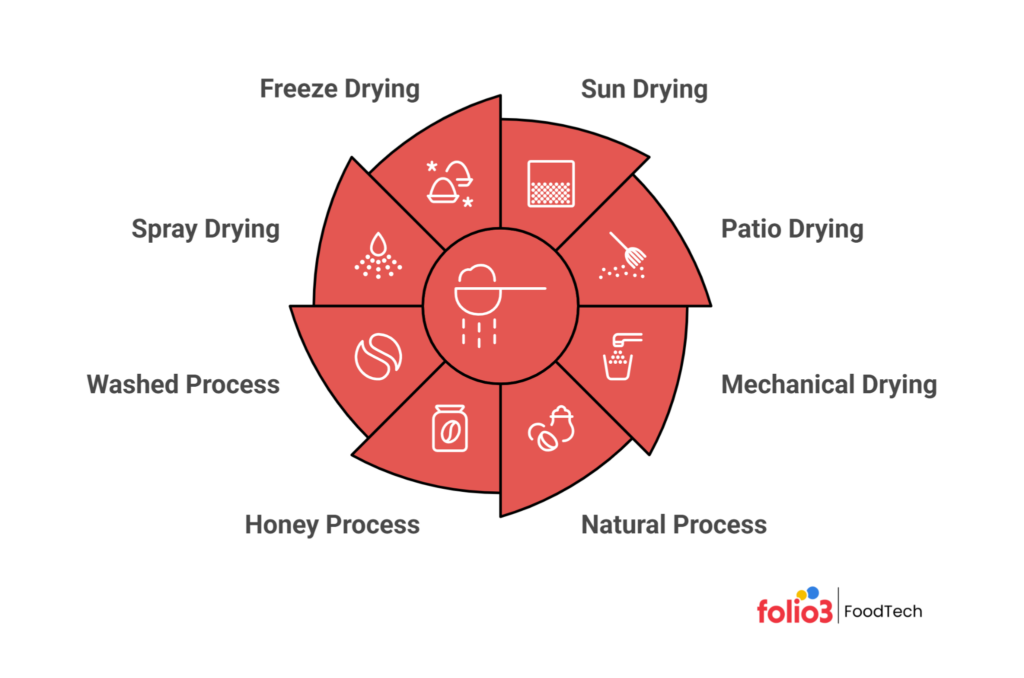
There is no single correct approach to the coffee drying process. The right method depends on the processing style, the local climate, available resources, and the quality target. Here is how the primary methods break down.
| Method | Drying Time | Best For | Key Risk |
| Raised bed (sun) | 10-30 days | Washed, honey, natural | Weather dependency |
| Patio drying | 8-20 days | High-volume natural process | Uneven drying |
| Mechanical dryer | 1-3 days | High humidity regions | Over-drying, heat damage |
| Spray drying | Seconds | Instant coffee production | Volatile flavor loss |
| Freeze drying | 12-24 hours | Premium instant coffee | High equipment cost |
Sun Drying on Raised Coffee Drying Beds
Raised African beds, also called raised drying beds or elevated drying tables, are the gold standard for specialty coffee. Beans are spread in thin layers on mesh or wire-mesh surfaces elevated off the ground. Air circulates above and below the beans, enabling more even moisture loss than flat patios.
Drying coffee on raised beds typically takes 10 to 30 days, depending on altitude, temperature, humidity, and whether the coffee is natural, honey, or washed. Beans are turned regularly, often every hour during peak sunlight, to prevent surface crusting and to expose all sides to airflow.
For washed coffees, the coffee bean drying process on raised beds is relatively quick because most of the mucilage has already been removed. For naturals, where the whole cherry dries intact, the process takes significantly longer and requires strict monitoring to prevent fermentation and mold.
Raised bed drying is common across Ethiopia, Kenya, Rwanda, and Colombia. It is labor-intensive and weather-dependent, but it consistently produces the most complex, cleanest cups when done well. If you are sourcing specialty green beans or working with producers on quality improvement, coffee drying beds are a key variable to understand.
Patio Drying
Patio drying is widely used in Brazil and other large-volume producing countries. Beans are spread across concrete or brick surfaces in the open sun. The advantage is scale: large quantities of coffee can be dried at once without the infrastructure cost of raised beds.
The limitation is consistency. Concrete patios absorb and radiate heat, which can cause the layer of beans closest to the surface to dry faster than those on top. Without frequent turning, uneven drying becomes a real quality risk. Beans at the edges of the patio also dry at different rates than those in the center.
Patio drying works well for the natural coffee processing method, where the volume of beans requiring the drying coffee step is high and the target market is commodity rather than specialty. It requires attentive labor, typically 15 to 20 days, and is entirely dependent on favorable weather.
Mechanical Drying
In regions with high humidity, frequent rainfall, or a limited drying season, mechanical dryers fill the gap where sun drying alone is not reliable. Drum dryers, horizontal dryers, or parabolic dryers use controlled heat and airflow to accelerate the coffee drying process.
The critical control point in mechanical drying is temperature. Research confirms that dryer temperatures should not exceed 40 to 45 degrees Celsius. Above that threshold, heat begins to destroy the volatile aromatic compounds that give specialty coffee its character. At extreme temperatures, the internal cell structure of the bean is damaged, and beans become brittle, essentially glass-like, and fracture during hulling.
A common approach on farms with both options is to begin with sun drying to remove the bulk of the moisture over several days, then finish in a mechanical dryer to hit the target moisture range precisely. This hybrid approach balances quality with speed and reduces the weather dependency risk.
Understanding the right drying method for your product matters just as much as getting food processing methods right in any other category of food production.
Natural Process Coffee Drying
The natural process, also called the dry process, is the oldest coffee processing method in existence. In this approach, the whole cherry is placed directly on raised drying beds or patios after harvesting, without any pulping or washing. The bean dries inside the fruit.
Natural process coffee drying time is the longest of any method, often 20 to 30 days on raised beds. The cherry must dry uniformly all the way through. If the outer fruit dries too quickly, the skin hardens and traps moisture in the inner layers, creating fermentation in an enclosed environment.
The upside of natural processing is flavor. When done correctly, the sugars in the drying cherry migrate into the bean during the drying coffee process, producing naturally processed coffees with pronounced fruit notes, full body, and sweetness that washed coffees rarely achieve.
The downside is variability. Uncontrolled fermentation, mold, and inconsistent ripeness in the lot are all harder to manage when the cherry is left intact. Sorting before drying is critical. Any unripe, overripe, or damaged cherries should be removed before they go onto the coffee drying beds, as they can contaminate the entire batch.
Many producers in Ethiopia, Brazil, and Yemen rely on natural process coffee drying beds as a core part of their post-harvest workflow. The method requires little water, which also makes it appropriate for regions where water scarcity is a production constraint.
Honey Process Coffee Drying
In honey processing, the cherry skin is removed but varying amounts of mucilage are left on the parchment before drying. The mucilage gives the beans their characteristic sticky texture during drying, which is where the name comes from.
The amount of mucilage left on the bean determines the honey type: yellow, red, or black. Yellow honey has the least mucilage and dries fastest, usually 8 to 12 days. Black honey retains nearly all the mucilage and requires up to 30 days on raised beds with frequent turning to prevent mold.
Honey process beans are particularly sensitive during the coffee drying process. The sugars in the mucilage create an ideal environment for yeast and bacteria if temperature and airflow are not managed correctly. Producers must turn the beans more frequently than washed coffees and protect them from heavy rain or excessive humidity.
The result, when the drying coffee step is handled well, is a cup that sits between washed and natural: cleaner than a natural but sweeter and fuller than a washed coffee. This is why honey process coffees have grown in popularity across Central America, particularly in Costa Rica and El Salvador.
Just as food safety culture requires consistent practices at every touchpoint, honey process drying demands the same level of operational discipline on the drying bed.
Washed Process Coffee Drying
Washed coffees go through depulping and fermentation before they reach the drying stage. By the time the beans hit the coffee drying beds, most of the mucilage has been removed. The beans at this point are in parchment, and drying coffee in parchment is less risky than drying naturals or honeys because there is less organic material to ferment.
The coffee drying process for washed beans typically takes 10 to 20 days on raised beds or patios. The main risks are still present: beans must be turned regularly, and any moisture that accumulates under the parchment layer can still lead to mold or flavor defects.
Washed coffees dried on raised beds at altitude generally produce the cleanest, brightest cup profiles, with acidity, clarity, and terroir-driven characteristics clearly expressed. This is why Ethiopia Yirgacheffe and Kenyan washed coffees are benchmarks in the specialty industry.
The washed coffee bean drying step is where dry process coffee and washed coffee diverge most clearly in terms of management. A dry-process coffee requires continuous monitoring for weeks. A washed coffee can reach optimal moisture levels faster with less risk, but that does not mean the drying step should be treated as an afterthought.
Spray Drying Coffee: The Industrial Method
Spray drying is the primary method used to produce instant coffee at scale. It is not a method used for green coffee or specialty coffee production. Instead, the spray drying coffee process takes brewed liquid coffee extract and converts it into a dry powder.
Here is how the spray drying coffee process works: Liquid coffee extract is pumped into a drying chamber. It is atomized into a fine mist through a nozzle. Hot air, typically between 150 and 300 degrees Celsius, is blasted through the chamber. The water evaporates almost instantly, leaving behind dry coffee powder that falls to the bottom of the chamber and is collected.
The entire spray drying coffee process takes seconds per unit of extract. This is why it is the preferred method for high-volume instant coffee manufacturing: it is fast, continuous, and cost-effective at scale.
The trade-off is flavor. The high temperatures used in spray drying destroy many of the aromatic volatile compounds that give fresh coffee its character. Spray-dried instant coffee has a recognizably flat, somewhat harsh flavor profile compared to freshly brewed coffee, because the compounds that carry aroma and complexity are lost during the drying process.
For brands and manufacturers focused on instant coffee quality, understanding where spray drying limitations start helps inform whether a premium product line might need a different approach, which leads directly to freeze drying.
Managing these processing trade-offs is also a key part of broader food product development decisions, particularly when brands are balancing production cost against finished product quality.
Freeze Drying Coffee: The Premium Option
Freeze drying coffee is a more sophisticated and expensive process, used to produce premium instant coffee that retains significantly more of the flavor and aroma characteristics of the original brew.
The freeze drying coffee process works in the following stages. First, brewed coffee extract is frozen into a solid state. Then, the frozen extract is placed in a vacuum chamber. Under very low pressure, the water in the frozen extract undergoes sublimation: it converts directly from ice to vapor without passing through a liquid stage. The vapor is then removed, leaving behind a porous, dry coffee solid that is ground or broken into granules.
Because the freeze drying coffee process operates at low temperatures throughout, the volatile aromatic compounds that spray drying destroys are largely preserved. The result is an instant coffee that is closer in flavor to freshly brewed coffee than anything produced through spray drying.
The process takes considerably longer than spray drying, typically 12 to 24 hours per cycle, and the equipment required is significantly more expensive to purchase and maintain. For this reason, freeze-dried instant coffee carries a higher price point, and it is primarily used by brands targeting the premium end of the instant coffee market.
Both spray and freeze drying are post-extraction drying methods, meaning they apply to brewed coffee, not green or roasted beans. This is an important distinction from the sun drying and mechanical drying methods used at origin, which work on green coffee before roasting.
Maintaining flavor integrity through these types of processing decisions is part of a broader approach to food quality assurance that applies across the food and beverage sector.
What Happens When the Coffee Drying Process Goes Wrong
Understanding the consequences of poor drying is as important as understanding the methods themselves. Here are the most common defects that trace back to a failed or inconsistent coffee drying process:
Mold and Mycotoxins
When coffee dries too slowly or the initial moisture content is too high, mold can establish itself on the surface of the bean or inside the parchment. Certain molds produce mycotoxins, which are toxic compounds that cannot be eliminated by roasting and can remain in the final cup.
Fermented or Sour Defect
Uncontrolled fermentation during the early stages of drying coffee produces acetic and lactic acids at levels that register as sour or vinegar-like in the cup. This is one of the most common defects in natural and honey process coffees that have not been turned frequently enough or have been stacked too deeply on drying beds.
Faded or Underdeveloped Flavor
Beans that are over-dried lose moisture below the safe threshold, and with it, they lose the cellular integrity needed for even roasting. The result is a flat, faded cup with poor roast development and low aromatic intensity.
Cracked or Broken Beans
Beans dried too quickly, particularly in mechanical dryers running above temperature limits, develop internal stress fractures. These beans crack during hulling, producing a high proportion of broken fragments that roast unevenly and reduce the overall cup score.
These are avoidable outcomes. Controlling the coffee drying process with moisture meters, consistent turning schedules, and appropriate temperature management eliminates most of them. The same principle of prevention over remediation applies to causes of food contamination in processing facilities more broadly.
Monitoring Moisture During the Coffee Drying Process
Experienced producers rely on moisture meters to track the drying coffee process in real time. A good moisture meter measures the electrical conductivity of the bean or parchment, which correlates to water content. These are calibrated against oven-drying tests, the reference method established by ISO for green coffee moisture measurement.
Readings should be taken from multiple points in the drying lot, not just from the surface. The center of a pile or the middle of a drying bed will often be wetter than the outer edges. Random sampling across the lot gives a more accurate picture of where the coffee actually stands in the drying process.
Many producers record moisture data at regular intervals throughout the drying period. This data helps identify batches that are drying too slowly, adjust airflow or turning frequency, and determine when the lot is ready to move to dry milling and storage. In larger operations, this kind of data tracking connects directly to food supply chain management systems that trace quality through the entire value chain.
How Coffee Drying Affects Shelf Life
Shelf life starts on the drying bed, not on the roastery shelf. Green coffee that has been dried correctly and reaches the target moisture range of 11 to 12% can remain in stable condition for 12 months or more under proper storage conditions. Coffee that comes off the drying beds too wet or with uneven moisture distribution will deteriorate much faster, regardless of how well it is stored afterward.
Key factors that link the coffee drying process to shelf life include:
• Moisture uniformity: Uneven drying means some beans are still holding excess water that will support microbial activity during storage.
• Water activity: Even when average moisture content looks acceptable, water activity (the availability of water for microbial use) can still be elevated if drying was uneven or rushed.
• Temperature during drying: High-heat mechanical drying can cause lipid oxidation that is not immediately obvious but accelerates flavor staling over time.
• Oxygen exposure: Beans dried on open patios are exposed to oxygen throughout the process, which begins the oxidation of aromatic compounds well before roasting.
These factors are why a thorough food shelf life testing approach matters even for agricultural commodities like green coffee, particularly when specialty producers or exporters need to guarantee quality over extended supply chain timelines.
What This Means for Coffee Businesses
If you are operating a coffee roastery, managing green coffee procurement, or running a coffee production facility, the drying process is a quality lever you cannot afford to ignore.
For roasters buying green coffee, understanding the drying process helps you ask better questions when sourcing. A coffee that was dried too fast on a patio at low altitude will behave differently in the roaster than one that dried slowly over 25 days on raised beds at 1,800 meters, often requiring an entirely different roast profile to compensate for the density and moisture differences. This is information worth having before you commit to a lot.
For producers and exporters, investing in raised coffee drying beds, training workers on turning schedules, and equipping processing stations with moisture meters is a direct investment in lot quality, export compliance, and price premiums.
For coffee manufacturers producing instant or ready-to-drink products, choosing between spray drying and freeze drying affects your product’s flavor profile, production cost, and market positioning. A premium instant line needs freeze drying. A high-volume commodity product makes spray drying economics work. Neither is wrong, but the choice has to be deliberate.
The right software infrastructure helps connect these quality decisions across the supply chain. Coffee roasting software designed for the specialty coffee industry can help roasters and producers track incoming lot data, link green coffee origin information to roast outcomes, and maintain quality records that support buyer relationships and certification requirements.
Broader production tracking also connects to how you manage food safety hazards throughout your facility, whether that means monitoring for mold risk in green coffee storage or managing temperature controls in a spray drying operation.
Conclusion
The coffee drying process is one of the most consequential steps in the journey from cherry to cup. It determines moisture content, which drives shelf life and export compliance. It shapes the flavor precursors that roasters work with. And it is where many of the most common quality defects are either created or prevented.
Whether you are working with natural process coffee drying beds, managing a washed lot through raised drying, running a mechanical dryer in a high-humidity growing region, or making decisions about spray drying versus freeze drying for an instant coffee line, the fundamentals are the same. Slow, even, controlled drying at the right temperature consistently outperforms fast, high-heat, or neglected drying.
Understanding this step in depth gives you better conversations with producers, better sourcing decisions, and better product quality outcomes. And that is worth far more than the time it takes to get it right.
FAQs
What Is the Ideal Moisture Content After the Coffee Drying Process?
The target moisture content at the end of the coffee drying process is between 11% and 12% for green coffee destined for export and storage. The International Coffee Organization sets the allowable export range at 8 to 12.5%. Falling below 9% risks damage to bean structure and flavor, while exceeding 12.5% creates mold and mycotoxin risk during storage and transport.
How Long Does Coffee Drying Take on Raised Beds?
Drying coffee on raised beds typically takes 10 to 30 days, depending on the processing method, altitude, ambient temperature, and humidity. Natural process coffees take the longest because the whole cherry must dry through completely. Washed coffees dry faster since the mucilage has already been removed. The actual time varies significantly by farm and growing region.
What Is the Difference Between Spray Drying and Freeze Drying Coffee?
Both the spray drying coffee process and the freeze drying coffee process are used to make instant coffee from brewed extract, but they differ significantly in temperature, time, and flavor outcome. Spray drying uses hot air, is very fast, and results in some loss of aromatic compounds. Freeze drying uses low temperatures and sublimation, takes longer, and preserves significantly more flavor and aroma. Freeze-dried instant coffee generally produces a better cup but costs more to produce.
Can Bad Coffee Drying Be Fixed After the Fact?
No. Defects created during the coffee drying process, such as mold contamination, uneven fermentation, or structural damage from over-drying, cannot be corrected at the roasting or brewing stage. This is why getting the drying step right at origin matters so much. Proper sorting before drying, correct moisture monitoring during the process, and appropriate turning schedules are the only effective preventive measures.
What Are Natural Process Coffee Drying Beds, and How Do They Work?
Natural process coffee drying beds are raised mesh or wire-mesh tables where whole coffee cherries are spread in thin layers and dried in the open air. The raised design allows airflow above and below the beans, which promotes more even moisture loss than flat patio surfaces. Workers turn the cherries regularly, often several times a day, to prevent surface crusting, mold formation, and uneven drying. Raised beds are widely used across Ethiopia, Kenya, Rwanda, and parts of Central America for both natural and washed coffees.
How Does the Coffee Drying Process Affect Flavor?
The coffee drying process affects flavor in several direct ways. The rate of drying influences how much residual fermentation occurs, which shapes the acids and sugars in the bean. The temperature during drying affects whether volatile aromatic precursors are preserved or degraded. The duration and method, whether sun on raised beds, mechanical heat, spray drying, or freeze drying, each produce different conditions that carry through to the final cup. Slower, more controlled drying generally produces better flavor outcomes for green coffee.
Is Mechanical Drying Worse Than Sun Drying for Coffee Quality?
Not necessarily. Mechanical drying is a tool, and like any tool, the outcome depends on how it is used. When temperatures are kept below 40 to 45 degrees Celsius and the process is carefully monitored, mechanical drying can produce quality results comparable to sun drying. The risk comes from running dryers at too high a temperature or for too long, which degrades flavor compounds and damages bean structure. Many producers successfully combine partial sun drying with a mechanical drying finish to hit precise moisture targets without sacrificing quality.


