

The CDC estimates that roughly 48 million Americans get sick from foodborne illnesses every year, leading to 128,000 hospitalizations and 3,000 deaths. A significant number of these cases trace back to contaminated surfaces inside food processing and preparation environments. For food processors, maintaining every food contact surface is not just a regulatory checkbox. It is a direct line of defense between your product and a potential recall, lawsuit, or public health crisis.
In this blog, you will learn what a food contact surface actually is, see practical examples you deal with every day, understand what materials qualify as food grade, and walk through the cleaning protocols and compliance steps that keep your facility audit-ready. Whether you run a small processing unit or manage a large-scale operation, this guide covers what you need to protect your consumers and your business.
What Is a Food Contact Surface?
A food contact surface is any surface that directly touches food or from which moisture, liquids, or residues may drain onto food during normal operations. This food contact surfaces definition comes directly from the FDA under 21 CFR Part 110, which also includes utensils and equipment surfaces that make contact with food products during manufacturing, processing, packing, or storage.
So what is a food contact surface in practice? Think about the cutting board your team uses to portion raw chicken. Think about the stainless steel conveyor belt moving packaged goods through your facility. Think about the rubber gaskets inside your mixing equipment. All of these qualify. If the surface touches the product, or if drainage from that surface can reach the product, it is a food contact surface.
Understanding this definition matters because every food contact surface in your facility falls under strict federal and state regulations. Failing to identify even one surface correctly can result in contamination that puts consumers at risk and puts your business in front of regulators. If you are trying to stay ahead of food safety hazards in your operation, getting this foundational concept right is where it all starts.
Common Examples of Food Contact Surfaces in Processing Facilities
When people hear the term food contact surface, they often think of obvious items like knives and cutting boards. But in a food processing facility, the list of contact surfaces goes much further. Here are some of the most common food contact surfaces examples that processors deal with daily:
| Category | Examples of Food Contact Surfaces |
| Preparation Equipment | Cutting boards, knives, slicers, grinders, mixers, blenders |
| Processing Machinery | Conveyor belts, filling machines, hoppers, tanks, pasteurizers |
| Storage and Holding | Shelving that contacts unwrapped food, storage bins, trays, racks |
| Packaging Components | Packaging films, containers, lids, sealing surfaces |
| Employee Touchpoints | Gloves, aprons, tongs, ladles, spatulas, thermometers |
| Cleaning Tools | Brushes, sponges, and cloths used on food contact surfaces |
What catches many processors off guard are the surfaces that are not immediately obvious. Rubber gaskets inside pumps, the interior walls of piping systems, and even the splash zones around sinks can qualify as food contact surfaces if drainage reaches the product. The key is to audit your entire production line and ask: does this surface, or anything draining from it, touch my product?
A thorough audit of all contact surfaces is the foundation of any solid food safety program. If you are also dealing with contamination in your processing facilities, identifying every food contact surface is the critical first step toward solving the problem.
Food Contact Material: What Makes a Material Food Grade?
Not every material can be used as a food contact surface. The FDA requires that any food contact material must meet specific safety criteria before it is allowed in a food processing environment. All food contact surfaces must be made from materials that are non-toxic, non-absorbent, corrosion-resistant, and durable enough to withstand repeated cleaning with commercial-grade sanitizers.
Here are the most widely used food grade materials in food processing:
Stainless Steel
Stainless steel is the most common food contact material in processing plants. Only specific grades qualify as food grade. Grade 304 is the standard choice because of its resistance to corrosion and ease of cleaning. Grade 316 offers better resistance to salt and acidic environments, making it ideal for seafood and dairy operations. Grade 430 is a budget-friendly option for less demanding applications. All three are non-porous, heat-resistant, and free of crevices when properly fabricated.
Food-Safe Plastics
Certain plastics like HDPE (high-density polyethylene), PP (polypropylene), and PTFE (Teflon) are approved for food contact. These materials are lightweight, resistant to chemicals, and easy to mold into complex equipment shapes. However, they must be replaced more frequently than metals because they can scratch, warp, or degrade over time, creating hiding spots for bacteria.
Other Approved Materials
Ceramics, tempered glass, and certain food-safe rubber compounds are also used as food contact surfaces in specific applications. Wood is approved for limited uses (like cutting boards in certain retail settings) but is generally avoided in processing plants because its porous nature makes it difficult to sanitize completely.
The FDA outlines the approved list of food contact substances in 21 CFR Parts 175 through 178. Every food contact material used in your facility needs to be traceable back to one of these regulations, a prior sanction, or a food contact notification (FCN). If a material does not have an authorization pathway, it should not be touching your product.
Getting your materials right is a core part of food quality control. Choosing the wrong material for a food contact surface can lead to chemical migration, bacterial harborage, and compliance failures during audits.
What All Food Contact Surfaces Must Be: Key Requirements
All food contact surfaces must be designed, constructed, and maintained to meet specific standards. Regulators, auditors, and certification bodies all look for these characteristics when evaluating your facility:
- Smooth and Non-Porous: The surface must be free of pits, cracks, and crevices where food particles and bacteria can accumulate. Even microscopic imperfections can harbor pathogens like Listeria and Salmonella. If you are working to control Listeria in your facility, surface smoothness should be one of your first priorities.
- Easy to Clean and Sanitize: Every food contact surface must allow for thorough cleaning and effective sanitization. If a surface cannot be reached by cleaning solutions or tools, it becomes a contamination risk. This applies to equipment interiors, joints, seams, and any hard-to-reach areas.
- Resistant to Corrosion: Food contact surfaces are exposed to water, cleaning chemicals, acids from food products, and sometimes high-pressure wash systems. The material must withstand all of this without breaking down, chipping, or corroding.
- Non-Toxic and Non-Absorbent: The surface must not leach chemicals or absorb food particles. Materials that absorb moisture become breeding grounds for mold and bacteria. Non-absorbent materials also prevent cross-contamination between production runs.
- Durable Under Operating Conditions: A food contact surface must hold up under the temperatures, pressures, and mechanical stresses it faces during daily operations. A surface that degrades or cracks under normal use creates a safety hazard and a compliance violation.
These requirements apply whether your food contact surface is a stainless steel table, a rubber conveyor belt, or a plastic container. The standard does not change based on the material.
Cleaning and Sanitizing Food Contact Surfaces: Step-by-Step Protocols
Keeping every food contact surface clean is not just about appearance. It is about eliminating the bacteria, allergens, and residues that cause foodborne illness. The FDA and most food safety certification programs require a structured approach to cleaning and sanitizing all food contact surfaces.
The Four-Step Cleaning Process
Every food contact surface should go through these four steps after use:
Step 1: Clean. Remove visible food debris and residue from the surface using an appropriate detergent solution. Use the right water temperature as specified by the detergent manufacturer.
Step 2: Rinse. Rinse the surface with clean water to remove all traces of the detergent and loosened food particles. Leftover detergent residue can interfere with the sanitizer in the next step.
Step 3: Sanitize. Apply an approved sanitizing solution to the food contact surface. The concentration, contact time, and temperature of the sanitizer all matter. Using too little sanitizer or not leaving it on long enough will not kill the bacteria you are trying to eliminate.
Step 4: Air Dry. Allow the food contact surface to air dry completely. Wiping with a cloth after sanitizing can reintroduce bacteria to the surface and defeat the purpose of the entire process.
When Should You Clean Food Contact Surfaces?
Timing matters as much as technique. You should clean and sanitize food contact surfaces:
After every use, especially between different food types. When switching from raw to cooked products, every contact surface must be cleaned and sanitized before the next product touches it. If equipment is in continuous use, clean it at least every four hours. After any interruption where contamination may have occurred. At the start and end of every shift.
These protocols directly support your efforts around food safety compliance. Missing even one cleaning cycle on a single food contact surface can create the conditions for a contamination event.
FDA Regulations and Compliance Standards for Food Contact Surfaces
Food contact surface compliance is not governed by a single rule. Multiple federal regulations and industry standards work together to set the requirements you must meet.
FDA Regulations Under 21 CFR
The FDA’s Code of Federal Regulations (21 CFR) is the backbone of food contact surface regulation in the United States. Parts 110 and 117 establish Current Good Manufacturing Practices (CGMPs), which include requirements for design, construction, and maintenance of all food contact surfaces. Parts 175 through 178 cover materials and substances authorized for use as food contact materials.
Under these regulations, every food contact material must be authorized through at least one of three pathways: a regulation listed in 21 CFR, a food contact notification (FCN), or a threshold of regulation (TOR) exemption. If the material in your equipment does not fall under one of these, it is not legally approved for use.
HACCP and Food Contact Surface Monitoring
If your facility operates under a HACCP plan, your food contact surfaces are likely tied to one or more critical control points. HACCP requires that you identify every point where contamination can occur, and food contact surfaces are among the most common sources. Your plan should include monitoring procedures and corrective actions specifically for food contact surface sanitation.
Third-Party Certifications
Beyond FDA requirements, many food processors pursue certifications like SQF, BRC, or FSSC 22000. All of these include detailed requirements for food contact surface management. Auditors will inspect your surfaces, review cleaning records, and test for microbial contamination. Falling short on food contact surface standards is one of the most common reasons for audit non-conformances.
Understanding the full scope of food safety standards that apply to your operation helps you build a compliance program that covers every food contact surface in your facility.
Common Mistakes Food Processors Make with Food Contact Surfaces
Even experienced food processing teams make errors when it comes to food contact surface management. These mistakes may seem minor, but each one can lead to contamination, failed audits, or worse. Here are the most common ones:
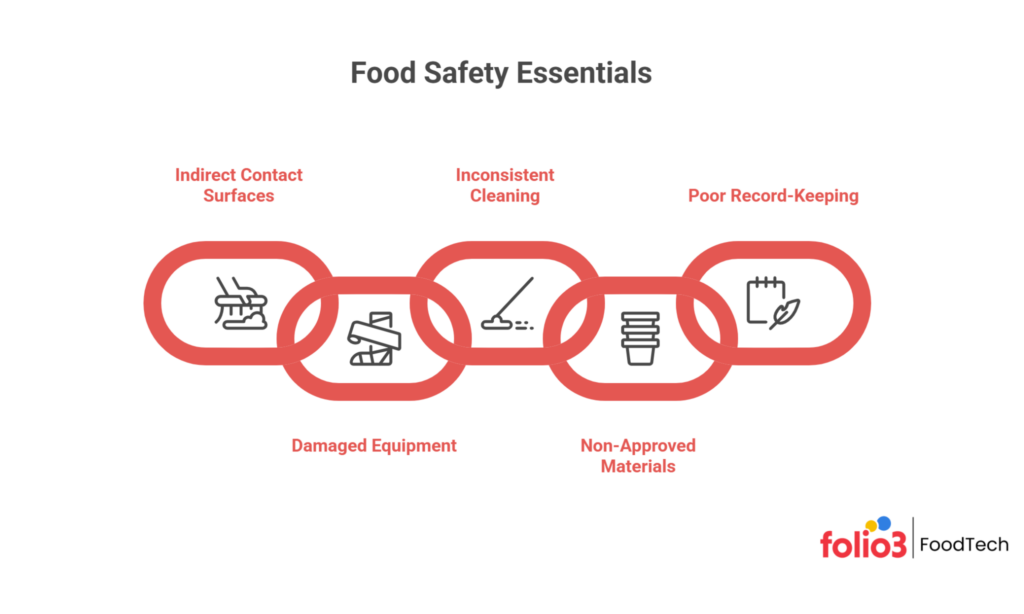
Overlooking indirect contact surfaces
Surfaces that do not directly touch food but allow drainage or splashing onto the product are still classified as food contact surfaces. Overhead pipes, splash guards, and equipment housings are often missed during audits.
Using damaged equipment
Cracked cutting boards, scratched stainless steel, and worn rubber gaskets create harboring points for bacteria. A food contact surface that was safe when new may no longer meet the standard after months of wear. Regular inspections and timely replacement are essential.
Inconsistent cleaning schedules
Cleaning protocols only work when followed consistently. Skipping a scheduled cleaning because production is behind is one of the fastest ways to create a contamination event.
Using non-approved materials
Substituting equipment parts with materials not verified as food grade is a compliance violation. This happens more often than you might think, especially during emergency repairs. Every replacement part that becomes a food contact surface must be verified against FDA-approved food contact materials.
Poor record-keeping
If you cannot prove a food contact surface was cleaned, sanitized, and inspected, regulators will treat it as if it was not. Documentation is your evidence.
Many of these mistakes tie back to biological hazards in food that thrive on improperly maintained surfaces. Fixing these issues is not complicated, but it does require discipline and accountability across your team.
How Technology Helps You Manage Food Contact Surface Compliance
Managing food contact surface compliance across an entire facility using paper logs and manual checks is prone to error. This is where technology makes a real difference.
Modern food safety software platforms allow you to digitize your entire sanitation program. You can schedule cleaning tasks for every food contact surface, assign them to team members, set automated reminders, and capture real-time verification data. When an auditor asks for proof that a specific food contact surface was cleaned on a specific date, you can pull that record in seconds.
Environmental monitoring systems can also track conditions like temperature and humidity in areas where food contact surfaces are used. These conditions affect bacterial growth, and real-time data helps you respond to risks before they become problems.
Traceability systems add another layer. By linking food contact surface cleaning records to specific production batches, you create documentation showing which surfaces were involved in producing each product. If a contamination issue arises, you can trace it to the specific food contact surface and timeframe.
For processors dealing with chemical hazards in food, technology also helps track cleaning chemical concentrations and ensures the right sanitizer is being used on each food contact surface at the correct dilution.
Building a Preventive Maintenance Program for Food Contact Surfaces
Cleaning is only half the equation. The physical condition of your food contact surfaces matters just as much. A preventive maintenance program ensures that every food contact surface stays in compliance before issues develop into safety risks.
Start by creating an inventory of every food contact surface in your facility, including less visible ones like pipe interiors, valve components, and gasket seals. Each surface should have a maintenance schedule that includes visual inspections and replacement timelines.
Train your maintenance team to recognize early signs of wear. Pitting on stainless steel, discoloration on plastic components, and cracking in rubber seals all indicate a surface is no longer safe. Pair your maintenance program with your food safety software system to automate inspection schedules and log findings digitally.
Conclusion
Every food contact surface in your facility represents a point where safety either holds or breaks. Understanding the food contact surfaces definition, knowing which food grade materials are approved, following the right cleaning protocols, and maintaining compliance with FDA regulations are the essentials of any food safety program.
The common thread is accountability. You need to know where every food contact surface is, what condition it is in, when it was last cleaned, and whether the material meets current standards. Technology can help you track all of this, but the commitment has to come from your team.
If you are looking to strengthen how your facility handles food contact surface management, start with a full audit of your surfaces, review your cleaning SOPs, and make sure your documentation is audit-ready. The cost of getting this right is always less than the cost of getting it wrong.
FAQs
What Is A Food Contact Surface?
A food contact surface is any surface that directly touches food or from which liquids and residues may drain onto food during production, processing, or packaging. This includes equipment, utensils, conveyor belts, and any other surfaces that come into contact with the product.
What Are Some Examples Of Food Contact Surfaces?
Examples of food contact surfaces include cutting boards, knives, mixing bowls, conveyor belts, storage bins, packaging materials, gloves, and the interior surfaces of processing equipment like tanks and pipes.
How Often Should Food Contact Surfaces Be Cleaned And Sanitized?
Food contact surfaces should be cleaned and sanitized after every use, when switching between different food types, at least every four hours during continuous use, and after any interruption where contamination may have occurred.
What Materials Are Approved For Food Contact Surfaces?
The FDA approves materials such as stainless steel (grades 304, 316, and 430), certain plastics like HDPE and polypropylene, tempered glass, ceramics, and specific rubber compounds. All must be non-toxic, non-absorbent, and corrosion-resistant under 21 CFR Parts 175 through 178.
What Happens If A Food Contact Surface Is Not Properly Maintained?
A poorly maintained food contact surface can harbor bacteria, mold, and allergens that contaminate food products. This can lead to foodborne illness outbreaks, product recalls, regulatory penalties, and failed audits.


