

The global frozen food market was valued at over $325 billion in 2025, and that number keeps climbing. Behind every frozen meal, bag of vegetables, or pack of seafood sitting in your freezer is one thing that determines whether you get a quality product or a freezer-burned disappointment: the packaging.
Frozen food packaging does far more than hold a product together. It acts as a barrier against moisture loss, oxygen exposure, and temperature swings that break down food over time. When packaging fails, businesses lose money, consumers lose trust, and perfectly good food ends up in the trash.
If you are a food manufacturer, distributor, or brand owner working with frozen products, understanding how frozen food packaging works is not optional. It directly impacts your product quality, regulatory compliance, shelf life, and bottom line.
In this blog, you will learn about the materials, formats, and technologies behind effective frozen food packaging. We will cover everything from shipping challenges to sustainable options, so you can make smarter packaging decisions for your business.
Why Frozen Food Packaging Matters More Than You Think
Many businesses treat packaging as an afterthought. They focus on the food itself, the freezing process, or the distribution logistics. But frozen food packaging is where all of those efforts either hold up or fall apart. The frozen food packaging market alone was valued at $12.05 billion in 2025, which tells you how much the industry invests in getting this right.
The USDA estimates that 30 to 40 percent of the U.S. food supply is wasted every year, much of it due to spoilage during storage, transportation, and distribution. A large portion of that spoilage in frozen products comes down to packaging that cannot maintain a proper barrier under cold storage conditions.
When frozen food packaging fails, here is what typically goes wrong:
- Freezer burn from moisture escaping the product surface
- Off-flavors caused by oxygen getting through the packaging material
- Texture breakdown from ice crystal formation during temperature fluctuations
- Contamination from torn or punctured packaging during transit
For businesses, these are not just quality issues. They translate directly into customer complaints, product returns, retailer chargebacks, and damaged brand reputation. Choosing the right frozen food packaging is one of the most cost-effective ways to protect your margins.
The Business Cost of Getting Packaging Wrong
Consider what happens when a retailer receives a shipment of frozen products with compromised packaging. The store pulls those items from the shelf. You absorb the cost. If it happens repeatedly, the retailer may reduce your shelf space or drop your product entirely.
Good packaging for frozen food is not about spending more. It is about spending wisely on materials and formats that match your product, your supply chain, and your customer expectations. Businesses that invest in the right frozen food packaging from the start almost always see lower waste rates and stronger retail relationships.
Common Frozen Food Packaging Materials and Formats
Not all packaging materials perform the same way under frozen conditions. The material you choose affects everything from barrier performance to printability and cost. Here is a breakdown of the most common options.
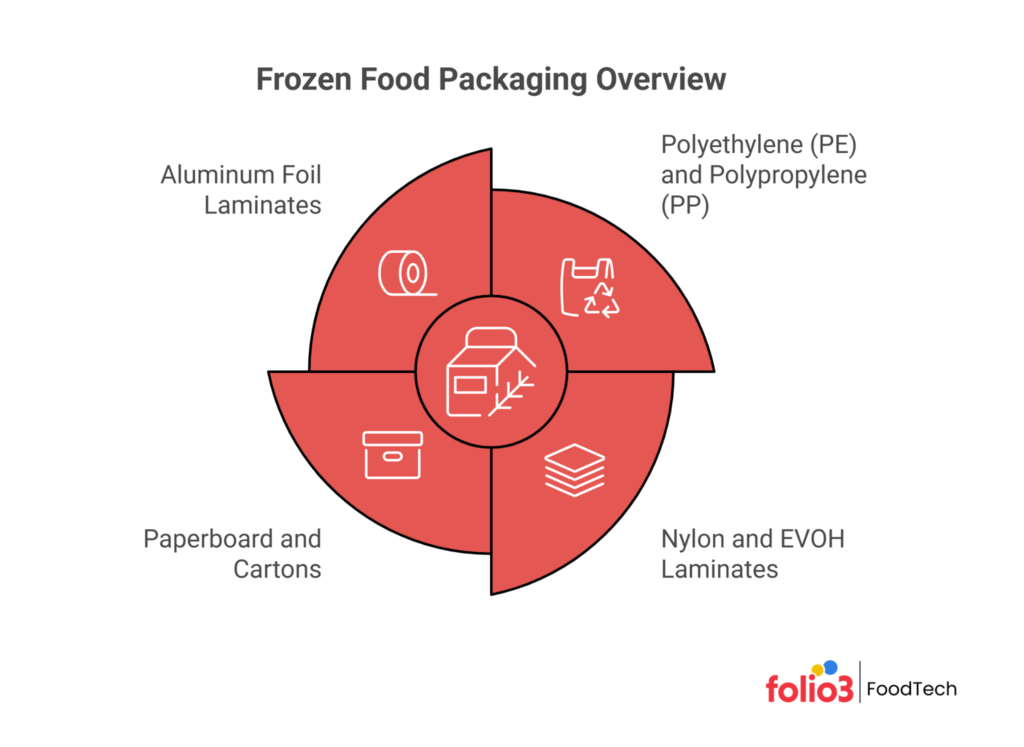
Polyethylene (PE) and Polypropylene (PP)
These are the workhorses of packaging frozen food. Polyethylene is flexible, moisture-resistant, and performs well at freezing temperatures without becoming brittle. Polypropylene offers better clarity and stiffness, which makes it a popular choice for rigid containers and trays.
Most stand-up pouches and bags used in frozen food packaging rely on PE-based films or laminates that combine PE with other materials for added strength.
Nylon and EVOH Laminates
When oxygen barrier performance is critical, like with frozen meat or seafood, nylon and EVOH (ethylene vinyl alcohol) layers get added to the packaging structure. These multi-layer films keep oxygen out and lock moisture in, which is exactly what you need for products with longer frozen shelf life requirements.
If you work with frozen proteins, understanding how material selection ties into frozen meat shelf life is essential for reducing product loss.
Paperboard and Cartons
Paperboard cartons are still widely used in frozen food packaging, especially for retail products like frozen dinners, pizza, and vegetables. They provide a flat surface for branding and labeling, and most are lined with a PE coating to resist moisture.
The downside is that paperboard alone offers limited barrier performance. It works best when paired with an inner bag or wrap that provides the actual moisture and oxygen protection.
Aluminum Foil Laminates
Aluminum-based laminates offer some of the strongest barrier properties available. They block light, oxygen, and moisture completely. You will see these used in frozen food packaging for premium products, portion-controlled meals, and items that require extended shelf life without preservatives.
The trade-off is cost. Foil laminates are more expensive than plastic-only options, and they can make packaging less flexible.
How Frozen Food Packaging Protects Product Quality
The primary job of any frozen food packaging is to create a controlled environment around the product. That means managing three things: moisture, oxygen, and temperature stability.
Moisture Barrier Performance
Frozen products lose moisture through a process called sublimation, where ice turns directly into vapor without passing through a liquid phase. This is what causes freezer burn. The white, dry patches you see on poorly packaged frozen food are areas where moisture has escaped.
High-quality packaging uses materials with low moisture vapor transmission rates (MVTR). The tighter the moisture barrier, the longer your product stays fresh. This is especially critical for products with high water content like fruits, vegetables, and seafood.
Proper food quality control during packaging ensures that barrier integrity is tested before products leave your facility.
Oxygen Barrier Performance
Oxygen is the enemy of flavor and color in frozen products. Even at freezing temperatures, oxidation still happens, just more slowly. Over weeks and months, oxygen exposure leads to rancidity in fats, color changes in meats, and off-flavors across a range of products.
Packaging with strong oxygen barriers, typically achieved through EVOH or nylon layers, slows these reactions significantly. For products like frozen fish, this is the difference between a premium product and one that smells stale when the customer opens the package.
Temperature Fluctuation Resistance
Your product will not stay at a constant minus 18 degrees Celsius from your freezer to the consumer’s home. It will go through loading docks, delivery trucks, retail display freezers, and shopping bags. Each transition creates small temperature swings.
Good packaging for frozen products needs to handle these cycles without cracking, delaminating, or losing seal integrity. Flexible packaging tends to perform better here than rigid formats, because it can expand and contract with the product as temperatures shift.
Frozen Food Packaging for Shipping: What You Need to Know
Shipping frozen products adds a whole new layer of complexity. Your packaging now has to survive mechanical stress, temperature abuse, and extended time in transit. Packaging for shipping requires a different approach than retail packaging alone.
Insulated Packaging Systems
For direct-to-consumer or ecommerce frozen food shipments, insulated packaging is non-negotiable. This typically includes an outer corrugated box, an insulating liner (EPS foam, recycled cotton, or air-cell panels), and gel packs or dry ice to maintain temperature.
The frozen food packaging itself still needs to provide barrier protection, but the outer system handles thermal insulation. The goal is to keep the product below minus 18 degrees Celsius for the full transit window, which could be anywhere from overnight to 48 hours.
Understanding cold chain management is critical if you are shipping frozen products across any distance.
Packaging Durability During Transit
Frozen packages get stacked, dropped, vibrated, and compressed during shipping. If your food packaging for frozen food is not designed to handle this, you end up with punctured bags, broken seals, and exposed product.
Thicker gauge films, corner reinforcements on cartons, and shrink-wrapped bundles all help protect packages during the shipping process. For palletized shipments, stretch wrapping provides an additional layer of stability.
Labeling and Compliance for Shipped Frozen Products
Shipping frozen food across state lines or internationally brings regulatory requirements into play. Your frozen food packaging labels need to include proper handling instructions, storage temperatures, allergen information, and nutritional data.
If you are dealing with food transportation across multiple distribution points, having your labeling and documentation right from the start saves you from costly holds and rejections.
Custom Frozen Food Packaging: When Does It Make Sense?
Custom packaging for frozen products is not just about putting your logo on a bag. It is about designing a solution that fits your specific product dimensions, your supply chain requirements, and your brand positioning.
When to Invest in Custom Packaging
Custom packaging makes financial sense when you are dealing with products that have irregular shapes, when you need specific barrier properties that off-the-shelf options cannot provide, or when your retail presence demands a unique shelf look.
For example, a company selling premium frozen seafood entrees will benefit from a custom solution that includes a windowed tray, a printed sleeve, and a modified atmosphere seal. The package protects the product while communicating quality to the buyer.
Balancing Cost and Performance
The biggest mistake businesses make with custom packaging is over-engineering it. You do not need the highest-barrier, most expensive laminate for every product. A frozen bag of peas has very different packaging needs than a frozen salmon fillet.
Work with your packaging supplier to match materials and formats to your actual shelf life targets and distribution conditions. This keeps costs in line without sacrificing product quality.
If you are developing new frozen products and need to think through the full process from formulation to packaging, the food product development process can help you plan packaging alongside product design.
Sustainable Frozen Food Packaging: Trends and Practical Options
Sustainability is a real business concern for frozen food brands, not just a marketing angle. Retailers are setting packaging reduction targets, consumers are paying attention to environmental claims, and regulatory pressure around plastic waste is increasing in multiple markets.
What Makes Frozen Food Packaging Sustainable?
Sustainability in packaging typically focuses on one or more of these areas: reducing total material usage, switching to recyclable or compostable materials, using recycled content, and improving packaging efficiency to reduce waste.
The challenge with frozen food flexible packaging is that most of it uses multi-layer laminates. These laminate structures, which combine different plastics and sometimes foil, are very difficult to recycle through standard municipal systems.
Practical Sustainable Options Available Now
Some of the best sustainable frozen food packaging solutions currently available include:
- Mono-material PE films: These use a single polymer type across all layers, making the package recyclable where PE film collection exists.
- Paper-based trays with PE liners: These reduce plastic usage while maintaining moisture barriers. The tray can often be separated and recycled.
- Thinner gauge films: Advances in film technology allow manufacturers to achieve the same barrier performance with less material.
- PCR (post-consumer recycled) content: Some packaging suppliers now offer films with up to 30 percent recycled plastic content.
The right sustainable choice depends on your product, your distribution model, and the recycling infrastructure available to your end consumers.
Reducing waste in your packaging process also ties directly into broader food manufacturing waste reduction goals that many manufacturers are working toward.
Advanced Frozen Food Packaging Technologies
The packaging has evolved well beyond simple bags and boxes. Several technologies now allow it to actively protect and monitor product quality.
Vacuum Packaging
Vacuum packaging removes air from inside the package before sealing. This dramatically reduces oxidation and freezer burn, making it one of the most effective methods for extending frozen shelf life. It is widely used for frozen meats, fish, and cheese.
The tight fit of vacuum packaging also reduces package volume, which lowers shipping costs and improves freezer space utilization.
Modified Atmosphere Packaging (MAP)
Modified atmosphere packaging replaces the air inside a package with a specific gas mixture, usually a combination of nitrogen and carbon dioxide. For frozen products, MAP helps control oxidation and microbial activity during storage.
MAP is especially useful for frozen bakery products, prepared meals, and pasta where you need the product to look fresh when the customer opens the package.
Smart and Intelligent Packaging
Some packaging solutions now include time-temperature indicators (TTIs) that show whether a product has been exposed to unsafe temperatures during distribution. These visual indicators give retailers and consumers a quick way to verify cold chain integrity.
While still relatively expensive for mass-market products, intelligent packaging is gaining traction in premium frozen food categories and in foodservice distribution where cold chain verification matters most.
Frozen Food Packaging Ideas to Improve Your Product Line
If you are looking for practical frozen food packaging ideas to improve your product line, start with the problems you are trying to solve rather than the latest trends.
Right-Size Your Packaging
Oversized packaging wastes material, increases shipping costs, and takes up more freezer space at retail. Review your current packaging dimensions and see if you can reduce the size without compromising protection. Even a 10 percent reduction in package footprint can deliver significant savings across a full production run.
Improve Seal Quality
Weak seals are the number one cause of packaging failure in frozen products. Invest in seal testing as part of your quality control process. Check seal strength, burst pressure, and leak rates on a regular schedule. This single step can reduce your packaging-related waste significantly.
Consistently meeting food safety standards in your packaging process protects both your customers and your business.
Consider Window Packaging
Consumers want to see what they are buying, especially with frozen products where they cannot touch or smell the food. Window packaging with a clear film panel lets shoppers see the actual product inside. This works particularly well for frozen fruits, vegetables, and premium proteins.
Use Packaging to Communicate Storage Instructions
Many frozen food quality issues happen after the customer buys the product. Clear storage instructions on your frozen food packaging, including ideal freezer temperature, maximum storage time, and thawing recommendations, help the consumer get the best experience from your product.
How Technology Supports Better Frozen Food Packaging Decisions
Managing packaging across a frozen food production line involves tracking materials, monitoring quality, coordinating with suppliers, and ensuring compliance. This is where food technology and ERP systems play a role.
A food ERP solution helps manufacturers manage packaging inventory, track lot numbers tied to specific packaging runs, and maintain traceability from raw materials through to finished goods. For frozen food operations specifically, ERP systems can monitor cold chain compliance, flag temperature excursions, and automate quality hold decisions.
If you deal with frozen seafood products, seafood traceability software provides the documentation and tracking you need to meet both regulatory requirements and retailer expectations for supply chain transparency.
Understanding how frozen food packaging integrates with your broader food supply chain management strategy is what separates reactive businesses from proactive ones.
Conclusion
Frozen food packaging is not a commodity decision. It is a strategic one that directly affects your product quality, shelf life, waste rates, and customer satisfaction. The right packaging protects your product through every stage of the supply chain, from your production line to the consumer’s freezer.
Whether you are evaluating materials, exploring sustainable alternatives, designing custom packaging for a new frozen product launch, or improving how you ship frozen food, the key is matching your packaging choices to your specific product and distribution needs.
Start by understanding your product’s sensitivity to moisture, oxygen, and temperature. Then select materials and formats that deliver the barrier performance you need without over-engineering the solution. Test your packaging under real-world conditions, not just lab conditions. And build packaging quality checks into your overall production process.
The frozen food market is growing, and the businesses that get packaging right will be the ones that capture that growth with less waste, fewer customer complaints, and stronger retail partnerships.
FAQs
What Is The Best Packaging Material For Frozen Food?
The best material depends on your product. For most frozen foods, multi-layer films combining polyethylene with nylon or EVOH offer the right balance of moisture barrier, oxygen barrier, flexibility, and cost. Frozen meats often need higher barrier laminates, while frozen vegetables can work well with simpler PE-based films. The best frozen food packaging always matches the material to your actual shelf life and distribution requirements.
How Does Frozen Food Packaging Prevent Freezer Burn?
Freezer burn happens when moisture escapes from the surface of frozen food through sublimation. Frozen food packaging prevents this by using materials with low moisture vapor transmission rates that keep moisture locked inside the package. Vacuum packaging and tight seals further reduce the air space around the product, minimizing the opportunity for moisture loss.
What Are The Biggest Challenges With Frozen Food Packaging For Shipping?
The main challenges include maintaining temperature throughout transit, preventing physical damage to the package from stacking and handling, and meeting labeling and compliance requirements for different markets. Insulated shipping systems with gel packs or dry ice handle the temperature side, while durable packaging materials and proper palletization address physical protection.
Can Frozen Food Packaging Be Recycled?
Some types can be recycled, but many cannot due to multi-layer laminate structures that mix different materials. Mono-material PE pouches are recyclable where film collection programs exist. Paperboard cartons can often be recycled if the PE liner is minimal. The industry is moving toward more recyclable designs, but infrastructure for recycling flexible frozen food packaging still lags behind in most regions.
How Does Modified Atmosphere Packaging Help Frozen Products?
Modified atmosphere packaging replaces the air inside the package with a controlled gas mixture, typically nitrogen and carbon dioxide. This reduces oxidation that causes flavor loss and color changes in frozen products. It also inhibits microbial growth. MAP is especially beneficial for frozen prepared meals, bakery products, and pasta where product appearance after thawing matters to the consumer.
What Is The Role Of Packaging In Extending Frozen Food Shelf Life?
Frozen food packaging extends shelf life by creating a controlled barrier between the product and the surrounding environment. It prevents moisture loss, blocks oxygen from reaching the product surface, and maintains seal integrity through temperature fluctuations. The better the barrier properties of your packaging, the longer your frozen product maintains its original quality, texture, and flavor.


