

A single hygiene lapse on your production floor can trigger a recall that costs millions and sinks years of brand equity overnight. In today’s heavily regulated food landscape, food hygiene is no longer just a best practice. It is your first line of defense against operational shutdowns, regulatory penalties, and lost consumer trust. This guide breaks down everything you need to know about building a food hygiene and safety program that protects both your people and your bottom line.
What Is Food Hygiene? Demystifying the Core Definition
Food hygiene refers to the conditions and practices that preserve the quality of food and prevent contamination at every stage of the production chain. It covers everything from how raw materials are received on your dock to how finished goods leave your facility. In simple terms, food and hygiene management is about keeping harmful bacteria, chemicals, and physical contaminants away from the food people eat.
But here is the part most generic definitions miss. For commercial food operations, food hygiene is not a vague idea about “keeping things clean.” It is a structured system of daily actions, all designed to stop contamination before it starts. Think of it as the tactical layer of your broader food safety program. Every handwash, every sanitized surface, every temperature check is a deliberate step in maintaining hygiene food standards across your facility.
Food Hygiene vs. Food Safety: Understanding the Operational Distinction
These two terms get used interchangeably, but they serve different operational roles.
Food safety is a strategic, risk-based framework. It includes your HACCP plans, traceability systems, supplier verification protocols, and regulatory compliance programs. It is the “what” and “why” behind your safety program.
Food hygiene is the tactical, day-to-day execution. It covers cleaning schedules, handwashing compliance, temperature monitoring, and contamination prevention on the floor. It is the “how” that makes your food safety framework work in practice.
Here is a quick way to think about it: food safety tells you that raw chicken and cooked chicken must stay separate. Food hygiene is the actual protocol your team follows, including color-coded cutting boards, zoned workflows, and sanitation schedules, to make that separation happen every single shift.
The Core Objectives of Food and Hygiene Management
Every food hygiene program in a processing facility should accomplish three things:
- Biological pathogen suppression: Prevent, reduce, or eliminate harmful microorganisms like Salmonella, Listeria, and E. coli through sanitation, temperature control, and proper handling procedures.
- Shelf-life extension: By managing microbial loads and contamination risks, proper hygiene practices directly extend the usable life of your products, reducing waste and improving margins.
- Audit and compliance readiness: A well-documented hygiene program keeps your facility prepared for unannounced audits from the FDA, USDA, or third-party certification bodies at all times. Tools like a food safety documentation system can streamline this process significantly.
The Strategic Importance of Food Hygiene in Commercial Operations
Most conversations about food hygiene start and end with health warnings. That is not enough for leaders running large-scale operations. The importance of food hygiene goes far beyond avoiding illness. It is about protecting the financial engine of your business.
Mitigating Public Health Risks and Foodborne Pathogens
The numbers are staggering. According to the CDC, an estimated 48 million people get sick, 128,000 are hospitalized, and 3,000 die from foodborne diseases each year in the United States alone. Globally, the WHO estimates that unsafe food causes 600 million cases of foodborne illness and 420,000 deaths annually.
The most common culprits in manufacturing pipelines are Salmonella, Listeria monocytogenes, and E. coli. These pathogens thrive in environments where food hygiene and safety protocols break down. Moisture buildup on processing equipment, inconsistent sanitation cycles, or uncontrolled temperatures on the production floor all accelerate microbial growth.
For processing facilities handling high-risk categories like meat, dairy, or ready-to-eat products, a lapse in hygiene does not just risk a health incident. It creates the conditions for a full-scale outbreak. Understanding the causes of food contamination in processing facilities is the first step toward prevention.
Protecting Brand Reputation and Financial Performance
A product recall is not just a logistics headache. It is a financial crisis. According to a joint study by the Food Marketing Institute and Grocery Manufacturers Association, the average food recall costs a company approximately $10 million in direct expenses alone. That figure does not include lawsuits, lost sales, or the long-term erosion of retail relationships.
In 2024, 422 food recall events were recorded in the FDA Enforcement Report Database. Poor hygiene and contamination-related issues remain among the top drivers. When a retailer pulls your product from the shelf, the financial damage compounds fast. You lose revenue, you lose shelf space, and you may lose that retail partner permanently.
Beyond the immediate financial hit, there is the slower damage to consumer trust. Shoppers who see your brand associated with a contamination event do not forget quickly. Rebuilding that trust takes years of consistent performance and significant marketing investment. For companies operating in competitive retail segments, a single hygiene failure can permanently shift market share to your competitors.
Your food supply chain partners are also watching. Distributors and co-packers evaluate your hygiene track record before entering or renewing agreements. A recall on your record makes those conversations much harder.
For food leaders, investing in food hygiene and safety is not a cost center. It is an insurance policy for your revenue stream.
Foundational Food Hygiene Rules and Best Practices (The 4 Cs Framework)
The 4 Cs of food hygiene, cleaning, cross-contamination, chilling, and cooking, form the operational backbone of any compliant food handling program. These are the food hygiene rules your team needs to follow every shift.
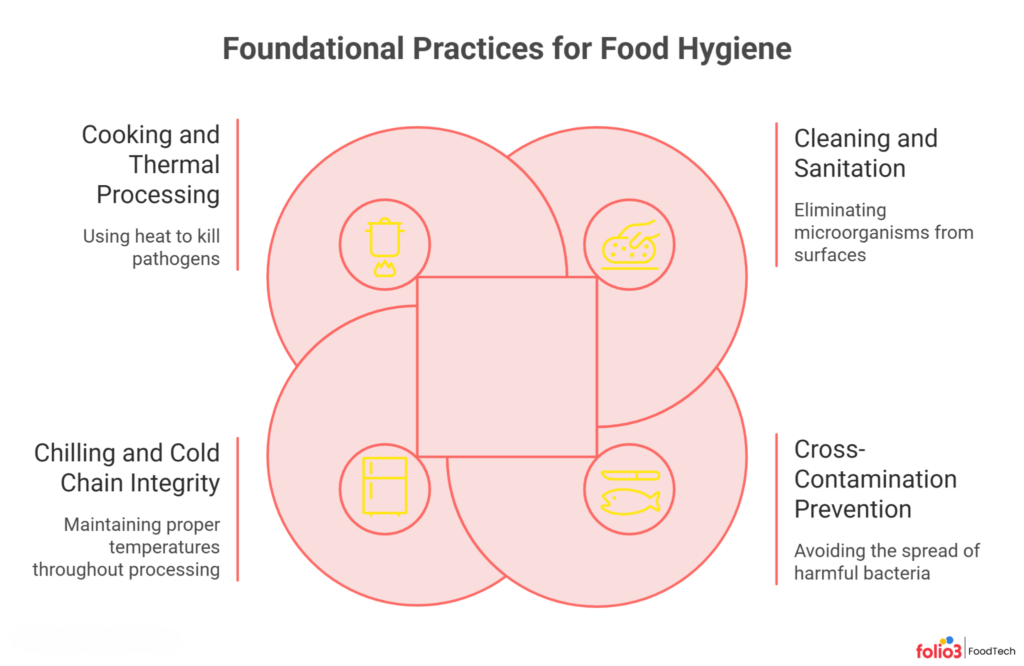
Cleaning and Sanitation: Eliminating Microorganisms
There is an important difference between cleaning and sanitizing, and most operations need both.
Standard surface cleaning removes visible dirt, grease, and food residue. It is necessary, but it does not eliminate harmful bacteria. Chemical sanitization goes further by using approved agents to reduce microbial populations to safe levels on food-contact surfaces.
In processing environments, automated sanitation methods have become essential. Clean-In-Place (CIP) systems circulate cleaning and sanitizing solutions through pipes, tanks, and processing equipment without disassembly. Clean-Out-of-Place (COP) systems handle components that must be removed and cleaned separately. Both methods deliver consistent results, reduce human error, and create verifiable logs for audit purposes.
Best practices for industrial sanitation include:
- Pre-rinse to remove loose debris before chemical application
- Use of EPA-approved sanitizers at validated concentrations
- ATP (Adenosine Triphosphate) swab testing to verify surface cleanliness post-sanitation
- Documenting every sanitation cycle with timestamps, chemical lot numbers, and personnel IDs
Cross-Contamination Prevention: Keeping Raw and Ready-to-Eat Distinct
Cross-contamination remains one of the top food safety hazards in processing facilities. Preventing it requires physical, procedural, and environmental controls working together.
- Structural segregation means designating separate zones for raw material handling, processing, and finished product packaging. Ideally, these zones have independent HVAC systems to control airflow dynamics and prevent airborne pathogen transfer from raw to ready-to-eat areas.
- Color-coded utensil and equipment systems are a simple but effective tool. Assign specific colors to specific zones or product types, so there is zero ambiguity about what goes where. Red for raw meat, green for produce, blue for cooked products.
- Zoning in food manufacturing plants typically follows a progression: Zone 1 (direct food-contact surfaces), Zone 2 (areas adjacent to food contact), Zone 3 (areas within the production room), and Zone 4 (areas outside production). Environmental monitoring programs should test all four zones at defined frequencies.
Chilling and Cold Chain Integrity in Processing
Temperature control is non-negotiable. When the cold chain breaks, pathogens multiply rapidly. For most perishable products, the danger zone between 40°F (4°C) and 140°F (60°C) is where bacterial growth accelerates to unsafe levels.
Real-time temperature tracking is now standard practice in modern facilities. IoT-enabled sensors placed in cold storage units, on processing floors, and inside transport vehicles provide continuous monitoring with automated alerts when temperatures drift outside acceptable ranges.
Key requirements for maintaining cold chain integrity include:
- Cold storage maintained consistently at or below 40°F (4°C)
- Continuous logging during transportation with GPS-tagged temperature recorders
- Documented corrective actions when deviations occur
- Regular calibration of all temperature monitoring equipment
For deeper guidance on maintaining temperature compliance across your supply chain, review best practices for cold chain compliance.
Cooking and Thermal Processing Standards
Thermal processing is your kill step. It is the point in production where you eliminate biological hazards through validated time-and-temperature combinations.
Every product category has specific critical limits. Poultry must reach an internal temperature of 165°F (74°C). Ground beef requires 160°F (71°C). These are not suggestions. They are validated parameters that must be verified and logged during every production run.
Critical components of a thermal processing program include:
- Kill-step validation studies specific to your product and equipment
- Continuous monitoring with calibrated thermocouples or data loggers at each Critical Control Point (CCP)
- Verification logs are reviewed and signed by trained QA personnel every shift
- Deviation protocols that define hold-and-test or disposal procedures when critical limits are not met
Personal Hygiene in Food Safety: The Human Component of Compliance
Even the most advanced processing equipment cannot compensate for poor personal hygiene practices on the production floor. Your team is the last line of defense, and food safety hygiene practices start with them.
What Is Personal Hygiene in Food Safety?
Personal hygiene in food safety refers to the set of individual practices that prevent workers from becoming a source of biological, physical, or chemical contamination. It covers everything from how employees wash their hands to what they wear on the production floor. It also includes policies around illness reporting and medical screening.
This is the human baseline for contamination control. No HACCP plan, no automated monitoring system, and no quality control program can fully compensate for a worker who skips a handwash or hides symptoms of a communicable illness.
Essential Rules for Personal Hygiene When Handling Food
Personal hygiene when handling food requires specific, enforceable protocols. Vague guidelines like “wash your hands frequently” are not enough. Your team needs clear, step-by-step standards they can follow consistently. Here is what a compliant program looks like:
Multi-Step Handwashing Protocols:
- Wet hands with warm running water, apply soap, and scrub all surfaces, including between fingers and under nails, for a minimum of 20 seconds
- Rinse thoroughly and dry with single-use paper towels or an air dryer
- Use contact-free fixtures (foot-pedal or sensor-activated faucets) to prevent recontamination after washing
- Apply an alcohol-based hand sanitizer after drying for an additional layer of microbial protection
- Handwashing is required before starting work, after breaks, after touching non-food-contact surfaces, after using the restroom, after handling raw products, after coughing or sneezing, and after handling waste or cleaning chemicals.
Post visual handwashing reminders at every station in the primary languages spoken by your workforce. Compliance is only as strong as the clarity of the instruction.
Personal Protective Equipment (PPE) Deployment:
- Hairnets and beard snoods are mandatory for all personnel entering production areas, with no exceptions for visitors or contractors
- Disposable gloves must be changed between tasks, especially when switching between raw and ready-to-eat product handling. Gloves are not a substitute for handwashing; hands must be washed before gloving
- Dedicated footwear or boot covers are required when transitioning between production zones, with sanitizing foot baths at zone entry points
- Smocks or coveralls should be facility-provided and laundered on-site or by a certified service. Personal clothing should never be worn on the production floor
- Remove all jewelry, watches, and loose accessories before entering production areas, as these items can harbor bacteria or become physical contaminants
Medical Screening and Illness Reporting Policies:
- Pre-employment health screenings for all production staff, including stool sample testing for high-risk roles
- Mandatory daily health questionnaires before shift entry, verified by a shift supervisor
- Strict policies requiring employees to report symptoms of vomiting, diarrhea, jaundice, sore throat with fever, or diagnosed infections like Norovirus, Hepatitis A, Salmonella, or E. coli
- Documented exclusion and return-to-work protocols that meet FDA Food Code requirements, including medical clearance before an employee returns to food-handling duties
- A workplace culture that encourages honest reporting without fear of penalty, because employees who hide symptoms to avoid losing a shift are the biggest risk to your entire operation
Navigating Food Hygiene Regulations and Legal Frameworks
The regulatory landscape for food hygiene is complex, with overlapping frameworks at the international, national, and regional levels. Understanding your food hygiene regulations is the foundation of any compliance program.
Global Benchmarks: Codex Alimentarius (FAO/WHO)
The Codex Alimentarius, established jointly by the FAO and WHO, provides the General Principles of Food Hygiene that serve as the baseline for food safety regulations worldwide. These principles outline the fundamental requirements for hygienic food production, from primary production through to final consumption.
For companies involved in international trade, Codex standards are particularly important. Many countries base their domestic food hygiene regulations directly on Codex guidelines. Meeting these benchmarks can simplify market access and reduce regulatory friction when exporting products across borders.
Regional Compliance Systems: US (FDA FSMA / USDA) vs. UK/EU Laws
United States: The FDA’s Food Safety Modernization Act (FSMA) shifted the regulatory focus from reactive response to preventive controls. Key rules include the Preventive Controls for Human Food rule, the Produce Safety Rule, and the Foreign Supplier Verification Program. The USDA oversees meat, poultry, and egg products under its own inspection framework. For a detailed breakdown, explore this FSMA certification and compliance guide.
UK/EU: The UK operates under retained EU food law post-Brexit, with the Food Standards Agency (FSA) as the primary enforcement body. EU Regulation (EC) No. 852/2004 sets out general hygiene requirements for all food business operators. Both systems emphasize HACCP-based approaches and require documented food safety management systems.
Key difference: FSMA places a heavier emphasis on preventive controls and hazard analysis documentation. At the same time, EU regulations focus more on outcome-based compliance with broader flexibility in how businesses achieve those outcomes.
What Does Due Diligence Mean in Food Hygiene? (The Legal Shield)
Due diligence in food hygiene is your legal defense. It means demonstrating that your business took all reasonable precautions and exercised all due diligence to avoid committing a food hygiene offense.
In practice, this translates to maintaining clear, time-stamped digital records of every hygiene action your team takes. Think sanitation logs, temperature records, training documentation, corrective action reports, and supplier verification files. When a regulator or auditor asks, “How do you know this product is safe?” your due diligence documentation is the answer.
Paper-based systems make this harder. Digital food safety compliance platforms create automatic audit trails with timestamps, user IDs, and version histories that hold up under regulatory scrutiny.
Implementing HACCP Food Hygiene Protocols in Manufacturing and Processing
Your HACCP food hygiene system does not start with Critical Control Points. It starts with the foundational hygiene programs that make everything else possible.
Prerequisite Programs (PRPs) vs. Critical Control Points (CCPs)
Think of it this way: Prerequisite Programs (PRPs) and Good Manufacturing Practices (GMPs) are the baseline. They cover sanitation, pest control, employee hygiene, equipment maintenance, and facility upkeep. These are the hygiene in food industry standards that must be in place before you even begin your hazard analysis.
Critical Control Points (CCPs) are the specific steps in your process where a control measure is essential to prevent, eliminate, or reduce a food safety hazard to an acceptable level. A cooking step with a validated kill temperature is a CCP. A metal detection station is a CCP.
The distinction matters because PRPs prevent general contamination risks, while CCPs target specific, identified hazards. Both are essential, but confusing the two leads to weak HACCP plans. For a deeper look at building effective plans, check out this guide on HACCP compliance software.
Hygiene in Food Processing Plant Layouts and Equipment Design
The physical design of your plant and equipment plays a direct role in hygiene in food processing. Poor layout decisions create hidden contamination risks that no amount of cleaning can fix.
Sanitary equipment design principles include:
- Use of 316L stainless steel for all food-contact surfaces (resistant to corrosion and easy to sanitize)
- Elimination of hollow frames, crevices, and dead legs where bacteria can harbor
- Sloped surfaces and rounded corners for proper drainage and cleaning access
- Equipment positioned with adequate clearance from walls and floors for cleaning underneath and behind
Plant layout strategies for hygiene:
- Unidirectional product flow from raw material receiving to finished product shipping
- Physical barriers or airlocks between raw and ready-to-eat zones
- Dedicated employee entry points with handwash stations and PPE gowning areas for each zone
- Positive air pressure in finished product areas to prevent airborne contamination from adjacent zones
The Food Hygiene and Safety Audit: Transitioning from Paper to Digital Tech
Digital tools are replacing paper binders for good reason. Here is how to build an audit-ready food hygiene checklist that works at enterprise scale.
The Enterprise Food Hygiene Checklist Matrix
A comprehensive food hygiene checklist maps every compliance area to specific actions, frequencies, and responsible personnel. Here is a framework you can adapt to your facility:
| Compliance Area | Core Hygiene Metric / Action Required | Verification Frequency | Responsible Persona |
| Personal Hygiene | Handwashing verification, correct PPE check, health screening logs | Every Shift Change | Line Supervisor / QA Team |
| Sanitation (CIP/COP) | Chemical concentration monitoring, ATP swab verification on contact surfaces | Post-Sanitation / Pre-Op | Sanitation Manager |
| Cross-Contamination | Verification of raw vs. cooked separation, color-coded tool compliance | Continuous / Daily | Floor Manager |
| Temperature Control | Cold storage monitoring (under 40°F / 4°C), hot-holding tracking | Automated / Hourly | Plant/Operations Manager |
| Waste & Pest Management | Secure waste disposal, perimeter inspection for pests, entry point validation | Daily / Weekly | Facilities Team |
Streamlining Food Hygiene Compliance via Foodtech
The shift from paper binders to automated foodtech platforms is not just a convenience upgrade. It fundamentally changes how your facility manages food hygiene compliance.
- IoT temperature sensors placed throughout your cold chain provide continuous, automated monitoring. They eliminate the risk of missed manual checks and generate real-time alerts when temperatures deviate from safe ranges.
- Digital compliance apps replace handwritten logs with mobile-enabled checklists that time-stamp every entry, flag overdue tasks, and store records in a centralized, searchable database. This makes audit preparation a matter of minutes instead of days.
- Automated corrective action workflows ensure that when a deviation occurs, the right personnel are notified immediately, corrective actions are documented, and follow-up verification is tracked to completion.
The result is a food hygiene and safety audit process that is faster, more accurate, and more defensible. Platforms like Folio3 FoodTech’s food safety software are built specifically for this purpose, helping food manufacturers digitize their entire compliance ecosystem from HACCP plans to daily hygiene checklists.
Strategic Summary and Takeaways
Food hygiene compliance is not a cost. It is a competitive advantage that protects your revenue, your reputation, and your ability to operate.
The bottom line is this: food hygiene is the operational foundation that holds your entire food safety program together. From sanitation protocols and personal hygiene enforcement to HACCP integration and digital compliance tools, every element works together to reduce risk and protect your business. If your facility is still relying on paper-based systems, manual temperature checks, or inconsistent hygiene enforcement, now is the time to transition. Digital food hygiene compliance tools reduce human error, improve audit readiness, and give you real-time visibility into every corner of your operation. Book a free consultation with FoodTech experts to explore how Folio3 FoodTech can help you build an audit-ready food hygiene program.
FAQs
How Often Should a Food Processing Plant Conduct Hygiene Audits?
Most food processing plants should conduct internal hygiene audits at least monthly, with more frequent spot checks on critical areas like sanitation and temperature control. Third-party audits are typically annual, but unannounced regulatory inspections can happen at any time.
What Is the Difference Between a PRP and a CCP in Food Hygiene?
A Prerequisite Program (PRP) covers foundational hygiene practices like cleaning and pest control that apply across the entire facility. A Critical Control Point (CCP) is a specific step where a control measure is essential to eliminate or reduce an identified food safety hazard.
Can Small Food Businesses Benefit From Digital Hygiene Compliance Tools?
Yes. Digital compliance platforms scale to businesses of all sizes. Even small operations benefit from automated temperature logging, digital checklists, and centralized record-keeping, especially when preparing for audits or expanding into regulated retail channels.
What Are the Most Common Causes of Food Hygiene Failures in Manufacturing?
The top causes include inconsistent sanitation practices, poor personal hygiene compliance among staff, inadequate temperature control, and cross-contamination from improper zoning or equipment handling. Most of these failures are preventable with proper training and digital monitoring.
How Does FSMA Differ From Traditional Food Hygiene Regulations?
FSMA shifted the regulatory approach from responding to contamination events after they happen to preventing them in advance. It requires documented preventive controls, hazard analyses, and supplier verification programs, which go beyond traditional hygiene rules focused mainly on cleanliness standards.
What Role Does Equipment Design Play in Food Hygiene Compliance?
Equipment design directly impacts your ability to clean and sanitize effectively. Poorly designed equipment with hollow frames, crevices, or hard-to-reach areas creates harborage points for bacteria. Sanitary design using materials like 316L stainless steel and smooth, sloped surfaces is essential for hygiene in food processing.


