

You already know the pressure. Line speed targets, tighter FDA and BRC audits, and ingredient costs that keep climbing. Every pack that leaves your line either protects your margin or quietly chips away at it.
Food checkweighing is your frontline defense against both costly product giveaway and brand-damaging underfills. When done right, it catches weight problems before they multiply across thousands of units. When ignored, small fill errors turn into big financial losses that no one notices until it is too late.
This guide walks you through what food checkweighing actually involves, why it matters, and how to connect weight data to your broader quality control and ERP systems for real production visibility.
What Is Food Checkweighing?
Food checkweighing is a standard inspection step in packaged food production. It helps you verify that every unit leaving your line meets its target weight.
Simple Definition for Food Production
Food checkweighing is the process of checking a food product or package against a target weight or an accepted weight range. The goal is simple: confirm that what your label says matches what the customer actually gets. It applies to raw portions, filled consumer packs, cases, and even pallets depending on where you place the check.
How It Differs From Basic Weighing
Basic weighing tells you what something weighs. Checkweighing goes a step further. It compares the actual weight against pre-set upper and lower limits, then triggers a pass, warning, or reject action. This pass/fail logic is what separates a checkweigher from a standard scale and makes it a decision-making tool on the line.
Where It Fits in Packaged Food
Checkweighing applies across nearly every food packaging format you can think of: pouches, trays, cans, jars, bags, cartons, multipacks, cases, and pallets. Whether you run a snack line, a dairy fill station, or a frozen ready meal operation, the format changes but the principle stays the same.
Why Food Checkweighing Matters in Food Manufacturing
Checkweighing for food is not just a compliance checkbox. It directly affects your profitability, your label accuracy, and how customers perceive your brand.
Net Quantity and Label Accuracy
Food labels must carry a net quantity declaration, and that declaration must accurately reveal the quantity of food excluding wrappers, trays, and other packing material. Federal regulations under the Fair Packaging and Labeling Act require this. The NIST Handbook 133 (2026 edition) provides the procedural guide that inspectors and manufacturers follow when testing packages for net content compliance. A single failed random inspection can trigger a hold, a fine, or worse.
Product Giveaway and Margin Control
Small overfills across thousands of packs quietly drain your bottom line. According to industry analysis, a 1% reduction in overfill on a line running 50,000 packages per week can save roughly 25,000 pounds of product, or approximately $25,000 per year on a single line. Multiply that across multiple SKUs and multiple lines, and food manufacturing waste from overfills becomes one of the most recoverable costs in your operation.
Underfills and Customer Trust
Underfilled products create retailer complaints, consumer dissatisfaction, and potential QA holds. In regulated categories, consistent underfills can lead to enforcement action. Either way, your brand reputation takes the hit long before a formal penalty arrives.
Quality Signals Beyond Weight
An out-of-range weight reading often points to problems that go beyond fill volume. It can flag missing components in a kit, poor filling consistency, wrong portion sizes, sauce variation, moisture loss, or packaging faults. In this sense, checkweighing for food acts as a quality screen, not just a weight check.
How Does a Food Checkweigher Work?
A food checkweigher inspects every pack inline without stopping your line. Here is how each stage of the process works.
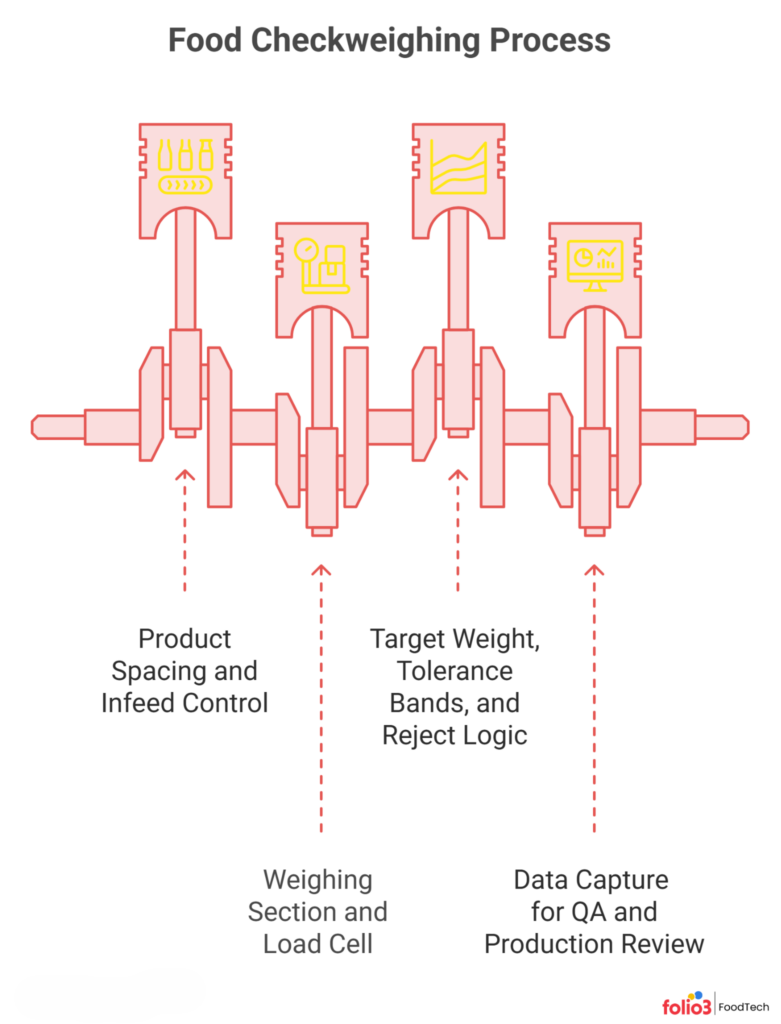
Product Spacing and Infeed Control
The infeed section creates consistent spacing between packs so each one can be weighed individually. Proper spacing prevents two packs from landing on the weighing section at the same time, which would produce inaccurate readings. Belt speed and timing gates control this process.
Weighing Section and Load Cell
The weighing section sits between the infeed and outfeed belts. A precision load cell measures the weight of each pack as it passes over the weighing belt. The controller captures the reading and compares it against your programmed target. All of this happens in fractions of a second, even at speeds above 100 packs per minute.
Target Weight, Tolerance Bands, and Reject Logic
Every product programmed on the checkweigher has a declared weight, an accepted range, and defined action zones. Packs under the lower limit are automatically rejected. Packs within the accepted range pass through. Packs above the upper limit may pass legally, but they represent product giveaway that costs you money every shift. Reject mechanisms typically use air jets, pusher arms, or diverter gates.
Data Capture for QA and Production Review
Weight data becomes far more useful when batch, SKU, shift, line, and operator store it. Checkweighers with data logging capabilities feed directly into your quality assurance records, giving you trend data rather than just snapshots.
Types of Checkweighing Equipment for Food
Your choice of checkweighing equipment for food depends on your line speed, product type, and plant environment.
Static Checkweighers
Static checkweighers are bench-top or platform scales used for manual weight checks. They are best for small batches, spot checks, low-volume packaging rooms, and offline QA sampling. They require an operator to place each pack on the scale and read or record the result.
In-Motion Checkweighers
In-motion checkweighers are the standard for inline packaged food operations where every unit must be checked without stopping the line. They handle high throughput, provide automatic reject capability, and capture continuous weight data. Most mid-to-large food manufacturers use in-motion systems on their primary packaging lines.
Combination Inspection Systems
Some operations combine checkweighing with metal detection, X-ray inspection, or vision systems into a single unit. These combination systems save floor space and provide multiple food safety checks at one point on the line, which is especially useful when floor space is tight.
Washdown and Hygienic Designs
Wet rooms, meat plants, dairy lines, seafood operations, and ready meal facilities need checkweighers built from food-grade stainless steel with cleaning-friendly designs. IP65 or IP69K rated systems allow high-pressure washdown without damaging sensors or load cells.
Where Should Checkweighers Be Placed on a Food Production Line?
Placement matters. Where you position your checkweigher determines what problems it catches and who owns the response.
Before Packaging or Filling
Placing a checkweigher before the filling stage lets you verify incoming portions, ingredient kits, dough pieces, meat cuts, or prepared components. This is your first chance to catch variation before it gets sealed inside a consumer pack.
After Filling and Sealing
This is the most common placement for a checkweigher for packaged food operations. Checking the finished consumer unit after sealing gives you the most accurate reading of what the customer will actually receive. It is the primary checkpoint for both underfills and overfills.
After Secondary Packaging
A checkweigher after case packing catches missing packs, wrong counts, or incomplete multipacks. If a carton should hold 12 units and one is missing, the weight difference is easily detected here.
Before Shipping
A final weight check before dispatch catches pallet errors, wrong case weights, and mislabeled shipments before they reach your customer’s dock.
Checkweigher Placement Reference Table:
| Placement | Best Use | What It Catches | Main Owner |
| Before filling | Portion control | Ingredient variation | Production |
| After sealing | Finished pack control | Underfills, overfills, missing inserts | QA |
| After case packing | Case accuracy | Missing packs, wrong count | Packaging |
| Before shipping | Dispatch check | Wrong case weight, pallet errors | Warehouse |
Setting Up Food Checkweighing Tolerances and QA Rules
Proper food checkweighing starts with setting the right tolerances. Wrong settings create either excess rejects or hidden giveaway.
Start With Declared Weight and Process Variation
Your target weight should account for the declared net weight, normal process variation, product behavior (such as moisture loss or settling), and your chosen legal tolerance approach. A target set too high inflates giveaway. A target set too low increases your regulatory risk.
Define Underweight and Overweight Actions
Underweight packs should be held or automatically rejected. Overweight packs may pass legal requirements, but they still hurt your margin. In food processing environments running high-value proteins or dairy, even a few grams of consistent overfill can add up. Raw food materials alone account for roughly 75% of manufacturing costs, which means giveaway hits you harder than most people realize.
Validate Rejects and Rework Flow
A rejected pack needs a clear process. Define who checks the reject bin, how often, whether rejected product goes to rework or waste, and how each decision gets documented. Unvalidated rejects are a common audit finding.
Keep Calibration and Verification Records
Calibration records, test weight verification logs, and adjustment documentation should be readily available for auditors. Follow the procedural guide used for compliance testing of net content statements on packaged goods, and both internal audits and third-party food safety audits will reference it. Your records need to show that checkweighers are calibrated on schedule, verified with traceable test weights, and adjusted when readings drift.
Connecting Food Checkweighing Data With ERP & QA Systems
Your checkweigher generates thousands of weight readings per shift. That data becomes powerful when it connects to your food ERP system and QA records.
Link Weight Data to SKUs, Lots, Batches, and Shifts
Weight checks become far more valuable when tied to production context. Linking data to lot numbers, batch IDs, shift records, and SKUs lets you answer questions like “Which shift had the highest overfill on Product X?” instead of just looking at averages.
Use Dashboards to Spot Filler Drift
Real-time dashboards that pull from checkweigher data help you spot filler drift before it turns into a full-shift problem. You can track trends by line, product, shift, and packaging format and take corrective action before waste accumulates.
Trigger Alerts Before Waste Grows
Automated alerts for rising overfills, reject spikes, and abnormal line variation let your team act quickly. Instead of discovering a giveaway problem at the end of a production run, you catch it while it is still correctable.
Support Traceability and Audits
Your QA team should be able to retrieve checkweighing records by batch, lot, product, or production date. This capability supports both internal reviews and external audits, including FSMA traceability requirements and BRC/SQF documentation standards.
How to Choose a Checkweigher for Packaged Food
Choosing the right checkweighing equipment for food requires matching the system to your specific operation.
Match the System to Line Speed and Package Type
Different formats behave differently on a weighing belt. Cans, jars, trays, flexible pouches, bags, cartons, and cases all require different infeed approaches, belt widths, and reject mechanisms. Match your system to the formats you actually run.
Match Accuracy to Product Value
Higher-value proteins, dairy products, seafood, and ready meals often justify tighter weight control. When your product costs more per gram, every gram of giveaway carries a higher dollar value.
Match Sanitation to the Plant Environment
Consider whether your environment is a wet room, dry room, chilled, frozen, or requires allergen changeover procedures. The checkweigher’s construction and IP rating must match.
Match Software Needs to Reporting Needs
Ask whether the system can export data to your ERP, MES, QMS, or reporting tools. A checkweigher that cannot share data with your catch weight management system is a standalone device, not a connected part of your production system.
Common Food Checkweighing Mistakes to Avoid
Even experienced operations make checkweighing errors that cost money. Watch for these common missteps.
- Using one tolerance rule across different SKUs. A sauce pouch and a frozen entree have different weight behaviors. Set tolerances per product, not per line.
- Ignoring overfills because only underfills feel risky. Overfill is invisible profit loss. Track it the same way you track rejects.
- Not validating rejects. If rejected packs sit unchecked in a bin, you lose both the product and the data about why it was rejected.
- Keeping weight records outside QA systems. Isolated spreadsheets do not support audits or trend analysis. Integrate records into your central quality system.
- Buying equipment without checking sanitation and integration needs. A checkweigher that cannot survive your washdown cycle or connect to your ERP is a poor investment.
Conclusion: Making Every Gram Count on the Production Line
Food checkweighing protects your margin, automates compliance, and gives your QA team the data they need to act before small problems become expensive ones. Every gram of unnecessary giveaway is margin you can recover. Every underfill you catch before it ships is a complaint you will never have to handle.
If you are ready to tighten weight control across your lines and connect checkweighing data to your broader production systems, talk to the Folio3 FoodTech team to schedule a line audit or a consultation with our foodtech specialists.
FAQs
How Often Should a Food Checkweigher Be Calibrated?
Most food manufacturers calibrate checkweighers at the start of each production shift and after any product changeover. Always use traceable test weights and log each calibration event for audit records.
Can a Checkweigher Detect Missing Items Inside a Sealed Pack?
Yes. If a sealed pack is missing an insert, a sauce packet, or a utensil kit, the total weight will fall below the expected range. The checkweigher flags it as underweight and triggers a reject.
What Is the Difference Between Checkweighing and Catch Weight?
Checkweighing verifies that a pack meets its declared weight. Catch weight management handles products that naturally vary in weight, like fresh meat or seafood, and prices them by actual weight rather than a fixed unit price.
Do Checkweighers Slow Down a Production Line?
In-motion checkweighers are designed to operate at full line speed without stopping or slowing production. Systems handling 100 to 300 packs per minute are common in packaged food operations.
What Happens if a Checkweigher Reject Rate Is Too High?
A high reject rate usually points to a filler calibration issue, ingredient inconsistency, or incorrect tolerance settings rather than a checkweigher problem. Investigate the upstream process before adjusting the checkweigher.
Is Checkweighing Required by FDA or BRC?
There is no single regulation that mandates checkweighing by name. However, the Fair Packaging and Labeling Act requires accurate net content declarations, and BRC/SQF standards expect documented weight control procedures. Checkweighing is the most practical way to meet both requirements.


