









microsoft

Microsoft Dynamics 365 for Food & Beverage Businesses

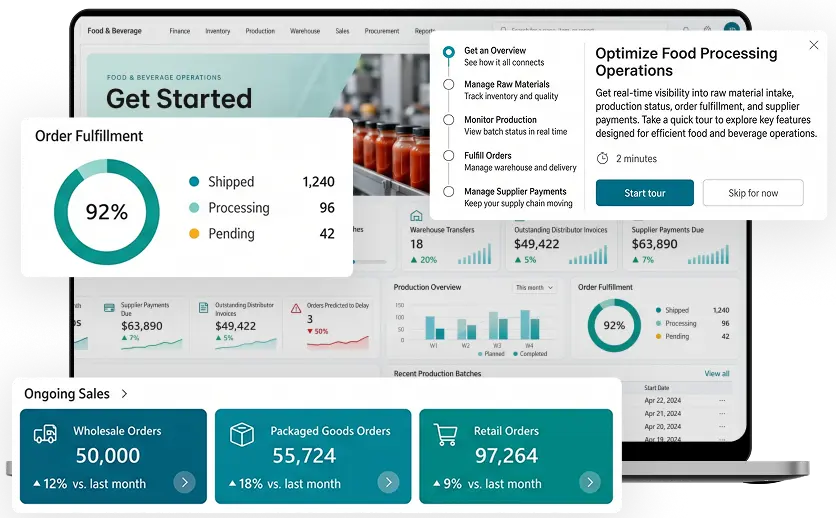
Food manufacturers, processors, and distributors run on connected data. Microsoft Dynamics 365 for food and beverage brings finance, production, inventory, procurement, warehouse operations, supply chain, and reporting into one platform so your teams stop working in silos.

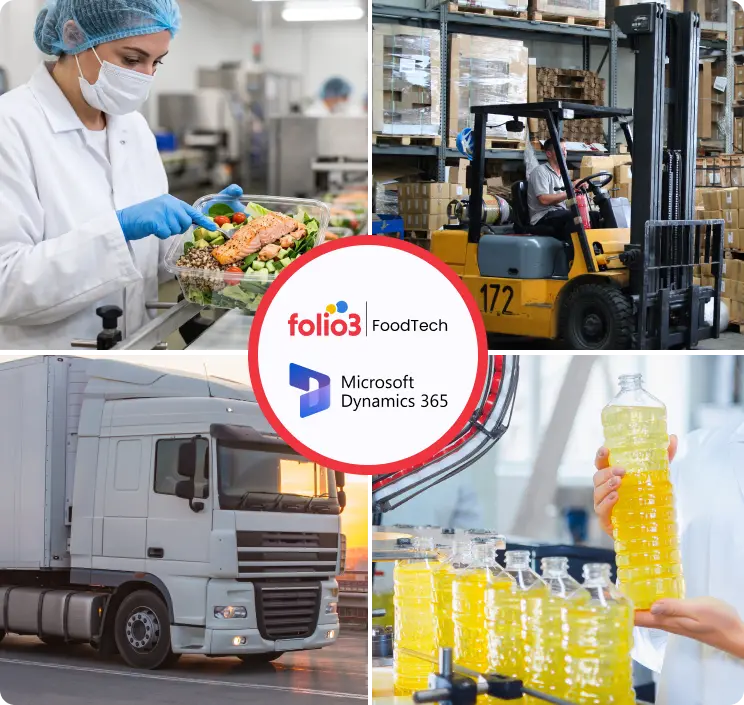
Folio3 FoodTech helps food businesses implement, configure, integrate, and support Microsoft Dynamics food ERP to fit how your operations actually run.

Microsoft Dynamics 365

What Is Microsoft Dynamics 365 for Food and Beverage

Microsoft Dynamics 365 for food and beverage is a suite of enterprise applications that connects finance, manufacturing, inventory, procurement, warehouse, supply chain, and reporting operations for food businesses. It gives manufacturers, processors, and distributors a single platform to manage day-to-day operations and make decisions based on real-time data.

The Microsoft Dynamics food and beverage ERP platform includes Dynamics 365 Business Central, Dynamics 365 Finance, Dynamics 365 Supply Chain Management, Power BI, and the Power Platform. These products can be configured individually or together to match how a food business operates. Folio3 FoodTech implements and supports Microsoft Dynamics for food companies, connecting Dynamics 365 food ERP with the tools, workflows, and systems each business already uses.

What Is Microsoft Dynamics 365 for Food and Beverage​

Why Food and Beverage Operations Need More Than Generic ERP

Generic ERP systems handle transactions. Food businesses need systems that handle complexity. Production schedules shift when raw materials arrive late. Shelf life dictates what ships first. A single recall can span thousands of lots across multiple warehouses. These are not edge cases; they are daily operations. Microsoft Dynamics 365 food manufacturing ERP can support these requirements when it is configured around them.

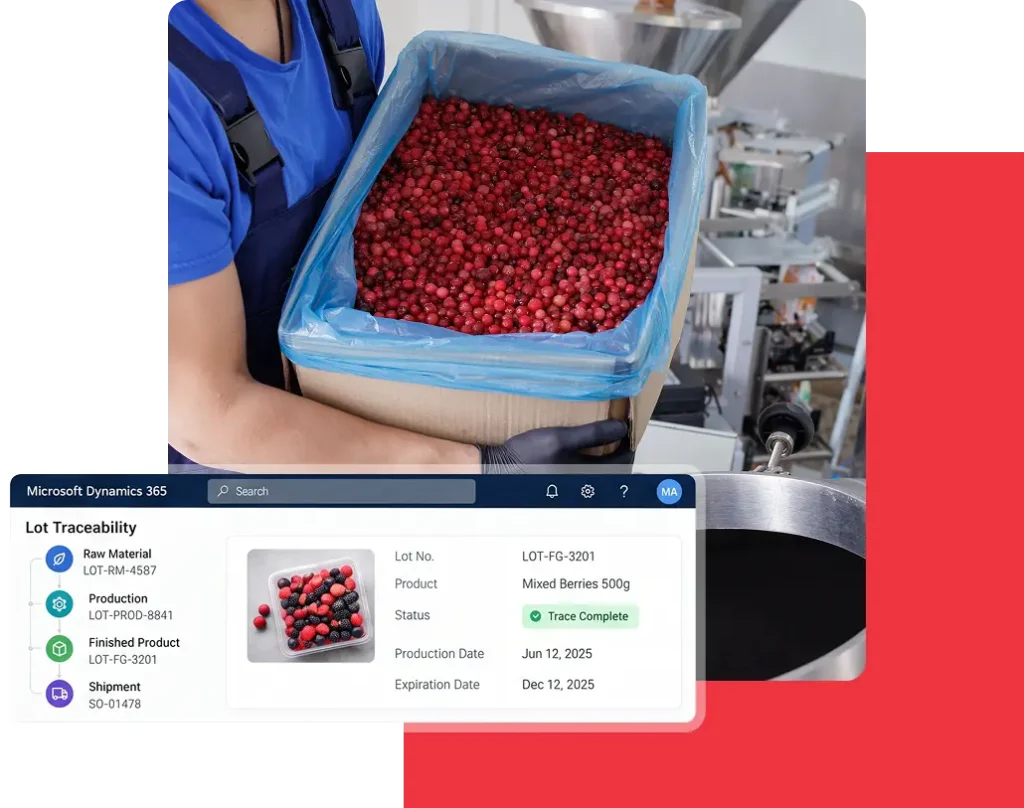
Lot Traceability & Recall Readiness 
Tracking raw materials and finished products by lot from receiving through production to shipment. When a recall occurs, lot data enables forward and backward tracing to isolate affected products quickly.
Managing FEFO logic across inventory, production scheduling, and order fulfillment. Products closest to expiration move first, reducing waste and keeping compliance risk under control.
Coordinating production orders, capacity, labor, and equipment across multiple lines. Formula-driven operations also need to handle variable yields, substitutions, and batch scaling across product lines.
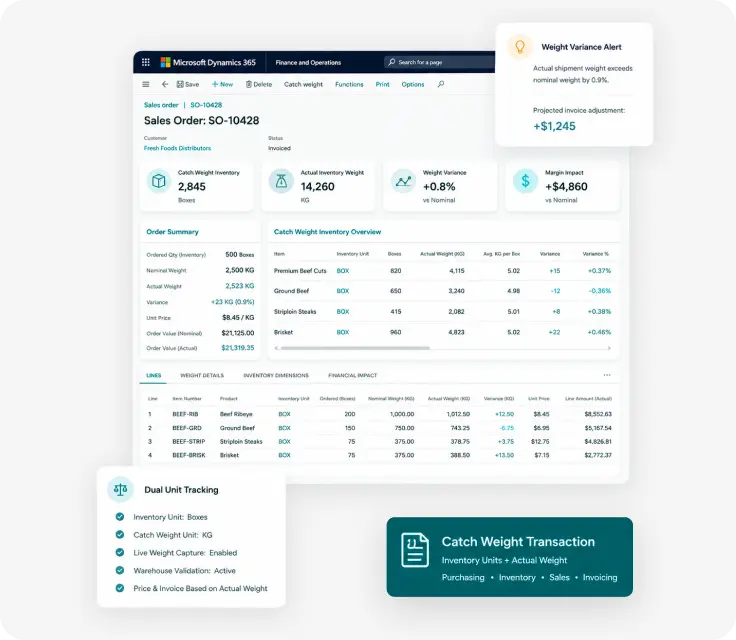
Managing products sold by weight where nominal and actual quantities differ. Without catch weight support, discrepancies compound at receiving, production, and shipment.
Aligning purchasing, supplier lead times, and seasonal availability with production schedules. When procurement is disconnected from planning, shortages reach the production floor before anyone sees them coming.
Enforcing hold, release, and inspection requirements at receiving, in process, and before shipment. Without structured checkpoints, non-conforming products move forward and become a bigger problem downstream.
Managing put-away rules, location directives, picking strategies, and movements tied to production and fulfillment. Disorganized warehouse flow slows production supply and delays outbound shipments.
Tracking actual costs against standard costs across procurement, production, labor, and overhead. Without real-time cost data, margin erosion stays hidden until the financial close.
Why Food and Beverage Operations Need More Than Generic ERP​

Which Microsoft Dynamics 365 Solution Fits Your Food Business

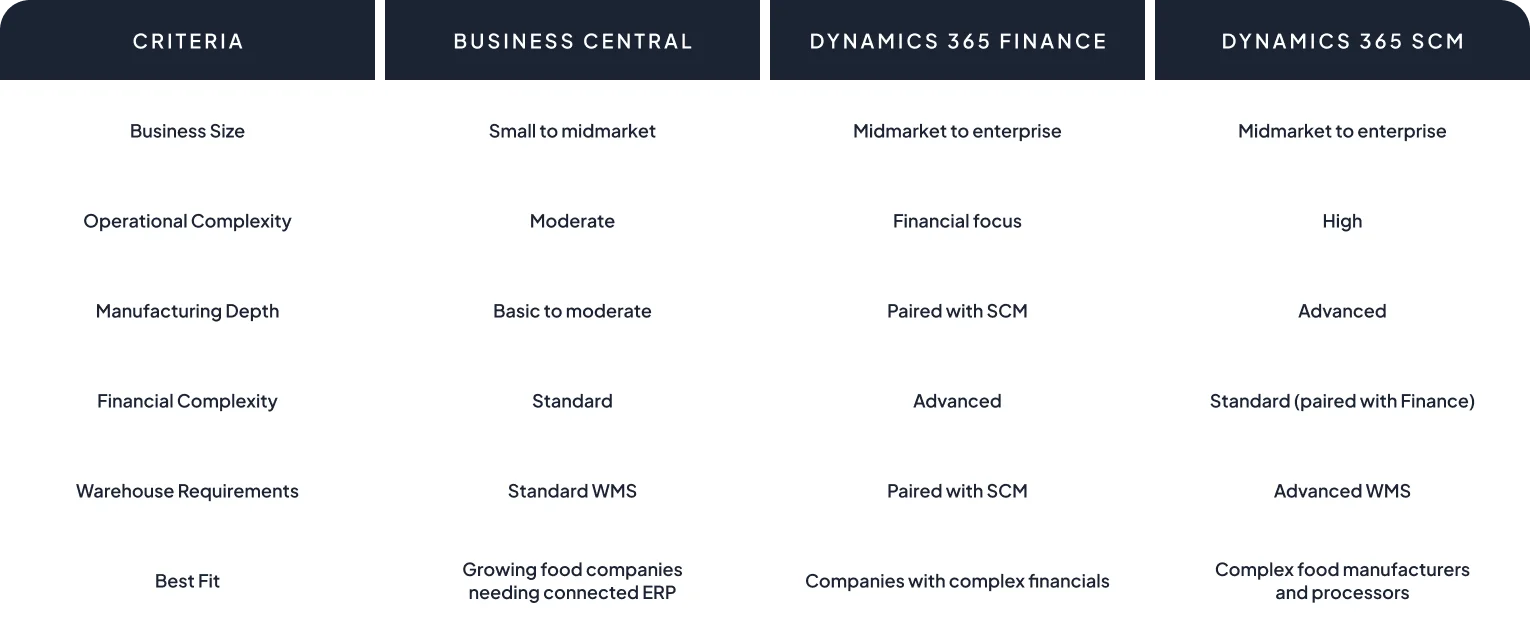
Microsoft Dynamics 365 is not one product. It is a family of applications, and the right fit depends on business size, operational complexity, and where the company is headed. Here is how the core products apply to food and beverage businesses.

Business Central

Business Central

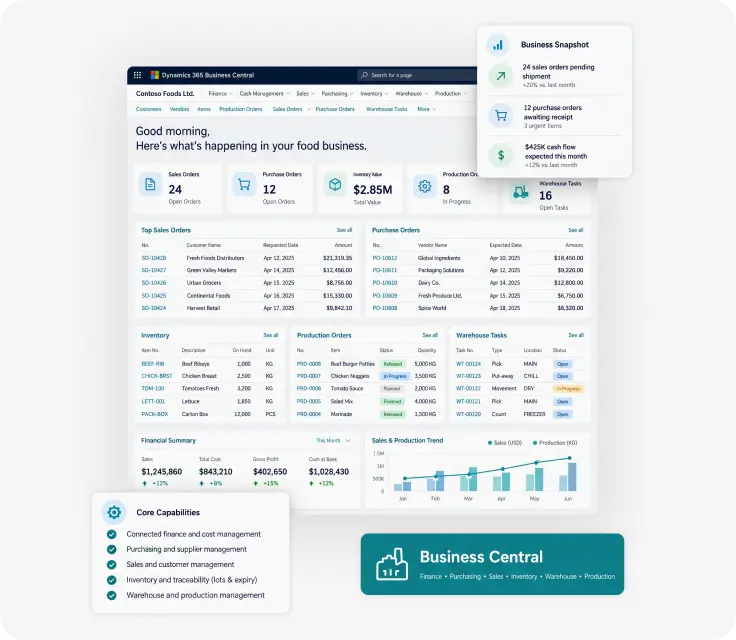
Best for growing food manufacturers, processors, and distributors that need connected finance, purchasing, sales, inventory, warehouse operations, and production management in a single system. Folio3's Business Central implementation for manufacturing covers core ERP requirements and works well for food businesses that do not yet need the depth of enterprise-grade manufacturing or supply chain planning.

Dynamics 365 Finance

Best for food companies with complex financial structures, multi-entity operations, advanced budgeting, consolidated reporting, and tighter controls over cash, costs, and compliance. Dynamics 365 Finance is typically deployed alongside Supply Chain Management when financial complexity outgrows what Business Central offers.

Dynamics 365 Finance
Dynamics 365 Supply Chain Management

Dynamics 365 Supply Chain Management

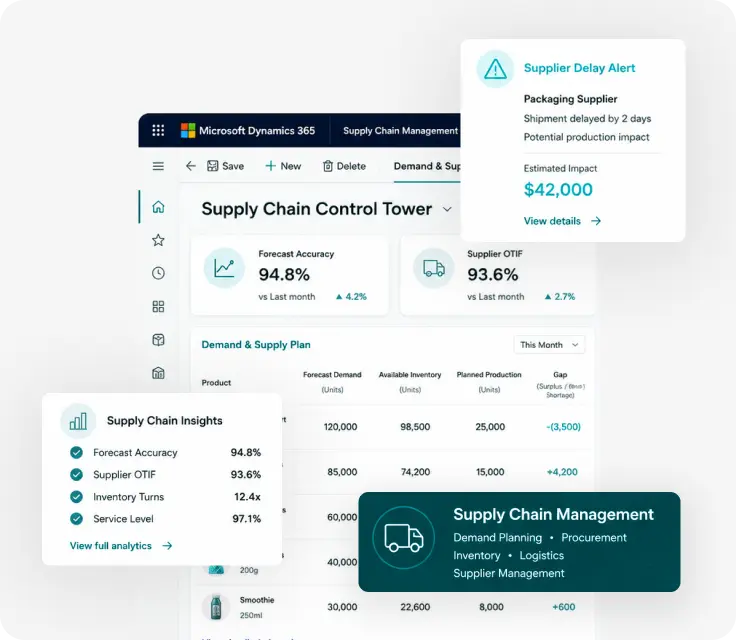
Best for larger and more complex food operations that need deeper manufacturing execution, procurement planning, production scheduling, advanced inventory, warehouse management, transportation, costing, and asset management. This is the product most food manufacturers evaluate when production complexity, scale, or multi-site operations require enterprise-level control.

Power BI and Power Platform

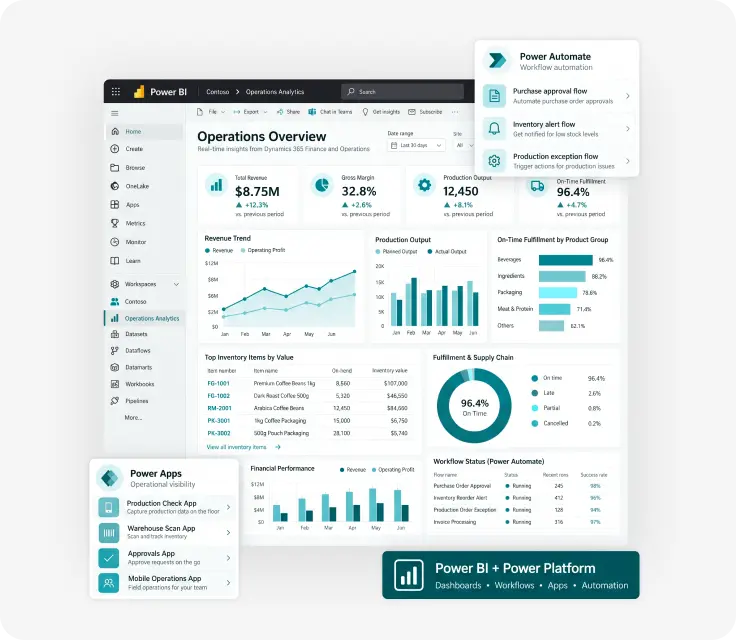
Supporting layers for reporting, dashboards, approval workflows, process automation, and operational visibility across the Dynamics environment. Power BI connects to Dynamics data for real-time production, inventory, financial, and supply chain reporting. Folio3 offers pre-built Power BI dashboards for Business Central for reporting on top of Dynamics data. Power Platform supports custom apps and automated workflows without custom development.

Power BI and Power Platform

Which Dynamics 365 Product Fits Your Food Operation?

Connect Core Food Operations With Microsoft Dynamics 365

Microsoft Dynamics 365 covers the operational areas food businesses rely on every day. Each area connects back to the same data, so decisions in one part of the business reflect what is happening everywhere else.

Manufacturing Management

Food manufacturers deal with production orders, bills of materials, capacity constraints, labor scheduling, and output costing across multiple lines. Microsoft Dynamics 365 Food Manufacturing connects production planning, execution, and costing so teams can manage orders, track material consumption, and monitor output in real time.

Manufacturing Management

Inventory Management

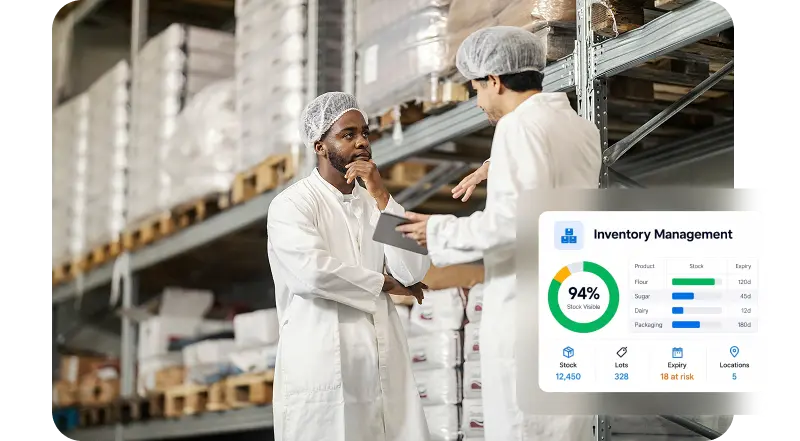
Raw materials, packaging, and finished goods all move through different stages with different shelf lives, lot numbers, and storage requirements. Dynamics 365 tracks inventory across locations, manages lot and expiry data, and gives teams real-time visibility into stock levels and availability.

Inventory Management

Procurement Management

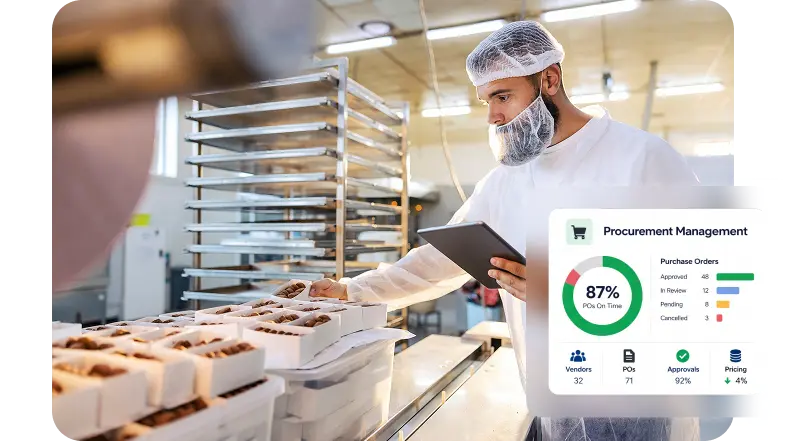
Food businesses source from dozens of vendors with varying lead times, quality levels, and pricing structures. Dynamics 365 manages vendor records, purchase orders, approvals, pricing agreements, and purchasing visibility so procurement stays aligned with production needs.

Procurement Management

Warehouse Management

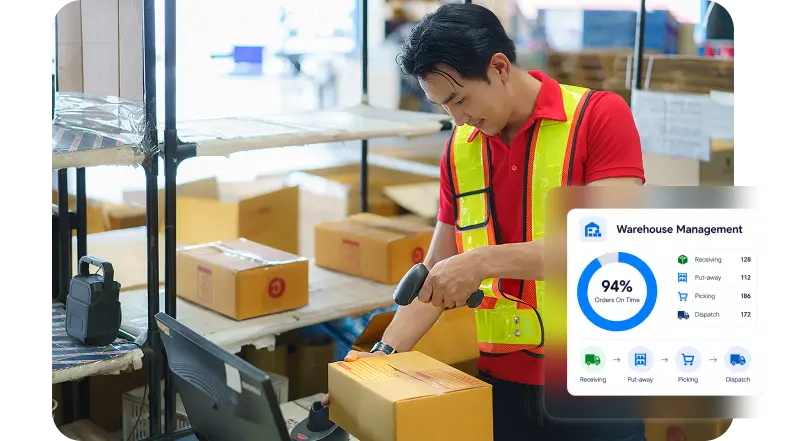
Receiving, put-away, picking, movements, production supply, and outbound operations all run through the warehouse. Dynamics 365 supports location directives, work templates, wave processing, and warehouse execution so product moves accurately from dock to production to shipment.

Warehouse Management

Supply Chain Management

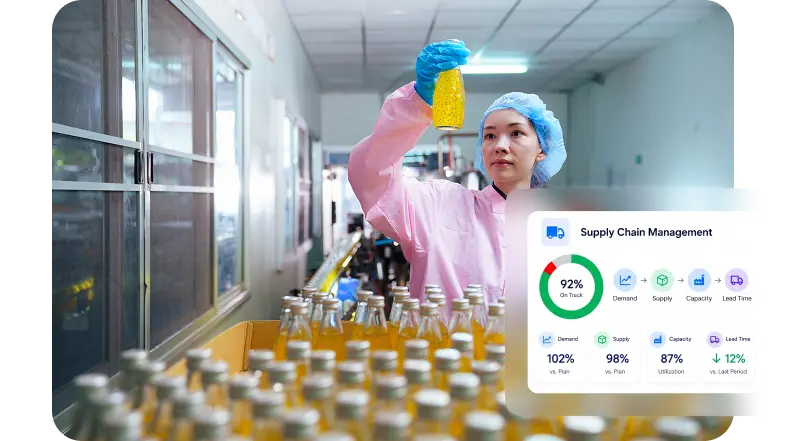
Planning across procurement, production, inventory, warehouse, fulfillment, and delivery requires visibility across every connected operation. Dynamics 365 Supply Chain Management connects these areas so planners can balance demand, supply, capacity, and lead times.

Supply Chain Management

Distribution Management

Order fulfillment, shipment preparation, inventory allocation, and delivery tracking need to run without gaps. Dynamics 365 supports the distribution process from order capture through shipping and delivery so distributors and manufacturers can meet customer expectations.

Distribution Management

Financial Management

Costing, budgeting, financial reporting, cash management, and operational controls sit at the center of every food business. Dynamics 365 Finance connects financial data with production, inventory, procurement, and sales data so finance teams work with numbers that match operations.

Financial Management1

Business Intelligence

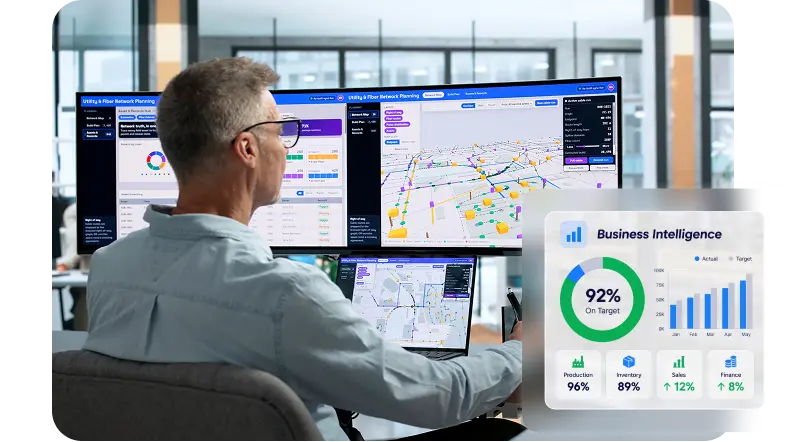
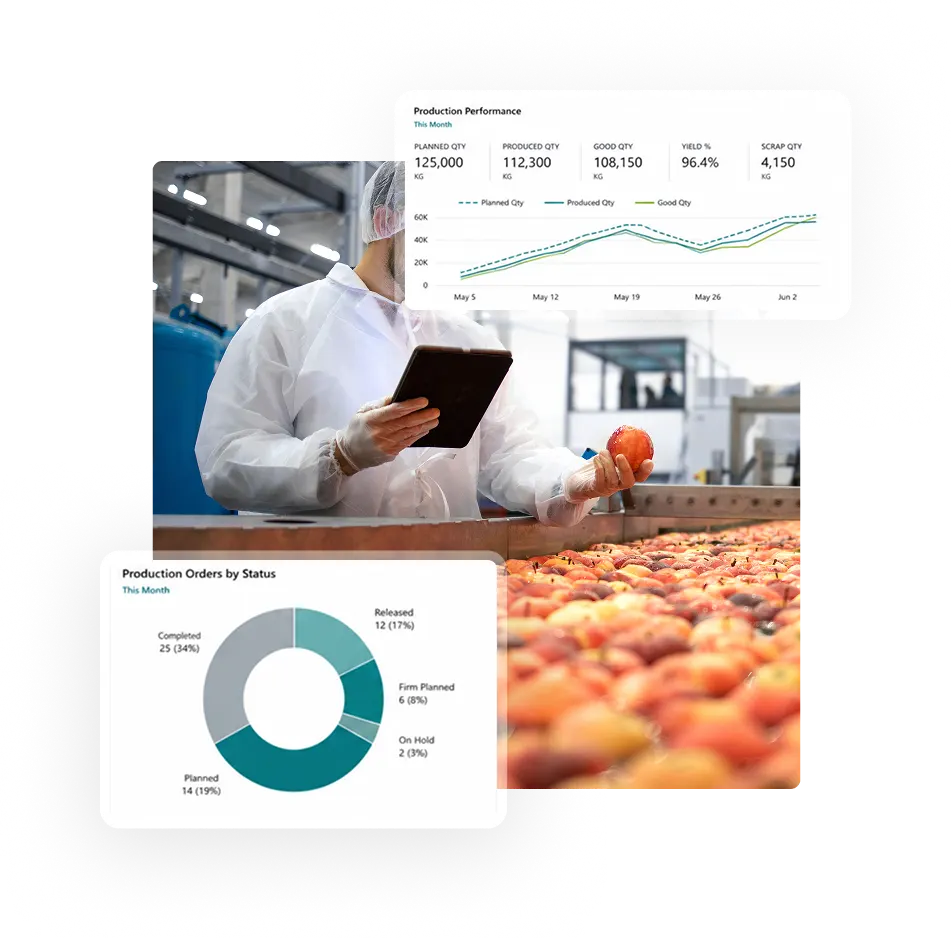
Reporting and dashboards across production, inventory, procurement, warehouse, sales, and finance help leadership see what is working and what needs attention. Power BI integrates with Dynamics 365 to deliver operational and financial reporting without manual data pulls.

Business Intelligence

Microsoft Dynamics 365 Across Food and Beverage Operations

Microsoft Dynamics 365 supports food and beverage businesses across segments, each with its own operational requirements. Here is how Dynamics applies across the industry.

Integrate Microsoft Dynamics With Your FoodTech Systems

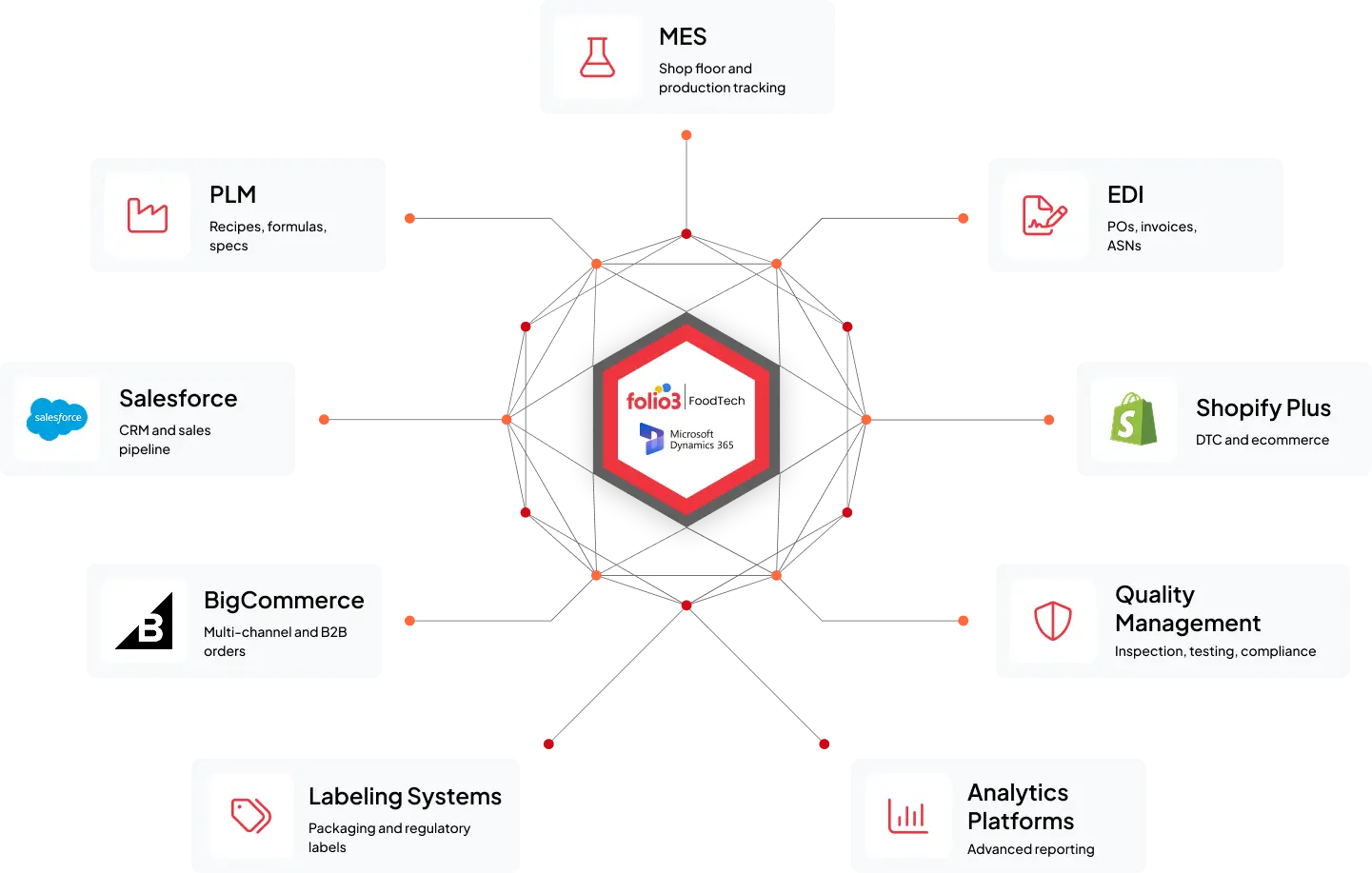
Most food businesses do not run on one system. Microsoft Dynamics 365 food ERP works as the operational and financial backbone while connecting with the specialist systems your teams already depend on.
Integrate Microsoft Dynamics With Your FoodTech Systems

Data that typically moves between systems

Production data, inventory levels, customer orders, purchase orders, supplier records, warehouse transactions, financial data, and product information.

Folio3 FoodTech builds and supports these integrations so Microsoft Dynamics food manufacturing ERP connects with the rest of your technology stack without replacing every system. Folio3 offers a Shopify connector for Business Central and a BigCommerce connector for Dynamics 365 Finance and Operations.

Extend Microsoft Dynamics With AI for Food Operations

Microsoft Dynamics 365 already centralizes food business data across finance, inventory, production, warehouse, and supply chain workflows. Folio3 can help extend that foundation with Microsoft Copilot, Power BI, Copilot Studio, and food-specific AI layers that support faster decisions, cleaner reporting, exception handling, and operational planning.

When Does Microsoft Dynamics 365 Make Sense for a Food Business

Microsoft Dynamics 365 is not the right fit for every food company at every stage. It makes the most sense when the business has outgrown its current systems and needs a connected platform that can scale.

Microsoft Dynamics for food and beverage is worth evaluating when:

Multiple locations or legal entities are difficult to manage from one system

Legacy systems cannot support current volume or planned growth

Production and finance run on disconnected platforms with manual data transfers

Reporting requires manual consolidation across multiple sources

Inventory accuracy issues affect production scheduling or customer fulfillment

The company already operates heavily within the Microsoft ecosystem

Procurement is disconnected from production planning and demand

The business needs stronger operational and financial visibility across departments

The right Microsoft Dynamics product depends on business processes, operational complexity, integration requirements, growth plans, and data maturity. The product comparison above can help narrow the options.

Microsoft Dynamics for food and beverage

Microsoft Dynamics 365 Services for Food and Beverage Companies

Folio3 FoodTech supports food businesses through every stage of a Microsoft Dynamics 365 project, from initial evaluation through long-term optimization.

ERP Assessment and Consulting

Evaluate current systems, business processes, and requirements before selecting the right Microsoft Dynamics product. You can begin with a Finance and Supply Chain Management solution or Business Central solution discovery as the starting point for food businesses.

Microsoft Dynamics Implementation

Configure, deploy, and launch Microsoft Dynamics 365 for food and beverage operations. Folio3 offers a complete Business Central Implementation covering system setup, data migration, process configuration, user training, and go-live support.

ERP Migration

Move from a legacy ERP, an older version of Dynamics, or another platform to Microsoft Dynamics 365. Migration covers data, processes, integrations, and user transition with minimal disruption to daily operations.

Customization & Configuration

Adapt Microsoft Dynamics 365 to match how your food business operates. This includes custom workflows, reports, forms, dashboards, and role-specific configurations that align with production, warehouse, procurement, and finance requirements.

ERP Integration

Connect Microsoft Dynamics 365 with MES, PLM, EDI, ecommerce, CRM, quality, labeling, and analytics systems. Integration ensures data flows between Dynamics and the rest of your technology stack without manual transfers.

Support & Optimization

Keep Microsoft Dynamics 365 running, updated, and aligned with changing business needs. Ongoing support includes issue resolution, performance monitoring, configuration updates, user support, and system optimization as the business grows.

Why Choose Folio3 for Microsoft Dynamics in FoodTech

microsoft

Folio3 FoodTech works with food manufacturers, processors, and distributors to implement, integrate, and support Microsoft Dynamics 365 across real food operations.

Our Microsoft Dynamics 365 Portfolio for Food and Beverage Businesses

With 20+ years in food and beverage ERP, Folio3 FoodTech has delivered 120+ Microsoft Dynamics projects for food businesses. These case studies show how connected finance, production, inventory, and supply chain data support real operations. Each one shows the outcome, not just the scope.

In the Words of Our Clients

Read what our clients say about their experiences and the difference our solutions have made for them.

Microsoft Dynamics 365 for Food and Beverage FAQs

Is Microsoft Dynamics 365 suitable for food manufacturing?
Yes. Microsoft Dynamics 365 for food manufacturing supports production planning, bill of materials, batch and lot tracking, formula management, quality control, and production costing. Dynamics 365 food manufacturing capabilities are available through Business Central for simpler operations and through Supply Chain Management for more complex production environments.
The best Microsoft Dynamics food ERP product depends on business size and complexity. Business Central fits growing food businesses with standard manufacturing and financial needs. Dynamics 365 Finance paired with Supply Chain Management fits larger companies with complex production, multi-site operations, and advanced financial requirements. Dynamics 365 food ERP selection should be based on current and projected operational needs.
Business Central is a connected ERP for growing food businesses that need finance, purchasing, inventory, warehouse, and basic production in one system. Dynamics 365 Supply Chain Management is built for larger and more complex food operations that need advanced manufacturing, procurement planning, warehouse execution, and asset management. Microsoft Dynamics for food companies often involves evaluating both products to find the right fit.
Yes. Dynamics 365 food manufacturing ERP supports lot and batch tracking across receiving, production, inventory, warehouse, and shipment. Lot data links to quality, shelf life, costing, and traceability so businesses can trace materials forward and backward through the supply chain when needed.
Yes. Microsoft Dynamics food ERP integrates with MES for shop floor data, PLM for product data, EDI for trading partner documents, Salesforce for CRM, Shopify Plus and BigCommerce for ecommerce, and quality, labeling, and analytics systems. Folio3 FoodTech builds and supports these integrations to connect Dynamics with the rest of your technology stack.
Implementing Microsoft Dynamics 365 for food and beverage manufacturing starts with a business process review and requirements analysis. From there, the project moves through system design, configuration, data migration, integration setup, user training, and go-live. Folio3 FoodTech manages the full implementation process, tailoring each phase to food manufacturing, processing, and distribution workflows.

Connect Your Food Operations With Microsoft Dynamics 365

Food businesses run better when finance, production, inventory, procurement, warehouse, supply chain, and reporting are connected. Microsoft Dynamics 365 brings these operations together on a platform built for how food companies actually work.

Folio3 FoodTech helps food manufacturers, processors, and distributors evaluate, implement, integrate, and support Microsoft Dynamics 365 so every part of the business runs on the same data. 

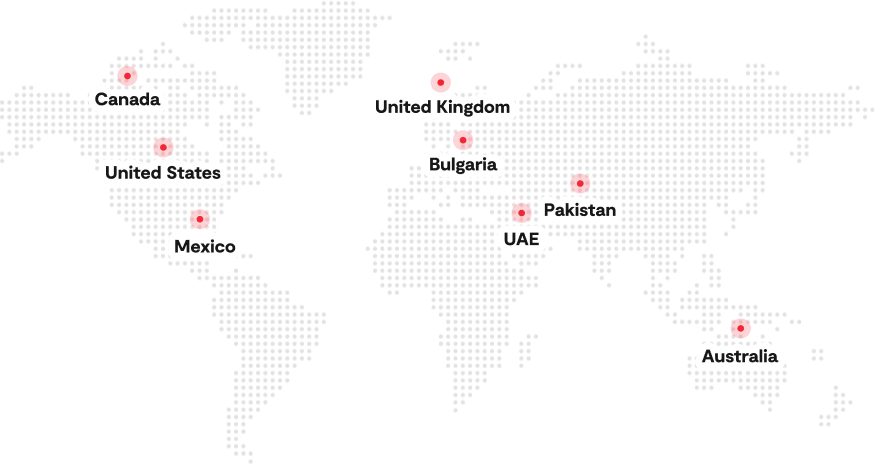
Serving the FoodTech Industry Globally Since 2004

Get in Touch

Drop us a line and we'll connect you to the right person.