

Fresh produce processing is one of the highest-risk operations in food manufacturing. You are dealing with razor-thin margins, products that start deteriorating the moment they leave the field, and FSMA regulations that hold you accountable for every step of the supply chain.
Here is the challenge most plant managers face: unlike meat or dairy, fresh-cut produce typically has no cooking step before it reaches the consumer. That means every mistake in your facility, from a poorly sloped floor drain to a dull cutting blade, can end up as a food safety hazard on someone’s dinner plate.
According to the CDC’s Interagency Food Safety Analytics Collaboration (IFSAC), over 85% of E. coli O157 illnesses are attributed to vegetable row crops and beef, with vegetable row crops carrying the highest estimated attribution percentage across all food categories.
This guide walks you through the core best practices for optimizing safety and throughput across every stage of produce processing, from receiving dock to sealed package.
The “No Kill Step” Challenge in Produce Processing Plants
Your processing line carries a unique vulnerability. Understanding this risk is the first step toward building a safer operation.
In meat or dairy operations, a thermal kill step (cooking, pasteurization, or retort) serves as a final safety net that destroys pathogens. Produce processing plants do not have that safety net. Fresh-cut salads, pre-washed spinach, sliced fruit, and vegetable medleys go straight from your facility into consumer packaging without any lethal treatment.
It means your entire facility must act as a continuous defense mechanism. Every surface, every water source, every air handler, and every employee touchpoint is a potential contamination vector for biological hazards like Listeria monocytogenes, Salmonella, and E. coli O157:H7.
Listeria is especially dangerous because it thrives at refrigeration temperatures, grows in wet environments, and builds resistant biofilms on processing surfaces. If your sanitation program misses even one harborage point, you risk a contamination event that cascades across entire production runs.
6 Core Best Practices for Produce Processing Facilities
These are not optional tips or nice-to-have upgrades. These six pillars represent the non-negotiable operational standards that separate compliant, high-throughput produce processing facilities from those at risk of recalls, shutdowns, and lost contracts.
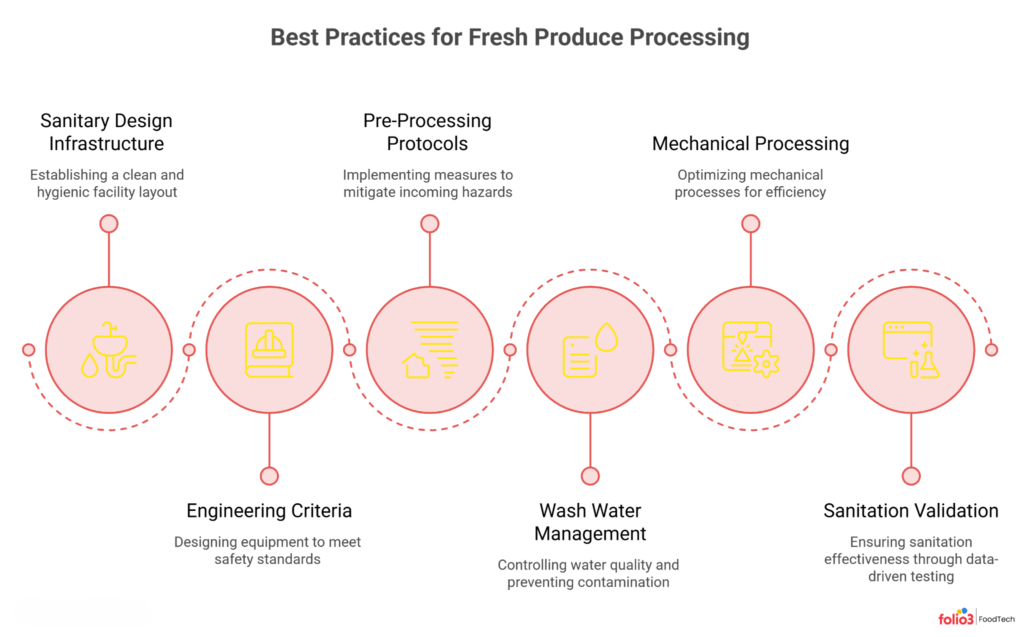
1. Sanitary Design Infrastructure in Modern Produce Processing Facilities
Facility layout is your first line of defense against cross-contamination. Getting the physical design right prevents problems before they start.
Implementing Strict One-Way Linear Product Flow
Your produce processing facility should enforce a strict “dirty-to-clean” trajectory. Raw agricultural commodities (RACs) arriving at receiving docks must remain physically isolated from final wash and packaging rooms. It means designing separate entry points, hallways, and workspaces that prevent any backward movement of raw product toward finished goods.
The goal is simple: product moves forward through the facility, and it never loops back. Employees working in raw receiving zones should not cross into finished product zones without changing protective clothing and passing through sanitizing footbaths or boot foam stations.
In the packaging area specifically, you should maintain positive air pressure relative to the surrounding rooms. It prevents airborne pathogens from migrating from the dirtier receiving areas into clean packaging zones. Dedicated air handling units with HEPA filtration for packaging rooms are standard in high-performing produce processing plants.
Environmental Controls: Eliminating Condensate and Standing Water
Standing water and structural condensation are the single biggest environmental threats in fresh produce processing. Pooling water creates a breeding ground for Listeria and other pathogens, and condensation dripping from overhead pipes or HVAC coils can directly contaminate open product lines below.
Your floors should maintain a minimum drainage slope of 1/4 inch per foot directed toward hygienic trench drains. Slot drains are preferred over grated drains because they are easier to clean and less likely to harbor debris. HVAC systems should include dehumidification cycles designed to prevent evaporator coil drip, especially in refrigerated processing rooms where temperature differentials cause condensation buildup.
Inspect overhead structures routinely for condensation. Insulate all cold water pipes, and ensure ceiling panels are non-porous, sealed, and sloped to prevent water from pooling above your lines.
2. Engineering Criteria for Fresh Produce Processing Equipment
The equipment you use directly affects both sanitation outcomes and throughput efficiency. Choosing the right specifications saves you time on every shift.
Material Selection: Moving Beyond Standard Stainless Steel
Not all stainless steel is created equal for fresh produce processing equipment. You should specify 304 or 316L grade stainless steel with a minimum 2B smooth mill finish or Ra (surface roughness) values below 32 microinches (µin). Smoother surfaces prevent microbial adherence by eliminating microscopic crevices where bacteria attach and form biofilms.
Avoid wood, porous plastics, and hollow-frame structural components in any area that contacts product or is exposed to wash water. Hollow tubing traps moisture internally and creates hidden harborage sites that your sanitation crews cannot reach during standard cleaning cycles. It is a critical consideration for maintaining food contact surface integrity across your operation.
Toolless Disassembly and 360-Degree Mechanical Access
Every minute your line is down for sanitation is a minute you are not processing product. That is why modern fresh produce processing equipment should be engineered for quick, tool-free breakdown. Look for cantilevered conveyor belts that swing open for full belt access, quick-release spray nozzles, and elevated frames that allow sanitation crews to clean under and behind processing lines without crouching or removing panels.
If it takes your crew more than 15 minutes to fully disassemble a section of your processing line, that equipment is costing you production hours every single night.
3. Pre-Processing Protocols: Incoming Hazard Mitigation
Contamination often arrives with the raw product itself. Catching problems at receiving prevents them from spreading through your entire processing line.
Secondary Inbound Inspection Protocols
Farm-level inspections are important, but they do not catch everything. You need a rigorous secondary inspection at your receiving dock, specifically looking for physical debris like field dirt, agricultural grease, animal feces, insects, and rotten raw products. Reject lots that show visible signs of advanced decomposition or pest damage before they enter your processing area.
Establish written criteria for incoming product acceptance. Your QA team should evaluate firmness, color, odor, and visual defect levels against documented specifications. It is a key part of any food quality control program and protects your downstream processes from contaminated raw inputs.
Pre-Cooling Dynamics and Core Temperature Stabilization
Field heat is your enemy. The moment produce is harvested, its natural metabolic respiration accelerates spoilage. Removing that field heat quickly through hydrocooling (cold water immersion) or forced-air cooling is essential for preserving shelf life and reducing pathogen growth potential.
Your target: bring core product temperatures down to below 40°F (4°C) before any mechanical cutting begins. Cutting warm produce accelerates enzymatic browning, increases cellular fluid loss, and creates a warm, nutrient-rich surface that pathogens exploit. Proper cold chain compliance at receiving sets the foundation for everything that follows.
4. Wash Water Management and Pathogen Infiltration Control
Wash water is both your primary sanitization tool and your biggest cross-contamination risk. Managing it correctly requires understanding the science behind water-to-product interactions.
Defeating Thermal Infiltration: The Delta-T Principle
Here is a concept that too many plant managers overlook: if warm produce enters cold wash water, a temperature-driven pressure differential forms at the product surface. This pressure differential physically pulls contaminated water into the internal tissues of fruits and vegetables through stem scars, cut surfaces, and natural pores.
Once pathogens are inside the tissue, no amount of surface washing will remove them. The solution is straightforward but demands discipline. Maintain wash water temperature at least 10°F (approximately 5.5°C) higher than the internal core temperature of the incoming produce. If you are using hydrocooling, the water must be heavily loaded with sanitizer to compensate for the inherent temperature differential risk.
Sanitizer Evolution: Transitioning from Chlorine to Peracetic Acid (PAA)
Chlorine has been the industry’s default sanitizer for decades, but it has a critical weakness. As organic matter (dirt, plant debris, cellular fluids) builds up in your wash water, chlorine rapidly loses its antimicrobial effectiveness. You end up chasing chlorine levels all day, adjusting dosing, and still falling behind.
Peracetic acid (PAA) offers a more stable alternative. PAA maintains its antimicrobial performance regardless of water pH levels and organic load buildup. It does not generate harmful disinfection byproducts (DBPs) like trihalomethanes, which is an increasing concern for facilities managing food hygiene and compliance requirements. Many leading produce processors have made this transition over the past five years, and PAA is now the sanitizer of choice in progressive produce processing facilities.
Mitigation of Organic Loads and Foam Management
High-starch crops like potatoes, corn, and peas release proteins and starches into wash water that cause severe foaming. Foam is more than a nuisance. It physically separates the sanitizer from the product surface, reducing contact time and killing efficacy.
To manage this, integrate inline filtration systems that continuously remove suspended organic solids from your recirculating wash water. Pair filtration with food-grade defoamers (vegetable-oil or silicone-based) to maintain water velocity and sanitizer contact across the full wash cycle. Monitor turbidity levels with inline sensors to know when your water quality is dropping before it compromises your kill step.
5. Mechanical Processing and Post-Wash Optimization
The cutting and finishing stages are where physical handling risks peak. Precision at this stage directly affects both product quality and microbial safety.
Precision Slicing: Minimizing Tissue Trauma and Cell Sap Pools
A dull blade does not cut produce. It crushes it. Crushed cells release internal fluids that pool on cut surfaces, creating a warm, nutrient-rich environment that is ideal for pathogen proliferation. That’s why blade maintenance is not a maintenance task; it is a food safety task.
Enforce automated, strict blade-sharpening schedules. Clean, surgical cuts maintain cellular integrity, reduce visible browning, and significantly lower the volume of surface sap that serves as a growth medium. The result is a safer product with better visual quality and longer shelf life.
Considering the FAO estimates that roughly 45% of all fresh produce is lost or wasted each year globally, optimizing your cutting precision plays a direct role in reducing waste within your own facility. Every percentage point of yield you protect goes straight to your bottom line.
Dewatering and Moisture Control Dynamics
Residual water inside sealed bags is a shelf life killer. It accelerates spoilage, encourages bacterial growth, and causes unsightly pooling that leads to retail rejections. Your dewatering step must bring surface moisture down to target levels before the product enters packaging.
High-velocity industrial centrifuges (spin-dryers) work well for robust greens like romaine and iceberg lettuce. For more delicate items like baby spinach or spring mix, vibratory dewatering shakers offer gentler moisture removal without bruising. In either case, validate your target moisture percentages and monitor them throughout each shift.
6. Sanitation Validation: Overcoming Biofilms with Data-Driven Testing
Visual cleanliness is not the same as microbial cleanliness. Your sanitation program needs objective verification to prove it is actually working.
Breaking Down Resistant Bacterial Biofilms
Pathogens like Listeria do not just sit on surfaces waiting to be wiped away. They build extracellular polymeric substances (EPS), commonly called biofilms, that create a protective shield against standard sanitizers. A surface can look perfectly clean and still harbor dangerous levels of bacteria underneath a biofilm layer.
Breaking biofilms requires a two-phase approach. First, mechanical scrubbing to physically disrupt the biofilm structure. Second, periodic deep alkaline and acidic Clean-In-Place (CIP) flushes that chemically dissolve the EPS matrix. Alternating between alkaline and acidic cycles prevents bacteria from adapting to a single chemical environment. This approach is fundamental to avoiding the most common food sanitation mistakes.
Real-Time Microbial Verification via ATP and APC Systems
Relying on visual inspection alone is a regulatory hazard and a recipe for audit failure. Implement 30-second Adenosine Triphosphate (ATP) bioluminescence swabbing on all critical food contact surfaces immediately after each sanitation shift.
ATP swabs measure organic residue in real time, giving your QA team immediate pass/fail feedback before production restarts. But ATP only tells you the surface is clean; it does not identify specific pathogens. For deeper verification, track Aerobic Plate Count (APC) trends week-over-week. A rising APC trend line is an early warning signal that your sanitation program is degrading somewhere, often in a spot you have not been swabbing. Catch it before an auditor or a pathogen test does.
Key Components of an Optimized Fresh Produce Processing Line
A well-designed processing line matches the right equipment to each critical control point. Here is a breakdown of what an optimized fresh produce processing line looks like from start to finish.
| Stage | Recommended Equipment | Best Practice / Critical Control Point |
| Pre-Cooling | Hydrocoolers, forced-air coolers | Remove field heat rapidly; target core temperature below 40°F before cutting |
| Initial Wash | Dump tanks with inline sanitizer dosing | Remove heavy soil and field debris before chemical sanitization |
| Flume Washing | Ozone bubble washers, PAA-dosed flume systems | Maintain Delta-T principle; keep wash water warmer than product core temp |
| Sorting and Inspection | Optical sorters, manual QA inspection stations | Remove defective, damaged, or foreign-material-contaminated product |
| Cutting / Processing | Precision water-jet cutters, ultrasonic slicers | Maintain sharp blades; minimize cell damage and sap release |
| Dewatering | Centrifugal spin-dryers, vibratory shakers | Remove surface moisture to target levels before packaging |
| Packaging | MAP systems, flow wrappers | Seal with optimized O2/CO2 ratios; validate seal integrity per shift |
Pairing this equipment with a purpose-built fresh produce ERP system allows you to track lot traceability, manage FEFO-based inventory rotation, and automate quality hold-and-release workflows across every stage.
Conclusion: Elevating Safety and Yield in Your Operations
Successful fresh produce processing comes down to the intersection of three disciplines: facility design and environmental control, equipment engineering and maintenance, and water chemistry and sanitation science.
Every practice covered in this guide, from enforcing one-way product flow to tracking APC trends, contributes to a safer product, a more efficient operation, and stronger audit performance. In an industry where margins are tight and regulatory requirements continue to tighten, the produce processors who invest in these fundamentals are the ones who protect their brand, their customers, and their bottom line.
Ready to bring data-driven traceability and quality control into your produce processing operation? Schedule a consultation with Folio3 FoodTech to see how our fresh produce ERP solutions can support your facility’s safety and efficiency goals.
FAQs
How Do You Prevent Water Infiltration in Fresh Produce Processing?
Keep your wash water temperature at least 10°F (5.5°C) warmer than the product’s internal core temperature. It prevents a pressure differential that pulls contaminated water into the produce tissue through stem scars and cut surfaces.
What Is the Best Sanitizer for Fresh-Cut Produce Wash Water?
Peracetic acid (PAA) is widely considered the top choice for fresh-cut produce because it maintains antimicrobial effectiveness regardless of organic load or pH levels. Unlike chlorine, PAA does not produce harmful disinfection byproducts.
Why Is Listeria Monocytogenes Especially Dangerous in Produce Processing Facilities?
Listeria thrives at refrigeration temperatures and builds protective biofilms on wet processing surfaces. Since fresh produce has no cooking step, any Listeria contamination in the facility reaches the consumer directly.
How Often Should Cutting Blades Be Sharpened in a Produce Processing Plant?
Most high-volume produce processors sharpen blades every 2 to 4 hours of continuous operation. Dull blades crush cells instead of cutting them, which releases fluids that promote pathogen growth and accelerate browning.
What Role Does Positive Air Pressure Play in Produce Processing Facilities?
Positive air pressure in packaging rooms pushes air outward toward less-clean zones. It prevents airborne contaminants from migrating into the clean packaging environment from raw receiving or wash areas.
Can ATP Testing Replace Microbial Pathogen Testing in Produce Processing?
No. ATP testing measures organic residue for immediate pass/fail feedback on surface cleanliness. It does not identify specific pathogens. You need both ATP swabbing for real-time verification and periodic Aerobic Plate Count (APC) or pathogen-specific testing for full sanitation validation.


