

Factory chocolate production transforms fermented and dried cocoa beans into a finished, packaged product through a controlled sequence of manufacturing steps. The chocolate making process includes cleaning, roasting, winnowing, grinding, formulation, refining, conching, tempering, molding, cooling, and packaging. Each stage changes the material physically and chemically, and each one demands specific process controls to produce consistent results at commercial scale.
One important distinction up front: farming, fermentation, and initial drying usually happen at the cocoa origin, not inside the chocolate factory. Your chocolate manufacturing process begins when those dried, fermented beans arrive at your receiving dock.
This article covers every step of how chocolate is made in a factory and explains the controls manufacturers use to maintain consistency, quality, and traceability throughout production.
How Is Chocolate Made in a Factory?
Chocolate factories clean and roast cocoa beans, remove the shells, grind the nibs into cocoa liquor, combine the liquor with cocoa butter, sugar, and other ingredients, refine the mixture, conch it, temper the chocolate, deposit it into molds, cool it, inspect it, and package it.
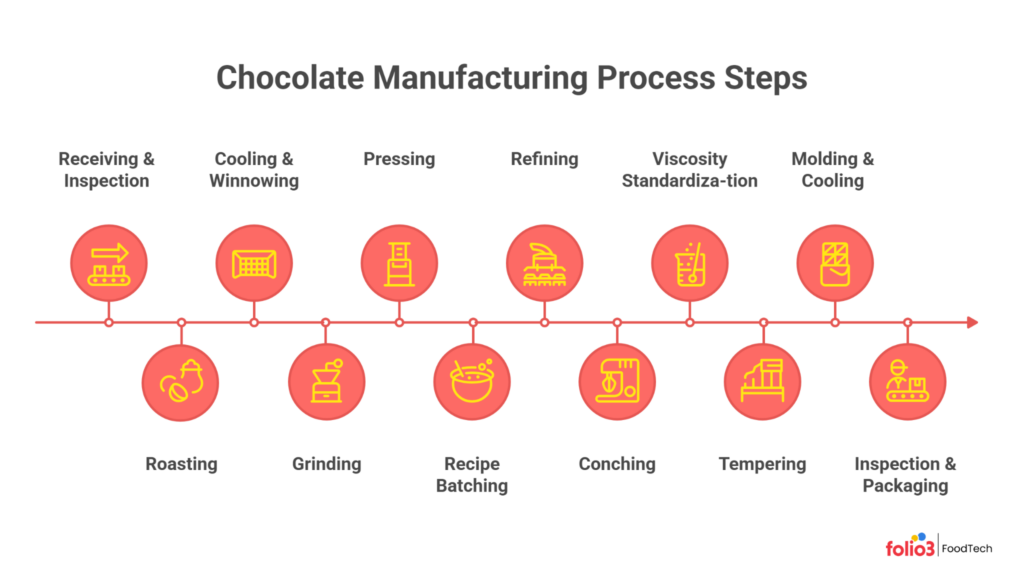
Chocolate Making Process Steps at a Glance
- Receiving, cleaning, sorting, and bean inspection
- Roasting
- Cooling, cracking, and winnowing
- Grinding cocoa nibs into cocoa liquor
- Pressing cocoa liquor (when applicable)
- Recipe batching and ingredient mixing
- Refining to the required particle size
- Conching
- Standardizing viscosity
- Tempering
- Depositing, molding, cooling, and demolding
- Inspection, packaging, and storage
Cocoa Processing Versus Chocolate Manufacturing
There is a key industry distinction that many descriptions blur. Producing cocoa liquor, cocoa butter, and cocoa powder from raw beans is cocoa processing. Making finished chocolate is a separate manufacturing stage. ICCO separates finished chocolate manufacture into batching, particle reduction, conching, and standardization after earlier cocoa processing operations. Understanding the difference between food processing and manufacturing helps you scope your own production operations accurately.
What Is Chocolate Made Of?
Your ingredient decisions define the flavor, texture, and processing behavior of every chocolate product. Here is what goes into formulation.
Cocoa Liquor and Cocoa Solids
Cocoa liquor, also called cocoa mass, is the base ingredient in most chocolate. Despite the name, it contains no alcohol. It is produced by grinding cocoa nibs until the cell walls break and naturally occurring cocoa butter is released. The result contains both cocoa solids (carrying flavor and color) and cocoa butter (providing fat content and flow).
Cocoa Butter
Cocoa butter is the fat naturally present in the cocoa bean. It controls flow behavior during manufacturing, determines how finished chocolate melts, and plays a direct role in tempering. The way cocoa butter crystallizes during tempering defines whether your bar has a glossy surface, clean snap, and smooth melt.
Sugar, Milk Solids, Lecithin, and Flavorings
Sugar provides sweetness and influences particle count during refining. Milk solids are essential in milk chocolate and introduce both flavor and allergen management considerations. Lecithin, typically from soy or sunflower, works as a food emulsifier to improve flow and reduce cocoa butter requirements. Vanilla or other flavorings round out the profile.
How Ingredients Change Dark, Milk, and White Chocolate
Dark chocolate uses cocoa liquor, cocoa butter, and sugar, with cocoa content driving intensity. Milk chocolate adds milk solids and milk fat, changing viscosity and allergen requirements. White chocolate contains cocoa butter but no cocoa liquor or solids, so it follows a different formulation path. A later section compares all three in detail.
What Happens to Cocoa Beans Before They Reach the Factory?
Your finished chocolate quality starts long before beans arrive at the factory. Here is what happens at origin and why it matters.
Harvesting Cocoa Pods
Cocoa comes from Theobroma cacao, a tropical tree that produces large pods containing 30 to 50 seeds each. Those seeds become cocoa beans after fermentation and drying. The global cocoa bean crop reached approximately 4.4 million metric tons in the 2023/24 season. The point for manufacturers: cocoa quality begins at harvest. Bean origin, variety, and harvest timing all affect the flavor potential of your raw material.
Why Fermentation Develops Chocolate Flavor
Fermentation is where flavor precursors develop inside the cocoa bean. Microorganisms break down the sugary pulp surrounding the seeds, generating heat and triggering chemical changes that create aromatic compounds responsible for chocolate flavor. The process typically lasts five to seven days.
Moreover, fermentation, along with roasting and conching, is among the major stages responsible for chocolate flavor chemistry development. The critical point for your production: poorly fermented beans cannot be fixed downstream. No amount of roasting or conching compensates for underdeveloped fermentation. Beans with limited flavor precursors carry that limitation through every subsequent step.
Drying Cocoa Beans for Storage and Transport
After fermentation, beans must be dried to reduce moisture and prevent mold during storage and transit. Drying methods range from sun exposure on raised beds to mechanical dryers, depending on region and volume. According to ICCO, cocoa is commonly dried to approximately 7.5% moisture for secure storage.
If moisture stays too high, beans become vulnerable to mold contamination that degrades quality and creates food safety risks downstream. Before leaving origin, beans undergo quality inspection for moisture level, mold, insect damage, and foreign matter. Beans that fail are downgraded or rejected.
Once fermented and dried beans arrive at your facility, factory manufacturing begins.
What Are the Steps in the Chocolate Manufacturing Process?
This is the core of the chocolate-making process. Each step follows the order it happens on the factory floor.
Step 1: Receiving, Cleaning, Sorting, and Bean Inspection
Your chocolate manufacturing process starts at the receiving dock. Supplier, origin, lot number, and shipment details identify incoming cocoa lots. Visual inspection and mechanical screening remove stones, plant material, dust, damaged beans, and foreign objects. Magnets catch ferrous contaminants.
FDA inspection guidance for cocoa and chocolate products addresses cocoa bean cleaning, magnets, contamination, mold, insects, and lot coding.
What manufacturers check at intake:
- Lot identification and supplier documentation
- Visual inspection for mold, insect damage, and off-odors
- Foreign object removal through screens, destoners, and magnets
- Moisture testing
- Lot segregation for traceability
Step 2: Roasting Cocoa Beans for Chocolate Production
Roasting is where your chocolate begins developing its flavor and aroma.
How cocoa beans are roasted: Beans are heated in rotating drum roasters or convection systems. Heat drives Maillard reactions and reduces moisture, transforming flavor precursors into the complex aromatic compounds that define chocolate character.
Time and temperature profiles vary according to bean origin, moisture content, batch size, equipment type, and desired flavor outcome. There is no single universal roasting temperature. Under-roasting leaves raw, astringent, and acidic notes in the finished product.
Over-roasting destroys delicate flavor compounds and introduces burnt or bitter off-notes that cannot be corrected later. Roasting is a major aroma-forming stage through Maillard chemistry. Getting the roast profile right for each bean lot separates average chocolate from consistently good chocolate.
Step 3: Cooling, Cracking, and Winnowing
Immediately after roasting, beans are cooled rapidly to stop the thermal reaction and prevent over-processing. The cooled beans are cracked using impact mills or roller systems that break the brittle shells without crushing the nibs inside. Winnowing systems then use calibrated airflow to separate the lighter shell fragments from the heavier cocoa nibs. Clean separation matters because residual shell in your nib stream introduces off-flavors, affects finished texture, and reduces the quality of cocoa liquor produced during grinding. Efficient winnowing directly protects every downstream processing step.
Step 4: Grinding Cocoa Nibs Into Cocoa Liquor
Cocoa nibs are fed into grinding mills where mechanical force breaks down the cellular structure and releases the naturally occurring cocoa butter. As grinding continues, friction generates heat that melts the released fat and transforms the solid nibs into a smooth, flowing paste called cocoa liquor or cocoa mass.
Despite the name, cocoa liquor contains no alcohol. The term refers to the liquid state of ground cocoa material. No additional ingredients are added at this stage. The resulting liquor contains both cocoa solids, which carry color and flavor, and cocoa butter, which provides fat content for downstream formulation.
Step 5: Pressing Cocoa Liquor Into Cocoa Butter and Cocoa Cake
Where does cocoa butter pressing fit into the chocolate making process? Some cocoa liquor is hydraulically pressed to separate cocoa butter from the remaining solid matter, known as cocoa cake. Cocoa cake can later be processed into cocoa powder. The separated cocoa butter re-enters chocolate formulations during the ingredient mixing stage.
This is a processing branch, not a mandatory step for every chocolate batch. Manufacturers producing chocolate bars may bypass pressing entirely and use cocoa liquor directly in their formulation. ICCO treats liquor pressing as part of cocoa processing, separate from the chocolate manufacturing stages that begin at batching.
Step 6: Recipe Batching and Ingredient Mixing
This is where the chocolate making process shifts from cocoa processing to actual chocolate formulation. Your recipe defines the exact proportions of cocoa liquor, cocoa butter, sugar, milk powder (for milk chocolate), lecithin, and flavor ingredients. Each ingredient is weighed and added according to batch specifications that govern every production run.
Recipe accuracy at this stage is critical. The ratios you set here directly affect particle count during refining, viscosity during conching, and finished product consistency. That’s where bill of materials management becomes essential. Every ingredient lot must be documented so your production records can trace each batch back to the specific raw materials used.
Step 7: Refining Chocolate to the Required Particle Size
The mixed chocolate mass passes through roll refiners, ball mills, or other industrial particle reduction equipment. The goal is to reduce the solid particles, including sugar crystals, cocoa solids, and milk solids, to a size small enough that your tongue cannot detect individual grains.
Refining is not the same operation as grinding. Grinding converts nibs into cocoa liquor earlier in the process. Refining reduces the particle size of the blended chocolate mass after ingredients are combined. Particle size is critical to both rheological behavior and sensory perception. Particles that are too large create a gritty mouthfeel. Particles that are too fine increase surface area needing fat coating, which raises viscosity and cocoa butter requirements.
Step 8: Conching the Refined Chocolate
Conching is where refined chocolate develops its final flavor profile and flow characteristics.
What is conching in chocolate manufacturing? Conching is a prolonged mixing, shearing, and aeration process applied to refined chocolate. It reduces moisture, removes unwanted volatile acids, coats solid particles with fat, and develops the smooth flow properties needed for tempering and molding.
During conching, the chocolate mass is continuously agitated and heated. The process balances moisture reduction, volatile acid removal, flavor development, particle coating with cocoa butter, and viscosity adjustment. As volatile acids evaporate and particles become fully coated, the chocolate transitions from a rough, acidic mass into a smooth, balanced product with the flow characteristics your downstream processes require.
Conching duration varies by formulation, equipment, and target product characteristics. Some dark chocolate formulations run 48 to 72 hours. Longer conching does not automatically produce better chocolate. The outcome depends on starting material quality, recipe design, and process control.
Step 9: Standardizing Viscosity and Final Chocolate Flow
After conching, the chocolate may need final viscosity adjustment before tempering. Manufacturers add measured amounts of cocoa butter or emulsifier to achieve the flow characteristics required for the intended application.
Molded bars need chocolate that fills cavities cleanly and releases properly. Coating and enrobing require thinner, more controlled flow to cover products evenly. Getting viscosity right here directly affects yield, appearance, and consistency. This industrial detail is one most descriptions of the food processing sequence miss.
Step 10: Tempering the Chocolate
Tempering is the controlled heating and cooling cycle that establishes stable cocoa butter crystals in the finished chocolate.
Why is tempering important in chocolate making? Without proper tempering, cocoa butter crystallizes in unstable forms that produce dull surfaces, soft texture, poor mold release, and fat bloom. Tempering ensures cocoa butter sets into the most stable crystal structure, giving chocolate its gloss, snap, smooth melt, and storage stability.
The process involves heating chocolate to melt all existing crystals, cooling under controlled conditions to form stable crystals, and gently rewarming to eliminate unstable forms. Tempering is critical for stable cocoa butter crystal structure and the appearance, texture, and shelf stability manufacturers require.
Tempering parameters vary by chocolate type and fat composition. Dark, milk, and white chocolate each require different temperature curves, which is why precise process quality control at this stage is essential.
Step 11: Depositing, Molding, Cooling, and Demolding
Tempered chocolate is deposited into molds using precision depositors that control volume and flow rate. Vibration tables remove trapped air bubbles that would leave holes or weaknesses in the finished product.
Filled molds pass through cooling tunnels where temperature, humidity, and airflow are controlled. As chocolate cools, it contracts slightly, allowing clean release from mold surfaces. The cooling profile must be gradual and consistent. Cooling too fast creates stress cracks or dull finishes. Uneven temperatures cause inconsistent contraction, difficult demolding, and higher reject rates. After cooling, chocolate moves to inspection and packaging.
Step 12: Inspection, Packaging, and Storage
Finished chocolate undergoes visual quality inspection for surface defects, color consistency, and structural integrity. Weight control systems verify that each unit meets the target weight within acceptable tolerances. Foreign material detection, including metal detectors and sometimes X-ray systems, screens for contaminants that visual inspection cannot catch. Lot codes are applied to every finished unit for lot traceability and barcode tracking, connecting each packaged product back to its production batch, ingredient lots, and original cocoa lot.
Primary and secondary packaging protect the product from moisture, light, odors, and temperature fluctuations. Storage conditions matter well beyond the packaging line. Temperature swings cause condensation on chocolate surfaces, which can lead to sugar bloom (white crystalline patches) or fat bloom (grey, waxy appearance). Both reduce consumer appeal and shelf life. Maintaining proper food and beverage quality through storage and distribution protects the quality your production team built during manufacturing.
How Does the Manufacturing Process Differ for Dark, Milk, and White Chocolate?
Different formulations need different processing approaches. Here is how the chocolate-making process changes by product type.
| Chocolate Type | Cocoa Liquor | Cocoa Butter | Sugar | Milk Solids | Processing Considerations |
| Dark | High | Yes | Yes | No | Higher viscosity, longer conching |
| Milk | Lower | Yes | Yes | Yes | Allergen control; milk fat affects tempering |
| White | None | High | Yes | Yes | Cocoa butter quality is critical |
Dark Chocolate
Dark chocolate uses higher proportions of cocoa liquor and cocoa butter relative to sugar, creating a more viscous mass during refining and conching. Flavor management is critical because the cocoa character is front and center with no milk solids to soften it. Conching profiles often run longer to reduce volatile acidity. Tempering follows standard cocoa butter crystallization curves, but higher cocoa content can affect viscosity at working temperatures.
Milk Chocolate
Milk chocolate adds milk powder, milk solids, and milk fat to the formulation. These change viscosity during refining, affect tempering behavior because milk fat interacts differently with cocoa butter crystallization, and introduce major food allergen requirements across your line. If you manufacture both milk and dark chocolate, your food safety protocols must include allergen segregation, validated cleaning, and documentation.
White Chocolate
White chocolate contains cocoa butter but no cocoa liquor or cocoa solids. It relies on cocoa butter quality for flavor, texture, and stability. White chocolate does not go through bean roasting and grinding as part of its direct recipe preparation. The cocoa butter used is typically deodorized for a neutral flavor base. Tempering and stability depend heavily on cocoa butter purity and treatment. White chocolate is more sensitive to storage temperature variations.
Does Every Chocolate Factory Follow the Same Manufacturing Process?
No. Chocolate factories can enter the process at different stages. Bean-to-bar manufacturers start with fermented, dried cocoa beans. Other factories purchase cocoa liquor, cocoa butter, or cocoa powder and begin with formulation. Optional processes such as alkalization or milk crumb production also change the sequence.
Bean-to-Bar Factories Start With Whole Cocoa Beans
Bean-to-bar manufacturers receive fermented and dried cocoa beans and perform roasting, winnowing, grinding, formulation, refining, conching, tempering, and finishing in-house. Fermentation and drying still happen at origin.
| Bean-to-Bar Route: Cocoa Beans → Roasting → Winnowing → Grinding → Mixing → Refining → Conching → Tempering → Finished Chocolate |
This is the most complete version of the chocolate-making process from bean to bar.
Some Factories Start With Cocoa Liquor and Cocoa Butter
Not every factory processes whole beans. Some purchase cocoa liquor, cocoa butter, or cocoa powder and begin at batching, then move through refining, conching, tempering, molding, and packaging.
| Cocoa Ingredient Route: Cocoa Liquor + Cocoa Butter + Ingredients → Mixing → Refining → Conching → Tempering → Finished Chocolate |
Academic descriptions commonly define chocolate production as beginning when cocoa mass is combined with sugar, cocoa butter, and other ingredients.
Alkalization Is an Optional Cocoa Processing Step
Some manufacturers alkalize (Dutch-process) cocoa nibs, liquor, or cake to modify color, flavor, and solubility. It is not required in every chocolate-making process. ICCO identifies alkalization as an optional processing operation.
Milk Chocolate Can Follow a Different Ingredient Route
Milk chocolate introduces milk solids and milk fat, affecting processing and tempering. One industrial variation is the chocolate crumb route, where milk, sugar, and cocoa are combined into an intermediate material before further processing.
| Crumb Route: Chocolate Crumb + Cocoa Butter + Ingredients → Refining → Conching → Tempering → Finished Milk Chocolate |
This means the milk chocolate manufacturing process can differ from the standard dark chocolate sequence.
How Do Chocolate Factories Manage Production and Traceability at Scale?
Consistent chocolate production requires more than good equipment. Here is how manufacturers connect process control with operational systems.
The Manufacturing Challenge Goes Beyond the Processing Equipment
Your factory floor runs roasters, refiners, conches, and tempering machines. But your production team also coordinates recipe versions, raw material lots, production batches, ingredient availability, production schedules, quality records, allergens, yield, scrap, finished inventory, costs, and traceability.
The real challenge is coordination. A recipe change affects your food recipe management system, purchasing, and production schedule. A supplier lot change requires updated receiving records and adjusted parameters. These information workflows separate a well-run food production operation from one that struggles with consistency and audit readiness.
Connecting the Cocoa Lot to the Finished Chocolate Batch
Traceability in chocolate manufacturing means connecting any finished product to its origin materials. The information chain runs:
| Supplier cocoa lot → receiving record → ingredient lot → production order → recipe → processing batch → quality results → finished SKU → warehouse lot → customer shipment |
Every link must be documented, retrievable, and maintained to meet food traceability compliance requirements. When a recall or complaint occurs, response speed depends on how well these connections are maintained. If you cannot trace a finished bar to its cocoa lot and ingredient lots, your recall scope expands, and costs multiply.
Where Food Manufacturing Systems Fit
That’s where food manufacturing solutions help manage the operational complexity behind the production line. Folio3 FoodTech provides capabilities built for process manufacturing environments like chocolate production:
- Chocolate recipe and formula management
- Batch management and production scheduling
- Cocoa and ingredient lot traceability
- Raw material and work-in-progress inventory
- Quality checks across production stages
- Ingredient and allergen tracking
- Yield, scrap, and variance tracking
- Batch-level production costing
- Traceability and recall readiness
Folio3 FoodTech does not directly control your roasters, conches, or tempering machines. It manages the production information and operational workflows surrounding those processes. It connects recipes, batches, ingredients, quality records, inventory, and costs into a single system that gives your production team full visibility and supports the traceability your customers, auditors, and regulators expect.
Conclusion
The chocolate-making process transforms fermented cocoa beans through cleaning, roasting, winnowing, grinding, formulation, refining, conching, tempering, molding, cooling, and packaging. Each step changes the material and demands specific controls.
Consistent factory production depends on managing both physical processing and the information tied to recipes, batches, ingredients, quality, inventory, yield, and traceability. Manufacturers who control both sides deliver reliable quality and scale their operations with confidence.
Consult with our Foodtech experts to discover how Folio3 FoodTech supports chocolate and confectionery manufacturing →
FAQs
How Long Does It Take To Make Chocolate in a Factory?
A complete cycle from roasted beans to packaged chocolate takes one to several days. Conching alone can run up to 72 hours depending on formulation.
What Is the Difference Between Cocoa Liquor and Cocoa Butter?
Cocoa liquor is the paste from grinding cocoa nibs, containing both solids and fat. Cocoa butter is the fat separated through pressing. They serve different formulation roles.
Why Does Chocolate Need To Be Conched?
Conching removes moisture and volatile acids, coats particles with fat, and develops smooth texture and balanced flavor. Without it, chocolate tastes rough and acidic.
Why Is Chocolate Tempered Before Molding?
Tempering establishes stable cocoa butter crystals that give chocolate its gloss, snap, and smooth melt. Without it, chocolate develops dull surfaces and fat bloom.
What Machines Are Used in Chocolate Manufacturing?
Factories use roasters, winnowers, grinding mills, refiners, conches, tempering machines, depositors, cooling tunnels, metal detectors, and packaging lines. Configuration depends on volume and product range.
How Is Chocolate Quality Controlled During Manufacturing?
Manufacturers monitor roasting profiles, moisture, particle size, viscosity, tempering curves, weight, appearance, and foreign material detection at multiple checkpoints from intake through packaging.


