
Food & Beverage ERP Implementation Services

Get Food ERP Implementation Services From Certified ERP Experts

Folio3 FoodTech offers food ERP implementation services backed by certified NetSuite and Microsoft Dynamics 365 ERP specialists and food industry expertise. From configuration and data migration to integrations and go-live, we prepare your ERP for everyday operations.

Trusted by Leading Food and Beverage Brands

What Is Food and Beverage ERP Implementation?

Food ERP implementation is the process of setting up an ERP system, such as NetSuite or Microsoft Dynamics 365, to run a food or beverage business. It covers planning, configuring recipes, lots, shelf life, and costing, migrating data, connecting existing systems, testing, training, and go-live support. Since 2004, Folio3 FoodTech has helped food manufacturers get this right, combining certified ERP consultants with real food industry experience.

Why Do Most ERP Implementations Fail?

Scope and Cost Overruns

New requirements surface after signing, pushing costs up and delaying go-live. Budgets and timelines become harder to predict.

Incomplete Migration

Missing or inconsistent item, recipe, and lot records lead to inaccurate inventory, unreliable reports, and costly errors after launch.

Generic ERP Setup

A standard setup can miss food-specific needs, from catch weight and co-products to shelf life and the way each plant runs production.

Rushed Go-Live

Poorly timed cutovers and limited training leave employees struggling with the new system, falling back on spreadsheets, and disrupting daily operations.

What Our Food ERP Implementation Services Include

As an ERP implementation partner for food industry, Folio3 FoodTech supports projects from initial assessment and configuration through integration, migration, and deployment.

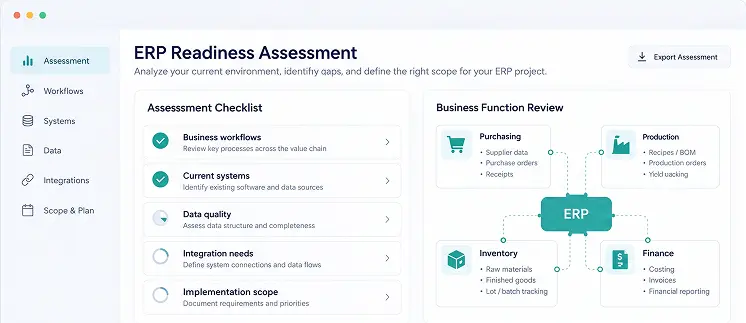
Pre-Implementation Assessment

We map how your business runs today, find the gaps, decide what goes live first, and hand you a fixed scope, cost, and timeline before you commit.
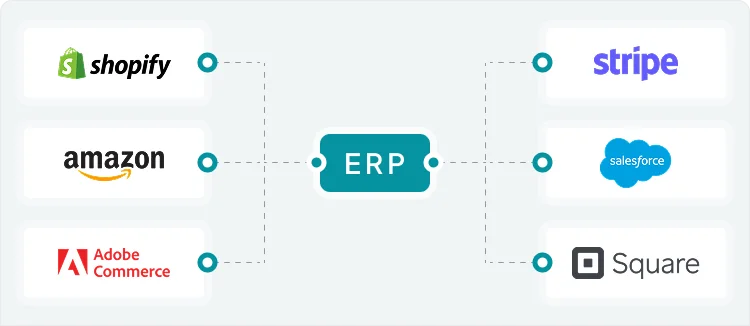
ERP Integration

Connect your ERP to ecommerce, POS, 3PLs, and retailer EDI using prebuilt connectors or custom APIs, so orders, inventory, and invoices flow without manual re-entry.
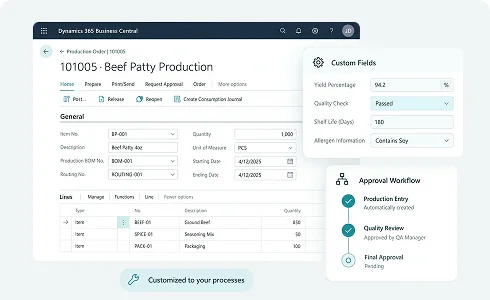
ERP Customization

We configure standard ERP features first, from workflows and approvals to reports. Custom development fills genuine gaps without making future updates harder for your team.
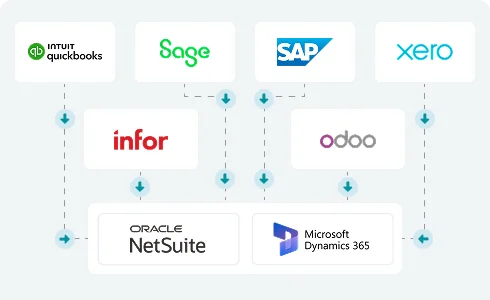
ERP Migration

Moving from spreadsheets, QuickBooks, Sage, SAP, or another legacy system? We transfer and validate item records, recipes, inventory lots, balances, and customer price lists.
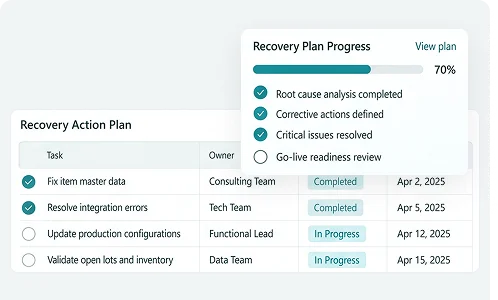
ERP Integration

With 35+ prebuilt ERP connectors, we connect ecommerce, POS, warehouse, logistics, and retailer EDI systems to keep orders and business data moving reliably between systems.
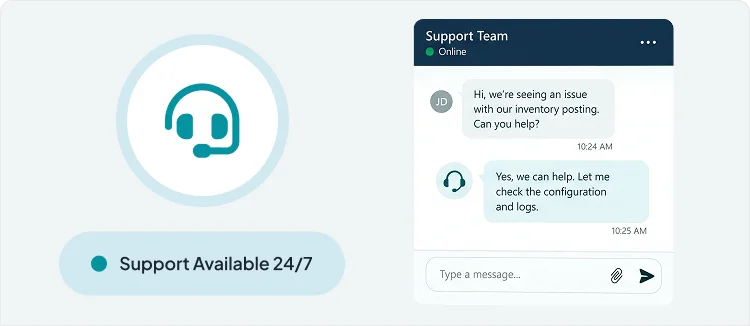
Deployment and Go-Live Support

We plan cutover around your operating calendar, complete final data checks, coordinate launch, and stay with your team 24/7 as the new ERP goes live.
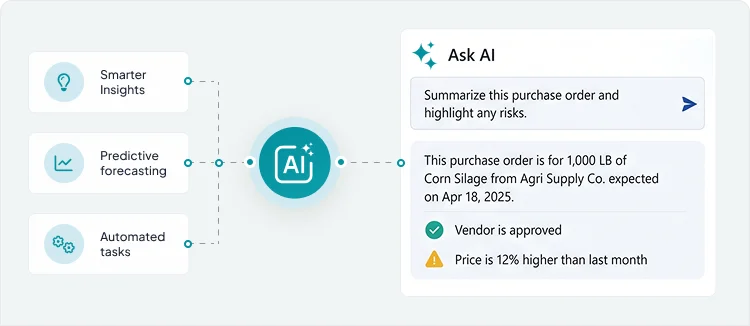
AI Readiness & Enablement

We assess your ERP, data, and workflows to identify useful AI opportunities, then help integrate the right capabilities into your existing business systems.
Free Discovery Call

How Folio3 FoodTech Takes Your Food ERP From Plan to Go-Live

We plan each phase of ERP implementation around your business requirements and operating calendar, with clear checkpoints to review progress, resolve issues, and confirm readiness before moving ahead.

Step 1

Project Planning and Requirements

We define scope, modules, budget, timeline, decision-makers, and escalation paths, then map current workflows, identify ERP gaps, and document requirements formally before implementation begins.

Step 2

ERP Configuration and Build

We configure your ERP in a test environment using approved requirements, setting up items, recipes, customers, roles, workflows, reports, and integrations to fit your operations.

Step 3

Testing and Sign-Off

We run unit, integration, and end-to-end tests to check system connections and workflows. Key users test real scenarios and formally approve the solution before launch.

Step 4

Go Live and Ongoing Support

We coordinate the cutover, support your team during launch, and resolve issues as operations transition to the new ERP. Ongoing support covers maintenance, updates, security, and system improvements.

Pick the Right ERP Implementation Path With Our Team of ERP Experts

Flexible implementation options for every stage of growth. Choose how fast you go live and how much you build at once, based on your food operation’s size, structure, and goals.

Rapid Start

For growing food businesses moving beyond spreadsheets or basic accounting software. Use Business Central Rapid Start or NetSuite SuiteSuccess where standard workflows fit your purchasing, inventory, production, and finance needs.

Phased Rollout

For manufacturers that need to keep plants running during implementation. Roll out by facility or business function, validating production, inventory, and order workflows before moving into each next phase.

Full-Scope Implementation

For multi-plant manufacturers with complex production, finance, warehousing, and supply chains. Implement core operations and required integrations under one coordinated plan across locations and business entities.

Certified Implementation Partner for NetSuite & Dynamics 365

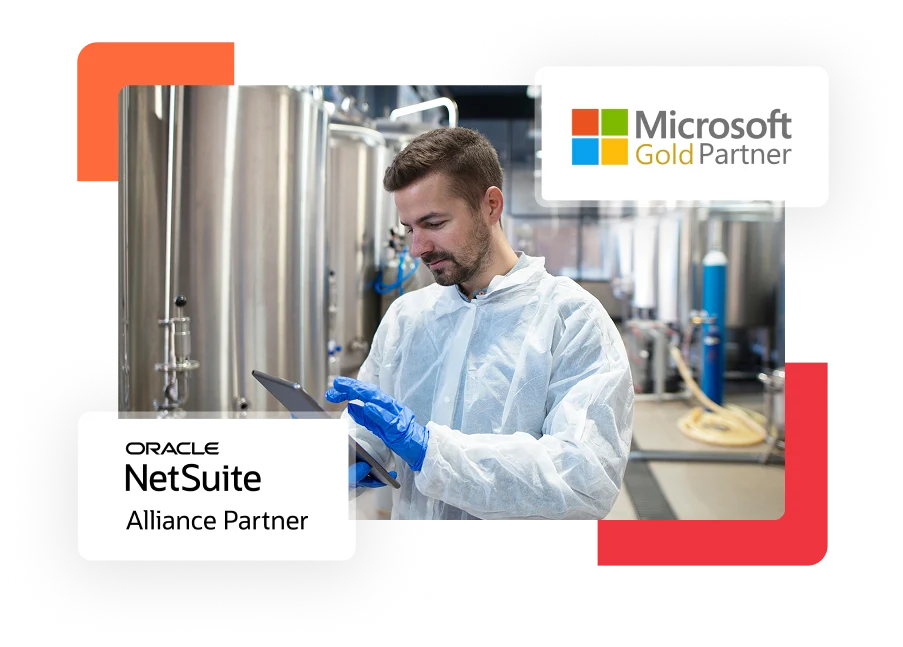
As an award-winning Oracle NetSuite Alliance Partner and a Microsoft Solutions Partner for Business Applications, we implement the ERP platforms food manufacturers rely on most, configured for how you produce, pack, and ship.

Microsoft Dynamics 365 Business Central

For small and midsize food manufacturers moving beyond spreadsheets, we implement Business Central across finance, purchasing, inventory, production, and sales, with Microsoft tools and Power BI reporting helping teams share information and track performance daily.

Microsoft Dynamics 365 Finance and Supply Chain Management

For larger manufacturers managing multiple plants and complex production, we implement Dynamics 365 Finance and Supply Chain Management to coordinate finance, planning, warehouse operations, product formulas, co-products, and high-volume supply chains across locations and teams.

Oracle NetSuite

For food brands and distributors expanding across entities, locations, or sales channels, we implement NetSuite with food-specific production, lot and expiry tracking, warehouse, ecommerce, and financial workflows in one cloud ERP to support future growth.
Results-Driven Food ERP Implementation

We plan each phase of ERP implementation around your business requirements and operating calendar, with clear checkpoints to review progress, resolve issues, and confirm readiness before moving ahead.

Certified NetSuite
consultants
0 +
go-live success rate
0 %
ERP Certified Experts
0 +

Lower Cost to Operate

Automated workflows and fewer errors cut operating costs by up to 30%, freeing budget for growth and innovation.

Faster Cash Flow

Orders move from entry to invoice without delays, with processing up to 55% faster, so cash reaches your account sooner.

Decisions Made on Live Numbers

Leaders see production, inventory, and profitability in real time, cutting reporting delays by up to 50% and surfacing problems early.

Stronger Retailer Relationships

Accurate orders and on-time shipments strengthen retailer relationships, with order errors down up to 89% and fewer costly chargebacks.

Growth Without Growing Pains

Add plants, product lines, sales channels, or acquisitions on the same system, scaling volume without rebuilding processes or adding staff.

Bringing ERP Implementation Expertise to Different Food Industries

Explore the food industries we serve and find ERP solutions suited to your products, processes, and business needs.

See How Food Businesses Move Forward With Folio3

From growing brands to established manufacturers, food companies turn to Folio3 FoodTech for ERP guidance that delivers results. Here are a few of their stories.

ERP IMPLEMENTATION TIMELINE

How Long Does Food ERP Implementation Take?

 Most food ERP implementations take anywhere from a few months to a year, depending on complexity. We show you exactly where your project falls and what speeds it up before work begins.

ERP IMPLEMENTATION COST

How Much Does Food ERP Implementation Cost?

The cost of food and beverage ERP implementation is confirmed during the assessment, based on what your food business actually needs. The main factors are the platform, number of plants and entities, integrations, data volume, and how much custom work is required.

Our Industry Advisors

Our industry advisors bring firsthand food industry knowledge to our ERP services, connecting real operational challenges with practical technology solutions.

Kevin Manion

Industry Advisor
CFO @ Capitol Food Co

Harold Birch

Industry Advisor
Co-Founder, UnCommon Farms

Sam Cossio

Industry Advisor
CEO @ Back to Basics Consulting

Jens Kjaer

Advisor,
Ex-Sen Associate Director, BI 

Jerry Flint

Advisor
Ex-COO, National Pork Board

Frequently Asked Questions

What makes food ERP implementation different from a standard ERP project?
Food ERP implementation must account for batch production, recipes and formulas, lot traceability, shelf life, yield costing, quality control, and food safety requirements. These processes need to work alongside purchasing, inventory, warehousing, sales, and finance.
The decision depends on your operational complexity, number of facilities and entities, production requirements, existing technology, and growth plans. Folio3 FoodTech implements both platforms and can help assess which best fits your business requirements.
The total investment can include implementation services, data migration, integrations, customization, training, and ongoing support, in addition to software licensing. Folio3 FoodTech defines the project scope and associated ERP implementation cost for food companies based on the requirements before implementation begins.
A well-planned implementation accounts for production schedules, peak seasons, facility dependencies, and cutover requirements. Phased deployment, realistic testing, user training, and a rehearsed transition plan help reduce disruption to daily operations.
The ERP must be configured to support lot and batch tracking, expiry management, quality checks, product holds, and relevant compliance records. Testing these workflows before go-live helps verify that traceability information remains accessible and accurate.
Yes. ERP can be integrated with existing MES, warehouse management, ecommerce, POS, EDI, and other business applications where suitable integration options exist. Folio3 FoodTech provides prebuilt connectors and custom integration development based on the systems involved.
Readiness depends on clear business requirements, reliable data, defined processes, stakeholder alignment, and the availability of key users for testing and training. An initial assessment can identify gaps and establish the scope, priorities, and timeline before the project starts.
Yes. With the right platform and configuration, ERP can support multiple locations, shared business processes, consolidated reporting, and location-specific operations. The implementation approach should account for differences between facilities and the complexity of your supply chain.
Evaluate the partner’s food industry experience, expertise in your chosen ERP, integration capabilities, approach to data migration and testing, and ability to support go-live and ongoing improvements. Folio3 FoodTech combines certified NetSuite and Microsoft Dynamics 365 expertise with food industry knowledge.
Support can include troubleshooting, user assistance, system maintenance, integration monitoring, and improvements as business requirements evolve. The objective is to stabilize operations after launch and help the ERP continue supporting your production, inventory, and financial processes.