

Running a tuna processing plant today means balancing razor-thin margins against rising labor costs, stricter food safety audits, and consumers who want everything from shelf-stable cans to sashimi-grade loins.
This guide breaks down every stage of tuna fish processing, from vessel-to-factory cold chain to final retort sterilization. You will find the exact thermal parameters, yield benchmarks, and automation strategies that separate high-performing tuna processing factories from those leaving money on the cleaning table.
Whether you are optimizing an existing canned tuna processing line or evaluating a new tuna processing method for a premium product rollout, this is the operational manual you need.
The Modern Landscape of the Global Tuna Processing Plant
The global tuna processing factory has changed dramatically in the last decade. Here is what is driving that shift and how modern facilities are adapting.
Global tuna catches reached 8.3 million tonnes in 2022, the highest level ever recorded. That volume feeds a canned tuna market valued at approximately USD 12.5 billion in 2025, growing at a projected CAGR of 4.5%. The scale is massive, and the operational demands are evolving fast.
Several macro shifts are reshaping how every tuna processing plant operates:
- Tighter regulatory standards: BRCGS, IFS, and FDA seafood HACCP now require digital documentation of every critical control point, from receiving temperatures to retort F₀ values.
- Automation to offset labor shortages: Skilled cleaning and loining workers are harder to recruit. Factories are moving toward vision-guided automated loining and robotic can-filling systems.
- Shift from cans to pouches: Consumer preference for flexible packaging is pushing processors to invest in pouch-fill and retort-pouch lines.
- Sustainability pressure: Buyers require MSC certification or equivalent chain-of-custody documentation, forcing traceability from vessel to finished product.
What is a modern tuna processing facility? A vertically integrated tuna processing plant handles thawing, pre-cooking, cleaning, loining, canning or pouching, retort sterilization, and warehousing under one roof. The best facilities maintain strict separation between raw and sterile zones while tracking every lot through digital seafood traceability systems.
Step-by-Step Breakdown of Industrial Canned Tuna Fish Processing
Canned tuna processing follows a precise sequence of thermal and mechanical steps. Each one directly impacts your yield, safety, and product quality.
The traditional double-cook method remains the backbone of high-volume tuna processing worldwide. Below is the step-by-step operational breakdown, with the food science parameters your QA team needs to monitor at each stage.
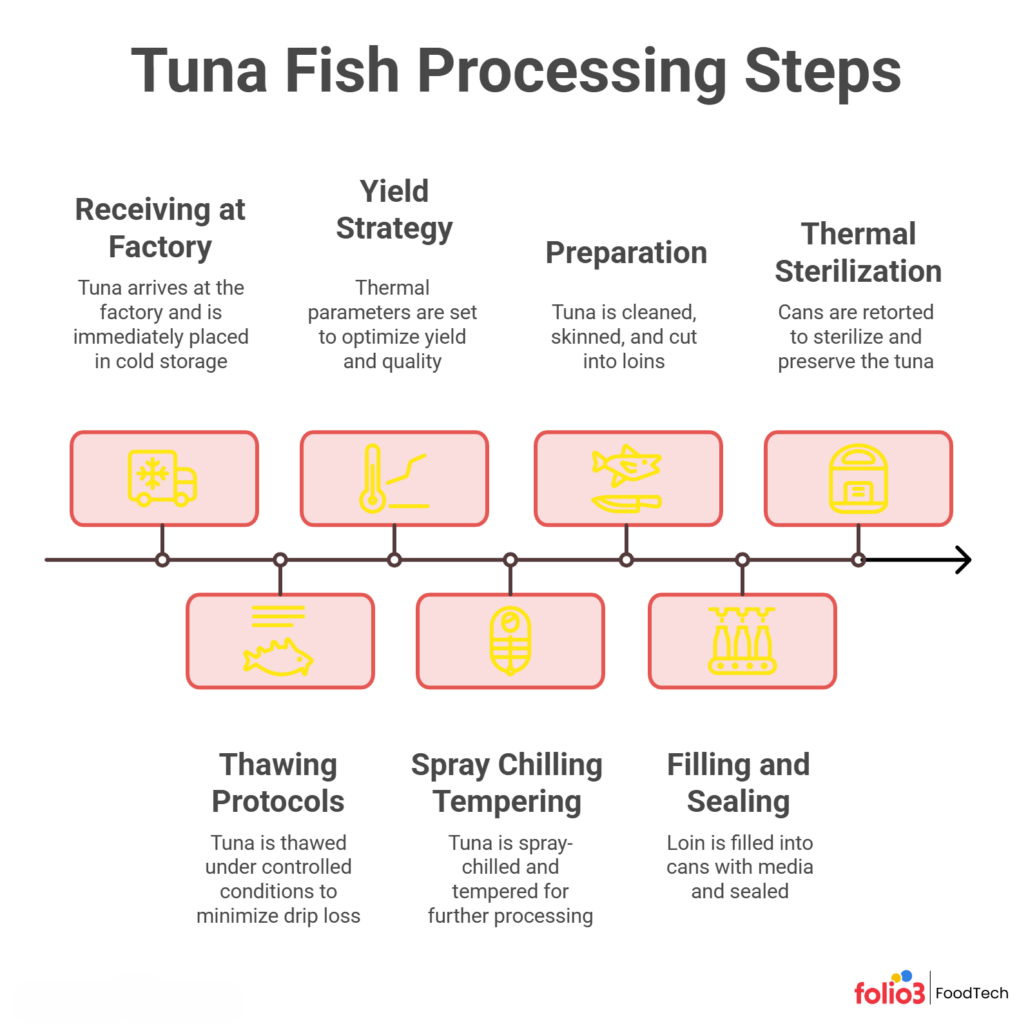
1. Cold Chain Integrity and Receiving at the Tuna Processing Factory
Your product quality is decided before tuna even reaches the processing floor. At the receiving dock, core temperatures must be verified immediately.
Frozen tuna should arrive at Ultra-Low Temperature (ULT) storage conditions between -35°C and -40°C. This is not optional. Tuna is a scombroid species, and histamine (scombrotoxin) formation begins rapidly when temperatures rise above -18°C. Once histamine forms in the muscle tissue, no amount of cooking will destroy it.
Your receiving protocol should include infrared core temperature checks on every pallet, rejection of any lot where core temperature exceeds -18°C, and immediate transfer to ULT cold storage. Maintaining strict cold chain compliance from vessel to factory is your first critical control point. Investing in proper seafood cold storage infrastructure pays for itself by preventing costly histamine-related rejections downstream.
What temperature prevents histamine formation in commercial tuna processing? Tuna must be stored at -35°C to -40°C during transport and receiving to prevent scombrotoxin formation. Histamine develops when tuna is exposed to temperatures above -18°C for extended periods.
2. Controlled Thawing Protocols to Mitigate Drip Loss
Thawing is where many processors lose yield without realizing it. Poorly controlled thawing leads to excessive drip loss, protein denaturation, and inconsistent pre-cook results.
Three primary commercial food thawing methods are used in tuna processing plants. Running-water thawing is most common, placing frozen tuna in flowing water tanks below 21°C. Air-blast thawing uses forced air circulation for more uniform temperature distribution. Vacuum thawing, the most advanced option, applies reduced atmospheric pressure to accelerate heat transfer while keeping surface temperatures low.
Your target is drip loss below 2% of the fish’s incoming weight. Anything above that means you are literally pouring margin down the drain. Standardize thaw-time calculations based on fish size and species.
3. The Pre-Cooking Stage: Thermal Parameters and Yield Strategy
Pre-cooking is where tuna processing diverges from most other food processing methods. You are cooking whole, eviscerated fish before cleaning, not after.
Steam cooking takes place in large pre-cookers at temperatures between 100°C and 105°C. The target is to bring the backbone temperature to 60°C to 65°C. This breaks down connective tissue, so loins separate cleanly, coagulates muscle proteins for firmer texture during cleaning, and partially dehydrates the fish.
Undercooking leaves soft, mushy flesh that tears apart on the cleaning line. Overcooking causes excessive moisture loss and lower yield. Use thermocouple probes at the thickest point near the backbone for accurate readings. Pre-cook weight loss typically ranges between 18% and 25% of the thawed fish weight. Tracking this per batch gives you a direct read on yield performance. Thermal processing parameters must be validated for every production run.
4. Spray Chilling and Tempering
After pre-cooking, the fish must be cooled before it hits the cleaning tables. Rushing this step creates problems.
Evaporative spray chilling uses fine water mists to bring the cooked fish temperature down to a handleable range (typically 35°C to 40°C) without shocking the muscle structure. This stabilizes the protein matrix and prevents the loin from flaking apart during cleaning.
Tempering, the brief holding period afterward, lets the internal temperature equalize throughout the fish. Skipping it means the outside is cool while the core is still soft, leading to poor loin integrity and lower solid-pack recovery rates.
5. Cleaning, Skinning, and Loining: Manual vs. Automated Lines
This is the most labor-intensive step in any tuna processing factory, and it is where your yield either holds or falls apart.
The goal is maximum recovery of white meat loins while cleanly removing skin, bones, and dark/red muscle. Dark muscle is a byproduct, typically redirected to pet food production lines. On a traditional manual cleaning line, skilled workers remove skin and fins, extract four loin quarters from the carcass, separate red muscle from white meat, and sort loins by grade (solid, chunk, or flake).
Automated vision-guided loin extraction systems are gaining ground in high-volume plants. These systems use cameras and AI to assess fish size and shape, then adapt cutting blade positions in real time. The result is more consistent cuts, less giveaway to the flake category, and higher throughput per square foot. If you are evaluating robotics in food processing, the cleaning and loining stage is where the ROI case is strongest for tuna.
6. Can Filling, Media Injection, and Double-Seam Sealing
Once loins are cleaned and graded, they move to the filling line. Mechanical filling systems pack loins into cans in three formats: solid pack (whole loin pieces, highest retail price), chunk (smaller loin pieces, dominant retail format), and flakes (fragments from cleaning, zero-waste utilization).
After filling, the can receives its packing medium: brine, vegetable oil (typically soybean or olive), or spring water. Sealing happens through double-seam technology using steam vacuum seamers. The seamer creates a hermetic seal while displacing residual oxygen from the headspace. Eliminating oxygen prevents lipid oxidation and ensures shelf stability. Every seam must be inspected against your food quality control standards, with teardown inspections at scheduled intervals.
7. Retorting and Thermal Sterilization (F₀ Value Assurance)
Retorting is your definitive critical control point. If this step fails, nothing else matters.
Sealed cans enter overpressure retorts operating at 116°C to 121°C. The target is an F₀ value between 10 and 15 minutes, representing the equivalent time at 121.1°C needed to achieve commercial sterility and complete elimination of Clostridium botulinum spores.
Overpressure retorting (steam-air or water immersion) prevents can deformation during the sterilization cycle. Every batch must be documented with time-temperature data from calibrated sensors, and deviations must trigger your corrective action process. This step is where your seafood HACCP plan lives or dies. Retort records are the first thing an auditor reviews and the last line of defense against a product recall.
Comparing Industrial Tuna Processing Methods: Single-Cook vs. Double-Cook vs. Fresh Loins
Not every tuna product follows the same processing path. Your choice of method shapes everything from capital investment to end-market positioning.
The Standard Double-Cook Method
The double-cook method described above is the industry standard for shelf-stable canned tuna. It handles high volumes efficiently, works with lower-grade raw material (whole frozen round fish), and produces a shelf-stable product suitable for mass retail and foodservice.
The tradeoff is that the initial steam cooking phase draws out water-soluble vitamins, minerals, and a portion of the natural omega-3 fatty acids. The liquid released during pre-cooking (“cook liquor”) is typically collected and processed into fish oil or fishmeal rather than reaching the consumer. For commodity markets, the double-cook method remains hard to beat on cost per unit.
The Single-Cook “No-Drain” Method
The single-cook method flips the process. Raw loins are cleaned, packed directly into cans, vacuum sealed, and cooked once inside the container during the retort cycle.
This retains 100% of the natural omega-3 fatty acids and water-soluble nutrients because there is no pre-cook liquid to discard. The consumer receives all natural juices, earning the “no-drain” label used by premium brands. You need higher-quality raw material (pre-cleaned frozen loins), and cleaning raw tuna is more labor-intensive than cleaning cooked fish. But for processors targeting health-conscious premium retail, the margin uplift can justify the added cost.
Ultra-Low Temperature (ULT) Fresh Loin Processing
ULT fresh loin processing bypasses canning entirely, targeting the sushi, sashimi, and premium tuna steak markets.
Fresh or brine-frozen whole tuna is butchered into loins under strict temperature controls. Where legally permitted, Carbon Monoxide (CO) gas flush treatments stabilize myoglobin color through distribution. This is a highly specialized operation requiring precision knife work and robust cold chain management. Yield recovery is moderate (50% to 55% from round weight) because sashimi-grade quality demands aggressive trimming of any discolored tissue.
Operational Evaluation Matrix: Processing Method Comparison
This matrix compares the three tuna processing methods across the metrics that matter most to operations directors.
| Operational Metric | Traditional Double-Cook (Canned) | Premium Single-Cook (No-Drain) | ULT Fresh/Frozen Loin Processing |
| Primary Raw Material | Whole Frozen (Round/Gilled & Gutted) | Pre-cleaned Raw Frozen Loins | Fresh or Brine-Frozen Whole Tuna |
| Average Loin Yield | 42% to 45% (Based on round weight) | 90% to 95% (From raw loin input) | 50% to 55% (High trimming required) |
| Labor Intensity per MT | High (Extensive cleaning/loining crews) | Medium (Automated filling dominant) | Extremely High (Precision manual knife work) |
| Thermal Process | Pre-cook (Steam) + Retort Sterilization | Direct Single Retort Sterilization | Zero Cooking (Strict Cold Chain Only) |
| Critical Safety Hazards | Histamine, Retort F₀ failure | Histamine, Seam integrity | Scombrotoxin, Parasitic vectors |
| Target Market | Mass Retail, Foodservice | Premium Organic, Health-Conscious Retail | Sushi/Sashimi, High-End Retail |
Engineering Automation and Factory Layout in Modern Tuna Processing Plants
Automation and layout optimization are your biggest levers for increasing throughput without proportionally increasing headcount.
Integrating Automated Loining and X-Ray Inspection Systems
Modern automated loining systems use machine vision to scan each pre-cooked fish, calculate its dimensions, and adjust cutting blade positions in real time. This eliminates manual variability and increases the percentage of product graded as “solid” rather than downgraded to “chunk” or “flake.”
Inline X-ray inspection systems are now standard in export-oriented tuna processing plants. These scanners detect bone fragments and contaminants that visual inspection would miss. For processors targeting bone-free certifications (required by major European and Japanese buyers), X-ray systems are a market-access requirement. Investing in food processing automation at the loining and inspection stages delivers measurable gains in both yield and compliance.
Optimizing Floor Layout for Smart Flow and Contamination Barriers
Your factory layout must enforce a strict one-way flow from raw material receiving to finished product warehousing. The critical design element is physical separation between the “Raw/Pre-cook Zone” and the “Sterile Post-Retort/Packaging Zone.” This means separate air handling systems, dedicated personnel with zone-specific uniforms, and controlled transfer points where cans cross to the sterile side only after retorting.
Compliance with global food safety standards like BRCGS, IFS, and FDA 21 CFR Part 113 depends on getting this separation right. Maintaining clean food contact surfaces across both zones is equally non-negotiable.
Circular Economy in Seafood Manufacturing
Every stage of tuna processing generates material that never reaches the consumer but still holds value. Heads, skins, and viscera can be processed into high-grade fishmeal and marine oils for aquaculture feed. Dark muscle scrap feeds directly into automated pet food canning lines. Cook liquor from the pre-cooking stage contains dissolved proteins and fats that progressive processors capture and concentrate into fish solubles sold to the nutraceutical and animal feed industries.
A comprehensive waste reduction strategy turns disposal costs into a secondary margin line. For large-scale tuna processing plants, byproduct valorization can contribute meaningful revenue. Learn more in our guide to meat and seafood byproduct utilization.
Actionable Summary for Seafood Processing Executives
Audit your thawing protocols for drip loss above 2%. Review pre-cook backbone temperatures for consistency. Benchmark your loin yield recovery against the 42% to 45% target for double-cook operations. Evaluate where automated loining and X-ray inspection can replace manual bottlenecks. Ensure your retort F₀ documentation is audit-ready at all times.
The processors who will lead the next decade are investing in yield management systems, digital traceability, and automation today. The margins in tuna are thin. The difference between profit and loss is operational precision.
FAQs
How Does Histamine Testing Work in Commercial Tuna Processing?
Histamine testing uses ELISA kits or fluorometric methods to detect scombrotoxin levels in raw tuna. FDA guidelines cap histamine at 50 ppm. Plants test incoming lots and reject any shipment exceeding safe levels.
What Is the Shelf Life of Commercially Retorted Canned Tuna?
Properly retorted canned tuna achieves a shelf life of 3 to 5 years at ambient temperatures below 25°C. The hermetic seal and F₀ value of 10 to 15 ensure commercial sterility that prevents microbial growth throughout storage.
How Do Tuna Processors Achieve Bone-Free Certification?
Bone-free certification requires inline X-ray inspection systems calibrated to detect fragments as small as 1 to 2 mm. Processors validate detection sensitivity daily. Major European and Japanese buyers require third-party verification of bone-free claims.
What Sustainability Certifications Apply to Tuna Processing Plants?
The most recognized certifications include MSC for sustainable sourcing, BRCGS and IFS for food safety, and dolphin-safe verification. Many retailers require at least one seafood sustainability certification as a supply condition.
Can Single-Cook Tuna Processing Replace Double-Cook for All Products?
Single-cook processing works best for premium, low-volume lines targeting health-conscious consumers. It retains more nutrients but requires higher-grade raw material and is not cost-effective for high-volume canning. Most large processors run both methods on parallel lines.


