

Running a salmon processing operation today means balancing two competing forces. On one side, you need to push fillet yields as high as possible. On the other, you face growing pressure from retailers, regulators, and consumers to prove your sustainability credentials at every stage.
This guide walks you through the entire salmon processing workflow, from raw material reception to final packaging. You will also find a realistic breakdown of capital expenditure for setting up a frozen salmon processing plant, along with the automation and compliance strategies that separate top-performing facilities from the rest.
With global salmon production reaching 3.8 million tons in 2025, the industry is scaling fast. Whether you are planning a new salmon processing facility or upgrading an existing line, this guide gives you a clear operational roadmap to stay competitive.
What Salmon Processing Means in a Commercial Plant
Understanding the scope of salmon processing helps you plan your facility layout and staffing. Here is how primary and secondary operations differ.
At its core, salmon processing in a commercial plant refers to the series of mechanical, thermal, and quality control steps that convert whole harvested salmon into retail-ready or foodservice-ready products. The scope of work inside a salmon processing facility depends on whether it handles primary operations, secondary operations, or both.
Primary vs Secondary Salmon Processing
- Primary processing covers the initial harvest-side steps. These include bleeding, chilling, gutting, and initial grading. Most primary work happens at or near the aquaculture site before the fish reaches a dedicated salmon processing plant.
- Secondary processing is where the real value gets added. This stage includes filleting, trimming, skinning, pin bone removal, slicing, portioning, packaging, freezing, and value-added production like marinated or smoked products.
Some vertically integrated operations handle both stages under one roof. Others operate strictly as secondary processors, receiving gutted and chilled fish from suppliers. Your decision here affects everything from your cold chain design to your food processing methods and equipment investment.
5 Salmon Processing Steps Inside a Factory
Modern secondary salmon processing relies on a seamless transition between automated stations. Each step is designed to preserve product temperature, maximize shelf life, and maintain consistent quality. When one station lags or breaks the cold chain, your entire line loses yield.
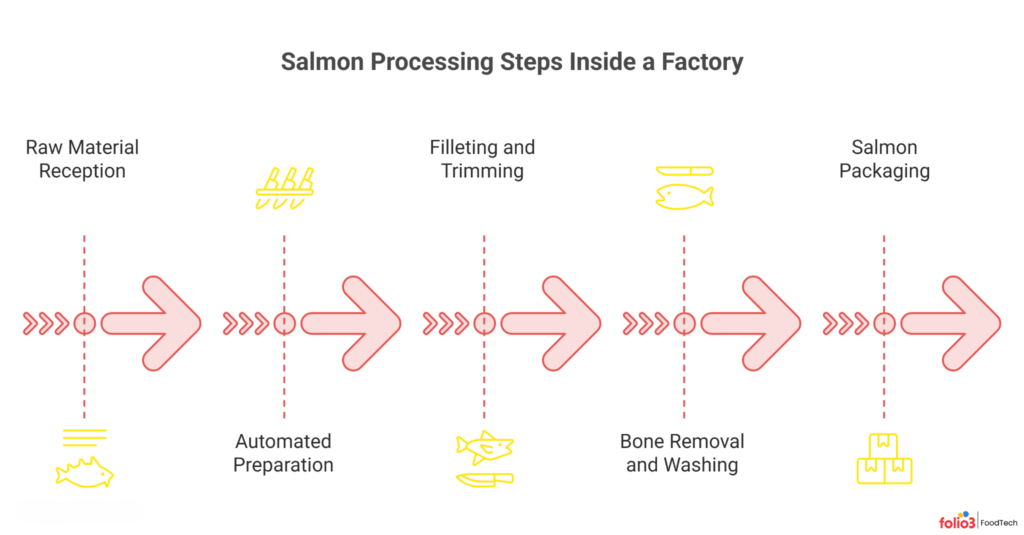
Step 1: Raw Material Reception and AI Grading at the Facility
Your salmon processing facility’s first touchpoint sets the tone for everything downstream. When chilled, gutted salmon arrives, the reception team immediately checks core temperatures to confirm they fall within the 0 to 4°C range required for food safety.
From there, modern facilities use biometric scanning systems that automatically sort each fish by weight, quality grade, and fat content. AI-powered vision grading stations can evaluate color consistency, surface defects, and size uniformity in seconds. This removes subjective human grading from the equation and routes every fish to the right processing salmon pathway before it even hits the main line.
This initial grading step is critical for yield management in food production. If you sort poorly at intake, you carry inefficiency through every downstream station.
Step 2: Automated Descaling, Deheading, and Desliming
The shift from manual labor to automated systems has been one of the biggest upgrades in salmon processing plant operations over the past decade. High-pressure water descalers now handle scale removal at speeds that manual crews simply cannot match.
Deheading is where precision matters most. The standard “V-cut” (also called a collarbone cut) follows the natural contour behind the gill plate. This technique recovers 4 to 5% more usable flesh compared to a straight cut. For a salmon processing plant running thousands of fish per day, that small percentage translates into significant revenue gains.
After deheading, mechanical desliming removes the protective mucus layer. This step is about more than cosmetics. Slime harbors surface bacteria, so thorough removal is essential for food contact surface best practices and downstream food safety.
Step 3: Precision Filleting, Skinning, and Trimming
This is the engineering heart of any salmon processing factory. Automated circular blade filleting machines run the fish along the backbone, separating both fillets in a single pass. These machines process 30 to 40 fish per minute and deliver remarkably consistent cuts.
After filleting, the fish moves to the skinning station, where a drum skinner grips the skin and separates it cleanly from the flesh. The quality of this step directly impacts your trim grade and final product value.
Here is a breakdown of standard trim grades used across the fresh salmon processing industry:
| Trim Grade | Specification |
| A-Trim | Backbone and belly bones removed; pin bones remain |
| B-Trim | A-Trim plus belly fat and fins removed |
| C-Trim | B-Trim plus pin bones removed; ready for portioning |
| D-Trim | C-Trim plus fatty belly membrane removed |
| E-Trim | C-Trim plus skinless and completely boneless |
Each upgrade in trim grade adds labor or machine time but increases the product’s value per kilogram. Your trim strategy should match your target market. Retail-ready portions typically require C-Trim or higher, while foodservice buyers may accept B-Trim.
Understanding how seafood processing plants work at each of these stages helps you benchmark your own operations against industry standards.
Step 4: Pinbone Removal and High-Tech Washing
Pin bones are one of the most common consumer complaints in salmon products, making this step critical for customer satisfaction and brand reputation.
Advanced salmon processing lines use automated pinbone remover machines that rely on roller and finger mechanisms. These systems detect and extract pin bones using calibrated pressure and speed settings tuned to different fillet sizes. The best machines achieve over 99% removal accuracy without damaging the surrounding flesh.
After pinbone removal, the fillets go through a final chilled water wash. This stage removes loose scales, bone fragments, and any residual debris. Water temperature is maintained at or below 2°C to keep the product firmly within the cold chain. This final washing step is your last checkpoint before the fillet moves into packaging.
Step 5: Fresh vs. Frozen Salmon Processing Packaging
Your packaging choice depends entirely on your end market and distribution timeline. Fresh and frozen channels have different requirements.
Fresh Salmon Packaging
For retail and foodservice fresh markets, processors typically use Vacuum Skin Packaging (VSP) or Modified Atmosphere Packaging (MAP). VSP creates an airtight seal around the fillet, extending shelf life while showcasing the product through a transparent film. MAP replaces the air inside the package with a controlled gas blend (typically CO2 and N2) to inhibit bacterial growth. Both methods can extend fresh shelf life to 12 to 16 days when combined with strict temperature control.
Frozen Salmon Packaging
For frozen markets, blast freezing tunnels operating at -40°C rapidly bring the core temperature down to lock in cellular structure and prevent ice crystal damage. Individual Quick Freezing (IQF) is the standard for portioned products like salmon steaks or cubes. IQF systems freeze each piece separately, preventing clumping and making it easier for foodservice operators to thaw only what they need.
After freezing, products move into frozen food packaging lines that use moisture-barrier films to prevent freezer burn during long-term storage.
Capital Expenditure: Estimating Frozen Salmon Processing Plant Costs
The frozen salmon processing plant cost varies widely based on your target throughput, automation level, and regulatory requirements. Below is a breakdown of two common investment tiers to help you plan realistic CapEx budgets.
Basic to Mid-Level Setup ($200,000 to $500,000)
This tier covers the essentials for a smaller operation or a facility just starting secondary processing:
- Manual trim lines with basic conveyor systems
- Standard blast freezing units for batch processing
- Standard vacuum sealers for packaging
- Basic metal detection and weigh-price labeling
The trade-off here is high ongoing labor costs. Manual filleting and trimming require skilled workers, and labor typically represents 40 to 60% of total operating costs at this tier. Throughput is also limited, making it harder to scale during peak season.
Fully Automated Industry 4.0 Setup ($1M to $3M+)
This tier represents a modern, fully integrated salmon processing factory built for scale:
- AI vision grading and robotic sorting at reception
- Automated circular blade filleting and skinning lines
- IQF systems ($200K to $800K alone, depending on capacity)
- Water-jet filleting and portioning systems
- Integrated ERP and food quality control software for real-time tracking
The upfront cost is significantly higher, but the long-term ROI comes from yield maximization, reduced labor dependency, and consistent output quality. Facilities at this tier routinely achieve fillet yields above 60% from whole gutted fish, compared to 50 to 55% with manual processing.
The Future of Salmon Processing Line with Automation and Sustainability
The salmon processing industry is entering a phase where automation and sustainability are no longer optional upgrades. They are becoming baseline requirements driven by ESG (Environmental, Social, and Governance) mandates from retailers and investors. Research estimates that roughly 50% of a whole salmon ends up as side-stream material during processing, creating both a waste problem and a byproduct opportunity.
Here is where leading facilities are investing:
- X-Ray Pinbone Detection: Advanced X-ray systems identify residual pin bones that mechanical removers miss. This improves product quality and reduces customer complaints, directly protecting your brand.
- Water-Jet Cutting: Precision water-jet cutters optimize fillet portioning while using a fraction of the water compared to traditional systems. Some setups operate at just 15 liters per minute versus heavy-water legacy systems.
- Byproduct Repurposing: Forward-thinking processors convert offcuts, frames, heads, and viscera into fish oil, fishmeal, collagen, and pet food ingredients. This is how zero-waste operations are becoming commercially viable, aligning with broader food manufacturing waste reduction goals.
- Robotics Integration: Robotics in food processing is accelerating across the salmon sector, with robotic arms now handling packing, palletizing, and even trim inspection at speeds that outpace manual crews.
Quality Assurance, Traceability, and Global Compliance for Salmon Processing Operations
For operations directors managing a salmon processing plant, compliance is non-negotiable. A single failure in traceability or safety can result in product recalls, lost contracts, and regulatory shutdowns. Here are the critical control points your facility must maintain:
- Inline Metal Detection: Every fillet passes through a metal detector before packaging. This catches wire fragments from conveyors, blade chips, and other foreign objects that would otherwise reach consumers.
- Automated Weigh-Labeling: Modern checkweighing systems track each product’s weight, origin, processing date, and batch number. This data feeds directly into your traceability system and supports FSMA 204 compliance for U.S.-bound exports.
- HACCP and FDA Adherence: Your seafood HACCP plan should identify every critical control point, from reception temperatures to final packaging seal integrity. Regular third-party audits validate your HACCP plan and build buyer confidence.
- Certification Standards: Meeting seafood certification requirements like ASC, MSC, and Global G.A.P. opens doors to premium retail channels that demand verified sustainable sourcing.
Investing in a dedicated seafood traceability system ties all of these data points together. It gives you the ability to trace any product back to its source within minutes, which is exactly what regulators and retail buyers expect.
Conclusion: Scaling Your Salmon Processing Operations
Upgrading your salmon processing line is no longer just about speed. It is about yield optimization, sustainability, and data-driven quality control working together as one system.
The processors who will lead over the next decade are the ones investing in AI-powered grading, automated filleting, IQF technology, and full-chain traceability today. These are not luxury upgrades.
If you are evaluating your current operations or planning a new salmon processing facility, now is the time to audit your line for gaps in automation, yield, and compliance. A targeted operational assessment with foodtech experts can reveal where you are losing margin and where smart investments will deliver the fastest returns.
FAQs
What Is the Average Fillet Yield From Whole Gutted Salmon?
Most commercial salmon processing plants achieve fillet yields between 55% and 65% from whole gutted fish. Automated filleting lines with precision V-cut deheading consistently deliver yields at the higher end of that range compared to manual operations.
How Long Does Fresh Processed Salmon Last With MAP?
Fresh salmon packaged using Modified Atmosphere Packaging typically maintains quality for 12 to 16 days when stored at 0 to 2°C. The gas blend ratio and cold chain consistency throughout distribution directly influence the actual shelf life your customers experience.
What Certifications Do Salmon Processors Need for Export?
Export-ready salmon processors typically need HACCP certification, FDA registration, and compliance with destination-country regulations. Premium retail channels also require third-party certifications like ASC, GlobalG.A.P., or BRC to verify sustainable and safe sourcing.
How Does IQF Differ From Standard Blast Freezing for Salmon?
IQF freezes each salmon portion individually, preventing pieces from sticking together and preserving cellular structure more effectively. Standard blast freezing works well for bulk slabs or whole fillets but does not offer the same portion-level flexibility that foodservice operators need.
Can Small Salmon Processors Afford Automation?
Yes. Entry-level automation for descaling, filleting, and pinbone removal starts in the $200,000 to $500,000 range. Many small to mid-sized processors adopt a phased approach, automating the highest-labor stations first and scaling up as throughput grows.
What Happens to Salmon Processing Byproducts?
Modern facilities convert heads, frames, skin, and viscera into high-value products like fish oil, collagen peptides, fishmeal, and pet food ingredients. This byproduct stream can represent up to 50% of the whole fish, turning what was once waste into a secondary revenue channel.


