

Almost every food you eat has been processed in some way. But ultra-processed foods are different from the canned beans, fresh bread, or frozen vegetables sitting in your pantry. These products go through a distinct type of industrial formulation that sets them apart from other forms of food processing.
The NOVA classification system is the most widely used framework for distinguishing between these categories. That said, there is no single universally accepted definition that every country, researcher, or regulator agrees on. Current debates continue around how to weigh processing methods, formulation complexity, nutritional quality, and the role of specific additives. Let’s break down what the research actually says.
What Are Ultra-Processed Foods?
Ultra-processed foods are industrial formulations typically made from food-derived substances, modified ingredients, and additives. Their production commonly involves processes such as fractionation, extrusion, molding, hydrolysis, or pre-frying. Not every ultra-processed product uses every one of these methods. What ties them together is that they are assembled from components extracted or derived from whole foods, combined with functional and sensory ingredients rarely found in home kitchens.
How Does the NOVA Classification Define Food Processing?
The NOVA system, developed by researchers at the University of São Paulo, divides all foods into four groups based on the nature and purpose of the processing applied to them.
| NOVA Group | Purpose of Processing | Typical Ingredients | Examples |
| Group 1: Unprocessed or minimally processed foods | Preservation of the original food | The food itself | Fresh fruit, plain milk, eggs, dried beans |
| Group 2: Processed culinary ingredients | Extraction and purification for cooking | Oils, butter, sugar, salt, flour | Olive oil, cane sugar, table salt |
| Group 3: Processed foods | Preservation and flavor enhancement | Whole food + salt, oil, sugar, or simple methods | Canned vegetables, traditional cheese, fresh bread |
| Group 4: Ultra-processed foods | Industrial formulation for convenience, shelf life, and palatability | Food-derived substances + additives | Packaged snacks, instant noodles, sweetened beverages, reconstituted meats |
The key distinction between Group 3 and Group 4 is the degree of formulation. Processed foods are recognizable versions of whole foods. Ultra-processed foods are industrial formulations where the original food structure is often no longer identifiable.
Is There One Universal Definition of Ultra-Processed Food?
NOVA dominates the research landscape. Over 200 published studies now reference the framework. However, alternative classification systems exist, and disagreements remain among researchers and food scientists.
A product should not be classified as ultra-processed simply because it comes from a factory or contains a long ingredient list. Current efforts are focused on identifying more practical markers, such as the presence of cosmetic additives and ingredients rarely used in home cooking. The conversation is still evolving, and what counts as ultra-processed food may become more precise as the science matures.
What Is the Difference Between Processed Food and Ultra-Processed Food?
This distinction trips up a lot of people. Let’s look at where processed food ends and ultra-processed food begins so you can evaluate products more clearly.
Processed Food vs Ultra-Processed Food at a Glance
The confusion between processed and ultra-processed food is understandable. Both involve some form of manufacturing. But the purpose, ingredients, and methods differ significantly.
| Dimension | Processed Food | Ultra-processed Food |
| Main purpose of processing | Preserve, enhance, or prepare a whole food | Create a convenient, shelf-stable, hyper-palatable formulation |
| Degree of formulation | Low to moderate | High, often with precise industrial specifications |
| Whole food still recognizable | Yes | Often not |
| Typical ingredient types | Whole foods + salt, sugar, oil | Food-derived substances + functional and sensory additives |
| Industrial processing methods | Canning, curing, fermenting, smoking | Extrusion, molding, hydrolysis, pre-frying, high-shear mixing |
| Role of additives | Minimal or none | Central to the formulation |
| Shelf life | Moderate | Often extended |
| Examples | Canned beans, canned fish, traditional cheese, fresh bread, pickled vegetables | Soft drinks, flavored snacks, instant noodles, reconstituted meats, many packaged baked goods |
The real difference is not about the number of steps in a food processing method. It is about whether the product was designed around whole food or assembled from extracted, modified, and recombined components.
Does Processing Automatically Make a Food Unhealthy?
No. Processing itself is not the problem.
- Pasteurization makes milk safe.
- Freezing preserves nutrients in fruits and vegetables.
- Fermentation creates yogurt and cheese.
- Canning makes beans available year-round.
- Fortification adds missing nutrients to staples like bread and cereal.
This article is about the nature and purpose of ultra-processing, not a blanket claim that all food processing is harmful. When you see a food has been processed, the right question is how and why.
How Are Ultra-Processed Foods Made?
If you work in food manufacturing, understanding these stages helps you see where formulation complexity grows. Here is a step-by-step look at the major stages of industrial ultra-processing.
There is no single UPF manufacturing formula. A soda, frozen pizza, breakfast cereal, chicken nugget, and protein bar each follow a different production line. The following sequence explains the major stages commonly associated with industrial ultra-processing.
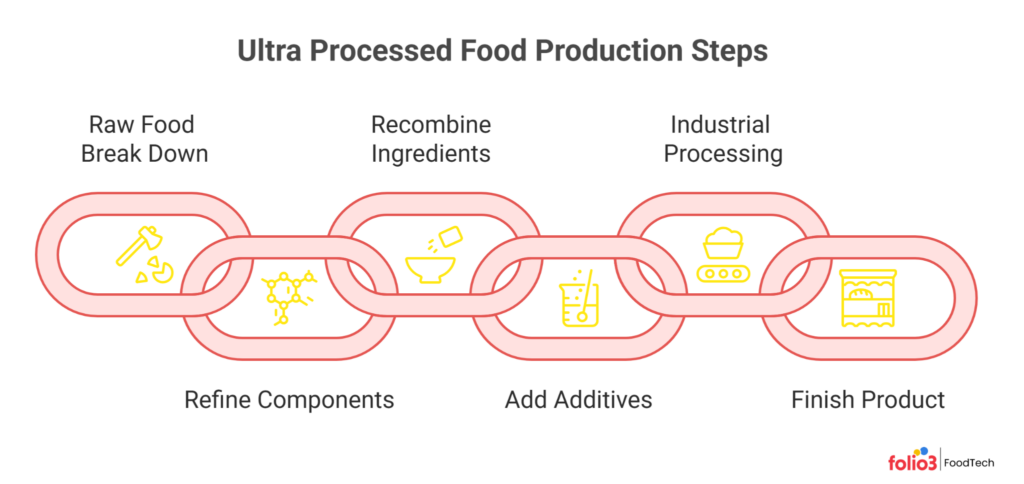
Step 1: Raw Foods Are Broken Into Functional Components
The process begins with fractionation. Whole foods are separated into their parts so each can serve a specific functional role in a finished product.
For example:
- Corn is separated into starches, syrups, oils, and protein fractions
- Soybeans yield oil, protein isolate, and lecithin
- Milk is fractionated into whey proteins, casein, lactose, and other components
These extracted ingredients may end up in very different finished products. Corn starch from one batch might go into a sauce, while corn syrup from the same crop ends up in a soft drink. This food ingredient analysis at the component level is where ultra-processing begins to diverge from traditional food manufacturing.
Step 2: Food Components May Be Refined or Modified
Once separated, many of these components are further altered to improve their performance in a formulation. Common modifications include:
- Hydrolysis to break proteins or starches into smaller, more functional fragments
- Hydrogenation or interesterification to change fat behavior at different temperatures
- Starch modification to adjust viscosity, texture, or stability under heat
- Protein isolation or hydrolysis to create concentrates with specific solubility or binding properties
The purpose of modification is to change solubility, stability, texture, viscosity, or overall functionality. Some of these steps also draw on thermal processing techniques to achieve the desired functional outcome. These changes are driven by manufacturing requirements, not by an intent to make ingredients unsafe.
Step 3: Ingredients Are Recombined Into a Controlled Formula
This is where the product starts to take shape. Manufacturers combine:
- Base ingredients (flour, starch, or protein fractions)
- Oils or fats
- Sweeteners (sugar, syrups, or non-caloric alternatives)
- Protein fractions
- Modified starches
- Water
- Functional ingredients that affect texture or processing behavior
Each ratio is specified to achieve repeatable flavor, texture, nutrition, cost targets, and processing behavior. This is the stage where food product development decisions lock in, and recipe management becomes critical. A small change in one ingredient ratio can shift everything from mouthfeel to shelf life to nutritional labeling.
Step 4: Functional and Sensory Additives Are Added
Additives serve specific functions in a formulation. Rather than treating them as one category, it helps to understand what each type does:
- Preservation: Extend shelf life by slowing spoilage or microbial growth
- Emulsification: Keep oil and water phases from separating
- Stabilization: Maintain texture and consistency during storage
- Texture modification: Adjust chewiness, crunch, creaminess, or mouthfeel
- Sweetness: Provide sweetness without sugar, or enhance existing sweetness
- Flavor: Add, modify, or intensify taste
- Color: Match consumer expectations for product appearance
- Acidity control: Maintain pH for safety, flavor, or stability
- Anti-caking or moisture control: Prevent clumping in powdered products
Some manufacturers also use encapsulation technology to control the release of flavors, nutrients, or bioactive compounds at specific points during processing or consumption. The presence of an additive is not, by itself, a health verdict. In the NOVA framework, certain additives and industrial ingredients help identify the type of formulation rather than determine safety.
Step 5: Industrial Processes Create the Final Structure and Texture
Physical production techniques shape the product into its finished form. Common methods include:
- Extrusion: Combines cooking, mixing, pressing, and shaping in one continuous process. Used for cereals, snacks, and some pet foods
- Molding: Creates repeatable shapes for bars, confectionery, and formed products
- Reconstitution: Assembles processed components into something that resembles a whole food, such as restructured meats
- Texturization: Changes protein or starch structures to produce specific textures
- Pre-frying: Partially cooks a product before frozen food processing and packaging
- High-shear mixing: Creates smooth, stable emulsions and suspensions
Each technique serves a specific manufacturing purpose. Extrusion, for example, can process a cereal or snack formulation from raw mix to finished shape in a single pass.
Step 6: The Product Is Stabilized, Finished, and Packaged
Once the product has its final structure, the focus shifts to stability and shelf life.
- Drying or moisture reduction brings water activity down to levels that limit microbial growth.
- Cooling sets the texture so the product holds its shape during handling and transport.
- Many products then go through a coating or seasoning step, adding flavor layers, glazes, or surface treatments.
- Final texture adjustments may follow, ensuring the product meets sensory specifications before it moves to the packaging line.
- Packaging itself plays a direct role in preserving quality.
- Oxygen barriers, moisture-resistant films, and modified atmosphere packaging protect the product from degradation.
Manufacturers set specific shelf life targets and run shelf life testing to validate that the product meets quality control standards through the end of its stated shelf life.
One important point: packaging alone does not make a food ultra-processed. A vacuum-sealed bag of dried lentils is packaged, but it is not a formulated product. What determines classification is the cumulative formulation and processing history, not the wrapper it comes in.
Example: From Raw Grain to Packaged Breakfast Cereal
Here is how the steps connect in one common ultra-processed product:
Raw grain arrives at the facility. It goes through milling or fractionation to separate starches, fibers, and proteins. These fractions are recombined with sweeteners, modified starches, and functional additives into a controlled formula.
The mixture moves through an extruder, which cooks, shapes, and texturizes it in one continuous process. Shaped pieces are dried to a target moisture content, then coated with a sugar or flavoring layer. Quality checks verify texture, color, moisture, and nutritional targets. The product is packaged with moisture barriers to protect shelf life.
Not every breakfast cereal follows this exact path. And not every cereal necessarily falls into the same nutritional category, even within the ultra-processed classification. Formulation differences matter.
What Foods Are Considered Ultra-Processed?
Many common grocery items fall under the ultra-processed category. Here is how researchers typically organize them, along with the important caveats you should keep in mind.
Common Ultra-Processed Food Examples by Category
Rather than a single flat list, here are the most common categories with examples:
- Sweetened beverages: Soft drinks, energy drinks, sweetened juice drinks
- Sweet and savory packaged snacks: Chips, flavored crackers, cookies
- Instant noodles and soups: Products designed for rapid preparation with minimal added ingredients
- Ready meals: Frozen dinners, microwaveable entrees
- Reconstituted meat products: Nuggets, hot dogs, and some deli meats; products that move through complex meat processing workflows before reaching a standardized, shelf-stable form
- Certain breakfast cereals: Particularly those with significant added sugars, flavors, and colors
- Mass-produced baked goods: Packaged cakes, pastries, muffins with extended shelf life
- Frozen pizzas: Pre-assembled with formulated sauces, modified cheeses, and processed toppings
- Confectionery: Candy bars, chocolate products with multiple formulated layers
- Some flavored dairy products: Sweetened yogurts with added colors, flavors, or thickeners where formulation complexity directly impacts dairy traceability requirements
- Protein bars and meal replacements: Products built from protein isolates, syrups, and functional additives
For every category, classification can depend on the actual formulation. Two products in the same category might differ based on their ingredient lists and processing methods.
Is Bread Ultra-Processed Food?
It depends on the bread. A loaf made from flour, water, yeast, and salt is a processed food under the NOVA system. It uses basic ingredients and straightforward food processing methods to create a recognizable product.
A packaged bread containing emulsifiers, added colors, flavoring agents, modified starches, or preservatives designed for extended shelf life may meet NOVA criteria for ultra-processing. The product name does not determine the classification. The ingredient list does.
Is Cheese a Processed Food or an Ultra Processed Food?
Different types of cheese vary widely in how they are produced, and that variation matters for classification. Traditional cheeses made with milk, cultures, enzymes, salt, fermentation, and aging generally fall within NOVA Group 3 (processed foods). They are recognizable transformations of a whole food using well-established methods.
Some cheese spreads, processed cheese products, flavored cheese formulations, and products using emulsifying salts or other specialized ingredients may fall into different categories depending on the recipe. Saying cheese is or is not ultra-processed without looking at the specific product is too simple.
Why Similar Foods Can Fall Into Different Categories
Bread, yogurt, cereal, and cheese can each appear in either processed or ultra-processed categories. The product name alone is not enough. What matters is the ingredients and the manufacturing purpose behind them.
Why Are Ultra-Processed Foods Made This Way?
Manufacturers do not use these methods randomly. Here is a look at the practical reasons that drive these formulation and production choices.
What Commercial Processing Is Designed to Achieve
Industrial ultra-processing serves real operational objectives:
- Longer shelf life: Products need to remain stable during distribution and retail display
- Consistent texture and flavor: Consumers expect the same experience every time they buy a product
- Large-volume production: Formulations must perform reliably across high-speed production lines
- Portability and convenience: Products need to be easy to store, transport, and consume
- Reduced preparation time: Many ultra-processed foods are designed for immediate consumption or fast preparation
- Ingredient functionality: Modified components behave predictably under specific processing conditions
- Cost control: Fractionation and modification can reduce raw material costs while maintaining sensory targets
- Distribution stability: Products must survive temperature changes, vibration, and handling during shipping
- Repeatability across facilities: A product manufactured in different plants needs to match the same specification
These objectives explain why manufacturers use the methods they use. They are driven by operational and commercial needs, not a deliberate plan to make products harmful.
Why Can Ultra-Processed Foods Raise Health Concerns?
Research is building around the health effects of ultra-processed foods. Here is what the evidence shows and where it still has gaps.
“Why Is Processed Food Bad for You” Is the Wrong Question
Many useful foods are processed. Pasteurized milk, canned vegetables, whole grain bread, and frozen fruit all involve processing and all contribute to a healthy diet.
The more relevant questions are: What does the product contain? How has it been formulated? What has processing changed about its original food structure? How often is it consumed? And what role does it play in the overall diet? Framing all processing as bad oversimplifies a topic that depends on specifics.
What Does the Research Actually Show About Ultra-Processed Foods?
The evidence falls into different categories, and it is important to separate them.
Observational studies consistently associate higher UPF intake with several adverse health outcomes. According to a 2024 umbrella review, higher ultra-processed food consumption was linked to 32 adverse health outcomes across multiple large studies.
A controlled feeding trial at the National Institutes of Health involving 20 adults found that participants consumed roughly 500 more calories per day during the ultra processed diet period compared to the unprocessed diet period, leading to about 2 pounds of weight gain over two weeks.
Research is still working to separate the effects of processing from nutrient profile, food structure, energy density, eating rate, additives, and other factors. A 2026 trial protocol specifically notes the lack of consensus over whether all UPFs carry the same cardiometabolic concern.
Are All Ultra-Processed Foods Nutritionally Equal?
No. It is one of the most important nuanced points in the entire discussion. Whole grain breads, some fortified cereals, certain yogurts, plant-based beverages, snack foods, sugary drinks, and reconstituted meats can all potentially fall under a broad UPF classification despite major differences in nutrient profile.
A protein bar with oats, whey, and minimal added sugar is a very different product from a candy bar, even if both technically qualify as ultra-processed. This is why blanket statements about UPFs are difficult to defend.
What Should Food Manufacturers Control When Producing Formulated Foods?
If you are making products with complex formulations, operational control is not optional. Meeting food safety standards while managing dozens of ingredients across multiple batches requires connected systems and clear documentation. Here is what you need to keep tight.
Keep Every Formula and Ingredient Specification Controlled
When you are working with ultra-processed or highly formulated products, your master formula is the single source of truth. You need to track:
- Master recipe and all approved versions
- Ingredient substitutions and their impact on the finished product
- Processing parameters tied to each formula version
- Approved supplier specifications for every ingredient
- Complete change history showing who changed what and when
A small formulation change can cascade through production and labeling. If your bill of materials is not locked down, you are exposed to errors that are hard to trace backward.
Link Ingredients, Additives, Allergens, and Labels
One ingredient change in a complex formulation can trigger a chain reaction:
- Your ingredient declaration on the label needs updating.
- Allergen management statements may need to change, especially if the substitution introduces or removes any major food allergens.
- Nutrition facts may shift.
- Supplier documentation needs to reflect the new input.
- Your finished product specification must match everything above.
For manufacturers producing ultra-processed foods with dozens of ingredients, this level of integration is not a nice-to-have. It is a compliance requirement. Getting food labeling wrong on a product with modified starches, emulsifiers, allergens, and functional additives creates real regulatory exposure. FSMA 204 traceability requirements add another layer, mandating that key data elements be captured and maintained at every critical tracking event across the supply chain.
Maintain Batch-Level Traceability From Supplier to Finished Product
The traceability chain for a formulated food runs from raw material to retail shelf:
| Supplier lot → Raw material receipt → Formula version → Production batch → Finished SKU → Shipment |
This matters for recalls, supplier investigations, audit readiness, and regulatory compliance. When a product uses 15 to 30 ingredients sourced from multiple suppliers, lot traceability and batch management become the backbone of your food safety program. Without them, a single contamination event can force a broader recall than necessary. A structured food recall management strategy is what lets you isolate affected batches quickly and limit the scope of any withdrawal.
Keep Quality and Production Records Connected
Your food quality control records should not live in a silo. They need to connect directly to:
- QA checks at each production stage
- Batch deviation reports
- Ingredient hold and release records
- Formula version approvals
- Shelf life validation data
- Supplier certifications and audit records
- Complete production logs
Manufacturers working with complex formulations need a connected record of how ingredients, formulas, quality data, labels, and batches relate to each other. That’s where a food manufacturing ERP system becomes essential, not as a feature list, but as the operational backbone that holds everything together.
Conclusion
Ultra-processing is not simply a matter of how many machines touch a food. It describes a specific type of industrial formulation involving particular ingredients, purposes, and processing techniques that set these products apart from traditionally processed foods.
For consumers, understanding the distinction helps you make more informed choices. For manufacturers, the practical issue is controlling exactly what goes into the formula, how it changes over time, how it is processed, what appears on the label, and which batches contain each ingredient.
Whether you are evaluating your own diet or managing a production line, the question is the same: what is in this product, and how did it get there?
FAQs
How Much of the American Diet Comes From Ultra-Processed Foods?
Research estimates that ultra-processed foods account for roughly 57% to 60% of total daily calorie intake among U.S. adults. This figure has remained high across multiple national nutrition surveys, making UPFs the dominant source of energy in the average American diet.
Can You Identify Ultra-Processed Foods From the Nutrition Label?
You can get close. Look for ingredients you would not find in a home kitchen, such as high-fructose corn syrup, hydrolyzed proteins, modified starches, emulsifiers, flavor enhancers, and colorants. A long ingredient list alone does not confirm ultra-processing, but these markers are strong indicators.
Are Plant-Based Meat Alternatives Considered Ultra Processed?
Most are. The plant-based protein manufacturing process typically relies on protein isolates, modified starches, flavoring agents, and binding additives to produce burgers, sausages, and nuggets. These are industrial formulations designed to replicate the texture and taste of meat, which places them firmly in the ultra-processed category under NOVA.
Do Ultra Processed Foods Affect Children Differently Than Adults?
Children may be more vulnerable because their diets are still forming. Studies show that children in higher-income countries get a significant portion of their calories from ultra-processed foods. Early dietary patterns tend to persist, which makes childhood UPF exposure a long-term concern for health outcomes.
Is It Possible to Manufacture Ultra-Processed Foods With Cleaner Formulations?
Yes. Some manufacturers are actively reformulating products to reduce additive counts, replace artificial ingredients with natural preservatives, and simplify ingredient lists. The challenge is maintaining the same shelf life, texture, and sensory profile that consumers expect while using fewer industrial ingredients.
How Does Ultra Processing Differ From Traditional Food Preservation?
Traditional preservation, such as salting, smoking, pickling, or fermenting, works with whole foods and simple ingredients. Ultra processing goes further by deconstructing food into components, modifying them, and reassembling them with additives into an entirely new product. The intent shifts from preserving a food to engineering a formulation.


