

The global ice cream market was valued at over $92.5 billion in 2024 and is projected to exceed $142 billion by 2034. That kind of growth puts enormous pressure on food manufacturers to produce faster, more consistently, and with tighter quality control than ever before.
If you run or manage a commercial ice cream facility, you already know the challenge. The gap between a great formula in your lab and a consistent product rolling off a high-speed production line is real. Every step in the ice cream manufacturing process affects the final product, and a mistake at any stage can cost you a full batch, a retailer relationship, or a compliance audit.
This guide breaks down the full ice cream manufacturing process, from raw ingredient handling to packaging. You will also find practical guidance on where things typically go wrong in industrial ice cream production and how well-integrated systems keep things running at scale.
What Sets Commercial Ice Cream Manufacturing Apart
Making ice cream at home and making it commercially are two completely different operations. At the industrial level, ice cream manufacturing is a precise, multi-step process that involves pasteurization, homogenization, controlled aging, continuous freezing, and hardening, all tied to strict regulatory requirements.
You are not just scaling up a recipe. You are managing ingredient variability, equipment throughput, cold-chain continuity, and food safety compliance simultaneously. A single temperature deviation during the ice cream production process can affect texture, shelf life, and safety.
The ice cream manufacturing process is also time-sensitive. Once the mix enters the freezer, the clock starts. Delays between stages create inconsistencies in overrun, crystal structure, and viscosity. That is why the sequence and speed of each step matter as much as the ingredients themselves.
Step-by-Step: The Ice Cream Production Process
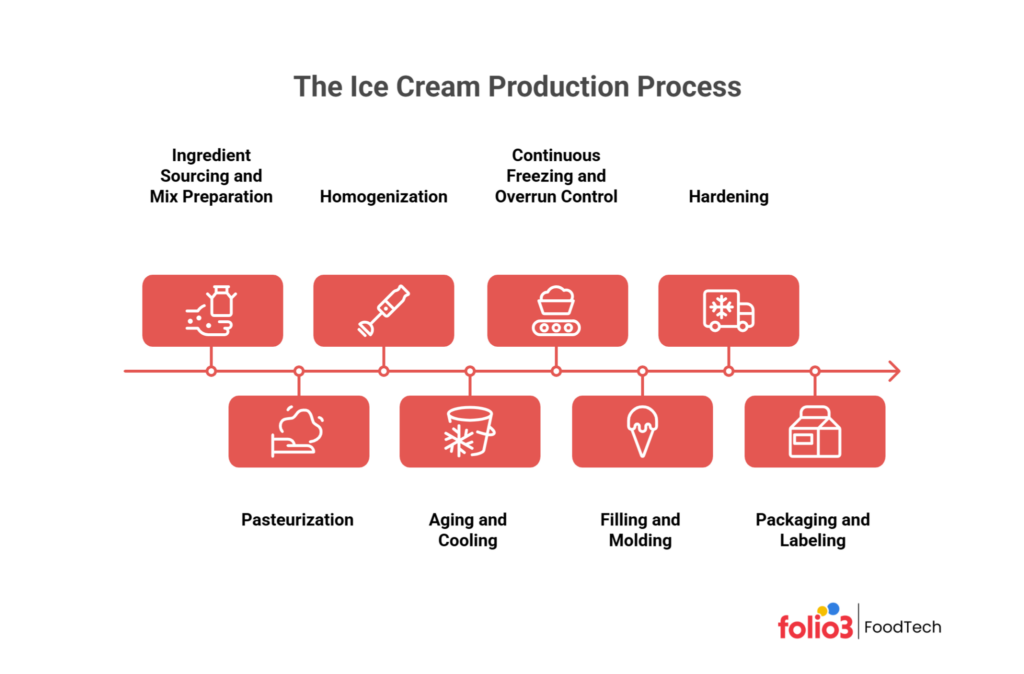
Step 1: Ingredient Sourcing and Mix Preparation
Every ice cream production process starts with your mix. For commercial ice cream, the standard base includes:
• Milk fat (cream, whole milk, or anhydrous milk fat)
• Non-fat milk solids (skim milk powder or condensed skim milk)
• Sweeteners (sucrose, corn syrup, or alternative sweeteners)
• Stabilizers (guar gum, locust bean gum, carrageenan)
• Emulsifiers (mono- and diglycerides, egg yolks)
• Flavoring agents (vanilla extract, cocoa, fruit concentrates)
In ice cream manufacturing, ingredient proportions are not estimates. They are calculated to hit specific fat, solids, and sweetness targets that determine how the mix will behave during freezing. Overrun, scoopability, meltdown rate, and shelf stability all trace back to formulation accuracy at this stage.
Getting dairy sourcing right is also a compliance issue. Facilities handling food safety hazards across raw material inputs need supplier verification protocols in place before ingredients enter production.
Step 2: Pasteurization
Once the mix is blended, it moves to pasteurization. This step heats the liquid mix to destroy pathogens and extend shelf life. In ice cream manufacturing, two primary methods are used:
• Batch pasteurization: heating to 68.3°C (155°F) and holding for 30 minutes
• High-Temperature Short-Time (HTST): heating to 79.4°C (175°F) and holding for 25 seconds
HTST is the standard in high-volume ice cream production because it processes large volumes continuously without the downtime of batch systems. Beyond safety, pasteurization also improves mix structure by partially denaturing proteins, which contributes to better emulsification and a creamier end product.
Skipping proper pasteurization or failing temperature records is a major HACCP violation. In a regulated ice cream manufacturing plant, every pasteurization cycle needs to be logged with documented temperature and hold times.
Step 3: Homogenization
After pasteurization, the hot mix goes through a homogenizer. This forces the liquid through a small valve at high pressure, typically between 2,000 and 2,500 psi, breaking fat globules down to a uniform size of roughly 1 to 2 microns.
Homogenization in ice cream manufacturing does two things. First, it prevents fat separation during aging and freezing. Second, it increases the surface area of fat globules, which gives emulsifiers more surface to work with and results in a smoother, more stable product.
Facilities that skip homogenization or run it inconsistently often see fat plugging in their continuous freezers, uneven mix viscosity, and texture complaints in the finished product.
Step 4: Aging and Cooling
Once homogenized, the mix is cooled to between 0°C and 4°C (32°F to 39°F) and held in jacketed aging vats for a minimum of 4 hours, though 12 to 24 hours is more common in commercial ice cream operations.
During aging, the ice cream mix undergoes several physical changes:
• Proteins fully hydrate, which improves water-binding capacity
• Stabilizers reach their full thickening effect
• Fat partially crystallizes, which is essential for controlled overrun during freezing
Aging is one of the most underestimated steps in the production of ice cream. Cutting aging time to speed throughput is a common mistake in high-demand periods, and it reliably shows up as poor body and texture in the finished product.
Step 5: Continuous Freezing and Overrun Control
This is the most critical mechanical stage in ice cream manufacturing. The aged mix enters a continuous freezer, where it is rapidly frozen to between -5°C and -7°C (23°F to 19°F) while being churned by a dasher.
Simultaneously, air is incorporated into the mix. This air incorporation is called overrun. Overrun is expressed as a percentage:
Overrun (%) = [(Volume of ice cream minus Volume of mix) / Volume of mix] x 100
Standard commercial ice cream manufacturing targets 80 to 100% overrun. Premium brands typically run 60 to 80%. Low-overrun products are denser and have a richer perceived taste. High-overrun products feel lighter and melt faster.
In industrial ice cream production, overrun is continuously monitored and adjusted through mix flow rate and back-pressure settings on the freezer. Deviations of even 5% in overrun can take a product out of spec.
The continuous freezer stage is also where most flavor and mix-in additions happen. For products with swirls, variegates, or large inclusions, the addition systems need to be in sync with freezer throughput. Robotics in food processing has made this step significantly more accurate in modern ice cream manufacturing plants.
Step 6: Filling and Molding
Once the ice cream exits the continuous freezer at the right consistency, it moves immediately to filling. Time between the freezer exit and the filler is critical. Any delay allows the product to warm and lose structure before it reaches its mold or container.
In commercial ice cream production, three main filling types are used:
• Cup and tub filling: for take-home cartons and family packs
• Stick novelty molding: for bars and pops frozen on a stick in refrigerated molds
• Extrusion: for shaped novelties like sandwiches and cones
Each format requires different equipment speeds, filler nozzle configurations, and temperature controls. Mismatched line speeds between the freezer and filler are one of the most common sources of product weight variation and packaging defects in ice cream manufacturing.
Step 7: Hardening
After filling, the ice cream is still semi-soft. It needs to move through a hardening tunnel or blast freezer to reach its final temperature of -30°C to -40°C (-22°F to -40°F). This rapid hardening locks in the ice crystal structure created during the continuous freezer stage.
Slow hardening is a significant quality risk. If the product temperature drops too gradually, large ice crystals form and recrystallize, resulting in a coarse, grainy texture. This is why hardening tunnel speed, airflow velocity, and temperature uniformity all matter in ice cream production.
Maintaining the cold chain from hardening tunnel to storage, and from storage to distribution, is critical. A reliable cold chain compliance framework ensures product quality is preserved all the way to the shelf.
Step 8: Packaging and Labeling
Once hardened, products are packed, labeled, and palletized before moving to frozen storage at -18°C (0°F) or below. Packaging in ice cream manufacturing serves multiple functions:
• Moisture barrier to prevent surface drying and freezer burn
• Structural protection during handling and stacking
• Compliance labeling with ingredient declarations, allergen statements, and nutrition facts
Packaging decisions also affect sustainability goals. Frozen food packaging choices in ice cream manufacturing are increasingly being evaluated for recyclability and environmental footprint alongside protection performance.
Key Equipment in an Ice Cream Manufacturing Plant
A complete ice cream manufacturing plant includes dedicated equipment for each production stage. Here is a quick reference for what each stage requires:
| Production Stage | Primary Equipment |
| Mix preparation | Weigh scales, blending tanks |
| Pasteurization | Plate heat exchanger (HTST) or batch pasteurizer |
| Homogenization | Two-stage homogenizer |
| Aging | Jacketed aging vats with agitation |
| Freezing and overrun | Continuous freezer (scraped-surface) |
| Filling | Cup filler, stick novelty line, extrusion line |
| Hardening | Blast freezer or hardening tunnel |
| Packaging | Flow wrappers, cartoning machines, labelers |
Where Ice Cream Manufacturing Goes Wrong (And Why It Matters)
Most quality failures in commercial ice cream production trace back to one of five root causes:
1. Inconsistent Overrun
Overrun fluctuations of more than 5% usually indicate a problem with mix viscosity, freezer back-pressure, or aging time. If you are seeing weight variation across filled units, overrun control is the first thing to check in your ice cream manufacturing process.
2. Coarse or Icy Texture
This points to either large ice crystal formation during slow hardening, heat shock during distribution, or temperature fluctuations in storage. In ice cream manufacturing, texture defects are almost always a cold-chain problem rather than a formulation one.
3. Shrinkage
Ice cream pulling away from the container walls is caused by a combination of overrun that is too high and packaging done too warm. The product contracts as it hardens, and if it was not packed at the right consistency, it loses contact with the container.
4. Flavor Defects
Off-flavors in the finished product almost always originate in raw material quality, pasteurization temperature issues, or contamination in aging tanks. Flavor defects in ice cream manufacturing are a traceability problem as much as a quality one.
5. Allergen Cross-Contact
Ice cream manufacturing plants often run multiple SKUs on shared equipment. Allergen management failures happen when changeover cleaning is incomplete or when ingredient staging is not controlled. Dairy, eggs, tree nuts, and soy are all common ice cream ingredients and all regulated allergens.
Understanding food hygiene protocols specific to frozen dairy operations is essential for any facility running multiple ice cream SKUs on shared lines.
Regulatory Compliance in Ice Cream Manufacturing
Ice cream manufacturing in the United States is governed by FDA standards under 21 CFR Part 135. The standard of identity for ice cream requires a minimum of 10% milkfat by weight and no less than 1.6 pounds of food solids per gallon of finished product.
Under FSMA, ice cream manufacturing facilities are required to maintain:
• Documented Hazard Analysis and Risk-Based Preventive Controls (HARPC) plans
• Pasteurization records for every batch or continuous run
• Supplier verification programs for all ingredients
• Environmental monitoring programs for Listeria control in refrigerated zones
• Traceability records supporting one-step forward, one-step backward tracking
Listeria monocytogenes is the primary pathogen concern in ice cream manufacturing environments. Controlling Listeria in food manufacturing requires a combination of environmental swabbing programs, corrective action protocols, and equipment sanitation that is specifically designed for cold, wet production areas.
For export markets, additional certifications may apply. Ice cream manufacturing plants supplying international retail or foodservice accounts often need country-specific export health certificates, which add another layer of compliance documentation to the production process.
How ERP and Digital Systems Support Ice Cream Production
Running an ice cream manufacturing plant without an integrated system means managing overrun targets, CCP monitoring, batch records, ingredient traceability, and production scheduling across multiple disconnected tools. At scale, that creates gaps.
An ERP system built for food manufacturing connects your ice cream production process end to end:
• Bill of materials management: formulation control with allergen flagging built in
• Production orders: batch scheduling tied to ingredient availability and shelf life
• Quality hold workflows: immediate hold on any batch that fails a CCP or inline check
• Cold-chain visibility: temperature logging integrated with storage and distribution
• Traceability: lot-level tracking from raw material receipt to finished SKU dispatch
For dairy processors managing ice cream alongside other product lines such as yogurt, butter, or fluid milk, the operational complexity multiplies. Dairy ERP software built specifically for multi-product frozen and refrigerated facilities handles these interrelated production workflows, allergen controls, and compliance requirements in one system rather than several.
Demand planning is another area where digital systems pay for themselves in ice cream manufacturing. Ice cream is one of the most seasonally volatile categories in food production. Volume can increase 40% during summer months, and that creates procurement and scheduling challenges that manual planning cannot absorb.
For facilities that also produce frozen novelties or other frozen food products, the broader context of frozen food processing applies across scheduling, energy management, and cold-chain operations.
Ice Cream Manufacturing: Specialty and Emerging Formats
Plant-Based and Dairy-Free Ice Cream Manufacturing
Manufacturing plant-based ice cream introduces a new set of formulation and production challenges. Oat milk, almond milk, and coconut cream-based mixes behave very differently than dairy in the continuous freezer. They often require modified stabilizer systems and different overrun targets to achieve comparable texture.
From a production standpoint, plant-based ice cream manufacturing on shared lines with dairy requires rigorous allergen management protocols, particularly for almond and soy-based bases.
Soft Serve and Foodservice Ice Cream Production
Soft serve is produced using the same base mix as hardened ice cream but is not taken below -4°C (25°F). It exits the freezer at a higher overrun, typically 30 to 50%, and is served directly. Foodservice soft serve mix is typically supplied in liquid or reconstitutable powder form to operators.
Commercial production of soft serve mix follows the same pasteurization and homogenization requirements as standard ice cream manufacturing, but the distribution chain differs because the mix ships unfrozen and requires refrigerated transport.
Artisan and Premium Ice Cream Manufacturing at Scale
Premium and artisan ice cream manufacturing uses the same fundamental production process, but with modified parameters. Lower overrun, higher fat content, and slower aging cycles are common. Specialty inclusions, swirls, and co-deposited layers require additional filling equipment and precise synchronization between the freezer and filler.
For manufacturers expanding into the premium segment or launching specialty SKUs alongside a standard line, the food supply chain management implications of maintaining separate ingredient streams, allergen controls, and traceability paths need to be worked through before production starts.
Quality Control Checkpoints Across the Ice Cream Production Line
Quality control in ice cream manufacturing is not a single inspection at the end of the line. It is a series of checkpoints tied to each stage of production:
• Mix preparation: fat content, total solids, pH, viscosity verification before pasteurization
• Post-pasteurization: temperature records, hold time confirmation, microbiological sampling
• Post-aging: viscosity, flavor check, temperature confirmation before freezing
• Continuous freezer: overrun measurement every 15 to 30 minutes, exit temperature monitoring
• Filling: net weight checks every 10 to 15 minutes, package integrity inspection
• Post-hardening: core temperature pull for hardening confirmation before palletizing
• Finished product: microbiological testing (coliform, standard plate count), sensory evaluation
Maintaining food contact surface sanitation across all the product-contact equipment in an ice cream manufacturing plant is an ongoing operational requirement, not a periodic task. Scraped-surface freezer barrels, aging vat agitators, and filler nozzles are all high-risk zones for biofilm buildup if sanitation programs fall short.
Scaling an Ice Cream Manufacturing Plant: What to Consider
If you are planning to expand capacity in an existing ice cream manufacturing plant or building out a new line, there are a few production constraints worth addressing before you commit to equipment:
• Freezer throughput: continuous freezers have a fixed capacity in liters per hour. Adding a filling line without a corresponding freezer upgrade creates a bottleneck that limits your entire ice cream production capacity.
• Refrigeration load: hardening tunnels and cold storage are the largest energy consumers in any ice cream manufacturing plant. Refrigeration system capacity planning needs to account for peak summer production volumes.
• CIP (clean-in-place) systems: the larger your production footprint, the more complex your sanitation cycles become. CIP systems need to be sized to handle the full pipeline and tank volume without extending downtime past shift allowances.
• Ingredient staging: larger batches require more mix tank capacity and ingredient metering precision. Weight-based ingredient systems reduce human error and improve batch-to-batch consistency in high-volume ice cream manufacturing.
The production planning and capacity management capabilities of a food ERP system for food manufacturing become especially important when you are scaling. Scheduling continuous freezer runs, coordinating ingredient deliveries against production orders, and managing changeover time between flavors and allergen classes requires visibility that spreadsheets cannot provide at volume.
Conclusion
Ice cream manufacturing is a precision operation. The production process spans mix formulation, pasteurization, homogenization, aging, continuous freezing, overrun control, filling, hardening, and packaging, each step dependent on the one before it.
For food manufacturers operating at commercial scale, the margin for error is narrow. Overrun deviations, cold-chain gaps, allergen mismanagement, and incomplete batch records all carry real production and regulatory risk.
The facilities that consistently produce at high quality and high throughput are the ones that treat ice cream production as a connected system rather than a series of isolated steps. That means formulation accuracy, equipment calibration, food safety protocols, and digital traceability all working together.
Whether you are optimizing an existing ice cream production line or planning for new capacity, understanding the full manufacturing process is the starting point for every decision that follows.
FAQs
What Are the Main Steps in the Ice Cream Manufacturing Process?
The main steps in ice cream manufacturing are mix preparation, pasteurization, homogenization, aging, continuous freezing with overrun control, filling, hardening, and packaging. Each step directly affects the quality, safety, and consistency of the finished product.
What Is Overrun in Ice Cream Manufacturing?
Overrun is the percentage volume increase in ice cream caused by air incorporation during the continuous freezing stage. Commercial ice cream manufacturing typically targets 80 to 100% overrun. Premium products run lower at around 60 to 80%. Overrun affects texture, mouthfeel, and weight per unit, so it is monitored continuously during production.
What Equipment Is Required for a Commercial Ice Cream Production Line?
A commercial ice cream production line requires blending tanks, a pasteurizer, a homogenizer, aging vats, a continuous freezer, a filling machine, a hardening tunnel or blast freezer, and packaging equipment. Larger ice cream manufacturing plants also include CIP systems, ingredient metering systems, and automated labeling lines.
How Long Does the Ice Cream Manufacturing Process Take?
The total time varies by product type and plant size, but a standard ice cream manufacturing cycle from mix preparation to packaged, hardened product typically takes between 12 and 24 hours. Aging alone requires 4 to 24 hours. Hardening adds another 2 to 4 hours depending on product size and tunnel capacity.
What Are the FDA Requirements for Ice Cream Manufacturing?
The FDA standard of identity for ice cream under 21 CFR Part 135 requires a minimum of 10% milkfat and at least 1.6 pounds of food solids per gallon. Ice cream manufacturing facilities are also subject to FSMA Preventive Controls for Human Food, which requires documented hazard analysis, pasteurization records, supplier verification, and environmental monitoring for Listeria control.
What Is the Difference Between Industrial Ice Cream and Artisan Ice Cream Manufacturing?
Industrial ice cream manufacturing uses continuous freezers running at high throughput with overrun targets of 80 to 100%. Artisan or premium ice cream manufacturing typically uses batch freezers or continuous freezers set to lower overrun (60 to 80%), higher fat mixes, and shorter production runs. The core production steps are the same, but the equipment speeds, formulations, and quality targets differ.
How Is Food Safety Managed in an Ice Cream Manufacturing Plant?
Food safety in an ice cream manufacturing plant is managed through documented HACCP or HARPC plans, ongoing CCP monitoring at pasteurization, environmental swabbing programs for Listeria, allergen control protocols for shared equipment lines, and full batch traceability from raw ingredient receipt through finished product distribution.


